
The obsession with matching at your #1 program is irrational. The data on long‑term outcomes by rank list position is boringly clear: after the first year or two, it barely matters.
Let me say that again, because it cuts against almost every emotional script you’ve been fed in med school: “Perfect match” versus “fifth choice” almost never shows up in your board scores, fellowship chances, job prospects, or long-term career satisfaction. What does show up? How you perform once you get there, and whether the program was at least a decent fit.
You’re in the thick of ERAS, rank lists, and now staring down Match Day. You’ve heard it all:
- “If you don’t match at your top three, you’re screwed for fellowship.”
- “People who end up at their lower-ranked programs are always miserable.”
- “The algorithm favors programs, so if you don’t rank them ‘right’ you’ll get burned.”
Most of that is mythology mixed with second-hand anecdotes and a healthy dose of panic.
Let’s dismantle the “Perfect Match” fallacy with what the data actually shows.
What the Match Algorithm Really Cares About (Spoiler: Not Your Feelings)
First myth: “If I rank a ‘reach’ #1, I’ll lose my realistic programs and end up unmatched.”
No. That’s not how the NRMP algorithm works.
The algorithm is applicant-proposing. In plain English: it tries as hard as it can to give you the highest-ranked program on your list that also wants you.
Think of it as:
- It tries to place you at your #1.
- If #1 doesn’t have a spot for you, it tries #2.
- Then #3. And so on.
It doesn’t punish you for ranking a dream program first. You don’t get “locked out” of your safer choices by being ambitious. That’s not my opinion; that’s in the NRMP technical documentation and in their outcome studies.

| Step | Description |
|---|---|
| Step 1 | Applicant rank list |
| Step 2 | Try top choice |
| Step 3 | Temporarily matched |
| Step 4 | Try next choice |
| Step 5 | Final match |
| Step 6 | Program rank includes applicant |
| Step 7 | Displaced by higher ranked? |
So ranking your actual preferences honestly is not risky. Gaming your list—pushing down places you love because you’re scared—is what backfires.
The “perfect strategy” is boring and algorithm-proof: rank in the true order you’d want to train there. That’s it.
Outcomes by Match Position: What the Studies Actually Show
Second myth: “People who don’t match in their top 3 are at a serious disadvantage.”
This is where the narrative completely falls apart once you look at outcomes.
NRMP and specialty organizations have published match and career outcome data for years. Do most people get their top choices? Yes. Are those who don’t objectively doomed? No.
Let’s look at some high-level patterns.
| Match Position | Approximate % of Matched Applicants |
|---|---|
| 1st choice | 45–55% |
| 2nd–3rd choice | 20–30% |
| 4th–5th choice | 10–15% |
| 6th or lower | 5–10% |
Depending on specialty and competitiveness, around half match at #1. That means the other half… don’t. Yet somehow the system is not flooded with disasters, failed careers, and broken humans.
Because when you track longer-term metrics, something happens: rank position fades into statistical noise.
Here’s what repeatedly shows stronger relationships with outcomes than “where the program was on the rank list”:
- In-training exam performance
- Faculty evaluations and clinical performance
- Procedural volume and case mix (especially in procedural specialties)
- Quality of mentorship and advocacy
- Your own initiative (research, QI, leadership, teaching)
Residency and fellowship directors do not sit there and ask: “Did this person match at their #1?” They ask: “Are they good? Did they train well? Can they function as an attending?”
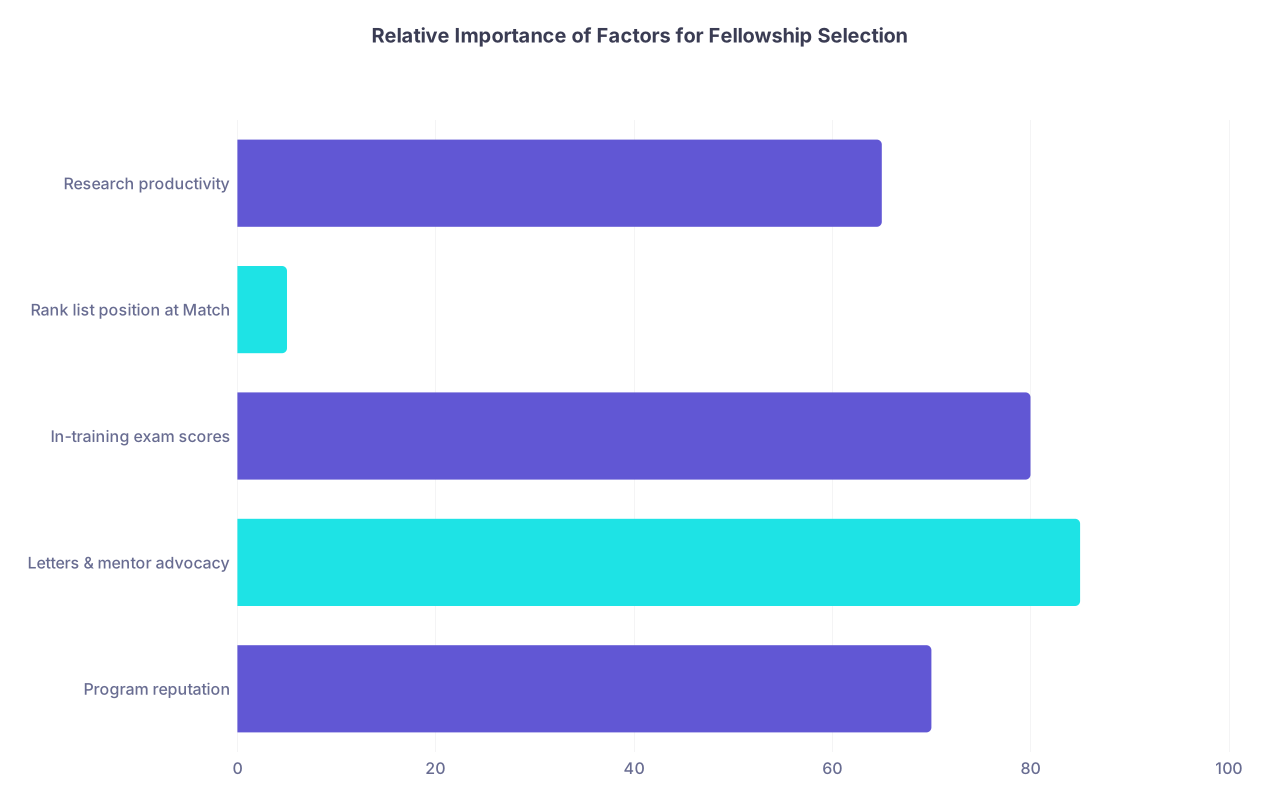
| Category | Value |
|---|---|
| Program reputation | 70 |
| Letters & mentor advocacy | 85 |
| In-training exam scores | 80 |
| Rank list position at Match | 5 |
| Research productivity | 65 |
Rank list position is a rounding error. It’s not part of anyone’s evaluation rubric.
The Psychological Trap: Why #1 Feels Like Everything
The “Perfect Match” is mostly a psychological construct, not a real structural difference in training.
You spend months idealizing:
- Geography (“If I’m not on the coasts my life is over.”)
- Program name (“If it’s not ‘Top 10’ it doesn’t count.”)
- Prestige signaling to your classmates.
Then you layer on sunk cost: away rotations, interview travel, letters from “big names.” By the time you certify your rank list, your top 1–2 programs are almost mythological in your head.
On Match Day, what I’ve seen over and over:
- Student A matches #1, a “top” university program. Shows up in July, discovers malignant culture and chronically understaffed services. Shocked that the brand doesn’t protect them.
- Student B matches #4, a solid community or mid-tier academic program. Great mentorship. Fair workload. They quietly crush it and match an excellent fellowship later.
- Student C matches #7 after a rank list meltdown. Feels humiliated initially. Two years in, they will tell you: “I cannot imagine having trained anywhere else.”
The operative variable isn’t the number next to the program on some February list. It’s the actual lived environment once you’re there.
Academic and Career Outcomes: Does Rank Position Matter Later?
Let’s get even more concrete.
Board Scores & In‑Training Exams
Once you’re in residency:
- Your board pass rates depend on: how much you study, quality of didactics, and how much cognitive bandwidth you have outside survival mode.
- You don’t get extra points on the ABIM or ABS for having matched at your #1.
Multi-program data sets show what you’d expect: variance in exam performance by individual and program-level emphasis on education—not by whether someone “got their top pick.”
Fellowship Match
Fellowship directors care about:
- Strong letters from people they know or respect.
- Specific competence in the field.
- A track record of follow-through (research, scholarly activity, leadership).
You know what that all depends on? Mentorship access and your own initiative. There are plenty of people matching cardiology, GI, heme/onc, surgical fellowships from “non-elite” programs that were their 4th or 5th choice. I’ve watched it happen. Regularly.
Job Market & Longitudinal Career
Five to ten years out, the questions people ask about you are:
- Are you clinically solid?
- Are you a decent human to work with?
- If academic: do you have a plausible scholarly niche?
No one—and I mean no one—cares whether you were at your #1 or #3. Half your colleagues won’t even know where you trained unless they stalk your CV.
Satisfaction, Burnout, and the Myth of “I’d Be Happy If I Got My #1”
The belief goes: “If I don’t get my top program, I’ll always wonder what could’ve been.”
Sometimes. But more often what happens is:
- You acclimate within 3–6 months.
- Whatever program you’re at becomes your baseline “normal.”
- Your happiness depends more on call schedules, culture, commute, support systems, and who’s on your team.
There is some data on resident well-being across programs. What it shows:
- Within a specialty, burnout is driven by structural factors (work hours, staffing, leadership) and personal factors (support networks, coping skills).
- Not by “was this your dream program?”
If anything, anchoring on a “perfect” top choice sets you up for more disappointment. No place lives up to the fantasy you built in your head scrolling Reddit and Doximity.
I’ve seen PGY-1s at their supposed dream institutions utterly crushed by reality: toxic seniors, passive-aggressive program leadership, nonexistent feedback, or chronic understaffing. Meanwhile, the “I just need to survive this 4th-choice program” residents often find stable, humane environments that let them grow.
Where Program Choice Does Matter (and How Rank Position Fits In)
Let me be precise: I’m not saying program choice is irrelevant. It matters. Just not the way the Match Day drama implies.
Here’s where your actual program environment has real impact:
- Case volume and diversity in procedural fields (ortho, gen surg, EM).
- Fellowship pipeline in super-subspecialized careers.
- Geographic networking if you’re tied to a region long-term.
- Culture and leadership – this is massively underrated.
But notice what I did not say: “Being at your #1, specifically, guarantees any of this.”
Often your #2–4 are basically equivalent on these metrics. A lot of rank list differences at that point are noise: a nice resident lunch here, a slightly better call room there, a city you liked more because it was sunny that day.
This is where people trap themselves: they confuse “I liked that visit more” with “my entire career hinges on that one program.”
Sometimes your #4 is actually better for:
- Lifestyle during training
- Spousal/partner job prospects
- Cost of living (this matters when you’re on a resident salary)
- Mentorship fit
But prestige and fear distort the list.
| Factor | Program A (#1 Rank) | Program B (#4 Rank) |
|---|---|---|
| Case volume | High | High |
| Fellowship pipeline | Strong | Strong |
| City cost of living | Very high | Moderate |
| Commute | 45–60 minutes | 10–20 minutes |
| Resident culture | Competitive | Collaborative |
Matching at Program B instead of Program A doesn’t “ruin” your trajectory. It might actually preserve your sanity.
Match Day Reactions: How to Not Lose Your Mind
Let’s talk about the actual day. Because this is where the “Perfect Match” fallacy does the most damage.
What typically happens in the room:
- People matched to #1 cry, scream, post on Instagram stories with confetti.
- People who matched #2–3 often feel quietly relieved… and a little “less than.”
- People at #4+ sometimes look shell-shocked, even if they matched into competitive specialties and solid programs.
- A few people slip out to the hallway to process that their fantasy plan didn’t happen.
If that’s you, here’s the unvarnished truth:
- Your reaction is emotional, not predictive. You’re grieving an imagined future, not seeing your real one clearly.
- Your classmates are not accurate barometers of program quality or your future success.
- The prestige or rank position high only lasts for about… a week. Then the realities of intern year equalize everyone.
I’ve watched plenty of “I got my #1!” people crash hard by October. I’ve watched “I only got my 5th choice” folks absolutely thrive.
The Data Exercise I Wish Every MS4 Did
If you want something practical and de-mystifying, do this:
- Take your final certified rank list.
- Pretend you matched at each of your top 5, one by one.
- For each imagined match, write down:
- Daily commute
- Call frequency
- Cost of rent where you’d realistically live
- Support system proximity (family, friends, partner)
- Known red flags (malignant rep, chaotic leadership, etc.)
- Now rate, honestly, how liveable that life looks for 3–7 years.
Chances are, once you strip away the halo effect of being “#1,” several options look… comparable. Or your “perfect” program suddenly looks a lot less magical when you admit the 1-bedroom near campus is $2,800/month and your partner would be three time zones away.
That’s the core of the Perfect Match fallacy: treating emotionally inflated, context-free impressions as if they’re destiny.
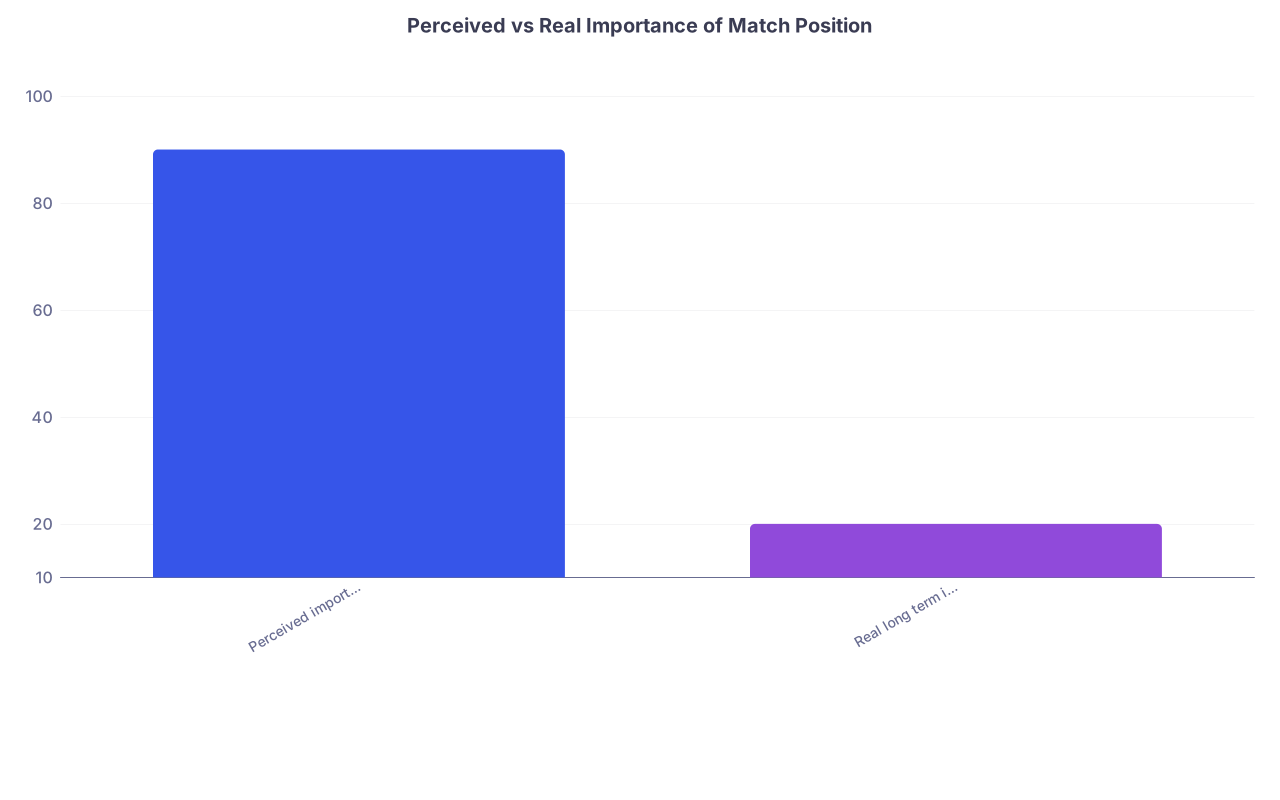
| Category | Value |
|---|---|
| Perceived importance | 90 |
| Real long term impact | 20 |
So What Actually Predicts Your Long-Term Outcome?
If you want to worry about something, worry about this instead of “Did I match #1?”:
- How you perform in residency. Show up prepared, teachable, and reliable.
- Who mentors you. A mid-tier program with a fierce advocate beats a top name with indifferent faculty.
- Your habits. Sleep, exercise, boundaries—these keep you functional enough to learn.
- Your tolerance for asking for help. People who get feedback and adjust outperform those who try to tough it out solo.
The Match is one constraint in a long chain of variables. It’s not the master key to your future.
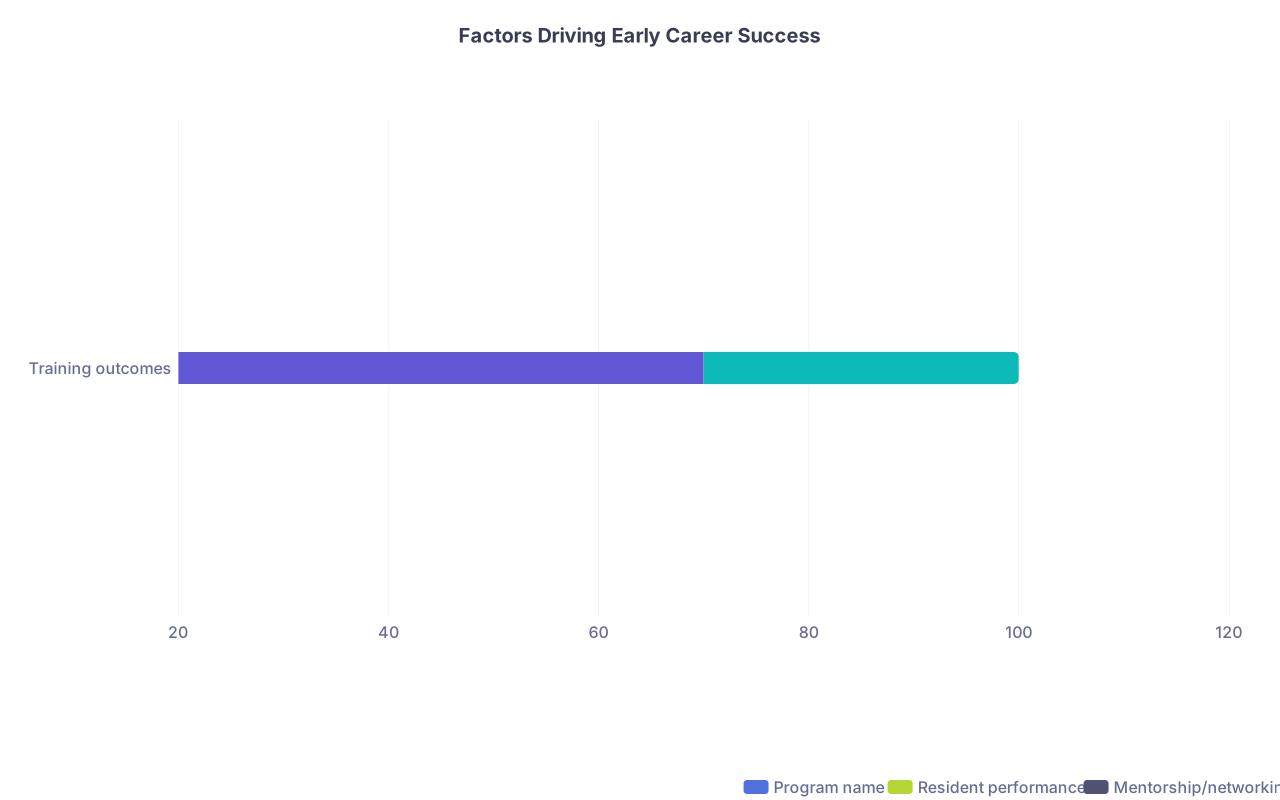
| Category | Program name | Resident performance | Mentorship/networking |
|---|---|---|---|
| Training outcomes | 20 | 50 | 30 |
The Bottom Line
Strip away the drama and you’re left with three blunt truths:
- The Match algorithm already favors getting you the highest program that wants you; gaming your list is pointless. Rank honestly.
- Longitudinal outcomes—boards, fellowship, jobs, satisfaction—are driven by your performance and environment, not whether the program was #1 or #5 on a list you made under stress.
- The “Perfect Match” is a story you tell yourself, not a measurable career determinant. A solid, supportive program a few spots down your list will beat a toxic “dream” institution every time.
Match Day feels monumental because it is a big milestone. But it’s not a verdict on your future. It’s just the starting line.