
No, Match Day Doesn’t Define Your Career: What Long-Term Data Shows
What if that envelope you open on Match Day — the one you’ve mentally turned into life or death — actually predicts far less of your future than you think?
Let me be blunt: Match Day is emotionally huge and professionally overrated. The culture around it is broken. Programs pretend they’re choosing “future leaders.” Students act like a name on that envelope locks in their entire trajectory, income, and happiness level for the next 40 years.
The numbers do not back that up.
If you’re about to match, just unmatched, or worried you “settled” for your backup specialty or a community program in the middle of nowhere, you’re exactly who I’m talking to.
Let’s dismantle a few myths.
Myth #1: “Where I Match Determines How ‘Successful’ I’ll Be”
You’ve heard the script: “If I don’t match at a big-name academic center, I’m done for research, fellowships, leadership roles, or competitive jobs.”
Here’s what the long-term data and real careers actually show: the hospital name on Match Day is a weak predictor of your eventual success. Not zero. But weak.
What the data really says
There have been several themes across studies and career tracking:
Longitudinal surveys of physicians (AMA, Medscape, specialty societies) consistently show:
- Job satisfaction is driven more by:
- Work hours and autonomy
- Practice environment and culture
- Control over schedule
- Debt and compensation relative to local cost of living
- And not primarily by prestige of residency institution.
- Job satisfaction is driven more by:
Fellowship match trends:
Review CVs of fellows in cardiology, GI, heme/onc, ortho, derm — you’ll find a mix:- Some from Harvard/Stanford/UCSF.
- Many from strong but non-elite academic programs.
- A surprising number from community or hybrid community-academic programs.
Do big-name places give you easier access to research and networking? Yes. Do they guarantee you end up happier, more successful, or in a better job than the resident at “County Hospital, No One Cares University”? No. At best, they front-load opportunity — they don’t cement outcomes.
| Factor | Evidence From Long-Term Surveys |
|---|---|
| Control over schedule | Strong positive association |
| Supportive work culture | Strong positive association |
| Compensation vs local costs | Moderate–strong association |
| Prestige of residency institution | Weak association |
| Specialty choice fit | Strong association |
The most satisfied physicians I know didn’t all come out of the “Top 10” echo chamber. Many trained at unglamorous programs that gave them reps, autonomy, and supportive mentors.
The prestige trap
You know what prestige does reliably? It messes with people’s expectations.
Residents at elite programs burn out at high rates. Constant comparison, hyper-competitive peers, and the pressure to chase “big” fellowships or academic careers even if they’re not interested. I’ve watched people at name-brand programs feel like failures because they chose outpatient primary care instead of chasing R01 grants and a triple-boarded subspecialty path.
Prestige isn’t free. There’s a cost. And the “cost” side almost never shows up in Match Day hype.
Myth #2: “If I Don’t Match My Top Specialty, I’ll Be Stuck Forever”
The fear script: “If I don’t match derm/ortho/ENT/rads this year, I’ll never get another shot. My life is over.”
Reality: specialty pathways are more flexible than students are led to believe — just messier, slower, and less Instagram-ready.
Here’s what I’ve seen over and over:
- People who:
- Did a prelim year.
- Did a transitional year.
- Matched into internal medicine, peds, FM, or general surgery.
- Then pivoted into a second residency or competitive fellowship.
Transferring into another residency or pivoting through fellowship is not mythical. It’s just not marketed, because nobody wants to admit how non-linear medicine actually is.
Actual career pivots that happen regularly
- IM → Cardiology, GI, Heme/Onc, Critical Care
- General Surgery → Plastics (independent), Vascular, Surgical Oncology
- Pediatrics → Peds Cardiology, Peds GI, NICU
- FM → Sports Medicine, Palliative, EM (in some systems), Addiction
- IM/FM → Informatics, Hospital Admin, Quality & Safety leadership
Are these automatic? Absolutely not. You need:
- Solid evaluations
- Advocacy from mentors
- Strategic case logs / research / networking
- Sometimes an extra year or a less direct pathway
But “didn’t match my dream specialty at 26” does not equal “I’m locked out of meaningful or competitive pathways until retirement.”
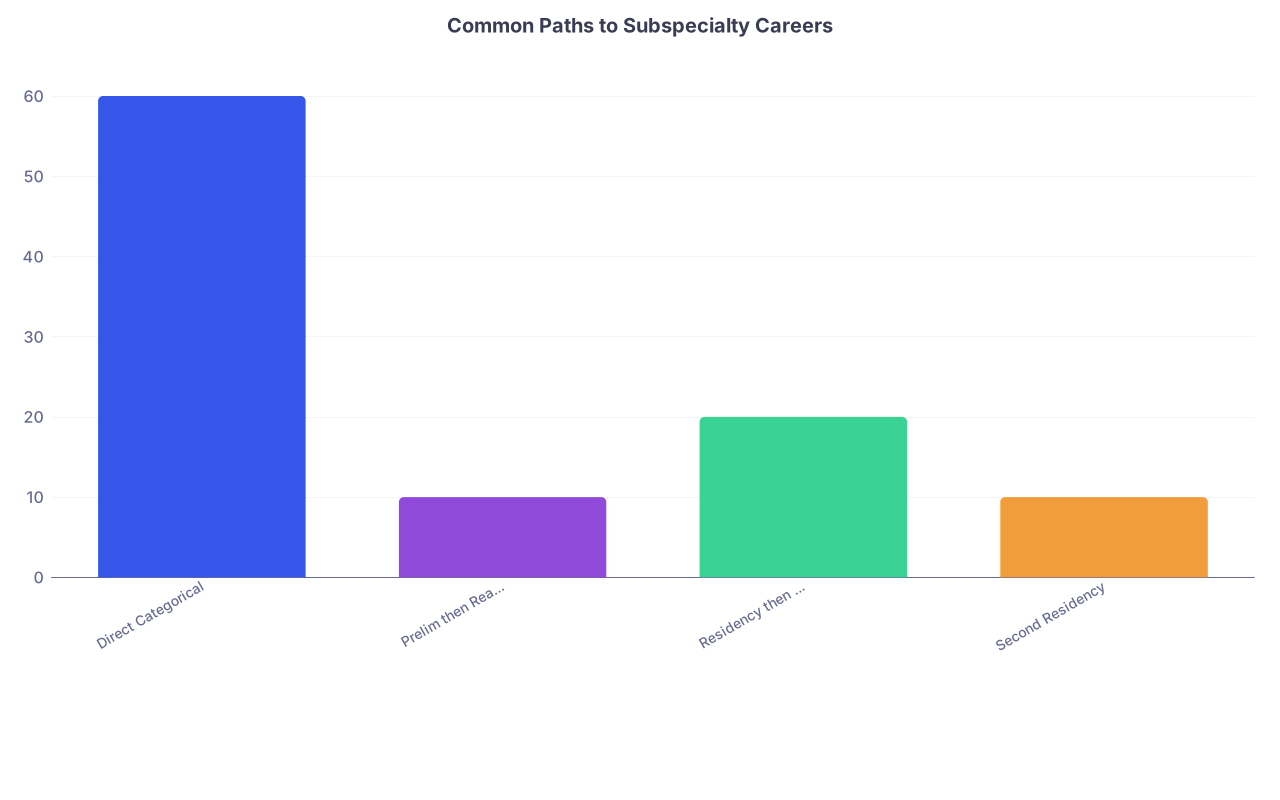
| Category | Value |
|---|---|
| Direct Categorical | 60 |
| Prelim then Reapply | 10 |
| Residency then Fellowship Pivot | 20 |
| Second Residency | 10 |
That rough breakdown is what you’ll see if you talk to enough mid-career physicians: a large chunk got there “the classic way,” but a very real minority used side doors.
The Match is a sorting mechanism, not a life sentence.
Myth #3: “Academic vs Community Match = Academic vs ‘Just Service’ Career”
The snobbery about community programs might be the most dishonest part of Match culture.
The unspoken belief: “If I match community, I’ll never do research, never teach, never lead.”
Completely false.
Look at:
- Program director lists
- Hospital CMO / CMO-equivalent bios
- Medical school clerkship site leaders
You’ll see countless people who trained at mid-tier or community-heavy programs.
Community-heavy training often gives you:
- Higher procedural volume.
- More autonomy earlier.
- Exposure to bread-and-butter medicine that actually dominates real-world practice.
These matter a lot when:
- You’re trying to get hired for your first attending job.
- You’re attempting to prove you can handle call alone.
- You want to build a robust outpatient or procedural practice.
How people build academic or hybrid careers from “non-elite” programs
I’ve watched residents from modest programs do the following:
- Publish case series or QI projects with committed mentors.
- Attend national conferences, present posters, network face-to-face.
- Land academic or hybrid jobs at university-affiliated community hospitals.
- Then build portfolios of teaching, quality work, committee work, and eventually slide into academic appointments.
Do some top fellowships care more about brand-name residency? Yes. But academic medicine is not only “top fellowship at top institution or bust.” The ecosystem is bigger than that.
Myth #4: “My Match Rank = My Talent, Intelligence, or Worth”
This one’s toxic. Also objectively wrong.
The NRMP and multiple analyses have been very clear: the Match is noisy. There’s strategy, bias, randomness, and timing baked in.
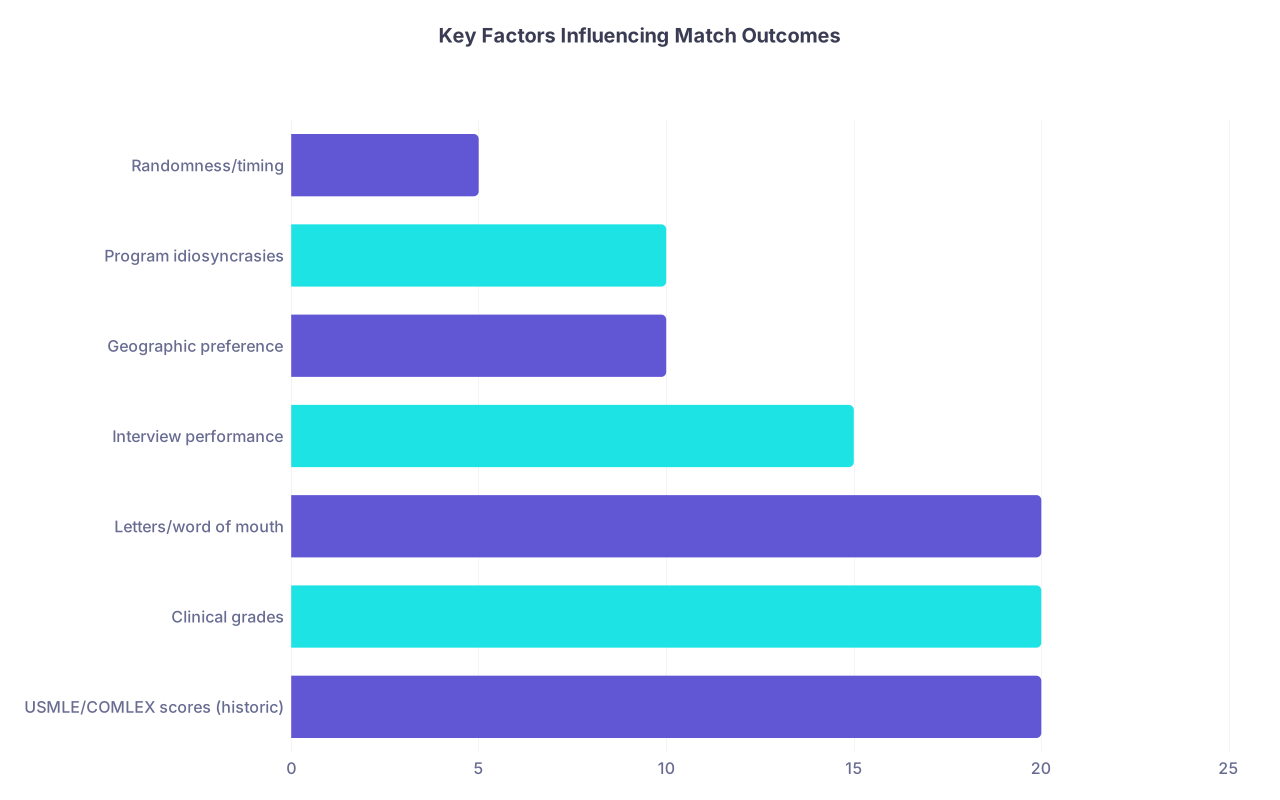
| Category | Value |
|---|---|
| USMLE/COMLEX scores (historic) | 20 |
| Clinical grades | 20 |
| Letters/word of mouth | 20 |
| Interview performance | 15 |
| Geographic preference | 10 |
| Program idiosyncrasies | 10 |
| Randomness/timing | 5 |
Those percentages aren’t official NRMP numbers — they’re a realistic conceptual breakdown of what actually drives outcomes when you listen to program directors off the record.
A few ugly truths:
- A mediocre interview at one program can matter more than a stellar one at another.
- One toxic comment from a faculty member can quietly crater your chances at an entire region.
- Program priorities shift year by year: “we want more research people” one year, “we want workhorses who will stay local” the next.
- Couples matching adds chaos. Visa status adds chaos. Late Step 2 scores add chaos.
Talent and potential aren’t linearly translated into Match result. They’re filtered through a messy, human system.
So no, if you land at #5 on your list instead of #1, it doesn’t mean programs “knew” you were worse. It often means the rest of the system — geography, personality fit, interview chemistry, random faculty preferences — pushed you slightly one way or another.
Myth #5: “If I Don’t Match, My Career Is Destroyed”
Going unmatched feels like a public failure ritual. It’s brutal. But long-term? It’s a detour, not a dead end.
Here’s what actually happens to a lot of unmatched applicants:
- They:
- SOAP into a prelim or transitional year.
- Do a research year with real mentorship and structured output.
- Take a non-clinical role (informatics, admin, education) while strengthening their application.
- Reapply with better letters, more clarity, and a more realistic list.
A large fraction of re-applicants do match in subsequent cycles. Not always into the original dream specialty, but very often into something they can build a solid, satisfying career in.
The psychiatrists, hospitalists, outpatient internists, anesthesiologists, and radiologists you’ll meet? More of them than you think had at least one “failed” step — didn’t match the first time, had to switch fields, scrambled into SOAP.
What do they all say later? Some version of: “It felt catastrophic then. It makes sense now.”
I’m not romanticizing this. It’s painful and unfair. But it is survivable. And it is not, by any realistic standard, career-ending.
Myth #6: “My Income, Lifestyle, and Burnout Risk Are Locked In on Match Day”
This one’s particularly misleading.
Students talk like:
“Derm = rich and happy.
Primary care = poor and miserable.
EM = doomed to burnout.
Anesthesia = passive income machine.”
Reality is uglier and more nuanced.
Longitudinal data on burnout and satisfaction (Medscape, specialty society surveys, AMA, etc.) show:
- Burnout hits high-income specialties too — often hard.
- Lifestyle is heavily shaped by:
- Practice setting (academic vs private vs employed)
- Group size
- Call structure
- Leadership competence
- Market saturation in your region
You can be:
- A miserable orthopod in a toxic practice.
- A happy, well-compensated outpatient internist in a supportive group with a 4-day workweek.
- A burned-out dermatologist drowning in cosmetics quotas.
- A fulfilled EM doc in a well-staffed, non-predatory ED.
Match Day doesn’t assign you those. Your later decisions and the job market do.
So What Actually Matters More Than Match Day?
Let me strip the hero-worship out and get practical. Over a 30–40 year career, the following matter more than that envelope:
How you handle residency:
- Do you build a reputation for being reliable, curious, and teachable?
- Do attendings trust you with autonomy?
- Do nurses want you on their team?
How you manage your early career:
- Do you say yes to everything and burn out, or choose deliberately?
- Do you pick your first job based on prestige, or on leadership, staffing, and sustainability?
How you negotiate and reevaluate:
- Do you stay in a toxic environment because it’s “big-name”?
- Are you willing to move states, systems, or practice models if needed?
Whether you protect your non-work life:
- Relationships, health, hobbies.
- These aren’t fluff. They’re directly correlated with burnout risk and resilience.
Residency match is your first major fork. It is not the only one.
How To Mentally De-Weaponize Match Day
You’re not going to “logic” yourself out of caring about Match Day. The emotional weight is real. But you can blunt the damage if things don’t go how you hoped.
A few mindset shifts that actually help:
Treat Match as Version 1.0 of your career, not the final build.
You’ll have V2 (first job), V3 (mid-career pivot), V4 (late-career role). Every attending you know has reinvented themselves at least once.Focus on the delta you control post-Match.
Same specialty. Different resident attitude, mentor relationships, research choices, leadership roles, moonlighting, and eventual job. Those vary by orders of magnitude more than your PGY-1 hospital name.Look at real CVs, not marketing.
Pull up a random cardiologist or hospitalist or surgeon at a decent hospital. Track their path: residency program, fellowship (or not), jobs. You’ll see plenty of “non-linear” and “not top 10” paths.Stop using your rank list as a personality test.
Matching #1 does not mean “I’m superior.” Matching #7 does not mean “I’m mediocre.” It means you’re now at a place where you still have enormous latitude to shape what kind of physician you become.
The Bottom Line
Match Day feels like a verdict. It is not.
Three key truths to keep in your head:
- The program and specialty you match into influence your first few years heavily — but they’re only modest predictors of your long-term success, satisfaction, income, or prestige.
- Careers in medicine are more flexible and non-linear than anyone admits on Match Day. People pivot specialties, fellowships, practice settings, and roles all the time.
- Your habits, mentors, boundaries, and decisions after Match Day will do more to define your career than whatever name is on that envelope.