

What do you say when your old boss asks, “So… you’re just a resident now?”
You left a real career. A title people recognized. A salary that made sense. Now it is Match season, and you are about to become (or just became) a PGY‑1 who makes less than your last intern, works nights, and needs to explain this to people who still live in your old world.
This is not a vague “follow your dreams” problem. This is specific:
- Your LinkedIn still screams “project manager / consultant / engineer / teacher.”
- Old colleagues are pinging you: “Heard you did med school! What’s next?”
- Your family does not understand why you are excited about being “on a list.”
- Someone will definitely say, “You’re starting over? At your age?”
You need a script. And a frame. Not a motivational poster.
Let’s build that.
Step 1: Get brutally clear on what you’re actually transitioning into
You cannot explain your transition if you talk like a medical student.
Your old world understands roles, compensation, timelines, and status. They do not care about “sub‑internships” or “away rotations.” They want to know:
- What is this job?
- Where is it?
- How long does it last?
- What does it qualify you to do?
- Are you moving up, sideways, or down?
So you translate residency into their language.
Here’s the plain version you should have ready:
- “Residency is a full‑time training job as a physician.”
- “It lasts X years, depending on the specialty.”
- “I’ll be employed by [Hospital/System], working in [specialty] with increasing responsibility each year.”
- “After residency, I practice independently as an attending physician. That’s the top of the track.”
If you came from corporate, you can layer it like this:
- “Match Day is basically offer day. All the ‘employers’ decide on the same day.”
- “Residency is like a 3–7 year rotational leadership program, but in medicine, where you carry real responsibility from day one and grow into full independence.”
If you came from the military, law, or education, you tweak the analogy. But the point is the same: you present residency as a structured, prestigious next phase of a clearly defined professional ladder, not “going back to school again.”
To drive that home, have your basic numbers in your head—how long your specialty is, roughly when you finish, and what that qualifies you for.
| Specialty | Years of Residency | Common Next Step |
|---|---|---|
| Internal Medicine | 3 | Hospitalist/Fellowship |
| Pediatrics | 3 | General Peds/Fellowship |
| Emergency Med | 3–4 | Attending EM Physician |
| General Surgery | 5 | Surgeon/Fellowship |
| Psychiatry | 4 | Outpatient/Inpatient |
Do not get caught flat‑footed when someone asks, “So how long is this going to take?” You should answer in one sentence without looking unsure.
Step 2: Decide the story you actually want them to remember
You’re not just “someone who used to be an accountant and now is a resident.” People will compress your whole transition into one sentence when they talk about you.
Your job is to write that sentence for them.
The formula that works for prior‑career folks looks like this:
“[Old identity] who took [core skill/value from old world] and moved into [specific medical role] to solve [problem you now care about].”
Examples:
- “He was a civil engineer who got obsessed with systems and safety and now he’s an emergency medicine resident at [Hospital], working on the front line of acute care.”
- “She was a teacher for 10 years, got frustrated watching kids bounce between systems with untreated mental health issues, and now she’s a psychiatry resident at [Program].”
- “He used to be in corporate finance, realized he wanted his decisions to touch actual lives instead of quarterly numbers, and now he’s an internal medicine resident at [Hospital].”
You want that through‑line. You are not “starting over.” You are “re‑deploying” skills and values into a higher‑stakes, more personally aligned field.
Write your one‑line sentence down. Literally. Say it out loud a few times. It should feel simple and obvious, not like a TED talk.
Then you build a 30‑second version off that same spine:
“Before med school I worked as a [role] at [company/sector]. The part I loved most was [core theme: solving complex problems / sitting with people in crisis / improving systems]. I eventually realized I wanted to do that work directly in healthcare, not from the side. So I went back to do the prereqs, completed med school, and I just matched into [specialty] at [program], where I’ll be training for [X] years to practice as a [future role].”
If you hate how it sounds, good. Fix it. This is your story; you should not cringe when you hear yourself say it.
Step 3: Translate “The Match” into something they understand
Match Day is bizarre to non‑med people. Algorithms, binding lists, no negotiation. If you do not frame it, they will either think:
- It’s random and you got “assigned,” or
- It’s like normal hiring and you just “picked” a job.
Both are wrong.
Here’s the short version you can throw into conversations:
“The Match is like a nationwide hiring day for doctors in training. We all apply, interview, and then both sides rank each other. A computer algorithm pairs us so that the most mutual preferences get filled first. On Match Day you find out in one shot where you’ll be training for the next several years.”
If they push further (your old VP of HR will), you can add:
“There’s no salary negotiation or jumping offers. Once you submit your rank list, you’re committed to wherever you match. So your strategy is about fit and training quality, not squeezing an extra $10k.”
Tie this back to something they know:
“It’s like if every law firm and every law grad in the country submitted rank lists on the same platform and all offers went out simultaneously through an algorithm, no counter‑offers allowed.”
That usually lands.
Step 4: Build a small script library for common reactions
You will hear the same comments on repeat. If you do not prepare, you will either overshare, get defensive, or undersell everything you just worked for.
Let’s go through the greatest hits and how to answer them without sounding apologetic.
“Wait, how much does a resident even make?”
They are not asking to shame you. They are mapping this to their world.
You do not need to give a dollar figure if you do not want to. But you need a clean frame.
Try:
“It’s not Wall Street money, for sure. It’s a standardized training salary—enough to live on, not to get rich. The real payoff is the skill set and license I’ll have at the end. Residency is the bridge from med school to independent practice, where compensation and control both jump.”
If they insist on numbers and you’re comfortable:
“Most residents make somewhere in the $60–75k range depending on the city and year. It’s like being paid to do an intense apprenticeship that qualifies you for a much higher‑responsibility, higher‑income role.”
If they start doing ROI math out loud (“So you gave up [X] to make [Y]?”), you shut that down calmly:
“Yeah, if this were only about near‑term money, that would be insane. But I traded a comfortable path for work that actually fits how I want to spend the next 30 years. For me that trade makes sense.”
You are not asking for their approval. You are stating a decision.
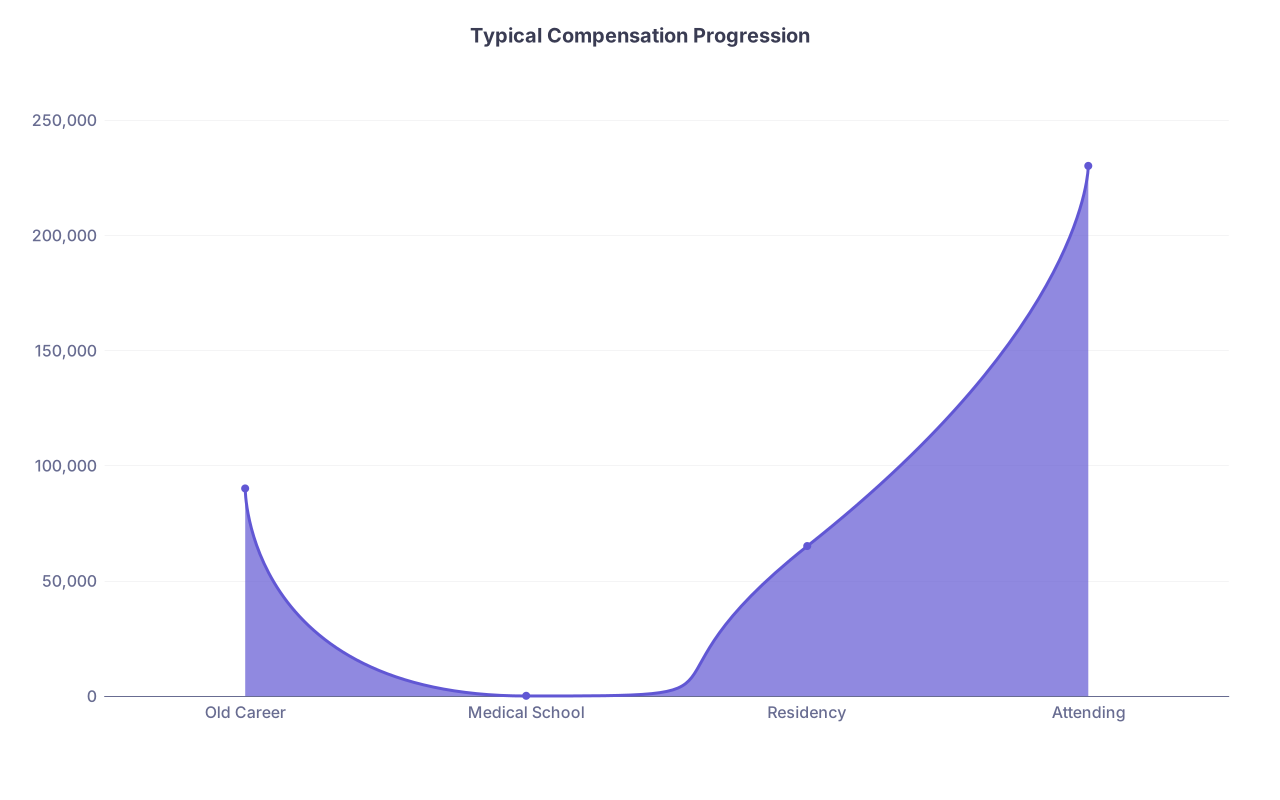
| Category | Value |
|---|---|
| Old Career | 90000 |
| Medical School | 0 |
| Residency | 65000 |
| Attending | 230000 |
“So you’re basically a student again?”
No. You are not. Say that clearly.
“I was a student for the last four years. Residency is different. I’m an employee of the hospital, taking care of real patients under supervision. I’m still learning every day, but this is a job with real responsibility, not just school.”
If they still persist with “back in school,” correct it lightly every time:
Them: “When you finish school…”
You: “When I finish residency, yeah. At that point I’ll be practicing independently.”
Do it without a lecture tone. Just matter‑of‑fact.
“Why didn’t you just stay in [old career]? You were doing well.”
Old colleagues will say this out of genuine confusion. They might also be low‑key testing whether you regretted leaving the herd.
Your move is to keep your answer aligned with your story sentence:
“I hit the point where the work stopped feeling like it mattered enough to me. I was good at [old role], but the part I kept caring about most was [human/system problem]. Medicine let me put that at the center of my job instead of on the edges. Harder path, better fit.”
You do not need a Hollywood epiphany. “Better fit for how I want to spend my time and energy” is enough.
Step 5: Control your public-facing story (LinkedIn, email, social)
If you do not set the frame on your visible profiles, people will create their own. Usually: “She left a solid career, stumbled through med school, and now she’s… doing something called ‘PGY‑1’.”
Fix that before Match Day if you can. Or right after, if you are reading this late.
LinkedIn: rewrite like a career move, not a detour
Headline after Match:
“PGY‑1 Internal Medicine Resident at [Hospital] | Former [Old Role/Field]”
About section (short, direct):
“I spent [X] years as a [role] in [industry], focused on [two skills/problems]. In 20XX I made a deliberate transition into medicine to apply that same analytical and people‑focused skill set at the bedside.
I completed medical school at [School] and matched into [specialty] at [Program], where I’ll be training for the next [X] years. My long‑term interests include [clinical focus] and [a tie‑back to your old skills: quality improvement, healthcare operations, medical education, health policy, etc.].”
Experience section:
Do not delete your old career. Keep it. This is part of your credibility.
Under your upcoming residency position:
“[Program Name] – Resident Physician, [Specialty] (PGY‑1)
– Full‑time clinical training role in [specialty], providing direct patient care under supervision
– Rotations through [key settings]
– Focus areas: [X, Y, Z, ideally tying to old skills where real]”
Then keep your old role described strongly, not like a “before” mistake.

Email / message to close former colleagues or mentors
You do not need to blast the whole company, but a small circle of people who mattered to you professionally should hear directly from you. It keeps doors open and reputations intact.
Here’s a bare‑bones template:
“Hi [Name],
I wanted to share some news and also say thank you.
After leaving [Company] to pursue medicine, I’ve now completed medical school at [School] and just matched into [Specialty] at [Hospital/System] for residency. I’ll be training there for the next [X] years.
I still think often about the time at [Company], especially [specific project/lesson], and it continues to influence how I approach clinical problems and systems in healthcare.
I hope you’re doing well and that [Company/Team] is thriving. Would love to catch up briefly sometime this year if you’re open to it.
Best,
[Your Name]”
That’s it. Simple, respectful, and clearly frames your Match as a professional advancement, not a midlife crisis.
Step 6: Handle in‑person situations without rambling
Match season you’ll run into people: weddings, conferences, random coffee meetups. You are going to get the “So what are you doing now?” question. A lot.
Use this structure and keep it under 45 seconds:
- Old anchor: “You might remember, before med school I was a [role] at [place].”
- Decision pivot: “I decided I wanted to apply that experience in a more direct way in healthcare.”
- Current status: “I just matched into [specialty] at [hospital] and start residency in July.”
- Future direction: “That’s a [X]‑year program that will let me practice as a [future role].”
Example:
“You might remember I was doing logistics optimization at FedEx before I left. I realized I wanted to work with complex systems where the stakes were people’s lives, not just shipping times. I went to med school at UTHSC, and last week I matched into emergency medicine at Vanderbilt. It’s a three‑year residency, and after that I’ll be practicing as an emergency physician.”
Then stop talking. Let them ask what they care about. You do not need to pre‑answer every possible question.

| Step | Description |
|---|---|
| Step 1 | Old colleague asks what you do now |
| Step 2 | Give 30-45 second answer |
| Step 3 | Answer briefly |
| Step 4 | Change topic or ask about them |
| Step 5 | Set gentle boundary - suggest call later |
| Step 6 | Continue light conversation |
| Step 7 | They ask follow up? |
| Step 8 | Too many detailed questions? |
If someone drags you into a corner and starts interrogating your life choices, you are allowed to say:
“It’s a long story and I could talk about it for an hour, but the short version is I’m very glad I made the switch. What’s new with you?”
You are not on trial.
Step 7: Prepare for family and culture‑specific pressure
Old colleagues are one thing. Family is another. Especially if you came from a culture where “starting over” in your 30s or 40s is seen as failure or irresponsibility.
You can use the same frames, but you might need different emphasis:
- Stability: “Residency is a structured, guaranteed position for X years with a clear next step.”
- Respect: “In this system, physician training is one of the most respected paths, even though the early years are demanding.”
- Long‑term security: “Right now is investment mode. The long‑term stability is significantly higher than my old profession.”
If they hit you with, “You were a manager; now you’re an intern again,” reframe:
“In medicine, this is actually the only way in. Everyone does it, no matter what they did before. It’s not a demotion; it is the standard training track to become the person in charge.”
If money is the sticking point, you can show them the arc, not just the next year.
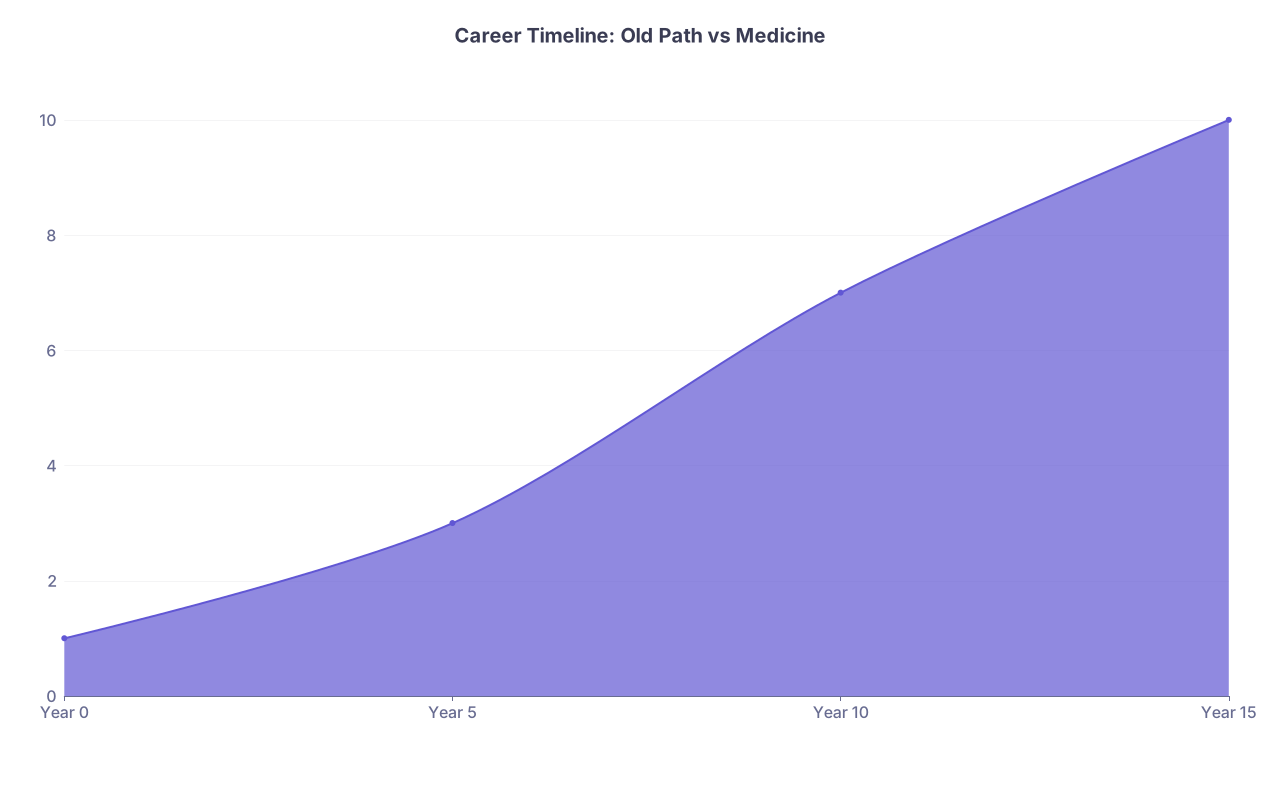
| Category | Value |
|---|---|
| Year 0 | 1 |
| Year 5 | 3 |
| Year 10 | 7 |
| Year 15 | 10 |
You do not have to explain every financial detail. The key message: “Short‑term sacrifice, long‑term fit and stability.”
Step 8: Keep the useful parts of your old identity alive
The worst thing you can do is act like your old career was a mistake you now regret. Old colleagues pick up on that immediately.
Instead, treat it like a foundation you’re proud of:
- Mention specific skills you still use: data analysis, negotiation, mentoring, design, teaching, project management.
- Volunteer for projects in residency that tap your old expertise: workflow redesign, teaching sessions, QI projects, EHR optimization.
- When you talk with old coworkers, bring up how you see things from that dual perspective now.
Example you can drop into conversation:
“Honestly my time in consulting has made residency easier in some ways—juggling multiple projects, horrible hours, dealing with difficult stakeholders… it all carries over. And I’m already working with our program on a project to streamline discharge communication using some of the same process mapping tools.”
That does two things:
- Signals you did not “throw away” your past.
- Shows you are an asset in your new environment because of it.

Step 9: Know what to say if you’re not happy with your Match
Sometimes you match into a program or even a specialty you’re not thrilled about. Old colleagues will still ask, “Did you get what you wanted?”
You do not need to give them the full NRMP drama.
Keep it tight:
If you’re basically okay with it:
“I matched into [specialty] at [place]. It’s a solid program and I’m excited to start.”If you’re wrestling with disappointment but do not want to unpack it:
“I matched into [specialty] in [city]. The program will give me strong training. I’m still sorting out where I want to land long term, but this is a good base to work from.”
If someone presses, “But is it what you wanted?” you can say:
“The system doesn’t work like picking a company off a list. It’s a match between what we rank and what programs rank. I didn’t get my absolute top choice, but I did get a good place to train. That’s what matters now.”
Do not use old colleagues as your therapy group. Save the real emotional unpacking for people who understand the system or for your own support network.
FAQs
1. Should I reconnect with old colleagues before or after Match Day?
If you already have decent relationships with them and you know you’re going through the Match this year, a brief “I’m in my final year of med school, applying to [specialty]” update before Match can lay the groundwork. But the heavier “here’s where I landed” conversation is cleaner after you actually know where you matched. Then you can speak concretely: “I will be in [city] at [hospital] from [year to year].”
If it’s been years and you have not spoken, wait until after Match so you have a strong, complete update instead of a “maybe this, maybe that” story.
2. What if I want to keep the door open to going back to my old industry later?
Then be very intentional with your framing. Do not trash your old field. Emphasize the cross‑over skills and the fact that you still think that world is important, you just chose to sit on a different side of the table. Keep LinkedIn updated, stay loosely in touch with a few key people, and consider getting involved in projects at the intersection—healthcare consulting, policy, informatics, quality, or leadership roles that interact with your old industry.
Even if you stay in medicine forever, that bridge will make you more valuable. And if you ever need to cross back, you will not be starting from zero.
3. How do I respond when someone says, “I could never give up my salary like you did”?
Do not argue with them. Agree with the premise but clarify the frame.
Something like: “Yeah, the financial part is not trivial. I wouldn’t recommend this path if money was your main driver. For me, long term, the trade was worth it in terms of meaning and the kind of work I get to do day to day. Short term, it’s definitely a sacrifice. I made peace with that before I started.”
They’re really saying, “I would not want to make that trade.” Your answer is simply, “I did, and I’m okay with it.”
Open your LinkedIn (or whatever platform your old colleagues actually check) right now and rewrite your headline and About section so they reflect your new identity as a resident—then draft one 30‑second script you can use the next time someone from your old world asks, “So what are you doing now?”


