

It’s Match Day. Your hands are actually shaking. You open the email, scan for your name, then your eyes land on the line that’s supposed to define your next 3–7 years:
“Congratulations! You have matched to:
[PROGRAM NAME YOU’VE NEVER HEARD OF IN YOUR LIFE]”
Your brain basically does a Windows error sound.
You blink. Read it again. Nothing. No recognition. No “Oh yeah, that great interview.” Just:
Wait. Who are you?
And then the spiral starts:
Did NRMP make a mistake?
Did I accidentally rank some random program?
Is this a prelim I forgot about?
Is this in a city I didn’t mean to apply to?
Did I seriously just commit my life to somewhere I can’t even picture on a map?
Let me walk through this with you. Because you’re not the first person this has happened to, and you definitely won’t be the last.
First: No, You Didn’t Break the Match Algorithm
If the program name looks unfamiliar, your brain will jump straight to “This is wrong. Something glitched. They sent me the wrong email.”
I get why. It feels like such a high‑stakes thing, it should look cinematic. Like fireworks and your dream hospital logo. Not “Some Hospital System – Regional Campus West” that sounds like a fake place from a standardized test passage.
Here’s the unexciting reality:
- The algorithm matched you to a program you ranked
- The name in the email is the official NRMP/ACGME name, which can look different from what you casually called it in your head
- It can include things you tuned out: corporate health system names, hyphenated campuses, or a city you didn’t emotionally register
You probably know it as “St. Mary’s in Cleveland” and the email says:
“MercyHealth – St. Mary’s Regional Medical Center Program, Ohio.”
Your brain just goes: “I don’t know her.”
You did not randomly get assigned to a program you never ranked. That’s not how this works. That’s not how any of this works.
If you matched, it’s to a program on your rank list, or (for those in SOAP) something you directly accepted.
Is there an extremely tiny, almost theoretical chance of an administrative error? Sure. But in the real world, the much more common explanation is that:
- You applied to way too many programs
- You interviewed at a ton
- You were exhausted when you built your rank list
- And you mentally filed some programs away as “the one with the nice PD,” “the one with the weird lunch,” not by full legal name
Your memory is not a database. And Match Day is not a memory test.
Why The Name Might Look Totally Foreign
There are some very normal reasons your Match email looks like it’s naming a hospital from an alternate universe.
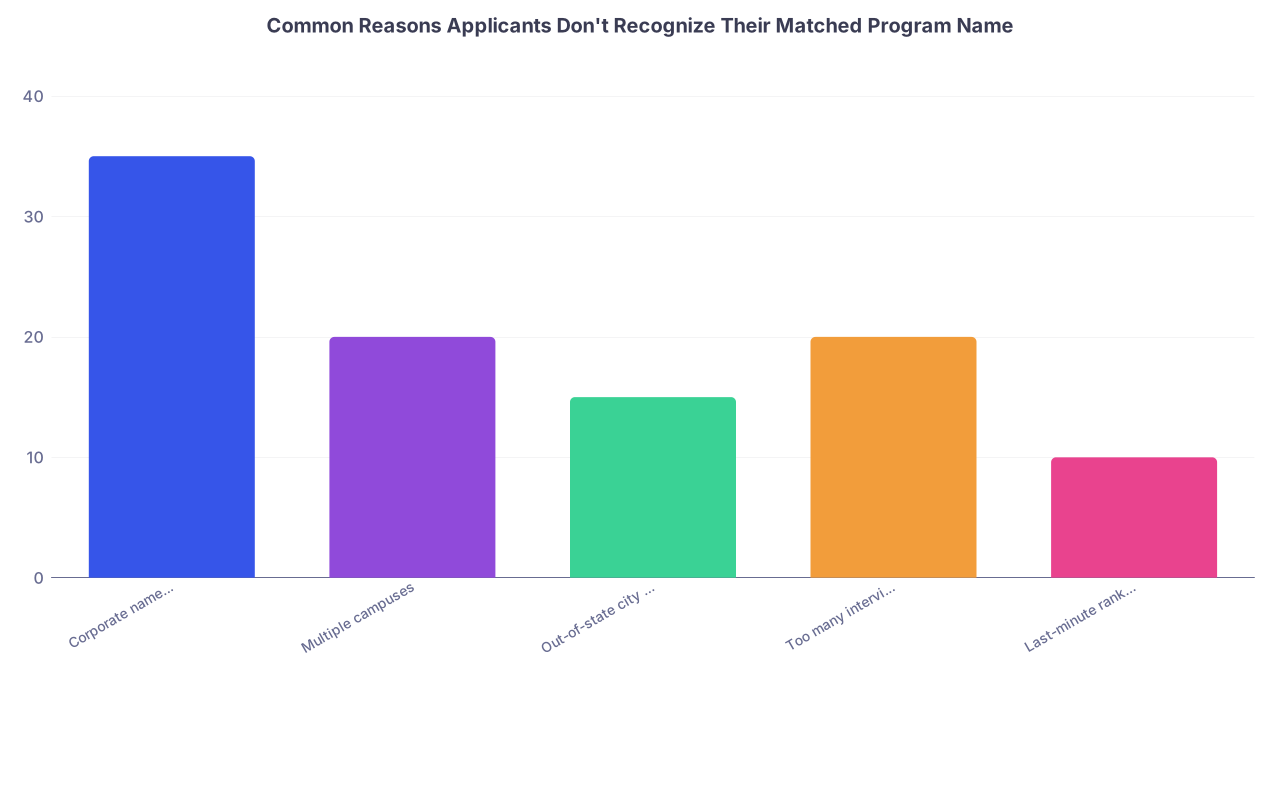
| Category | Value |
|---|---|
| Corporate name mismatch | 35 |
| Multiple campuses | 20 |
| Out-of-state city name | 15 |
| Too many interviews | 20 |
| Last-minute rank changes | 10 |
Here’s what I’ve actually seen people go through:
Corporate + hospital + city mashup nightmare
Programs love stacking names. You remember it as “County Hospital – Tulsa,” but your email says: “University HealthCare System – County Medical Center / Tulsa Program.”
Yeah. Of course your stressed-out brain doesn’t connect that immediately.Main vs regional campus confusion
Some systems have:- Main academic center
- Regional/community hospital
- Satellite rural program
All with suspiciously similar names. You might have interviewed at multiple branches without fully appreciating how different their formal names were.
You applied in multiple states/regions
You told yourself, “I’d prefer to stay near home,” and then panic-applied to 80+ programs across the country. Months later, on Match Day, seeing: “XYZ Health – North Campus, Idaho”
triggers: Wait. Idaho??You made late changes to your rank list
I’ve watched people move a “safe” program from #10 to #3 two hours before the deadline and then completely forget they did it. On Match Day, they see the name and swear they never ranked it that high. But they did. That panic is real.You remembered the interview, not the name
You remember:- “The one where I clicked with the chief”
- “The one where the PD swore they cared about wellness”
- “The one with the free parking and actually decent food”
But your email gives you none of those associations. Just a sterile, bureaucratic label.
None of this means anything is wrong with your Match. It just means this process is messy, overstuffed, and cognitively overwhelming.
What You Should Do in the First 30 Minutes
Here’s the part your anxiety wants to skip: the boring, grounding steps.
Do them anyway. They’ll pull you out of “I matched to an imaginary hospital” mode.

| Step | Description |
|---|---|
| Step 1 | See unknown program name |
| Step 2 | Pause and breathe |
| Step 3 | Check original rank list |
| Step 4 | Look up program in ERAS/NRMP |
| Step 5 | Confirm location and track |
| Step 6 | Read program website |
| Step 7 | Reach out to trusted mentor |
Pull up your original rank list
Log into NRMP. Look at what you actually ranked. Confirm the program name on your result matches something on that list. It will. But seeing it helps shut down the “this is a glitch” spiral.Find it in your ERAS applications
Go back to your ERAS or email archives. Search the hospital/health system name. You’ll almost always find:- Their interview invite email
- A follow‑up “thank you for interviewing”
- Pre‑interview information packets
And then it snaps into place: “Oh. That one.”
Confirm the location and track
This matters. Look carefully for:- City and state
- Main vs regional campus
- Categorical vs preliminary vs advanced
Most freak-outs I’ve seen are actually about: “Wait, is this the prelim year only?” or “Is this really in [city] or the smaller town an hour away?”
Revisit your notes (if you took any)
If you were that person with a spreadsheet of interview impressions, open it. Nobody remembers what they wrote; you’ll be surprised by your old self:
“Residents seemed happy.”
“Good trauma exposure.”
“Strong fellowship match in XYZ.”
You might actually have liked it. You just didn’t remember the formal name.Text one calm, sane person
Not the anxious friend who will spiral with you. Someone who will say: “Okay. Let’s look it up. Send me the name.”
Borrow their prefrontal cortex for a bit.
What This Does Not Mean About You or Your Future
Your brain is probably saying something like:
“I don’t even recognize the program. I must have totally screwed up my rank list. I’m careless. I clearly didn’t end up where I was supposed to be.”
That story feels convincing in the moment. It’s also garbage.
Here’s what an unfamiliar program name does not mean:
- It does not mean you matched somewhere “bad”
- It does not mean your career is over
- It does not mean you were reckless with your ranking
- It does not mean this is the “wrong” life path
It means: you applied widely; this process is insane; your brain was on survival mode. That’s it.
I’ve seen people absolutely thrive at places that were originally their #8, #12, even #20 pick. I’ve also seen people miserable at “dream” programs that looked shiny on paper but didn’t fit them as humans.
You are not locked into an identity because of one line on an email. You’re starting at a place that will be:
- As good as its leadership and culture
- As good as your attitude, boundaries, and support system
- As good as the people you train with
The glossy brochure matters way less than you think. The day-to-day reality of rounding with sane humans matters more than the logo.
But What If This Really Was My “Safety” and I Hate That?
That’s the part that really stings, right?
It’s not just that you don’t recognize the name. It’s that once you figure out which program it is, you realize:
“Oh. This was one of my lower-ranked places. I didn’t picture ending up there.”
I’m not going to sugarcoat it. That’s a grief moment. A little (or a lot) of mourning the version of your life where you matched at your #1–3.
Let that be real. You’re allowed to feel:
- Disappointed
- Embarrassed
- Confused
- Weirdly cheated, even if logically you know the algorithm did what it does
But then, after the first emotional wave, you have to separate two things:
- “This wasn’t my top choice.”
- “This is therefore a terrible program that will destroy my career.”
Those are not the same. At all.
Here’s what usually happens when people land at a “safety” they didn’t expect:
- Month 1: “I can’t believe I’m here; this feels surreal.”
- Month 3–6: “Okay, my co-residents are actually great. I know where to get lunch. I know how to not get yelled at on rounds.”
- Year 2+: “I’m too tired to care about brand names; I care about whether my team watches my back at 2 a.m.”
Your metric for “good program” will shift from:
“Prestige, name, fellowship pipeline”
to
“Do I feel safe, taught, not constantly humiliated, and able to grow?”
And that can absolutely happen at a place that didn’t initially light up your brain on Match Day.
How to Re-Frame This Program Over the Next Few Weeks
You don’t have to force yourself into fake gratitude. But you can build a more accurate picture of where you’re going instead of leaving it as “mystery place with scary name.”
Here’s what I’d actually do:
Stalk, but with purpose
Look at:- Program website
- Current residents’ bios and where they went to med school
- Recent fellowship matches or job placements
- Call schedule, rotation structure, clinic setup
You’re not trying to prove it’s perfect. Just trying to ground it in reality.
Find someone who trained there or knows it
Ask faculty, upperclassmen, even random med Twitter/Reddit (with some skepticism but still). You’ll get:- “Oh yeah, they’re strong in critical care.”
- “PD is known to be very resident‑focused.”
- “They work you, but you come out solid.”
Contact your future co-residents
A lot of programs set up group chats. If not, you can email the coordinator and say something like: “I’m excited to be joining the program and would love to connect with any of the incoming interns if there’s a group chat or email list.”
Hearing from others in the same boat helps a ton.Let go of the idea that your rank order = your worth
You are not your program’s brand. You are the physician you become. I’ve watched people from community programs crush boards, match competitive fellowships, and get dream jobs. Quietly. Without Instagram-brag programs attached to their name.
Here’s a comparison that might help you recalibrate expectations:
| Factor | Dream Program (on paper) | Unfamiliar/Lower-Ranked Program |
|---|---|---|
| Name recognition | High | Variable |
| Day-to-day workload | Often heavy | Often heavy (everywhere) |
| Teaching quality | Can be great or terrible | Can be great or terrible |
| Resident happiness | Mixed, depends on culture | Mixed, depends on culture |
| Your future potential | High if you show up and do the work | High if you show up and do the work |
The common denominator is you. Not the name in your email.
When Should You Actually Worry?
There are a few very narrow situations where confusion about the program name deserves a closer look, not just reassurance.
Red flags to clarify (not panic about, but clarify):
- You thought you ranked one campus, but the email clearly references a different campus in another city within the same health system
- You aimed for a categorical position but the result looks like a preliminary only (or vice versa)
- You were in a couples match, and one of the emails looks like it’s from a program you don’t remember either of you ranking
What to do if any of those ring true:
- Re-check your rank list very carefully
- Verify the NRMP ID and ACGME code listed in your match information
- If you still think there’s a real mismatch between what you ranked and what you got, reach out to your dean or student affairs office first
- Let them interface with NRMP if there’s a true discrepancy
But 9 times out of 10, once you line up codes and names, you realize it’s exactly what you ranked; your brain just filed it under “too many details, will process later.”
The Part You’ll Only Believe in Retrospect
Right now, the name in your email feels huge. Loud. Overwhelming.
Fast-forward a year.
You’re going to remember:
- Your co-intern who brought you coffee after a brutal night
- The attending who quietly pulled you aside to say, “You did a good job with that family meeting”
- The nurse who called you out, then taught you what you missed, and then had your back the next time
The official, long, strange program name?
It becomes a line in your email signature and your badge. Background noise.
Years from now, you won’t remember the split second of panic when you didn’t recognize the program name in your Match email. You’ll remember how you handled that moment: whether you let it define you, or you took a breath, got the facts, and decided to build a life and a career anyway.
FAQ (Exactly 5 Questions)
1. Could NRMP actually match me to a program I never ranked?
No. The algorithm can’t assign you to a program that wasn’t on your rank list (or that you didn’t actively accept in SOAP). If the name looks unfamiliar, it’s almost always a naming/branding or memory issue, not a system failure.
2. What if I really don’t want to go to this program now that I know which one it is?
You still have a binding contract through the Match. Walking away can have serious consequences for future training and licensing. You can feel disappointed and still commit to showing up, giving it a chance, and then later exploring options like fellowship, jobs in other locations, or—very rarely and very carefully—transfers.
3. I thought I ranked Campus A, but my email says Campus B under the same system. Is that possible?
It’s only possible if you ranked both or accidentally chose the wrong NRMP code when submitting your list. That’s why you should compare the code in your Match results with your final rank list. If they match, the system did what you told it to do, even if it wasn’t what you meant to do.
4. Does matching at a place I barely remember mean my application was weak?
Not necessarily. It might mean you applied widely, the specialty was competitive, or your higher-ranked programs filled with other candidates they preferred numerically. People with strong applications match at lower-ranked programs all the time because of how supply, demand, and program preferences line up.
5. How long does it usually take to feel okay about matching somewhere unexpected?
For most people, the sharp disappointment lasts days to weeks. By orientation and the first few months of internship, your brain is too busy surviving and adapting to cling to the original narrative. It doesn’t magically turn into “this was my dream,” but it becomes regular life—and often, genuinely good in ways you couldn’t see from the outside.


