The hours after you match are far more important than anyone tells you. Program directors are already watching how you handle them—even if you have no idea they are.
Match Day feels like a finish line. To PDs, it is the first data point of who you are as a resident. You celebrate. They evaluate. Quietly.
Let me walk you through what PDs secretly hope you’ll do in the first 24 hours after you see the word “Congratulations” on your screen. This is the playbook very few applicants ever see, but every seasoned program director talks about behind closed doors.
1. Your First Move: A Fast, Professional Signal
Here’s the unspoken truth: the relationship between you and your PD starts the minute you match, not at orientation.
Faculty have a running mental list that sounds like: “Who seems mature? Who’s going to be high-maintenance? Who gets it?”
And the first thing they’re hoping for?
A short, professional, same‑day email.
Not a poem. Not a TED talk. Something like this:
Subject: Excited to Join [Program Name] – [Your Name]
Dear Dr. [PD Last Name],
I am thrilled to have matched at [Program Name] and I’m truly grateful for the opportunity to train with your team. I’m very excited to join the [Specialty] residency and contribute to the program.
Looking forward to getting started in July.
Best regards,
[Full Name, Degree]
[Med School]
[Phone]
That’s it. Two paragraphs. No drama.
What does this actually signal to PDs?
- You’re not entitled. You’re grateful.
- You’re not a chaos generator. You can hit basic professional notes under emotional stress.
- You care enough to close the loop.
I’ve sat in PD offices where they literally pulled up matched lists and said, “Let’s see who has already emailed.” They won’t tell you they’re doing that. But they are.
Who else they hope you’ll contact that day
They also hope you’ll send:
- A quick thank‑you to your interview day hosts (that chief who ran the social; that APD who took extra time with you).
- A short, respectful update to any programs you ranked higher where you had very personal interactions. Not to grovel. Just to close the loop.
Something like:
Dear Dr. [X],
I wanted to share that I matched at [Program]. I’m very grateful for your time and the opportunity to interview with your team. I truly appreciated learning more about [specific thing].
Warm regards, [Name]
Why PDs like this: the world is small. They meet at national meetings. They talk about “this year’s applicants” over coffee. When your new PD hears from a colleague, “Oh, [Your Name] wrote a really classy note after matching—good student,” that sticks.
2. The Social Media Test You Don’t Realize You’re Taking
Let me be blunt: some of you get labeled “problem resident” before July because of what you post in the 6 hours after the Match email.
Programs absolutely look.
Not all. But enough that you should act like they do.
What PDs secretly hope you’ll do after matching:
- Lock down the stupid stuff.
- Post like an adult, not like a college kid who just got into a frat.
If you’re going to post, they’re hoping it looks like:
- A photo with your classmates, holding envelopes or sitting together, captioned with something like: “Grateful and excited to be joining [Program] [Specialty] Residency Class of 20XX.”
- Tags of your school, maybe the program, nothing suggestive, nothing bitter.
What they do not want to see—and yes, I’ve heard PDs read these out loud in meetings:
- “Guess I’m stuck in [City] for 3 years lol”
- “Didn’t get my top choice but whatever, it’s over”
- “RIP social life, see you in 3 years”
- Anything complaining about the match, your school, or your rank list
- Drunk party photos by 2pm with your program hashtagged
One PD I know screens all new interns’ public profiles in the week after the Match. They don’t tell them. They just quietly log a mental “hmm” next to names.
The PD’s fantasy scenario? You:
- Post something clean, excited, and positive.
- Avoid subtweeting or vague “it is what it is” bitterness.
- Do not publicly compare your match outcome with others (“So happy for my friends at MGH while I’m headed to ___”).
You’d be shocked how many first impressions get poisoned before anyone sets foot in orientation.
3. The Call That Changes How They See You
Most applicants think the PD wants an email and that’s it.
Some PDs, especially in smaller or community programs, are quietly hoping for something more: a short, professional phone call within 24–48 hours.
They will never say this in public because they don’t want to look like they’re adding pressure. But when the phone rings and it’s a newly matched intern, most PDs sit up a little straighter.
The right kind of call is simple:
- You don’t ramble.
- You don’t negotiate vacation.
- You don’t ask for special treatment.
You just say, “I matched at your program, I’m genuinely excited, and I wanted to personally say thank you.”
Script it like this:
“Hi Dr. [Last Name], this is [Your Name]. I just matched into the [Specialty] residency. I wanted to personally thank you for the opportunity and say I’m really excited to be joining the team.”
Then you stop. Let them carry it.
On their side of the line, here’s what they’re thinking:
- Confident but not cocky.
- Mature enough to use a phone like a professional.
- Seems genuinely engaged.
I’ve seen PDs tell chiefs, “That’s the intern I want paired with the sickest service in July. They care.”
Will it hurt you if you don’t call? No. Most people don’t.
But if you keep it short, respectful, and not needy, it sticks in the right way.
4. What They Hope You’ll Do With Your Own People
You think PDs don’t care how you treat your classmates on Match Day? They absolutely do.
Because your behavior with peers on the happiest day of med school predicts exactly how you’ll behave with co‑interns at 2 a.m. when everyone’s exhausted.
Here’s what gets back to PDs more often than you’d think:
- Who gloated.
- Who disappeared right after opening their envelope, without saying a word to friends who scrambled or matched lower‑ranked places.
- Who sat with the unmatched classmate and didn’t post a thing until that person was taken care of.
They’re hoping you’ll do three things in those hours:
Celebrate without being a jerk
You’re allowed to be thrilled. They want you to be thrilled. But if three of your classmates did not match, and your entire Instagram is champagne, screaming videos, and “dreams realized” captions, someone at your school is noticing. And that often makes its way back through the grapevine.Acknowledge your support system
Not for their ego. For your humility. PDs like to see gratitude to mentors, family, classmates. It signals teachability. Residents who think they did everything alone are the hardest to train.Avoid public bitterness about where you matched
Even if this wasn’t your first choice, do not torch the place online or in group chats that may leak. PDs have literally pulled screenshots of intern chats where someone trashed the program the day they matched. It colors everything.
5. The Quiet Homework They Hope You Start Immediately
No PD expects you to start reading UpToDate on Match Day.
But there are a few very specific things they’re hoping you’ll do in the first few days—because these are the people who get up to speed fastest.
They want you to actually read what they send
Once the NRMP dust settles, most programs send out some version of:
- Welcome email
- Paperwork checklist
- Institutional onboarding details
- Maybe a preliminary schedule form or preference sheet
Here’s what they hate: sending this, then watching 4–6 interns ignore it for three weeks.
What they’re hoping you’ll do within 24–48 hours:
- Reply: “Received, thank you. I’ll review and complete everything by [reasonable date].”
- Actually put their deadlines into your calendar.
- Not ask a question that was clearly answered in the email you didn’t read.
The hidden metric here is not intelligence. It’s reliability.
Residents who respond promptly to these first touches get mentally filed as “safe pair of hands.” Residents who disappear force PDs to start tracking you early. That’s never good.
The one bit of studying that impresses them
PDs don’t expect you to pre‑round in March.
But they do quietly hope you’ll:
- Look again at the program website
- Re‑read the rotation structure
- Note key hospitals, clinics, and maybe the main EMR used
Why? Because by the time orientation hits, the residents who took one hour back in March to understand the basic structure are the ones asking real questions instead of, “Wait, where is the VA?”
6. The Logistics PDs Hope You’ll Start Addressing (Even If You Don’t Tell Them Yet)
Programs have been burned by interns who show up late to the game—moving in mid‑June, panicking about housing, scrambling for licensure at the last second. That chaos lands squarely on PD and coordinator desks.
So yes, there are things they’re hoping you start tackling in the background almost immediately.
I’ll lay them out cleanly:
| Task Category | Ideal Start Time | Why PDs Care |
|---|---|---|
| Housing search | Within 1 week | Avoid last-minute crises and commute issues |
| State license paperwork | Within 2 weeks | Prevent onboarding delays |
| Credentialing documents | As soon as requested | Keeps GME office off their back |
| Health/immunization records | Within 2 weeks | Occupational health clearance on time |
| BLS/ACLS renewals | Within 1 month | No training delays or schedule reshuffles |
They’re not watching each of these individually on Match Day. But they are hoping you’re the type of person who thinks:
“I should probably start looking at housing and local logistics this week,” not “I’ll deal with it in June.”
The residents who start calmly chipping away at these things now are the ones not sobbing in HR in late June because their license hasn’t cleared.
7. What PDs Don’t Want You to Do After Matching (But Won’t Say Out Loud)
There are also landmines.
Patterns that send subtle but real red flags. I’ve watched program directors roll their eyes and say, “Here we go,” based only on a few early behaviors.
Let me be very explicit.
1. Trying to renegotiate your life on Day 1
PDs do not want your first contact to be:
- “Can I start two weeks late because of a wedding?”
- “I already booked a month‑long international trip overlapping orientation.”
- “I need every Friday off for a side business.”
If you absolutely have a non‑negotiable conflict, you handle it respectfully, briefly, and only once you’ve already expressed enthusiasm and gratitude. And you accept no as an answer.
But if your first interaction is you asking for an exception, they categorize you as “high maintenance” before you show up.
2. Over‑sharing your disappointment
You might not have matched at your #1. They know. They’ve been on the other side of this.
What they don’t want:
- Emails that say, “Although this wasn’t my top choice…”
- Social media posts hinting that you “settled.”
- Group chats or class messages where you openly call the program a backup or a safety.
A chief resident will see it. Someone will screenshot it. And the story will make its way to your PD.
Better move: whatever your private feelings, publicly and professionally, you’re “excited and grateful.” Full stop. You can rant to your therapist or your best friend later.
3. Going completely dark for weeks
This one bothers PDs more than you think.
They love seeing early responsiveness to GME emails. They hate:
- Failing to respond for 10–14 days.
- Needing multiple reminders for basic forms.
- Having to hunt you down for simple confirmations.
Silence tends to cluster with other issues: incomplete immunizations, late Step scores, extended absences. PDs get spooked. They start asking, “Are we going to be chasing this person for everything?”
8. The Emotional Side: How They Hope You Handle the High
Underneath the checklists and bureaucracy, most PDs actually care how you process this transition.
They’ve watched many interns burn out before they even start because they never came down from Match Day adrenaline and never reset.
What they hope you’ll do that first night and weekend:
- Celebrate hard for a few hours, then unplug.
- Take a walk alone and let the “I’m really going to be a doctor in 3 months” realization land.
- Talk honestly with someone you trust about fear, not just excitement.
The best interns I’ve seen show up in July are the ones who allowed themselves to be fully happy, but then quietly got serious again. They didn’t live in “Match Day energy” for four straight months.
Residency is coming whether you’re ready or not. PDs can tell who’s starting to mentally shift into “next phase” mode—and they’re quietly rooting for you to use the post‑Match days to lay that foundation.
9. A Simple 24-Hour Game Plan PDs Secretly Wish You’d Follow
If I had to boil their wishes down into a single, realistic 24‑hour sequence, it would look like this:

| Step | Description |
|---|---|
| Step 1 | See Match Result |
| Step 2 | Celebrate with classmates |
| Step 3 | Send brief thank you email to PD |
| Step 4 | Post a clean positive social update |
| Step 5 | Reach out to unmatched classmates |
| Step 6 | Short calls or messages to family and mentors |
| Step 7 | Skim program website and welcome materials |
| Step 8 | Make rough plan for housing and logistics |
| Step 9 | Unplug and rest |
Is anyone expecting perfection? No.
But if you hit most of these, you’ll start your relationship with the program on exactly the right note.
10. The Truth Behind the Curtain
Here’s the part nobody advertises on brochures:
Program directors are not just selecting brains. They’re selecting humans they can trust at 3 a.m., in front of families, in front of nurses, in front of other services.
The hours after you match show them more about your character than you think:
- Do you show gratitude or entitlement?
- Do you respect the opportunity even if it wasn’t your dream outcome?
- Do you handle joy without trampling people who had a worse day?
- Do you answer basic communication like an adult?
You do not need to be perfect. You just need to be intentional.
If you treat the hours after Matching like your first professional impression on your future bosses—because it is—you’ll be ahead of most of your class before July even starts.
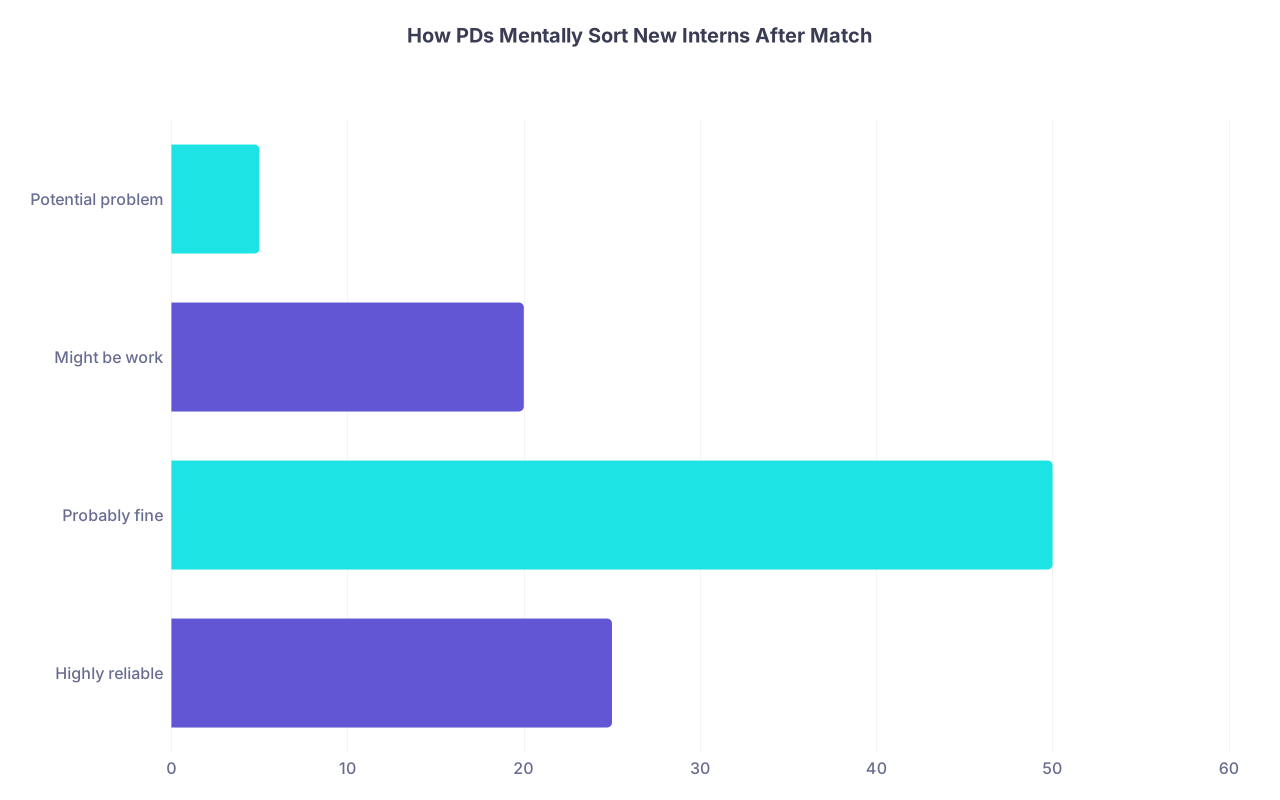
| Category | Value |
|---|---|
| Highly reliable | 25 |
| Probably fine | 50 |
| Might be work | 20 |
| Potential problem | 5 |
That rough distribution? I’ve watched versions of that conversation happen in conference rooms every spring. You want to live in the first two rows. These small, early choices push you there.