
Last month, a PGY-2 called me at 2:15 a.m. from a stairwell between the ICU and the wards. Voice low, pissed, and a little scared. “The ICU attending wants to keep him full code and push pressors. I examined him. This guy is dying and has said three times he doesn’t want this. What the hell am I supposed to do?”
That’s the real problem. Not the textbook ethics, not the “multidisciplinary collaboration” slogans. You, on call, alone, holding the pager, stuck between what you think is right for the patient and what the ICU team has already decided. Let’s talk about how to handle that without blowing up your relationships or abandoning the patient.
First: Figure Out What Kind of Disagreement You’re In
Before you start arguing, you need to name the fight in your own head. There are only a few basic types of clashes with the ICU team.
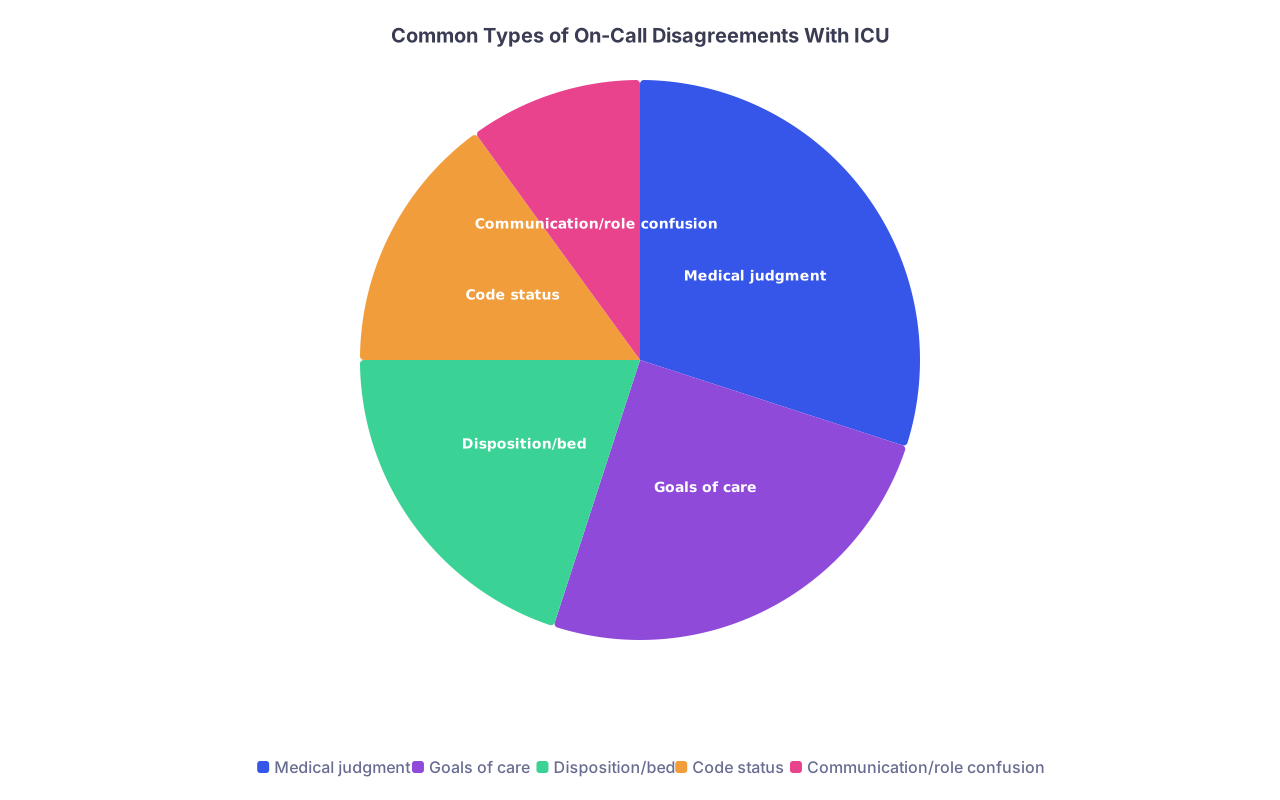
| Category | Value |
|---|---|
| Medical judgment | 30 |
| Goals of care | 25 |
| Disposition/bed | 20 |
| Code status | 15 |
| Communication/role confusion | 10 |
Roughly, disagreements fall into:
Medical judgment
- Example: They want to aggressively diurese, you think the patient is septic and needs fluid.
- You disagree on diagnosis or treatment choice.
Goals of care / code status
- Example: Patient clearly expressing they don’t want intubation, ICU still pushing “full code, maximal support.”
- You disagree on what the patient would want or what’s appropriate at end-of-life.
Disposition / whose patient is this
- Example: ICU wants to transfer a marginal patient to the floor; you think they’re still too unstable. Or the reverse.
Process / respect / communication
- Example: “Just do what I put in the note.” Attending dismissive, not listening, or giving unsafe instructions.
You handle each slightly differently. But the first step is the same: get clear, in your own mind, what exactly you disagree with.
Concrete move:
Before talking to anyone, write one sentence in your own words:
- “I think the ICU plan of X is wrong because Y, and I believe we should do Z instead.”
If you can not fill in X/Y/Z clearly, you are not ready to escalate or push back yet.
Stabilize First, Argue Second
On call, your first job is not to be right. Your first job is to keep the patient from crashing.
So you’re in this situation: ICU has a plan. You disagree. It’s 1 a.m., nurse is asking, “What do you want to do?” The temptation is to start a philosophical war. Don’t.
Sequence it:
Does the patient need something right now to not die?
- Airway, breathing, circulation, arrhythmia, obvious sepsis, uncontrolled bleeding, unrelenting pain, severe agitation compromising safety.
If yes, act. Call for help (rapid response, senior, ICU fellow) while you move.
- Airway, breathing, circulation, arrhythmia, obvious sepsis, uncontrolled bleeding, unrelenting pain, severe agitation compromising safety.
Is the risk of waiting 20–30 minutes to clarify the plan low?
- Borderline troponin trend, mildly rising creatinine, bit of a pressor disagreement, fluid strategy, vent settings that are “maybe not optimal” but not unsafe.
You have time to clarify.
- Borderline troponin trend, mildly rising creatinine, bit of a pressor disagreement, fluid strategy, vent settings that are “maybe not optimal” but not unsafe.
Here’s the rule:
Do not let your disagreement delay immediate, clearly necessary care.
You start with:
“Right now, I’m going to do A and B to stabilize him. Then we need to clarify the overall plan, because I have concerns about X.”
That framing keeps the team on your side. You’re not the difficult resident. You’re the one who took care of the crisis, then raised legitimate concerns.
How to Talk to the ICU Team Without Getting Steamrolled
The worst way to do this is: “I don’t agree with your plan.”
They’ve been in the ICU all day (or all week). You’re “the on-call resident” who may not have seen the last 48 hours of chaos with this patient. If you open adversarially, you lose.
Here’s a structure that works at 2 a.m. when everyone is tired.
Step 1: Lead with the shared patient, not your ego
“Hey, this is [Your Name], night float on [service]. I’m with Mr. Smith in 17B. I’ve just reassessed him because [specific change: his pressures dropped / he’s saying he doesn’t want intubation / his lactate is up]. I want to run my findings by you and make sure I understand the plan.”
You’re not declaring war. You’re checking your understanding.
Step 2: Present clean, tight data
This part matters. If you ramble, they tune out.
Hit:
- One-line ID
- Reason you’re calling now
- Focused exam changes
- Key vitals and trends
- Labs/imaging that matter to the disagreement
Example:
“67-year-old with septic shock from pneumonia, day 3 in ICU. You had him on norepi 0.06, full code. I was called because he’s more hypotensive and saying repeatedly he doesn’t want aggressive measures. Right now MAP 58 on norepi 0.14, sats 92% on BiPAP 12/6, HR 120, lactate up from 2.8 to 4.1. Mentating, oriented. He told me, quote, ‘I don’t want a breathing tube or chest compressions.’ There’s no advanced directive in chart.”
Clear. Concise. Concrete words from the patient.
Step 3: Ask for their reasoning before you counter
Phrase I use a lot:
“Can you walk me through your thinking for the current plan so I don’t miss anything?”
Then shut up and actually listen.
You’re listening for:
- Information you don’t have (family discussions, prior episodes, risk you did not consider)
- Whether they’ve already thought about your concern and rejected it
- Whether this is an attending-level decision vs fellow/resident autopilot
Only after you’ve heard their logic do you offer yours:
“Got it. That makes sense. What I’m seeing now is X, Y, Z. Based on that, I’m concerned that continuing Plan A might cause B. I’d like us to consider Plan C instead.”
You’re not saying they’re wrong. You’re saying the situation has changed, and you have a specific concern.
When It’s a Medical Judgment Fight (Fluids, Pressors, Vent, etc.)
These are the most common and the easiest to handle professionally.
Your strategy:
Be specific about the risk
“I’m worried that more fluids will worsen his oxygenation and push him toward intubation. His CXR from four hours ago already shows pulmonary edema, and his oxygen requirement has climbed.”Offer a concrete alternative
“Instead of another liter, I’d like to try a small fluid challenge of 250 mL and reassess, or consider starting low-dose norepi.”Tie your recommendation to objective data and a short reassessment window
“If he doesn’t respond in 30–60 minutes, we can pivot.”
What you avoid:
- Abstract arguments about guidelines at 3 a.m.
- “My attending during days would never do that.”
- Emotional tones like “I’m really uncomfortable” without explaining why in medical terms.
If they still disagree but the plan is not clearly unsafe, this often becomes: “I documented my concern and I’ll follow their plan, reassess closely, and loop in my attending early in the morning.”
We’re talking about residency survival, not career martyrdom.
When It’s Goals of Care / Code Status – The High-Voltage Situation
This is where you actually feel sick. The patient is telling you one thing, the documented plan says something else, and the ICU team isn’t budging.

Basic rules:
You cannot unilaterally change documented code status on a patient you do not primarily own, based solely on your impression, unless:
- There’s a clear, urgent, capacity-verified conversation you’ve had, and
- You’ve involved appropriate seniors/attendings, and
- Local policies allow it.
You can and should document the patient’s stated wishes and your assessment of capacity, then urgently escalate.
Concrete script with ICU fellow/attending:
- “I’m with Mr. Lopez. He’s awake, oriented, answering questions consistently. I did a focused capacity assessment. He clearly states he understands that refusing intubation/CPR could lead to death, and he repeats multiple times he does not want those interventions. The chart lists him as full code. This is a direct conflict. I think we need to urgently reassess his code status and get this documented correctly.”
If they resist:
- “I hear that you discussed with family before. Right now, I have a capable patient expressing a different preference. Ethically and legally, current capable patient preferences override earlier family discussion. I’m uncomfortable proceeding with interventions he’s explicitly refusing without clarification from an attending.”
Then you move up your own chain:
- Call your senior.
- Call your on-call attending.
- If your institution has an ethics consult or palliative care on-call, ask your attending if they’ll involve them.
Document like a grown-up:
- Capacity assessment highlights
- Exact patient quotes
- Time, who you spoke with, their stated plan
- Your concern and the fact that you escalated it
That documentation protects the patient and your license.
When the Issue Is Disposition or “We Want to Send Them to You”
This one is classic: ICU wants to “downgrade” a marginal patient to the floor while you’re already drowning.
You’re not wrong to be suspicious. But you need more than “I feel like they’re too sick.”
Here’s what to anchor on: Concrete floor vs ICU capabilities.
| Aspect | ICU | Floor |
|---|---|---|
| Monitoring | Continuous, invasive OK | Intermittent, tele only |
| Nurse ratio | 1:1–1:2 | 1:4–1:6 (varies) |
| Pressors | Yes (various agents) | Usually no |
| Ventilation | Intubated, BiPAP, HFNC | Often no BiPAP, limited HFNC |
| Rapid interventions | Immediate | Delayed by pages/response |
Your script:
- “Right now, they’re on [HFNC 60/60, norepi 0.08, requiring frequent titration]. Our floor can’t manage vasoactive drips or this level of respiratory support safely. I’m concerned a downgrade would put them at high risk for decompensation without the resources to intervene quickly.”
Offer a measurable threshold:
- “If they’re off pressors for 6–12 hours, on no more than X liters by nasal cannula, and not needing frequent ABGs, I agree they’re appropriate for the floor.”
If the ICU attending insists:
- Loop in your attending. “ICU is planning to downgrade X. Here’s the objective data and my concern about floor capabilities. I’d like your input before we accept the transfer.”
Do not let this become a personal turf war: “They’re dumping on us.” Stick to patient safety and actual unit capabilities.
When the Problem Is Disrespect or Unsafe Orders
Sometimes the ICU plan is technically defensible, but the way it’s being pushed on you is not. Or you’re being directly told to do something you believe is unsafe.
Example script you’ve heard:
- “Look, just do what’s in the note.”
- “We talked about this all day. I’m not reopening it at midnight.”
- “You’re just the resident. Put in the order.”
Here’s where you need some spine.
You say:
- “I understand you’ve thought about this a lot. I’m calling because something has changed and I’m worried the current plan might now be unsafe. I need to be clear on your recommendation, because if there’s harm, my name is also on these orders.”
If they still dismiss:
- “I respect your experience. I remain concerned about [specific risk]. I’m going to loop in my attending so we’re all on the same page.”
Then actually do it. Page or call your attending. Use their title in the conversation with ICU:
- “Dr. Lee, our on-call attending, shares my concern and would like to discuss this with you directly.”
You’re not throwing the ICU under the bus. You’re appropriately escalating a safety concern.
And if someone flat-out orders you to do something dangerous? You document and you refuse.
- “I’m not comfortable ordering that because I believe it’s unsafe for the patient. I’ve called my attending to discuss.”
That’s not insubordination. That’s basic professionalism.
Use Documentation as Your Silent Backup
You’re on call. Adrenaline high. Conversations get messy. You’ll forget details by morning. Your EMR note is your memory and your shield.
Key elements to include:
- Time you assessed the patient and what triggered the reassessment
- Objective findings (vitals, exam, labs)
- Patient’s own words, in quotes, about preferences or symptoms
- Who you spoke with (ICU fellow, ICU attending, your senior, your attending)
- What was recommended and why (both sides, briefly)
- What plan was ultimately agreed on
- Your contingency plan: “Will reassess in X hours or sooner if Y”
Example line:
“01:40 – Reassessed patient due to hypotension and expressed wish to avoid intubation. After discussion with ICU fellow Dr. X and on-call attending Dr. Y, decision made to maintain full code status overnight with plan for formal goals-of-care meeting with family and ICU attending in the morning. I remain concerned there may be misalignment between patient’s stated preferences and current code status; this was communicated to both teams.”
That is how you both advocate and cover yourself.
How to Keep the Relationship Alive for Tomorrow
You still have to work with these people. Often. They will remember how you handle conflict.
After the night:
- Debrief with your attending or PD if it was major.
- If things got heated but resolved, you can send a short message:
- “Thanks for talking through Mr. X last night. I know it was late and complicated. Helpful to hear your reasoning around [issue].”
- Learn from their perspective even if you still think they were wrong.
You’re playing the long game: build a reputation as the resident who:
- Actually examines patients
- Calls with clear, succinct information
- Raises concerns specifically and respectfully
- Documents well
- Knows when to escalate and when to let go
That reputation buys you enormous influence the next time you disagree.
A Practical Flow You Can Actually Use at 2 a.m.
Let’s put it all together in a quick mental map.

| Step | Description |
|---|---|
| Step 1 | Assess patient |
| Step 2 | Stabilize and call for help |
| Step 3 | Clarify disagreement type |
| Step 4 | Medical judgment |
| Step 5 | Goals of care or code |
| Step 6 | Disposition or bed issue |
| Step 7 | Process or disrespect |
| Step 8 | Call ICU with clean data |
| Step 9 | Ask for reasoning |
| Step 10 | Propose specific alternative |
| Step 11 | Document and monitor |
| Step 12 | Escalate to senior or attending |
| Step 13 | Document discussion and plan |
| Step 14 | Emergent threat? |
| Step 15 | Still unsafe or misaligned? |
You don’t need to memorize a script. You just need to run through:
- Stabilize
- Define the disagreement
- Call with clean data
- Ask for their thinking
- Offer a concrete alternative
- Escalate if safety or ethics are truly compromised
- Document the hell out of it
What This Looks Like as You Grow Up in Training
Early PGY-1:
You mostly notice that “something feels off,” and you lean heavily on your seniors. That’s fine. Your job is to speak up when the alarm bells ring, not to win arguments with the ICU attending.
Mid PGY-2:
You start to know exactly what you disagree with and why. You can frame concerns with data. You escalate correctly. You’re still learning nuance, but you’re not silent.
Senior resident:
You anticipate the conflicts before they explode. You set tone on your team: “If you’re worried a patient’s wishes don’t match the ICU plan, I want to know immediately.” You’re comfortable directly but respectfully challenging another attending’s plan and backing it up.
And eventually, as an attending, you’re the one getting the 2 a.m. call. Your behavior then will be shaped by how you were treated in residency. Remember that.
With these tools, you’ve got enough to survive the night and advocate for your patient without sacrificing your relationships or your sanity. The next step is learning to preempt some of these conflicts during the day—clearer family meetings, better handoffs, tighter documentation. But that’s a battle for another shift.