

What do you do when a program on your list turns into a harassment nightmare on interview day?
You’re not confused about what happened. They made a sexist comment. Or they touched you in a way that was absolutely not OK. Or they kept pushing personal/sexual questions “as a joke.” You walked out of that interview feeling gross, angry, maybe a little shaken—and now you’re staring at your rank list thinking:
“Do I tank my entire career over this? Or do I swallow it and rank them anyway because the program is ‘good’?”
Let’s walk through this like an attending walking you through a bad complication: what happened, what your options are, what’s actually at stake, and how to make a decision you can live with five years from now.
Step 1: Name what actually happened (and stop gaslighting yourself)
Before you touch your rank list, you need clarity about the event itself. Not because you owe the program a perfectly documented case file, but because your brain will do Olympic-level gymnastics to minimize it.
Run through this mental checklist:
- Did someone make comments about your body, gender, race, relationship status, or sexual orientation that had nothing to do with your ability to practice medicine?
- Did an interviewer or resident touch you in a way you did not invite (hand on lower back, prolonged shoulder rub, hug you could not easily refuse, blocking your path)?
- Did they ask completely inappropriate personal questions (sex life, plans for children in a way that felt coercive, comments about your attractiveness)?
- Did they threaten or imply retaliation (“people who don’t know how to take a joke don’t do well here,” “you seem too sensitive for this specialty”)?
If you’re hesitating to call it harassment but your gut is screaming—listen to the gut. Residents don’t spontaneously become respectful and safe on July 1. Programs don’t magically grow a spine about boundaries after match.
You’re not “making a big deal” out of this. They already made it a big deal by doing it.
Step 2: Separate three distinct questions
You’re actually juggling three different decisions, and they’re easy to mix up:
- Do I report this?
- Do I rank this program at all?
- If I rank them, how high or low?
Those are three separate levers. You can:
- Report and still rank them.
- Not report and completely drop them.
- Report and then rank them dead last as a “break glass in case of unemployment” option.
- Any combination that lets you sleep at night.
You’re not morally obligated to pick one combo over another. You are allowed to prioritize your safety, your future, and your sanity in whatever balance makes sense to you.
Step 3: Decide whether to report (and how)
Let’s be blunt: reporting during application season is risky, emotionally exhausting, and politically messy. I’ve watched applicants do it. Some were glad they did; others regretted the stress. There’s no universal right answer.
Here’s how to think about it practically.
Who you can report to
You usually have at least three options:
The program itself
Typically the Program Director (PD), an Associate PD, or program coordinator—often through a follow-up email or call.The institution’s GME office / Title IX / HR
Larger hospitals and universities have formal processes for harassment and discrimination. Often anonymous or at least confidential.Your own med school
Your dean of students, advisor, or student affairs. They can advise you, help you document, and sometimes communicate on your behalf.
How to report without setting yourself on fire
If you’re going to report, do it like a physician writing a note: factual, specific, calm.
Example structure for an email to GME or a PD:
One-line purpose:
“I’m writing to document and report an incident that occurred during my interview day on [date].”What happened (basic timeline, no drama language):
“During the resident lunch, Dr. X (PGY-3 in Internal Medicine) made repeated comments about my appearance, including [direct quote if you remember it]. When I tried to change the subject, he leaned closer, touched my lower back, and said [quote]. I felt uncomfortable and attempted to move away.”Impact on you:
“This made me feel unsafe and disrespected during what should have been a professional process. I worry about what this suggests about the culture residents experience there daily.”What you want (optional, but helpful):
“I’m sharing this so there is a record of the behavior and so it can be addressed. I do not require a response, but I do want this documented.”
or
“I would appreciate knowing whether this will be investigated.”
Document everything. Save screenshots of emails, write down the date/time, and who was present.
If you’re scared they might retaliate in the Match:
- True, they could rank you lower if they know it’s you.
- Also true: do you really want to spend 3–7 years under people who retaliate against harassment reporting?
Brutal, but real. Retaliation risk is also a giant flashing sign about program culture.
Step 4: Clarify your non-negotiables
Before you even think about specific rank numbers, you need to decide what is non-negotiable for you.
For some applicants, it’s:
- “I will not train in a place where I was harassed. Full stop.”
- “I will not reward a program that made me feel unsafe—even if it hurts my match odds.”
For others, honestly:
- “I’ve already gone through so much, and I just need to match. I’ll tolerate some risk if I have to, but I want to minimize it.”
Neither stance makes you a hero or a villain. It makes you a human stuck in a crap system that often protects institutions more than trainees.
Write down your hard limits. Literally on paper:
- “I will / will not rank a program where I personally experienced harassment.”
- “I will / will not rank a program where leadership dismissed my concerns.”
- “I am / am not willing to put one such program at the absolute bottom as a last resort.”
Once that’s on paper, you stop spinning in circles.
Step 5: Gather real data about that program’s culture
One data point (your experience) is very strong. But check for corroboration before you finalize.
Here’s where to look:
Fellow applicants
Quietly ask trusted classmates: “Hey, did anything feel off to you at [Program X]? Any weird comments or vibes?” The phrase “weird vibes” is often code for “stuff we don’t want to say out loud yet.”Residents (not on official time)
If you got a personal phone number or email from a resident you trusted, you can carefully ask:
“I had an interaction on interview day that made me uncomfortable. I don’t want to overshare, but I’m trying to understand if this is common there or an outlier. Honestly—do you feel the culture is safe and respectful, especially for [women/URiM/LGBTQ+ trainees]?”Reputation: Reddit/SDN/word of mouth
Don’t treat anonymous boards as gospel. But if you see multiple independent reports of harassment, bullying, or “this place chews up women” at the same program, you’re probably not imagining things.How leadership responds if you report
Huge tell. If you do report and the response is:- Dismissive
- Defensive
- “We’ve never had a complaint before”
- Blaming you (“misunderstanding,” “joke,” “cultural difference”)
that’s a culture problem, not a single bad actor.
Step 6: Build your actual rank strategy
Here’s where everyone freezes: “I hate what happened, but I also need to match. Now what?”
Let’s break it down into scenarios.
| Scenario | What Many Applicants Do | Main Tradeoff |
|---|---|---|
| Hard No | Remove program entirely | Slightly higher non-match risk but safer |
| Last Resort | Rank program last | Safety net vs. potential 3–7 years in bad culture |
| Conditional Rank | Keep mid/low only if strong evidence it was isolated & addressed | Requires trust in leadership |
| Report & Drop | Report incident, do not rank | Maximizes safety and sends clear message |
| Report & Keep | Report, still rank based on other factors | Balances safety, risk, and career pragmatism |
Option 1: Remove them from your list completely
You do this if:
- You experienced clear harassment.
- Your gut says this is not an isolated issue.
- Or leadership’s response was trash.
Upside: You will not wake up on Match Day and discover you’re stuck there for years. Future you will thank you, loudly.
Downside: Slightly increased risk of not matching, especially if you already had a thin list.
Reality check: For most specialties, one program more or less doesn’t dramatically change match odds unless your list is extremely short or your application is very weak.
Option 2: Rank them dead last as your “only if the algorithm is desperate” option
You do this if:
- You’re very anxious about not matching.
- You have no or very few backup specialties or prelim options.
- You’re willing to endure a bad culture only if every single other program on your list rejects you.
This is the “break glass if needed” approach.
But be honest: if you matched there, would you seriously consider withdrawing and going SOAP or reapplying rather than training there? If yes, then ranking them at all might be pointless.
Option 3: Keep them on the list, but only after a very careful reassessment
There are rare situations where you might keep them somewhere in the middle or low-middle:
- The incident was from one clearly intoxicated resident at a social event,
AND - Multiple residents privately told you this person is a problem, not the norm,
AND - Leadership responded strongly: “Thank you for telling us; this is unacceptable; we’ve already addressed it; here’s how we’re fixing it.”
Even then, I’d keep them below any program where you felt respected and safe.
Option 4: You’re in an ultra-competitive specialty with a thin list (e.g., derm, plastics, ortho)
This is where people start rationalizing abuse: “This is just how [field] is.” No. Toxic norms in some specialties do not obligate you to accept harassment.
In these high-risk scenarios:
- Strongly consider dual applying (if it’s not too late).
- Weigh whether you’d rather:
- Match into your dream specialty in a program that treats you like garbage, or
- Match into a second-choice specialty in a program that treats you like a colleague.
I’ve seen residents change specialties after a hellish PGY-1. The identity hit is real, but many of them are far happier later. Golden specialty + abusive training = terrible quality of life.
Step 7: Think like “future you,” not “desperate applicant you”
Five years from now, when you’re a PGY-4 or attending, you won’t care that Program A had an NIH grant machine or famous name if:
- You were chronically harassed.
- You woke up dreading going in.
- You had to plan call nights around avoiding specific attendings.
Ask yourself:
If I matched there, would I tell a friend, “At least I feel safe”?
If no, that’s a problem.If a med student I cared about told me this same story, would I tell them to still rank that program?
If no, why are you treating yourself as less deserving of safety than them?
You’re not choosing a 1-year internship. You’re choosing the people who will hold power over your schedule, your letters, and your sanity for years.
Step 8: How to actually place them on the list
Let’s create a simple triage for placement.

| Step | Description |
|---|---|
| Step 1 | Experienced harassment? |
| Step 2 | Rank normally |
| Step 3 | Report or not? |
| Step 4 | Assess culture & leadership response |
| Step 5 | Do NOT rank |
| Step 6 | Rank last or drop |
| Step 7 | Rank low only if desperate |
Practical rules you can use right now:
- Any program with harassment + dismissive/defensive leadership → remove completely.
- Any program where multiple people independently mentioned similar behavior → remove completely.
- If you decide to keep them:
- Place them below every program where you felt neutral or positive about culture.
- Do not bump a safer, slightly “less prestigious” program below them just for name recognition.
Prestige doesn’t call you at 2 a.m. when your attending is yelling at you. People do.
Step 9: Emotional fallout and self-blame (this is real, don’t skip it)
You will probably cycle through:
- Anger: “How dare they do this in 2026?”
- Fear: “What if this ruins my match?”
- Self-blame: “Maybe I should’ve said something in the moment.”
- Minimization: “It wasn’t that bad, I’m probably overreacting.”
Standard. Also wrong.
You are not too sensitive. You are not weak. You’re reacting normally to abnormal behavior.
It can help to:
- Talk it out with someone outside the match bubble: therapist, non-med friend, partner.
- Get one grounded opinion from a trusted faculty mentor who is not directly involved in your application.
- Write a short, private narrative of what happened and how you’re choosing to respond. Not for ERAS. For yourself. A statement of “I’m not crazy. This happened. Here’s why I’m making the choices I’m making.”
Step 10: What if you already submitted your rank list?
If you’ve already certified and then processed what happened more fully, you still have options—up until the rank deadline.
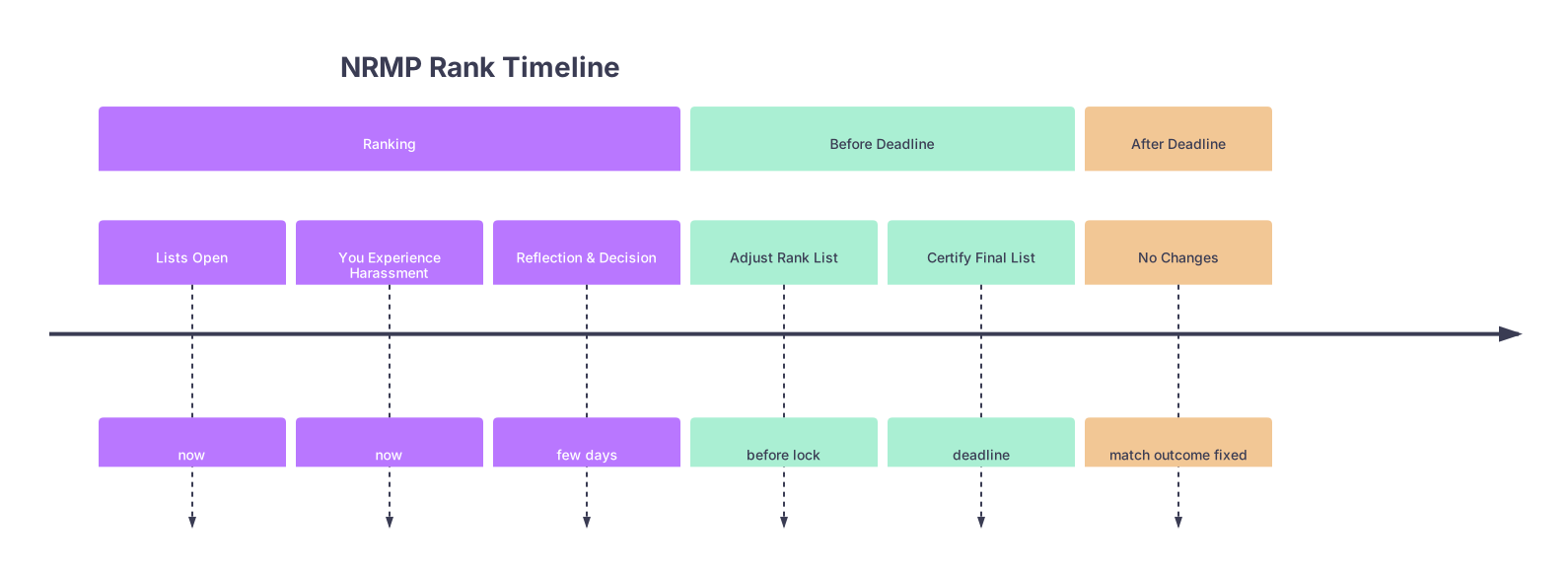
| Period | Event |
|---|---|
| Ranking - Lists Open | now |
| Ranking - You Experience Harassment | now |
| Ranking - Reflection & Decision | few days |
| Before Deadline - Adjust Rank List | before lock |
| Before Deadline - Certify Final List | deadline |
| After Deadline - No Changes | match outcome fixed |
If it’s before the NRMP deadline, you can:
- Log back in, change your list, and re-certify.
- Remove the program.
- Drop them to last.
If it’s after the deadline:
- You can’t change the rank list.
- You can still report the incident if you choose.
- If you end up matching there and feel strongly unsafe, you can talk with GME and your med school about options (transfer later, leave program, etc.)—none of which are easy, but you’re not completely trapped.
A quick word about “career suicide”
People throw this phrase around way too freely. Reporting harassment and/or refusing to rank a toxic program is not career suicide.
You know what actually wrecks careers?
- Burnout so severe you quit medicine.
- Depression and anxiety from prolonged abuse.
- Botched evaluations from vindictive seniors who know they can get away with it.
You’re not choosing between “perfect career” and “I complain and ruin everything.” You’re choosing between slightly higher short-term risk and potentially huge long-term damage.
Visual: Balancing Safety vs. Match Anxiety
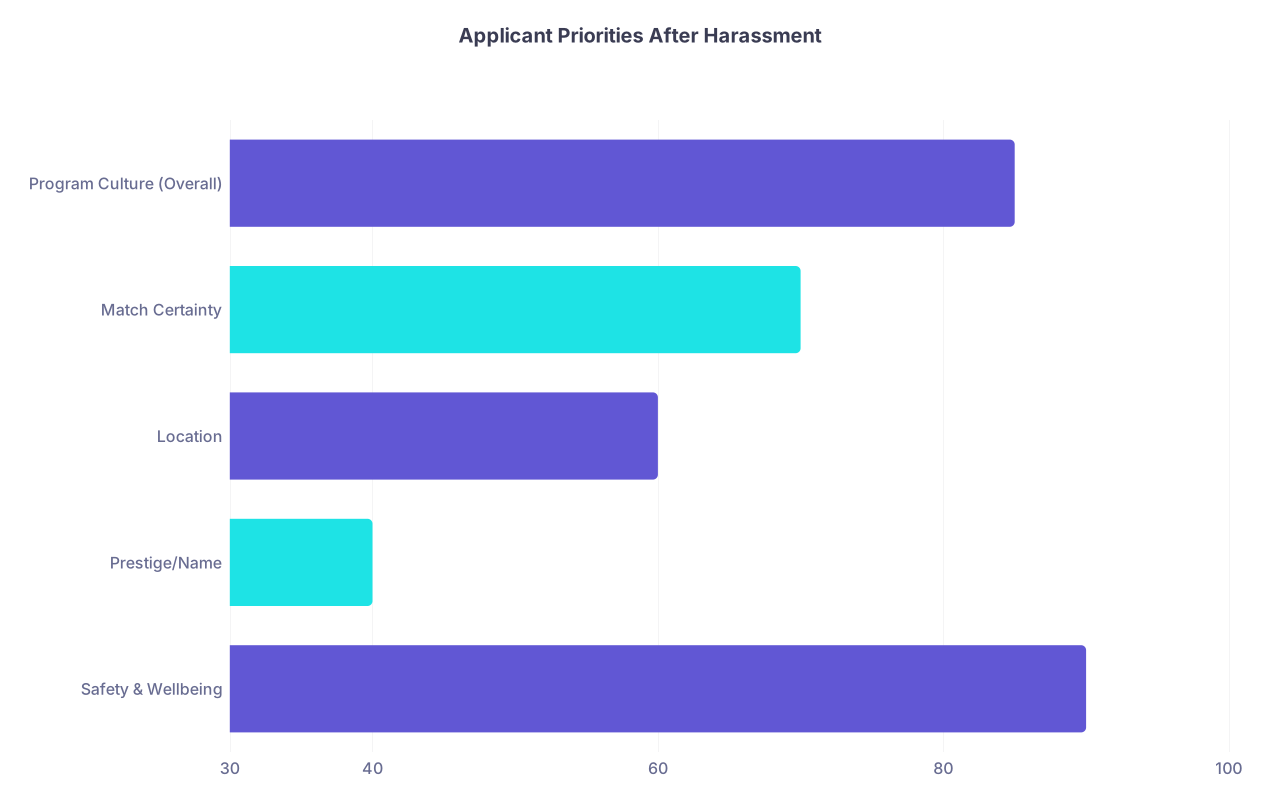
| Category | Value |
|---|---|
| Safety & Wellbeing | 90 |
| Prestige/Name | 40 |
| Location | 60 |
| Match Certainty | 70 |
| Program Culture (Overall) | 85 |
This isn’t scientific data—it’s what most residents wish they had prioritized more, looking back. Safety and culture end up mattering a lot more than they thought.
If you only remember three things
- Harassment on interview day is a massive red flag, not a small “oops.”
- You are allowed—morally and strategically—to completely remove that program from your list.
- Future you will not regret choosing safety and respect over prestige and fear.
FAQ (Exactly 5 Questions)
1. Should I ever rank a program where I was personally harassed?
My bias: usually no. If the harassment was anything more than a truly borderline comment, and especially if it involved physical contact or repeated behavior, I would not rank them. The only scenario where I’d even consider it is if leadership responded exceptionally well, clearly addressed it, and you have strong reason to believe this was a rare outlier. Even then, low on the list.
2. Will reporting the incident hurt my chances of matching at that program?
Possibly, yes. They might rank you lower if they know it’s you. But if they’re the kind of people who punish someone for reporting harassment, that’s confirmation you probably do not want to train there. You’re trading a maybe-hurt chance at one problematic program for a clearer view of their culture—and protecting yourself long term.
3. What if the program is in my dream city or near my support system?
Location matters, but it does not outweigh personal safety and basic respect. Being near family is great, but not if you come home every post-call day drained, humiliated, or scared. If you absolutely cannot let go of the location, then you need to be brutally honest with yourself about what you’re willing to tolerate—and have an exit strategy if it’s as bad as you fear.
4. Could this just be “one bad resident” and not reflect the program?
It could. But ask: why is “one bad resident” comfortable behaving like this on interview day, in public, without fear? That usually means at least some degree of cultural tolerance. If leadership takes it seriously, acts quickly, and residents you trust tell you this is not typical, you can consider that context. Still, it’s a legitimate reason to downgrade or remove the program.
5. I’m scared of not matching. Isn’t a bad program better than no program?
Not always. A truly toxic environment can damage your mental health, your confidence, your evaluations, and even your license risk if you’re pushed past safe limits. Some people do survive and move on, but many end up switching programs, changing specialties, or leaving clinical medicine entirely. A controlled reapplication or SOAP into a more humane place can absolutely be better than three to seven years in hell.
Open your draft rank list right now and circle every program where you felt disrespected, unsafe, or minimized—even a little. Then ask yourself, one by one: “If I match here, will I feel safe walking in on July 1?” If the answer is no, move them down—or off—the list today.


