

Programs are far more afraid of your rank list than you are of theirs. They just do a better job pretending they are not.
Let me pull back the curtain. Behind those polite interview smiles and “we look forward to seeing your rank list” emails, there’s a very real anxiety sitting in every program director’s gut: “Are we going to get embarrassed on Match Day?”
Because that’s what being ranked “too low” really means to programs. Public embarrassment. Loss of status. Questions from the chair. Nervous jokes from other PDs at national meetings.
And you can use that to your advantage—if you understand how they actually think.
The Quiet Terror Behind Every Rank Meeting
Here’s the part you rarely hear: programs worry about their position on your list much more than you realistically worry about your spot on theirs.
Not because they care about your feelings. Because of metrics and politics.
Every March, PDs and chairs dissect the Match results like a post-op complication review. They do not just ask “did we fill?” They ask questions like:
- “How many of our top 10 actually matched here?”
- “How far down our list did we go?”
- “How many of our own interviewed applicants ranked us #1?”
- “Why did that 270 + AOA applicant rank us 6th?”
And it’s not just idle curiosity. These numbers become ammunition for:
- Chair reports to the Dean: “Look how competitive we are.”
- Department bragging rights at national meetings.
- Negotiating for more funding or spots: “We’re a program people want.”
So when a program tells you, “We hope you’ll rank us highly,” what they are actually saying is:
“Please do not make us look bad in front of our chair and our peers.”
Let me make this more concrete.
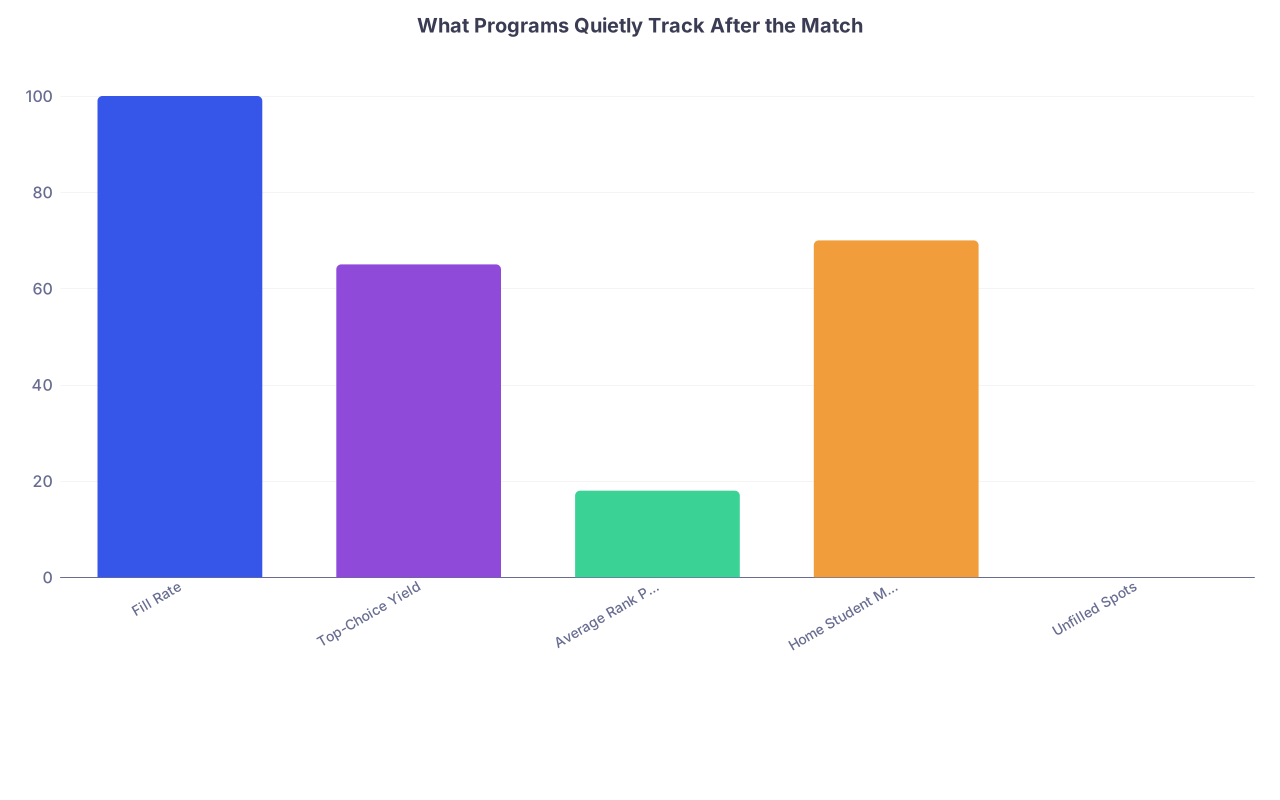
| Category | Value |
|---|---|
| Fill Rate | 100 |
| Top-Choice Yield | 65 |
| Average Rank Position | 18 |
| Home Student Match | 70 |
| Unfilled Spots | 0 |
Obviously the specific numbers vary, but those categories? Nearly every serious program tracks some version of them.
They will never show you this on interview day. But they care. A lot.
How the “Being Ranked Too Low” Fear Actually Works
You need to understand the psychology here, not just the math.
Programs do not see your rank list. They do not know where you put them. The algorithm protects you.
So why do they still obsess about being “ranked low”?
Because after the Match, they can infer it. And the inferences hurt.
Here’s what a PD thinks when a strong applicant they loved does not match there:
- “They must have ranked us low.”
- “We’re clearly not a top-tier destination for applicants like this.”
- “What did we do wrong on interview day? Did someone say something stupid?”
- “Are we not competitive enough with [rival program across town]?”
And when they fill—but mostly with people far down their list—they know exactly what happened:
“We were a backup. Again.”
I sat in a rank meeting once where, after the Match, the PD circled three names on the final matched list and said, “All three of those had us below number five. You can tell. Look at where else they interviewed and who we didn’t get.”
Was he guessing? Yes. Was he often right? Also yes.
This is why programs are so desperate for any signal that you might rank them high. Any praise. Any “this is my top choice region.” Any hint you “felt at home here.”
They are not just recruiting you. They are protecting their ego and their optics.
The Power You Don’t Realize You Have
You’ve probably been told: “You have no control. Just be honest. The algorithm is applicant-favoring.”
That’s only half-true. The algorithm is applicant-favoring in the match mechanics. But the pre-match dance? That’s human. Messy. Emotional. And you are underestimating how much leverage you have.
Let me be blunt:
Your perceived enthusiasm can move you up or down a program’s list.
Not at every program. Not in a perfectly systematic way. But enough to matter.
Why? Because when programs fear being ranked too low, they:
- Bump up people they think will actually come.
- Push down “superstars” they assume are unattainable.
- Overvalue signals of commitment (geographic ties, spouse’s job, couples match).
- Obsess over “yield protection” in a way you only hear discussed publicly for med school admissions.
Yes, residency programs also practice a version of yield protection. They will deny it. They do it anyway.
I’ve seen this play out in committee:
Applicant A: 265, AOA, great letters, no geographic tie, vague answers about ranking. Applicant B: 240s, strong but not flashy, clear “this is my top choice,” partner already in town.
Guess who sometimes ends up higher on the rank list? B. And not because of altruism. Because they’re lower risk from a “we don’t want to be ranked #7 on everyone’s list” standpoint.
Inside the Rank Meeting: What They Actually Say
Let’s simulate what happens in many programs the week before rank lists are due. This is the conversation you’re not in the room for.

| Step | Description |
|---|---|
| Step 1 | Interview Season Over |
| Step 2 | Initial Score-Based List |
| Step 3 | Committee Review |
| Step 4 | Consider Small Bump Up |
| Step 5 | Leave As Is |
| Step 6 | Consider Slight Drop |
| Step 7 | Finalize Rank List |
| Step 8 | Perceived Interest? |
Now translate that into real words I’ve actually heard:
- “She’s amazing, but let’s be honest, she’s probably going to [Brand-Name Program].”
- “He sent that follow-up email saying we’re his top choice. He’s a solid fit. Can we bump him a bit?”
- “This guy told three programs they were his number one. I don’t trust it. Leave him where he is.”
- “We’re losing too many people to [Local Competitor]. If they have strong ties to the city, mark that—we want them higher.”
Does every program explicitly factor “likelihood to rank us high” into their list? No. Some are rigidly score/metric-based.
Do more programs do it than will admit it publicly? Absolutely.
The key point: they are guessing. Guessing who will rank them high, who will rank them low, and who will realistically land there. And they guess based on the tiny behavioral scraps you give them.
Which, again, helps you—if you stop acting like a passive victim of the process.
How to Ethically Exploit This Fear (Without Lying)
You don’t need to play mind games or send a dozen “you’re my favorite” emails. That backfires more than it helps.
But you do need to be intentional about how you signal interest.
Here’s the core strategy:
- Decide your true top tier (programs you’d actually be thrilled to match at).
- For that top tier, let them feel like they’re in your top tier.
- Be precise, honest, and restrained with “#1” language.
And here’s how to do it in ways programs actually pay attention to:
1. During the Interview
Most PDs, chiefs, or faculty will at some point ask some version of:
“So where else are you looking?” or “How are you thinking about ranking?”
Nobody wants to commit. Fair. But you can be honest and strategic.
Instead of vague nonsense like, “I’m still keeping an open mind,” say:
- “I’m focusing my list on programs in [region] because of family and my partner’s job. You’re genuinely one of the few here that checks both training and location for me.”
Or:
- “I’m looking for strong [X specialty niche] with high operative volume and supportive culture. Of the places I’ve seen, you’re absolutely in that top group.”
You did not say “You’re my #1.” But they heard: “I won’t rank you #10.”
2. Post-Interview Communication
Programs vary. Some officially say “no post-interview communication needed.” Many still track it quietly.
There are three tiers of post-interview signals:
- “Thank you, great day” – nice, but everybody sends these.
- “Specific reasons you’re a strong fit and what you liked” – this is where you separate yourself.
- “You are my #1 choice” – you get one of these. Maybe two if you like playing with fire. But you better mean it.
An email that actually makes them think you’ll rank them high looks like:
“After finishing all my interviews, your program stands out as the one that best matches what I’m looking for in [X: operative volume, research focus, resident camaraderie, geographic location]. I can clearly see myself training here and would be genuinely excited to join your team.”
That’s the kind of line PDs remember in the rank meeting.
But do not spray this at every program. They talk. Faculty move. Chiefs show each other emails. Your word matters.
3. Use Geography and Personal Constraints
Programs love when your life circumstances lock you to them. Because it reduces their fear that you’ll rank them low.
If something tethers you—spouse, kids, visa limits, family caregiving—state it clearly.
On interview day and in follow-up:
- “My partner is already matched in [city]. We’ll be here for the next 3–4 years.”
- “My parents live 20 minutes from here and rely on me for support.”
- “This is the only city where both my and my partner’s fields have strong options.”
That doesn’t just make you “look committed.” It lowers their anxiety that you’ll drop them to #7 behind the shiny coastal name brands.
The “Superstar Penalty” and How to Avoid It
Here’s a dirty little secret: if you’re a very strong applicant, some programs quietly assume they’re your backup plan.
You saw it in med school admissions: 525 MCAT + 3.9 GPA applies to a low-prestige state school? Committee whispers: “We’re their safety. They won’t come.”
Residency does this too—just more subtly.
Who gets hit by this “superstar penalty”:
- High Step scores + AOA + heavy research.
- Interviewing at a ton of top-10 name brands.
- Weak ties to the local program or city.
- Mild or generic expressions of interest.
For these applicants, some programs worry:
“If we rank them at 5 and they rank us at 12, we’ve wasted a high slot on someone who doesn’t want us.”
So they drop you. Not far. But enough that a couple of others with more perceived interest leapfrog you.
How do you counter that?
Be specific about what makes their program not just “good,” but uniquely appealing to you.
Not “you’re strong in research.” Say, “Your [specific PI]’s work in [specific topic] is exactly what I’ve been doing; I can see that continuity.”Drop at least one concrete, real-sounding reason you’d actually choose them over a flashier name.
Example: “At larger programs, I worry I’d get lost as a resident. Here, I felt like faculty know their residents individually, which really matters to me.”If they’re in your genuine top 3? Tell them they are in your top 3. That phrase carries more weight than you think. It says: “I am realistically likely to match here if you rank me high.” That reassures them.
Where Students Screw This Up
Most applicants fall into one of two dumb extremes:
The Ghost
Says nothing, sends generic thank yous, avoids any talk of ranking, assumes “the algorithm will take care of me.”Result: Programs assume you’re lukewarm. Or worse, that everyone else will want you more. You get nudged down.
The Politician
Tells three programs they are “my top choice.” Sends over-the-top love letters. “I can’t imagine training anywhere else” to four different places.Result: They can imagine you training elsewhere—because they’re reading your same copy-paste email in a different chair’s inbox.
Programs are not naïve. PDs compare notes at conferences. Residents share gossip with co-residents at other institutions. I’ve literally watched someone pull up an email on their phone and say, “Didn’t he tell you the same thing?”
You don’t need to be perfectly pure. But you do need basic integrity. Choose:
- 1 program for “You are my true #1.”
- A small handful (3–5) for “You’re in my top group/top tier.”
- Honest, thoughtful appreciation for everyone else.
That’s enough. More looks desperate or dishonest.
Understanding the Real Risk–Reward Calculus for Programs
Programs are balancing two conflicting fears:
- Fear 1: “If we rank this person too low, we might lose them.”
- Fear 2: “If we rank this person too high and they rank us low, we waste a valuable slot on our list.”
You can’t remove Fear 2. That’s built into the game.
But you can soften Fear 1 for programs that matter to you.
Here’s how their mental math sounds in meeting:
- “She said we’re her top choice and she has a partner here. Low risk to rank her high.”
- “He was strong but very vague. Might go to [another program]. Leave him mid-list.”
- “This applicant clearly wants big-name coastal places. We’re Midwest. Don’t push them up too high.”
Every time you provide a credible reason that you’d realistically choose them over other options, you tilt that balance. Their fear of being ranked too low by you drops. Their willingness to rank you higher rises.
It’s not magic. It won’t overcome massive differences in how they rated you. But when they’re deciding between you and someone similar on paper? It matters.
A Quick Reality Check: What This Does Not Mean
Let me kill a few myths before they grow legs:
- Programs do not reorder their entire rank list because of one nice email. They fine-tune. Nudge. Single-digit moves.
- You cannot “game the algorithm” by precisely guessing where you are on their list. You can’t see it. Stop trying.
- You should not rank programs based on where you think they’ll rank you. That’s how people wake up in cities they hate.
Your job remains the same:
Rank programs in your true order of preference. Full stop.
Your tactical job is different:
Make sure the programs you truly love are less afraid that you’ll embarrass them by ranking them too low.
That is the leverage you actually have.
A Simple Practical Playbook
If you want this in plain language, here’s the no-BS version of what to do:
- Keep your rank list honest, in your genuine preference order.
- Identify your top 3–5 programs—the ones you’d be legitimately thrilled to attend.
- For those programs:
- Be specific on interview day about why they fit you.
- Show you’ve done your homework: mention concrete features, faculty, opportunities.
- Send a thoughtful follow-up email.
- For your actual #1 program:
- After you’re sure, send a clear, concise, honest message that they are your first choice and you will rank them #1.
- For others:
- Send a brief, sincere thank you if you want. Do not engage in emotional theater or make promises you cannot keep.
This doesn’t guarantee the match result you want. Nothing does.
But it shifts the odds in your favor at the places that genuinely matter to you—by calming the very real, very human fear sitting in every PD’s mind.

FAQ: Behind-the-Scenes Answers Programs Won’t Give You
1. Can telling a program they’re my #1 ever hurt me?
Yes, if you lie. If you tell multiple programs they’re your #1 and they find out, your credibility tanks. Faculty move; residents talk. Programs hate feeling manipulated. But telling one program they’re truly your top choice, and meaning it, will not hurt you. The worst case is they still rank you where they would have anyway. The best case is a small bump in your favor when it’s close.
2. Do programs actually move applicants up or down based on post-interview emails?
Some do. Some explicitly don’t. The problem is you don’t know which is which. In practice, what I’ve seen: strong, specific, credible expressions of interest can be a tie-breaker when two applicants are similarly ranked. Nobody is taking a weak candidate and vaulting them to the top because of a nice email. But for close calls? It matters more than programs publicly admit.
3. Will programs know where I ranked them before they submit their list?
No. Never. The NRMP algorithm doesn’t reveal your rank list to them at any point. They have only what you say and how you behave. All their assumptions about being ranked “too low” are based on post-Match inference and their own insecurity, not access to your list.
4. Should I rank programs based on where I think I’m highest on their list?
No. That’s how people end up miserable. Your rank list should reflect one thing: where you most want to train, in order. The match algorithm is built to protect that. Your only strategic role is influencing how programs perceive you before they set their list, not trying to reverse-engineer their internal ranking afterward.
5. How do I show strong interest without sounding fake or desperate?
Be specific, be concrete, and be restrained. Instead of vague praise (“Great program, loved the vibes”), say: “Your [X rotation, Y conference, Z resident mentorship structure] fits how I learn.” Mention one or two genuine reasons you’d choose them. Do not write novels. Do not over-flatter. And reserve “you’re my #1” for the one place where it’s actually true.
With this perspective, you’re no longer just another nervous applicant staring at a blank rank list. You know what’s happening in those committee rooms, what programs fear, and how your signals shape their decisions.
You’ve played your part in the pre-Match game.
With that foundation in place, you’re ready for the real test: trusting your list, pressing submit, and facing whatever the algorithm hands you. The next chapter—how to respond when the Match result is perfect, disappointing, or downright shocking—that’s a story for another day.


