

You are 57, post-call but wired, sitting at your kitchen table with your third cup of coffee. Your practice is busy, the kids are almost done with college, and your E*TRADE or Fidelity account shows a number you never thought you’d see when you were drowning in $300k of med school loans.
But your portfolio is a mess. Random mutual funds from different advisors. Old 403(b)s from residency and your first job. A brokerage account your spouse started with a friend’s advisor. You know “I should be reducing risk as I get closer to retirement.” You have no idea what that actually means in a concrete, stepwise way.
That is what a glide path is for. Not a buzzword. A specific, math-based way to turn “I think I should be more conservative now” into precise asset allocation changes year by year.
Let me break this down specifically for physicians.
1. What a Glide Path Actually Is (For a Physician, Not a Textbook)
Forget the jargon for a second.
A glide path is just a pre-planned schedule that dictates how your portfolio’s risk level changes over time as you get closer to (and move through) retirement.
Two key parts:
- A “starting point” allocation when you are far from retirement (for physicians, this might still be aggressive at age 40–50 because your peak earning window starts late).
- An “ending point” allocation when you are in retirement (what your stocks vs bonds / risky vs safe mix looks like once you are living off the portfolio).
Everything in between is the slope of the glide path.
For example:
At 50: 80% stocks / 20% bonds
At 65: 50% stocks / 50% bonds
At 75: 40% stocks / 60% bonds
That is a glide path. Crude, but functional.
Physician twist: your income profile is different from the average investor. You earn late, peak late, and compress your serious accumulation years into your 40s and 50s. So the standard “target date fund” glide paths are not automatically a good fit.
2. The Three Risks You Are Actually Managing
You are not “reducing risk” in a vacuum. You are trading one type of risk for others. Get this wrong and you solve the wrong problem.
There are three big dogs in this fight:
- Market risk
- Sequence-of-returns risk
- Longevity + inflation risk
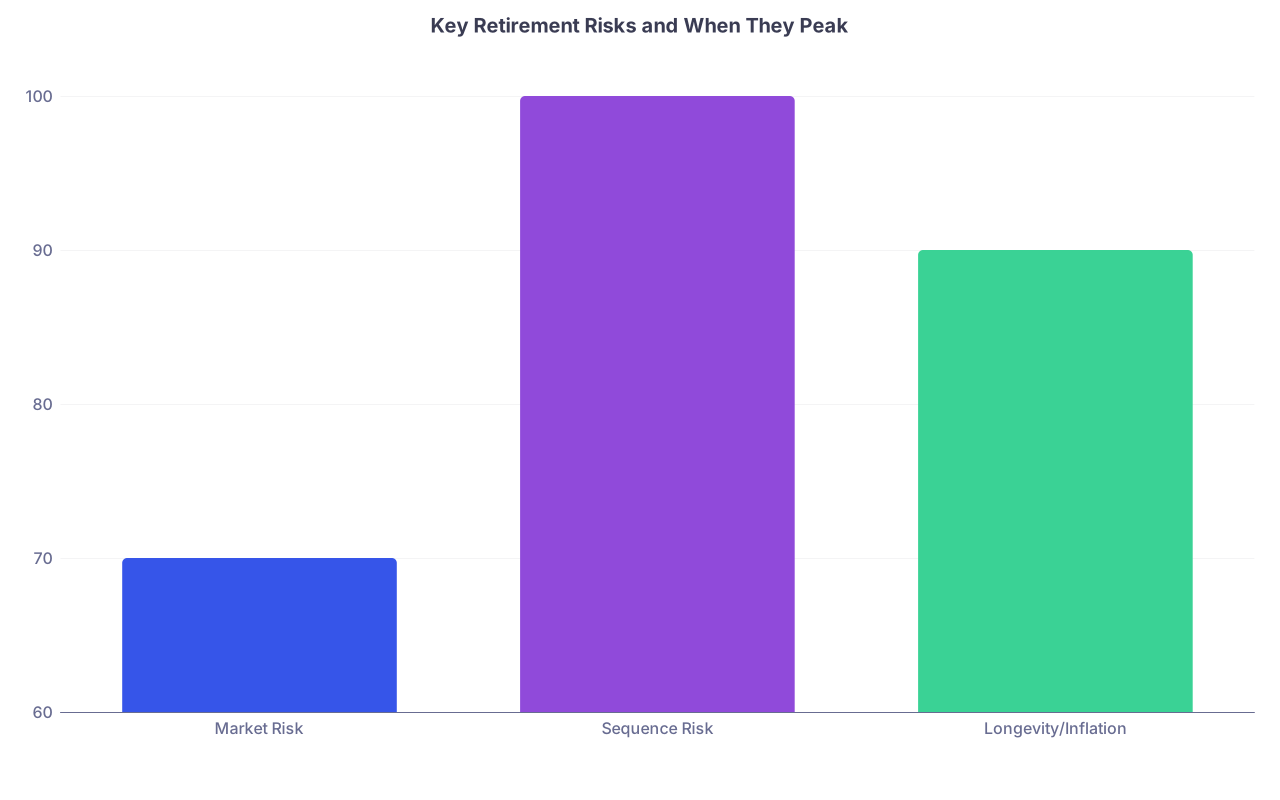
| Category | Value |
|---|---|
| Market Risk | 70 |
| Sequence Risk | 100 |
| Longevity/Inflation | 90 |
That is the relative intensity, not a statistic. Let’s translate it into plain language.
Market risk
Obvious one. Markets can drop 20–50% in a year. If you are 38 with good future earnings, that is “annoying.” If you are 64 and planning to retire in 12 months, that can wreck your timeline if your portfolio is too equity-heavy.
Sequence-of-returns risk
This is the quiet killer that most high-income professionals do not understand until they see a backtest.
It is not your average return that kills you. It is when the bad years happen.
Two retirees both get 6% average annual returns. One has the bad years at age 65–70, while they are just starting withdrawals. The other has bad years at 80–85, when they have already compounded for 15 years and withdrawn some money. Same average, VERY different outcomes.
Your glide path is fundamentally about controlling sequence-of-returns risk around your retirement date and the first 5–10 years after.
Longevity and inflation risk
You probably underestimate how long you will live. Physician cohort, non-smoker, decent income, access to health care. Plenty of you will see 90+. Some will see mid-90s.
If you retire at 60–65, that is 25–35 years of portfolio life. You cannot put 80–90% in bonds and expect to keep up with inflation for three decades without very high initial capital or very low spending. Too conservative = you run out of money or have to cut lifestyle more than you want.
So your glide path is a balancing act:
- Reduce sequence risk near retirement
- Keep enough growth to survive 20–30+ years
- Avoid panic-level drawdowns that cause behavioral disasters (selling at the bottom, never recovering)
3. How Much Can You Actually Lose? Run the “Punch in the Face” Test
Before designing the glide path, you need a simple stress test.
I like to ask physicians two questions:
If your portfolio dropped 30% next year, would that cause you to:
- Delay retirement?
- Work more call?
- Lose sleep?
If your portfolio dropped 15% next year, same questions.
If a 30% hit absolutely derails your plans within 3–5 years of retirement, your equity allocation is too high. Period.
You do not need a PhD in finance to get an approximate sense. Use the rough rule:
Drawdown ≈ Equity % × Severity of Bear Market
Example:
Portfolio: 60% stocks, 40% bonds
Bear market: –50% in stocks, bonds flat
Approximate hit: 0.60 × 50% = 30% portfolio drop
Same bear, but you have 40% stocks, 60% bonds:
0.40 × 50% = 20% drop
That is the real-world pain you are calibrating against.
4. A Physician-Specific Framework: Time Buckets, Not Just Percentages
The standard advice is “shift from 70/30 to 60/40 to 50/50 as you age.” That is too vague.
For physicians, I prefer to think in buckets of years of spending needs. Because your biggest risk window is the first 10–15 years of retirement.
Here is a concrete way to design it.
Step 1: Define your annual spend from the portfolio
Example:
- You need $260k a year to live your life (after tax)
- You will have $80k from Social Security + small defined benefit + rental
- So you need $180k/year from your portfolio
That $180k is your spend. That is the number we care about.
Step 2: Set safety buckets in years of spending
Use this as a starting framework (you can tweak later):
- Cash + very short-term bonds: 1–2 years of spending
- Intermediate bonds / low-volatility fixed income: 3–8 years of spending
- Equities / growth: remainder
If you are 1–5 years from retirement, I want your first 5–10 years of spending not dependent on stock market performance. That is how you neutralize sequence-of-returns risk.
Let me translate that into numbers.
You are 63, planning to retire at 65. Your portfolio is $4M. You need $180k/year from the portfolio.
You want 10 years of relatively safe money by the time you walk out of the hospital at 65:
10 years × $180k = $1.8M in “safe-ish” assets
The remaining $2.2M can be in growth (equities, maybe some real estate, etc).
Safe-ish does not mean 100% cash. It means a ladder of safety.
For example at age 65:
- 2 years ($360k) in cash / money market / very short-term bond funds
- 3 years ($540k) in high-quality short/intermediate-term bonds
- 5 years ($900k) in a mix of higher-quality bonds, maybe some conservative income funds
Total “ballast”: $1.8M
The rest $2.2M (~55%) can be in a global equity portfolio.
That effectively gives you a ~45/55 or 50/50 style allocation, but in a way that is anchored to spending years, not just abstract percentages.
5. Practical Glide Path Milestones: Ages 50–75
Let’s build something usable. This is not tailored advice, but it is a strong baseline for a typical physician with solid savings.
I will assume:
- You are on track to have 20–30x your annual required spending by retirement.
- You are not starting from zero at 55.
Age 50–55: Peak accumulation, still growth-heavy
You are probably in your highest earning years or close.
Typical target:
- 70–80% equities
- 20–30% bonds / cash
I tend to cap most physicians at ~80% stocks by this point. You are no longer “young” in investing terms if you are only 10–15 years from realistic retirement.
Key moves here:
- Consolidate accounts (old 403(b)s, 401(k)s into a few platforms).
- Standardize asset allocation across accounts, not one-off in each.
- Start mentally committing to a glide path so you are not improvising later.
Age 55–60: Start the slope down, especially if early retirement is possible
You are inside the sequence-risk window if you want to retire around 60–65. Time to get intentional.
Common targets by 60:
- 60–70% equities
- 30–40% bonds / cash
Progression example:
- 55: 75/25
- 58: 70/30
- 60: 65/35
The exact slope does not matter as much as the discipline. You are transitioning from “maximum growth” to “don’t blow up my retirement date.”
This is also when many physicians finally get serious about tax location: which assets belong in pre-tax vs Roth vs taxable to support flexibility later.
Age 60–65: Build your 5–10 year “ballast”
This is the critical zone.
By the year you retire (say 65), I like to see:
- 45–60% equities
- 40–55% bonds / cash / very safe fixed income
Where you land in that band depends on:
- How secure your non-portfolio income is (pensions, rentals, part-time work).
- How flexible your spending is.
- Your psychological risk tolerance (this is not imaginary; watching $800k vanish in a bear market hurts, even if the math says you will be fine).
You also want to have structured:
- 1–2 years of cash-like reserves
- 3–8 years of laddered bonds
Not just “I own a bond fund.” Specific buckets with specific purposes.
Age 65–75: Glide in retirement, not off a cliff
The common mistake: dropping risk too aggressively at retirement and then freezing the allocation for 25 years. That is how you get eaten alive by inflation 15 years in.
Instead, think of two phases:
- The first 10 years of retirement: protect against sequence risk
- The latter 15–20 years: protect against longevity and inflation risk
That means:
- At 65: 50–60% equities might be entirely reasonable for a physician with good health, especially if they are not withdrawing 4–5%+ annually.
- At 75: you might still be 40–50% in equities, not 20%.
A reasonable example path:
- 65: 55/45
- 70: 50/50
- 75: 40–45% stocks, 55–60% fixed income
You keep enough growth to support decades, while still reducing volatility somewhat with age.
6. Physician-Specific Landmines When Designing a Glide Path
I see the same patterns over and over in physician portfolios. Some of them are… not great.
Landmine 1: Practice sale or big liquidity event not integrated
You sell your practice at 62, get $1.5M after taxes, and just dump it into a brokerage account on top of your existing allocation. No rebalance. No glide path adjustment.
Reality: that $1.5M is part of your ballast build. It should usually shift your overall risk down. Many physicians just turn a windfall into more equity risk because they want to “let it grow,” then get crushed when the market corrects.
Landmine 2: Overreliance on illiquid alternatives as “safe”
Private real estate funds, private credit, weird limited partnerships pitched by dentist-neighbor or a “high net worth” advisor.
A lot of these are sold as “low volatility” because they do not mark to market daily. That does not mean low risk. Illiquid, opaque vehicles are a terrible match for the near-retirement ballast bucket.
Put them (if at all) in the growth side of your glide path, not the safety side.
Landmine 3: Bond risk misunderstood
When rates rise, bond prices fall. A 20+ year duration bond fund is not “safe ballast” if your horizon for that money is 3–5 years.
For the ballast part of a physician’s glide path, I prefer:
- Short to intermediate-term, high-quality bond funds
- Some TIPS (inflation-protected) if they are reasonably priced
- CD ladders, Treasuries, or money-market funds for the 0–5 year bucket
What I do not like as near-retirement ballast:
- Long-duration bond funds
- Junk-bond heavy “income” funds
- Exotic yield-chasing products
7. How to Implement a Glide Path Across Multiple Accounts
You probably have:
- 401(k) / 403(b)
- Traditional IRA / rollover IRA
- Roth IRA
- Taxable brokerage
- Maybe a non-qualified annuity or defined benefit on top
The mistake is trying to make each account 60/40 or 50/50 by itself. That is not necessary and is often suboptimal for taxes.
You care about your total household allocation.
Here is the clean approach:
Decide your global target. Example at age 63:
- 60% stocks / 40% bonds-cash
Decide which accounts are best for each asset type:
- Bonds and REITs: primarily in pre-tax accounts (401(k), traditional IRA)
- Equities (especially tax-efficient index funds): in taxable and Roth
- Highest growth potential (small-cap, emerging, etc): prefer Roth if you use these at all
Use a spreadsheet or software to view aggregate allocation. You rebalance at the household level, not piecemeal.
So your 401(k) might be 30/70 (stock/bond), your Roth might be 100% equity, your taxable 80/20. Net effect: 60/40 overall. That is fine. In fact, it is better.
8. The Legal and Behavioral Side: IPS, Spouse, and “Future You”
We are under “Financial and Legal Aspects,” so let us not ignore the document side.
Investment Policy Statement (IPS)
Write it down. One or two pages is enough. This is your glide path in legalese-lite.
It should include:
- Target equity range by age band
- Rebalancing rules (e.g., rebalance if >5 percentage points off target or every 12 months)
- Which accounts hold which asset types
- What happens when you receive a windfall (inheritance, practice sale)
- Rules for withdrawals in retirement (prefer taking from which buckets, etc.)
This is not a court document. It is a guardrail document so that 63-year-old you does not panic and abandon the plan after a 20% correction.
Spouse / partner alignment
I have seen couples where one is fine with 60% stocks at 68 and the other still has trauma from 2008 and wants everything in CDs.
You need a joint understanding of:
- What drawdowns you are willing to accept
- What you will do in advance in a bad market (cut discretionary spending? pause big purchases? hold course?)
Put that in writing. It is part behavioral, part practical.
Powers of attorney and decision continuity
If you become incapacitated at 72, who manages the glide path?
If your spouse or adult child steps in, and they see 55% in stocks and freak out because “this is too risky for mom at 72,” they may blow up a plan that was well constructed.
Your POA and your executor should:
- Know where the IPS is
- Understand high-level reasoning behind your allocation
- Have access to a financial planner or advisor who understands the design
That is the legal-meets-behavioral bridge.
9. Concrete Example: Designing a Glide Path for a 52-Year-Old Cardiologist
Let me walk through an example so you can see numbers rather than abstractions.
Profile:
- Age: 52
- Plans to retire from full-time at 62, maybe do some locums 62–65
- Current portfolio: $2.6M (70% stocks, 30% bonds/cash)
- Target retirement spending: $240k/year after tax
- Expected non-portfolio income at 62+: $70k (small pension + rental)
So portfolio needs to cover: $170k/year initially.
Goal: At 62, have at least 10 years of “safe-ish” portfolio support = $1.7M in ballast.
Projected portfolio at 62 (assuming continued contributions and moderate returns): let us say $4.0–4.5M range. I will use $4.2M.
Design the glide path:
Age 52 (today): 70/30 (current) – acceptable
Age 55: shift to 68/32
Age 58: 65/35
Age 60: 60/40
Age 62 (retire): 55/45 with explicit buckets
At 62, approximate structure:
- Cash / ultra-short: 2 years × $170k = $340k
- Short/intermediate bonds: 3–4 years × $170k = ~$600k
- Additional safety ballast (high quality bonds, maybe some stable-value, TIPS): ~$800k
- Total ballast ≈ $1.7–1.8M
- Remaining ~$2.4–2.5M in diversified equity funds
That gives a 55–60% equity posture at retirement with 10 years of withdrawals not forced to come from equities during a bear market. That is a robust glide path for a retiring physician at 62.
Then from 62–72, gradually shade from 55–60% equities down to 45–50%, largely by letting withdrawals fall proportionally more from equities during strong markets and more from ballast during weak ones.
10. When to Be More Aggressive vs More Conservative Than the “Typical” Glide Path
Not every physician fits the standard mold. Here is where I tilt one way or the other.
More aggressive glide path (higher equity later) if:
- You have very strong non-portfolio income in retirement (large defined benefit, multiple rentals).
- Your withdrawal rate is low (2–3% of portfolio per year).
- You plan to work in some capacity to age 70+.
- You are leaving substantial legacy / charitable bequests and are fine with volatility.
More conservative glide path (lower equity earlier) if:
- You are under-saved relative to your lifestyle and are tempted to “swing for the fences.”
- You have high fixed expenses you cannot or will not reduce.
- You are planning to retire early (before 60) and sequence risk is enormous.
- You know you will panic-sell in a crash and never come back. (Your behavior is part of the design constraint. Not an insult, just reality.)
11. Building the Mechanism: How to Actually Move Along the Glide Path
Conceptually, this is simple: once a year, rebalance toward your target.
Mechanically:
- Once a year (or after big market moves), calculate current allocation vs target.
- If more than 5 percentage points off in either direction, rebalance.
- Use new contributions and dividends to minimize selling.
- Inside pre-tax accounts, you can shift freely without tax impact.
- In taxable, be more surgical: harvest losses when possible, and trim winners with the least tax damage.
You do not need to adjust monthly. That is noise. Annual is usually fine; semiannual if the market is wild.
You also do not let your equity percentage balloon unbounded after a big bull market. That is how 62-year-old you ends up accidentally at 80% stocks because “it kept doing well.”
Your glide path is the discipline: you systematically trim risk as you approach and move through retirement, even when your emotional brain says “leave it, it is working.”
FAQ (Exactly 5)
1. Should physicians just use target date funds instead of building a custom glide path?
Target date funds are better than random investing, but they are generic. Most are built for someone starting work at 25, retiring at 65, and earning a median salary. Physicians have later peak earnings, bigger taxable accounts, and often more complex tax and asset situations. I prefer using target date funds as a reference, not a default. A custom glide path built around your spending needs and retirement age usually fits better.
2. How does Social Security timing affect my glide path?
Delaying Social Security (to age 70) increases your guaranteed income floor later, which reduces longevity and inflation risk. That can justify holding a bit more equity in your 60s and 70s because a larger portion of your baseline spending is covered by an inflation-adjusted, government-backed stream. If you claim early, your portfolio must carry more of the long-term load, which may push you toward a slightly more conservative withdrawal rate and more focus on robust ballast.
3. Is the “100 minus age” rule for stock allocation useful for physicians?
Not really. That rule assumes a typical retirement age and risk tolerance, and it was created in a completely different interest-rate environment. A 65-year-old physician with a $6M portfolio and low spending can safely hold more than 35% in equities. A 65-year-old with marginal savings who is overspending may need a different approach entirely. Use time-horizon and spending-based frameworks, not simplistic formulas.
4. How do I adjust my glide path if I plan a phased retirement (cutting to 0.5 FTE)?
Phased retirement stretches the “risk window.” If you reduce to 0.5 FTE at 60 and fully stop at 68, your sequence risk is lower because you are not drawing heavily from the portfolio early. In that case, you often can hold a bit more equity in your early 60s and do a slower glide down, because earnings act as a buffer. The key is to re-run your spending and savings assumptions: how much will you actually withdraw from the portfolio at each phase?
5. How often should I revisit or change my glide path?
Formally: review it annually. Practically: only change it when your real life changes—retirement date shifts, practice sale, major inheritance, health shock, divorce, etc. If your plan and circumstances are stable, you should not be rewriting your glide path every time the market moves. The point of writing it down is to avoid redesigning your risk strategy in the middle of fear or euphoria.
Key points:
- A glide path for a physician should be built around years of spending and sequence-of-returns risk, not just age-based rules of thumb.
- By retirement, you want 5–10 years of “ballast” (cash and high-quality bonds), while still maintaining enough equity exposure to fund a 20–30+ year horizon.
- Documenting the plan, coordinating across all accounts, and enforcing it with periodic rebalancing is what turns a glide path from a nice idea into real retirement resilience.


