

The default retirement advice for American doctors breaks for international medical graduates.
If you’re an IMG who trained or worked abroad and now practices in the US, you’re playing a two-board chess game with retirement: US rules on one board, your home-country’s messy mix of pensions, taxes, and currency risk on the other. If you try to “wing it,” you’ll overpay taxes, lose benefits, or trap money where you cannot easily access it.
Let’s walk through what to actually do, step by step, if you’re an IMG trying to coordinate US and home-country retirement.
Step 1: Get Absolutely Clear on Your Scenario
Before anyone can give you useful advice (including me), you need to pin down a few facts. Vague answers like “I have a pension back home” are how mistakes happen.
You need to write down:
Where you have ties
- Country of citizenship
- Current country of tax residence (probably US if you’re here on a work visa or green card)
- Any other country where you’ve worked long enough to earn pension rights
Your likely future
- Do you expect to retire in the US, back home, or split time?
- Do you realistically see yourself giving up US tax residency before retirement age?
- Are you planning for your kids to settle in the US?
Your existing retirement “buckets”
- US: 401(k), 403(b), 457(b), traditional IRA, Roth IRA, HSA, taxable brokerage
- Home country: government pension, mandatory contribution scheme, employer pension, personal retirement plans, property intending as “retirement”
If you don’t know this yet, that’s your first task this month: list every account, country, and rough balance, even if you’re unsure of details.

| Step | Description |
|---|---|
| Step 1 | IMG Physician |
| Step 2 | US Retirement Accounts |
| Step 3 | Home Country Pension |
| Step 4 | Future Residence Decision |
| Step 5 | US Tax Rules |
| Step 6 | Home Country Tax Rules |
| Step 7 | Coordination Strategy |
Here’s the brutal truth: most US financial advisors don’t fully understand foreign pensions. Most advisors in your home country don’t fully understand US tax. So you need to be the project manager here, even if you hire pros.
Step 2: Understand How the US Will Treat Your Home-Country Pension
This is where IMGs get burned.
From the US tax perspective, foreign retirement accounts fall into a few buckets. The details shift by treaty and country, but the framework is the same.
A. Check if there’s a US tax treaty with your country
Go to the IRS treaty list and find your country. If there’s a treaty, read the section on “pensions” and “social security.” Yes, it’s dry. Read it anyway.
Common patterns:
- Some treaties:
- Let you defer US tax on contributions and growth in certain foreign pensions
- Agree that only the country of residence (or source country) taxes the pension
- Others:
- Ignore your home pension for deferral purposes and treat it like a regular foreign investment account
If there is NO treaty, assume the US may tax:
- Annual growth inside the account
- Employer contributions
- Possibly force information reporting (FBAR, Form 8938, maybe PFIC forms if there are foreign mutual funds)
If you’ve never told your US tax preparer you have a foreign pension, fix that immediately. Silence here is dangerous, not harmless.

Step 3: Decide Your “Anchor Retirement Country” Now, Not at 65
You don’t have to be 100% sure where you’ll die. You do need a working assumption about where you’ll spend most of your retirement years.
Because that answer changes what “optimal” looks like.
Think in three models:
US-anchored retirement
- You’ll live primarily in the US, keep US tax residency in retirement
- Trips back home, maybe a few months a year there, but US is home base
Home-country-anchored retirement
- You’ll fully move back before or at retirement
- You’ll likely give up US tax residency (card surrender or no substantial presence)
Split-country retirement
- Substantial time in both places, with more complicated tax residency questions
- Common for people with aging parents abroad and kids in the US
Your default, if you’re unsure: assume US-anchored. That’s what usually happens: kids stay here, job prospects here, health care here.
This assumption drives how you prioritize contributions and where you take risk.
Step 4: US Contributions vs. Home Country Contributions – Who Gets Priority?
If you’re working in the US now, here’s the blunt prioritization for most IMGs (yes, there are exceptions):
If your employer in the US offers a match (401(k)/403(b)):
- Always contribute enough to get the full match. Turning down a match is free money set on fire.
Consider maxing US tax-advantaged accounts first if:
- You plan to retire in the US OR
- Your home-country retirement system is unstable or inflation-prone
Typical US order for an IMG who expects to stay:
- Full employer match in 401(k)/403(b)
- HSA contributions (if eligible; triple tax advantage)
- Max 401(k)/403(b) if you can afford it
- Roth IRA or backdoor Roth IRA (if not blocked by foreign account issues or PFIC problems)
- Then taxable brokerage
Home-country contributions:
- If you’re legally required to contribute – you contribute. No choice.
- If contributions are optional: only prioritize them if:
- You are highly likely to retire back home, AND
- The system is reasonably stable, AND
- There’s a clear tax or employer benefit for participation
| Priority | If Staying in US | If Likely Returning Home |
|---|---|---|
| 1 | US employer match | US employer match |
| 2 | US HSA | Confirm home-country mandatory pension compliance |
| 3 | Max US 401(k)/403(b) | Split: US 401(k)/403(b) and home voluntary plans |
| 4 | Roth IRA / backdoor Roth | Home-country tax-advantaged accounts |
| 5 | Home-country voluntary plans | US Roth / brokerage selectively |
This is not perfect for everyone. But it’s a clean baseline.
Step 5: Deal with Currency and Inflation Risk Like an Adult
A lot of IMGs tell me, “I’ll just keep some money in the US, some at home, and it’ll balance out.” That’s not a strategy. That’s hand-waving.
You need to be explicit:
- What currency do you expect to spend most in retirement? Dollars, your home currency, or both?
- What’s the historic inflation and currency stability of your home country vs. the US?
- Are you comfortable holding a big chunk of your future purchasing power in a potentially unstable currency?
If you expect to retire in the US:
- It’s usually better to have the majority of your investable retirement wealth in US-dollar-denominated assets.
- Home-country pension benefits become a “bonus” or diversification piece, not the main pillar.
If you expect to retire back home:
- You may still want significant US-dollar exposure as a hedge against local inflation or political risk.
- But you can consciously tilt more savings toward assets that map to your home-country currency.
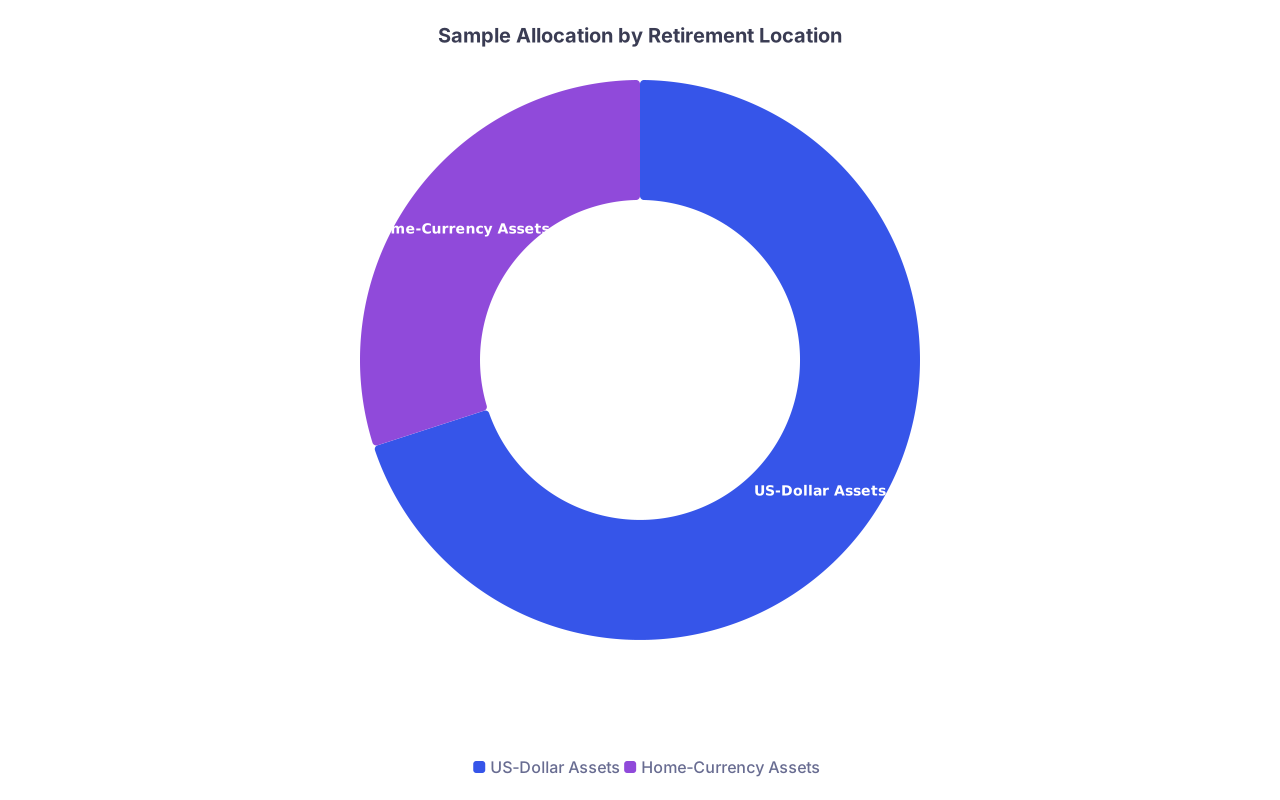
| Category | Value |
|---|---|
| US-Dollar Assets | 70 |
| Home-Currency Assets | 30 |
I’ve seen too many IMGs with 70–80% of their net worth tied up in real estate and pensions in unstable economies because “that’s what my parents did.” Different world. Different risk.
Step 6: Understand Access Rules and Taxation for Each Bucket
At retirement, you’ll likely be pulling from:
- US tax-deferred accounts (401(k)/403(b)/traditional IRA)
- US Roth accounts
- US taxable brokerage
- Home-country pensions/retirement plans
- Maybe rental properties here or abroad
You need a simple grid with:
- When can you access each (age, restrictions)?
- Who taxes the withdrawals? US, home country, or both?
- Is there a treaty that avoids double taxation?
- How will you physically receive the money (bank account, currency, transfer limits)?
For example:
US 401(k) if you live in the US in retirement:
- Taxed as ordinary income in the US
- No 10% penalty after age 59½ (with some exceptions like separation at 55 from that employer)
Home-country government pension paid while you live in the US:
- Often taxable in the US as ordinary income
- May also be taxable in the source country unless a treaty assigns exclusive taxing rights
Set up a short appointment with a cross-border CPA and walk through a few specific scenarios:
- “I’m 67, living in the US, taking $40k/year from my US 401(k) and $12k/year equivalent from my home-country pension. How is that taxed?”
- “What if instead I move back home at 65 and give up my green card? How are my US withdrawals taxed then?”
You want clarity before you start locking in accounts and contribution patterns.
Step 7: Clean Up Compliance: FBAR, FATCA, and All the Ugly Acronyms
If you have more than $10,000 aggregate in foreign financial accounts at any point in a year (including pensions, bank accounts, some insurance products), you probably need to file an FBAR (FinCEN Form 114).
Also possible: Form 8938 (FATCA), depending on total amounts and filing status.
People ignore this. Until they don’t. Then they pay penalties.
Fix this:
- Make a list of all non-US accounts: pensions, savings, investments, cash-value insurance.
- Gather account numbers, maximum yearly balances, institution names and addresses.
- Confirm with your CPA that they’re reporting everything correctly. If your CPA shrugs off foreign accounts, you need a different CPA.
This isn’t “nice to have.” It’s table stakes for IMGs with offshore assets.
Step 8: Decide What to Do With Old Home-Country Retirement Accounts
You’ve got three main choices with old pensions or retirement accounts back home:
- Leave them where they are until retirement
- Cash them out early, if allowed
- Transfer or roll them to some other vehicle (rarely simple across borders)
Here’s how I see it play out in real life:
Leave them if:
- The system is reasonably stable
- Fees are not outrageous
- There’s a reasonable chance you’ll return or at least claim the benefit later
- Early withdrawal triggers heavy penalties or horrible tax treatment
Consider cashing out if:
- The system is unstable, high inflation, or there’s political seizure risk
- You’ve left the country and no longer build benefits
- You can get the funds out at a tolerable tax cost
- You can reinvest efficiently in the US or elsewhere
But be careful:
Cashing out a foreign pension might be a taxable event both in the home country and in the US. Sometimes in the same year. You do not push this button without a tax pro running numbers on both sides.
Step 9: Coordinate Estate Planning: Who Inherits What, Where
You’re a doctor. There’s a decent chance you’ll accumulate meaningful assets. Your cross-border situation makes estate planning harder.
Questions you need answered:
- If you die as a US tax resident with assets in your home country, how is that taxed there vs. in the US?
- Does your home country recognize US wills, or do you need a local one too?
- Who will help your spouse or kids actually claim your foreign pension?
At minimum:
- Have a US will and beneficiary designations updated on all US retirement accounts.
- Ask a home-country lawyer: “If I die living in the US, what happens to my assets and pensions here? Do I need a local will as well?”
- Make a simple written “asset map” for your family that lists all accounts, in both countries.
This isn’t perfection. It’s triage. But it beats leaving your spouse to chase down a government office in your home country with no paperwork.

Step 10: Build a Simple, Brutally Practical Retirement Plan
You don’t need a 40-page glossy plan. You need a 2–3 page working plan that answers:
- Where am I saving now (US vs. home country)?
- What is my target “anchor” country for retirement (provisional is fine)?
- What are my estimated retirement income streams, by country and currency?
- What big legal/tax projects do I still need to complete?
Something like:
- “I’ll maximize my US 401(k) and Roth IRA. I’ll keep required contributions going to my home-country pension but no extra voluntary contributions.”
- “Assume primary retirement in the US. Treat home-country pension as bonus income in my 60s.”
- “Once balances are large enough, I’ll hire a cross-border CPA and maybe a fiduciary advisor who understands foreign pensions.”
Simple. Actionable. Not perfect—but better than blind hope.
FAQ (Exactly 4 Questions)
1. Should I convert my US traditional 401(k)/IRA to a Roth if I might retire back in my home country?
Maybe—but only after running real numbers. If your home country taxes foreign retirement withdrawals harshly, paying US tax now via Roth conversion might actually reduce future double-tax scenarios. If your home country gives favorable treatment to foreign pensions, conversions might be pointless or even harmful. This is one of those “pay a cross-border CPA for one hour” decisions. Do not guess.
2. I’m on a temporary work visa (H‑1B/J‑1). Is it still worth contributing heavily to US retirement accounts if I might be forced to leave?
Usually yes, at least to the level of employer match and often beyond. You can typically leave your accounts in the US even if you depart, and they’ll keep growing. The real question is: what tax will your home country apply to those withdrawals later, and can you physically access them from abroad? Again, treaty and local law matter. But default: do not skip free employer money just because of immigration uncertainty.
3. Are foreign mutual funds in my home-country accounts a problem for US taxes (PFICs)?
Inside a foreign pension that’s recognized by treaty as a retirement account, they may be fine. Outside such a structure, foreign mutual funds often trigger PFIC rules in the US—brutal tax and reporting. If you’re a US tax resident holding investments abroad in non-retirement accounts, you want to be extremely careful about buying local mutual funds or ETFs. Often better: use US-domiciled funds in a US account and keep foreign accounts to cash or simpler assets unless you’ve had PFIC advice.
4. How often should I review my cross-border retirement plan?
Every 2–3 years, or when one of these happens: you change immigration status (e.g., get a green card), you change your long-term view on where you’ll retire, there are major tax law changes in either country, or your income jumps significantly (attending salary, partnership, etc.). You don’t need to obsess every quarter. But if you reach age 50 and have never seriously coordinated US and home-country retirement structures, you’re behind and should address it now.
Key points:
- Choose a provisional “anchor country” for retirement now—that decision quietly drives almost every other move.
- Treat foreign pensions and US accounts as one combined system, not two separate lives; map taxes, access rules, and currencies for each bucket.
- Use a cross-border CPA strategically for a few critical decisions (treaty interpretation, cash-outs, Roth conversions), not as an afterthought when problems already exploded.


