

The fastest way to destroy your retirement is to “temporarily” support family without a plan.
If you already know you’ll be helping parents, siblings, or adult kids, you’re not being selfish by protecting your retirement. You’re being the only adult in the room. Let’s set this up correctly so you can help them without lighting your future on fire.
Step 1: Get Brutally Clear on Who You’re Likely to Support
Do not start with spreadsheets. Start with reality.
Ask yourself, very concretely:
- Who might you realistically be supporting?
Parents? In-laws? Adult children? Siblings? A disabled relative? - What kind of support are we talking about?
Housing? Monthly cash? Health costs? Immigration help? Education for nieces/nephews? - Is this:
- Already happening,
- Clearly coming, or
- “Probably” coming because of known patterns?
Write names and rough roles down. Not in your head. On paper.
Then, for each person, give an honest 1–3 rating in two categories:
- Likelihood you’ll have to support them: 1 = unlikely, 3 = almost certain
- Size of support if it happens: 1 = small, 3 = big (like rent, medical, living expenses)
Multiply the two numbers. The 6s and 9s? Those are your real planning priorities. Stop pretending those are “maybe” problems. They’re not.
Now convert that to money.
| Person / Group | Type of Help | Monthly Estimate | Duration Assumed |
|---|---|---|---|
| Mom & Dad | Rent + utilities | $1,200 | 15 years |
| Sister | Occasional cash | $200 | 5 years |
| Adult Son | Health insurance | $400 | 3 years |
Are those numbers perfect? No. They don’t need to be. They just need to be “not delusional.”
Step 2: Separate Retirement From Family Support — On Paper
You cannot protect what you mix.
You need two separate plans:
- Your retirement plan
- Your “family support” plan
If you lump them, you will prioritize whoever screams the loudest, not what matters most.
A. Define your retirement number first
Rough and dirty method:
- Take your target retirement spending (today’s dollars).
- Multiply by 25 if you want a 4% withdrawal rate.
Example: You want $60k/year in retirement → $60,000 × 25 = $1.5M needed.
You can tighten this later, but you need a ballpark now.
B. Make your retirement accounts off-limits (mentally and legally)
Your 401(k), IRA, Roth IRA, 403(b), etc. are not family emergency funds. They’re your life support in old age.
Tell yourself, and possibly your family:
“My retirement accounts are never used for anything except my retirement. If I help, it will be from separate savings or current income.”
If you’re married, both spouses need to say this out loud to each other. Then act like it’s law.
Create a clear mental structure:
- Retirement accounts = Sacred. Off-limits.
- Taxable / brokerage / cash savings = Where we talk about family help from.
- Current income = Can be partially allocated to support, but with a cap.
You’re creating a firewall. On purpose.
Step 3: Put a Hard Cap On How Much You’ll Support – Before Anyone Asks
If you try to “decide in the moment” every time someone needs help, you’ll overspend. Every. Single. Time.
You need:
- A dollar cap on total annual family support.
- A policy on what forms of support you will and will not provide.
Think like this:
- “We will allocate $X per year to extended family support, total.”
- “We will not reduce retirement contributions below $Y/month to do it.”
For example:
- Household income: $150,000
- Retirement contributions: $27,000/year (18%)
- You decide: “We’ll give up to $6,000/year to support extended family, but never by cutting retirement below $27k.”
That means if support requests exceed $6,000/year, your answer is: “I can’t. That would endanger my own future.”
You aren’t being cruel. You’re being responsible.
Step 4: Prioritize Types of Support That Don’t Permanently Drain You
Some ways of helping are vastly more dangerous than others. Freeing up your retirement accounts, co-signing big obligations, or taking on open-ended support will sink you.
Here’s the pecking order, from safest to most dangerous:
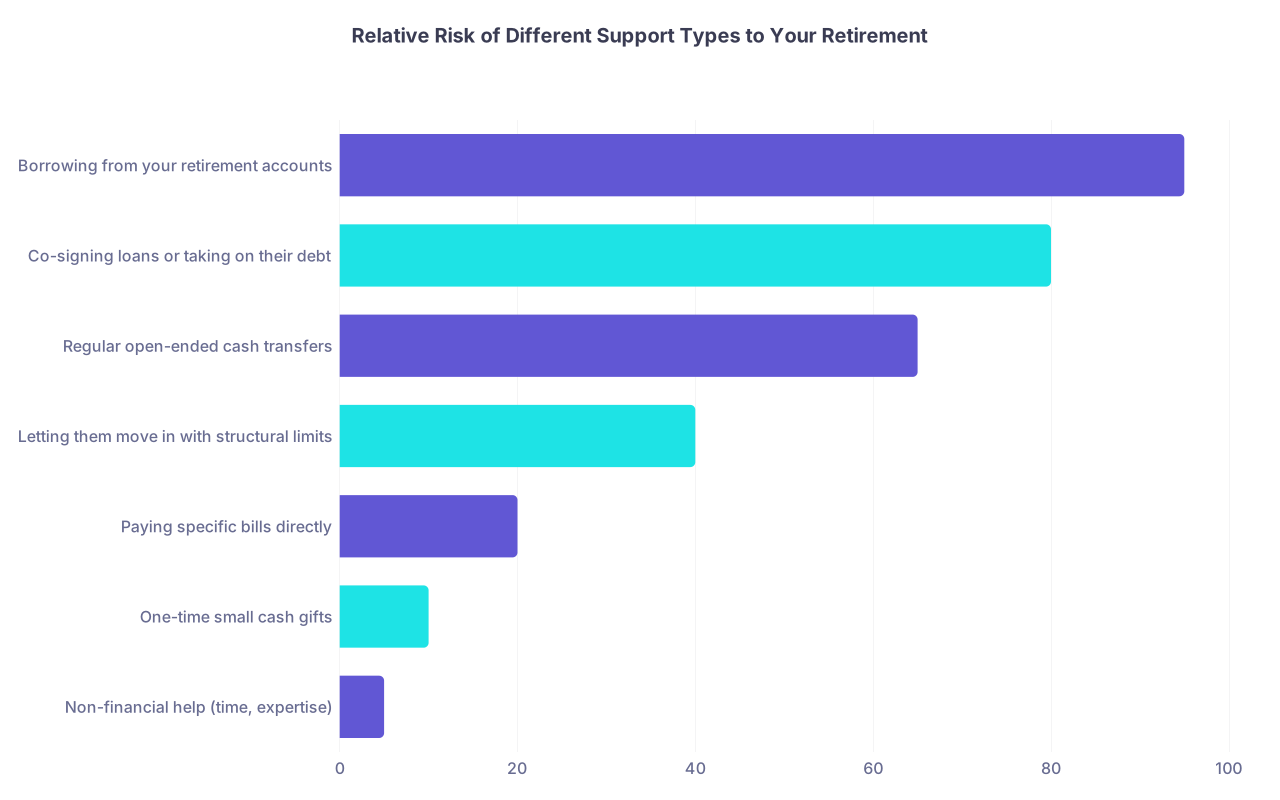
| Category | Value |
|---|---|
| Non-financial help (time, expertise) | 5 |
| One-time small cash gifts | 10 |
| Paying specific bills directly | 20 |
| Letting them move in with structural limits | 40 |
| Regular open-ended cash transfers | 65 |
| Co-signing loans or taking on their debt | 80 |
| Borrowing from your retirement accounts | 95 |
So if you’re in a situation where you know you’ll be contributing:
- Start with structure:
“You can live with us for 12 months while you get back on your feet. After that, we reassess.” - Pay things directly when possible:
Cover utilities or part of rent instead of Venmoing cash that disappears. - Avoid debt entanglement:
Don’t co-sign student loans, car loans, or credit cards unless losing that money entirely won’t harm your retirement. Assume you will end up paying 100%.
And say no to:
- Borrowing from your 401(k) or IRA “just this once”
- Cashing out retirement to help family with down payments, bailouts, or business ventures
I’ve watched people nuke 15 years of compounding for a family “emergency” that, bluntly, was predictable and recurring. Do not be that person.
Step 5: Build a Dedicated “Family Support Fund” Separate From Retirement
If you realistically expect to help extended family, treat it like a known expense category. Not like a surprise tragedy.
Create a separate bucket:
- A high-yield savings account or conservative taxable investment account
- Named clearly: “Family Support / Parents / [Surname] Fund”
Then:
- Decide a monthly contribution (even $100–300/month adds up)
- Automate it
This account is for:
- Helping aging parents with rent or medication
- Short-term help for a sibling between jobs
- Supporting extended family in another country with remittances
Retirement accounts remain untouched.
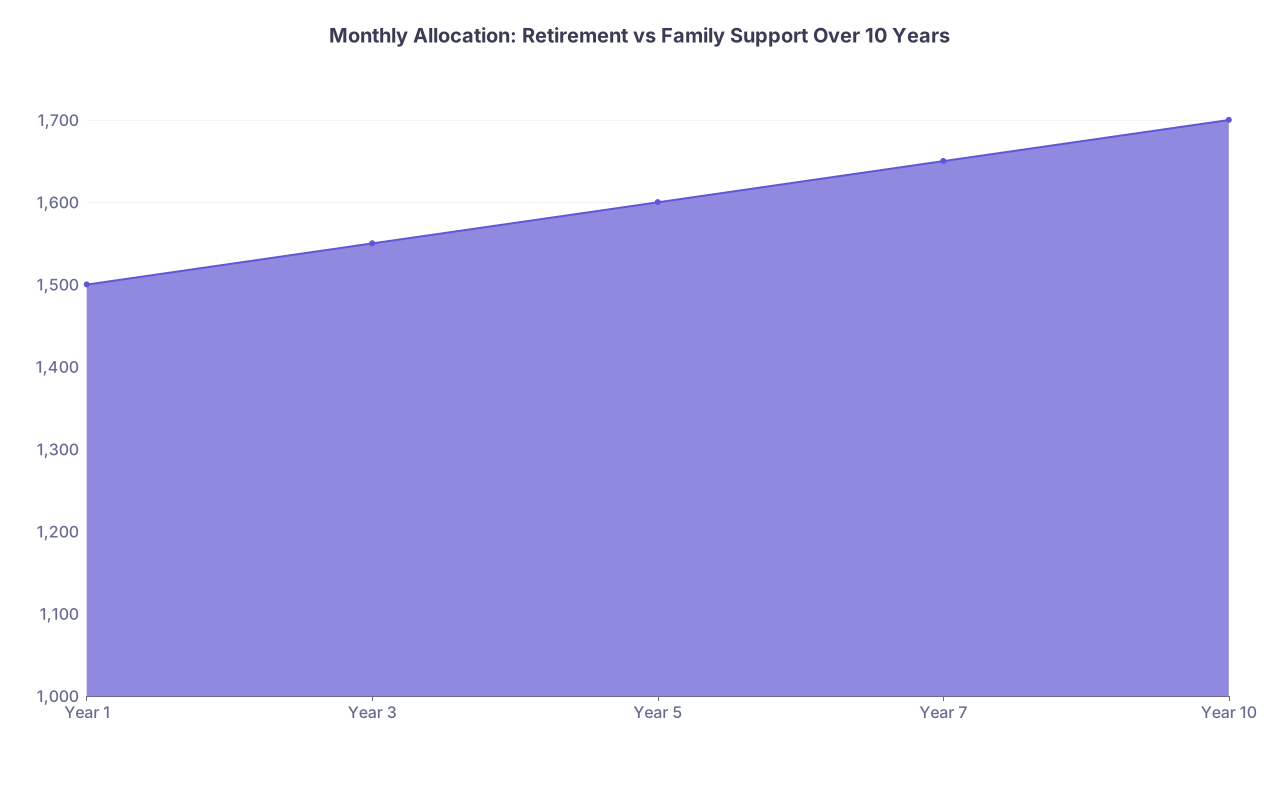
Here’s a simple visualization of how your monthly allocation might look over time as family support grows but retirement stays protected:
| Category | Value |
|---|---|
| Year 1 | 1500 |
| Year 3 | 1550 |
| Year 5 | 1600 |
| Year 7 | 1650 |
| Year 10 | 1700 |
(Imagine retirement contributions slowly rising while your family support fund contributions also increase, but neither cannibalizes the other.)
If family needs go up one year and you tap this fund? Fine. You refill it later. But you don’t touch retirement.
Step 6: Face the Ugly Truth About Your Parents’ Situation
Parents are the most common financial sinkhole, especially if:
- They have little or no retirement savings
- They’re in poor health
- They’re relying on “our kids will take care of us”
You cannot fix all of this with vibes and guilt.
You need data:
- Do they have:
- Social Security? How much per month?
- Pensions?
- Savings/investments?
- Life insurance with cash value?
- Do they rent or own? Mortgage left?
- Any high-interest debt?
Then you make a basic projection: “If they live to 90, what’s the gap between their income and basic living costs?”
If you see a clear shortfall, you have three levers:
- Lower their expenses:
- Move them to smaller/cheaper housing
- Bring them into your home (with ground rules)
- Move them closer so you can help logistically, not just with cash
- Increase their guaranteed income (if possible):
- Optimize Social Security claiming strategy
- Check if they qualify for benefits, Medicaid, SNAP, housing programs
- Share the burden:
- Siblings contribute proportionally (by income, not by “we’re all equal”)
Do not just silently start sending $800/month because you feel bad. That’s how resentment and burnout grow.
Instead:
“Mom, I can commit to $300/month starting now. Beyond that, I’d be risking my own retirement, which would then make me dependent on my kids. We need to adjust some things so this works long-term.”
Cold? No. Long-term adult thinking.
Step 7: Protect Yourself Legally When People Live With You
If you expect parents, siblings, or adult kids to move in at some point, plan the legal and practical side now. Before it’s urgent and emotional.
You need, in writing:
- Who pays for what (utilities, groceries, Wi-Fi, etc.)
- How long this arrangement is intended to last
- What happens if they don’t follow household rules (substance use, guests, noise, childcare help that was promised but doesn’t happen)
If they’re elderly parents:
- Clarify:
- Whether they’re paying you “rent” or sharing costs
- How caregiving will be handled over time
- Make sure you are not accidentally making yourself ineligible for benefits they might otherwise receive (Medicaid rules, for example, can get messy if you own the home and they “pay” you in a certain way—this is where an elder law attorney is worth every penny).
And for your own protection:
- Have a durable power of attorney and health care proxy for yourself and your spouse
- Encourage your parents to complete:
- Will
- Power of attorney
- Health care directives
You’re avoiding two disasters:
- You having to support them without any legal authority to manage their finances/decisions.
- Your extended family fighting over decisions while you’re doing all the work and bleeding cash.
Step 8: Set Boundaries With Siblings and Other Relatives
If you’re the “responsible” one, you’ll be targeted first for money, time, and guilt. That’s almost always how this shakes out.
You need:
- A clear internal policy
- A short, repeatable script
Internal policy examples:
- “I will not provide monthly support to a sibling who refuses to work or keeps repeating the same financial self-sabotage.”
- “If I help once, I will call it one-time and mean it.”
- “I will not agree to be the sole financial support for our parents if there are other siblings with income.”
Script examples:
- “I can help this one time with $300. After that, I need to stay focused on my own obligations.”
- “My retirement savings are non-negotiable. I’m not reducing them to increase support to anyone.”
- “If we’re going to support Mom and Dad, we need a shared plan. I’ll do $300/month. Can you commit to something?”
People may still be angry. That’s fine. They can either be angry now, or they can be shocked later when you’re also broke at 70 and can’t help anyone.
Step 9: Use Insurance and Legal Tools to Protect Your Future Self
If you’re likely to support extended family, you have less margin for your own disasters. That means you need some defenses.
Consider:
- Adequate term life insurance if others rely on your income (including the family you’re supporting)
- Disability insurance (short and long term) — if you can’t work, the whole support structure collapses
- Long-term care planning for yourself so you don’t later end up relying on your own kids in the same way
And seriously consider talking to:
- A fee-only financial planner (not a product salesperson) to:
- Map out retirement + expected family support
- Stress test different scenarios
- An elder law attorney if parents are low-asset and high-need
They’ll help you structure things to avoid:
- Disqualifying parents from benefits
- Accidentally making yourself financially responsible for others in a way that’s hard to reverse
Step 10: Adjust Your Retirement Plan for This Reality — Not the Fantasy
Yes, helping family usually means you need:
- More savings
- A later retirement
- Or a lower retirement lifestyle
Ignoring that trade-off doesn’t make it go away. It just makes it hit you harder at 65.
You might need to:
- Increase your savings rate by 2–5%
- Push retirement back a few years
- Or accept that your retirement spending will be, say, $50k/year instead of $70k
Run scenarios (or have a planner run them):
- Baseline: No family support
- Realistic: $X/month to family for Y years
- Worst-case: Higher support or longer duration
Then decide now what life you’re willing to trade for supporting extended family. Consciously, not by accident.
FAQs
1. Is it selfish to prioritize my retirement over helping my parents or extended family?
No. It’s the opposite. If you drain yourself now, you’ll almost certainly become dependent on someone else later—usually your kids. Protecting your retirement means you’re not adding another generation to the dependency chain. You can still help, but within limits that don’t destroy your future.
2. What if saying “no” to more support causes major family conflict?
Then it causes conflict. The choice isn’t “conflict or no conflict”; it’s “conflict now with a chance at long-term stability” or “temporary peace now and a financial disaster later.” You can soften the message with: “Here’s exactly what I can commit to,” and by offering non-financial support (time, rides, paperwork help). But boundaries that never upset anyone aren’t real boundaries.
3. Should I tell my family exactly how much I have saved for retirement?
Generally, no. Sharing vague reassurance (“I’m planning for my retirement”) is fine. Sharing exact numbers often backfires and turns you into the “bank.” You can say: “My retirement is fully allocated to my own needs. If I help, it will come from a separate smaller pool that has strict limits.”
Open your budget or planning spreadsheet today and add one new line: “Extended Family Support – Annual Cap: $____.” Put a real number in that blank, and commit not to touch your retirement contributions to go above it. That single boundary changes everything.


