
The biggest mistake physicians make in retirement is not clinical. It’s timeline. They wake up 6 months out and realize half the critical decisions needed 1–2 years of lead time.
You will not do that.
Here’s your month‑by‑month, then week‑by‑week guide for the last 24 months before you retire from practice – focused on money, contracts, liability, and legal clean‑up. At each point I’ll tell you exactly: at this point you should…
24–18 Months Before Retirement: Foundation and Feasibility
At this point you should stop “thinking about” retirement and start treating it like a project with a hard deadline.
24 Months Out: Decide Your Target Date and Run the Numbers
At this point you should:
- Pick a working retirement date (month and year), not “sometime in a couple years.”
- Block it on your calendar and your spouse/partner’s calendar.
- Schedule three meetings:
- Your financial planner or investment advisor
- Your accountant/CPA
- An attorney familiar with physician practice and estate planning
Financial checklist (24 months):
Define your retirement budget
- List:
- Fixed expenses: housing, insurance, basic living costs
- Variable: travel, gifts, hobbies
- Build a realistic annual spending number (not aspirational, not fantasy).
- List:
Inventory your assets
- 401(k)/403(b)/profit‑sharing plans
- IRAs, Roth IRAs
- Defined benefit or cash balance plans
- Brokerage accounts
- Real estate (practice building, rentals, home)
- HSAs, deferred comp, stock plans (if employed by a system)
Stress‑test your retirement plan
- Ask your planner to run:
- Conservative return assumptions
- A long life expectancy (age 95+)
- A “bad decade” early in retirement
- Confirm: Can you retire on the date you picked without needing to go back?
- Ask your planner to run:
| Item | Target / Question |
|---|---|
| Annual Retirement Spending | Clear, realistic number (not a guess) |
| Cash Reserve | 6–12 months expenses in liquid accounts |
| Debt Status | Pay off or plan to service comfortably |
| Retirement Date Feasible? | Yes/No under conservative projections |
| Healthcare Bridge Plan | Defined for pre-Medicare years |
22–21 Months Out: Clarify Employment/Practice Structure
At this point you should:
- Pull your:
- Employment contract, partnership agreement, or shareholder agreement
- Any buy‑in/buy‑out metrics
- Non‑compete clauses
- Call obligations and notice requirements
Legal/contract checklist:
- Identify:
- Required notice period (90 days? 6 months? 12 months?)
- How your ownership interest is valued and paid out
- What happens to AR (accounts receivable) and WIP (work in progress)
- Post‑employment restrictions: non‑compete radius and duration
- Make a simple one‑page summary for yourself:
- “If I retire on [date], I must give notice by [date]”
- “Estimated buy‑out: $___ paid over ___ months”
If you’re in solo or small group private practice, at this point you should also start a rough exit strategy:
- Will you:
- Sell the practice?
- Merge into a larger group?
- Wind down and close?
You do not need all the answers yet. You do need to know which path you are likely on.
18–12 Months Before Retirement: Commit and Structure the Exit
This is where you move from “maybe” to “yes, I’m leaving.” Money, malpractice, and practice sale details start here.
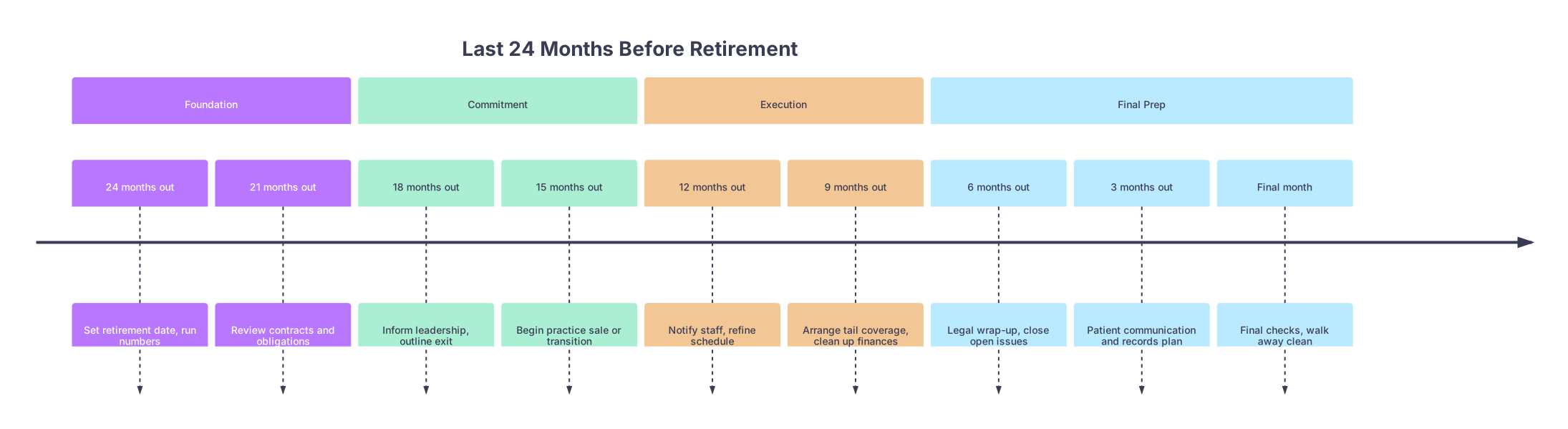
| Period | Event |
|---|---|
| Foundation - 24 months out | Set retirement date, run numbers |
| Foundation - 21 months out | Review contracts and obligations |
| Commitment - 18 months out | Inform leadership, outline exit |
| Commitment - 15 months out | Begin practice sale or transition |
| Execution - 12 months out | Notify staff, refine schedule |
| Execution - 9 months out | Arrange tail coverage, clean up finances |
| Final Prep - 6 months out | Legal wrap-up, close open issues |
| Final Prep - 3 months out | Patient communication and records plan |
| Final Prep - Final month | Final checks, walk away clean |
18 Months Out: Quietly Commit and Start Negotiating
At this point you should:
- Lock your retirement date internally. Pencil becomes ink.
- Have confidential conversations with:
- Practice leadership/partners
- Hospital/health system CMO (if employed)
- Ask directly:
- How have other physicians retired from this group?
- What flexibility exists in buy‑out, schedule taper, or part‑time continuation?
Financial and legal tasks (18 months):
Clarify what income you will receive after you stop clinical work:
- Deferred comp payouts (timing and tax impact)
- Buy‑out payments and AR collection
- Pension/defined benefit start dates
Start a tax strategy outline with your CPA:
- High‑income year vs. lower‑income year planning
- Roth conversions during early retirement if income drops significantly
16–15 Months Out: Practice Value and Malpractice Game Plan
At this point you should, if in private practice:
- Get a preliminary practice valuation (not Zillow for clinics; a real healthcare practice valuation if the numbers justify it).
- Decide:
- Target buyer type: partner, junior associate, local group, hospital, or closeout.
- Desired deal structure: lump sum vs. payments over time.
Malpractice coverage checklist:
- Find out:
- Are you on claims‑made or occurrence coverage?
- If claims‑made, who pays for tail?
- Many hospital systems cover tail if you’ve been there X years.
- Some private groups push it on the physician unless negotiated.
- Request written confirmation:
- Requirements for retirement coverage
- Cost estimate for tail if you must pay it
At this point you should put a big star on your calendar around 9–6 months before retirement: “TAIL COVERAGE DEADLINE”. You do not want to be scrambling for this at the end.
12–9 Months Before Retirement: Public Commitment and Financial Positioning
This is where your plan becomes visible. Staff, partners, and sometimes patients start hearing about it.
12 Months Out: Formal Notice and Schedule Redesign
At this point you should:
- Deliver formal written notice consistent with your contract.
- Clarify:
- Last full clinical day
- Last call shift
- Any admin/leadership duties and their end dates
Schedule management:
- Work with scheduling or your administrator to:
- Stop new long‑term follow‑ups that will outlive your planned availability.
- Gradually reduce high‑intensity or call‑heavy duties (if your group allows it).
- Define a tapering schedule if you want to wean down rather than cold‑turkey quit.
Financial positioning (12 months):
- Start moving toward your retirement “asset allocation” gradually.
- Many physicians are still aggressively invested right up to the cliff. That’s reckless.
- With your advisor, outline a 12‑month glide path from “working risk level” to “retirement risk level.”

| Category | Equities % | Bonds/Cash % |
|---|---|---|
| 12 mo | 70 | 30 |
| 9 mo | 60 | 40 |
| 6 mo | 55 | 45 |
| 3 mo | 50 | 50 |
| Retire | 45 | 55 |
10–9 Months Out: Clean Up Financial Loose Ends
At this point you should:
- Review all workplace retirement plans:
- Estimate final year contributions.
- Confirm vesting schedule and what happens at separation.
- Decide:
- Will you roll 401(k)/403(b)/cash balance funds into an IRA?
- Will you leave funds in the employer plan for a period?
Income and taxes:
- With your CPA, sketch:
- Expected W‑2 income in your final partial year
- Required minimum distributions (if applicable in later years)
- Optimal time to start Social Security (for US physicians)
If you have practice ownership:
- Tighten AR management:
- Shorten billing cycles.
- Aggressively work down old receivables.
- Reduce “sloppy” billing that lingers for months.
9–6 Months Before Retirement: Legal, Malpractice, and Estate Alignment
This is the ugly paperwork window. Ignore it and you’ll regret it.
9 Months Out: Lock Malpractice and Licensing Strategy
At this point you should:
Finalize malpractice tail coverage:
- Get quotes in writing.
- Confirm:
- Coverage duration (often unlimited for services while you were insured)
- Policy limits
- Whether there is a “retirement endorsement” required.
Decide on license status post‑retirement:
- Maintain active license for part‑time/locums/volunteer?
- Convert to inactive/retired status to save fees and CME requirements?
Regulatory and credentialing checklist:
- Make a list of:
- State medical boards
- DEA registration
- Hospital medical staff memberships
- Payer/insurance panels
- At this point you should map out specific dates:
- When to resign privileges
- When to terminate payer contracts
- When to surrender DEA if you will not prescribe at all
8–7 Months Out: Estate Plan and Asset Protection Tune‑Up
At this point you should:
Meet with your estate planning attorney to align documents with your retirement reality:
- Wills
- Revocable trusts
- Healthcare proxies and powers of attorney
- Beneficiary designations on retirement accounts and insurance
If you have:
- Practice real estate
- Ownership in surgery centers, imaging centers, or joint ventures
then you should:
- Confirm what happens to ownership at retirement:
- Forced buy‑back?
- Valuation formula?
- Continued distributions allowed?
Liability and risk:
- Review any asset protection structures:
- LLCs holding real estate
- Umbrella insurance
- Professional vs. personal liability lines
This is where you want to make sure a patient lawsuit filed five years from now can’t wipe out everything you built.
6–3 Months Before Retirement: Patient Communication and Final Financial Adjustments
The clinical world will feel this now. This window is about transparency and clean handoffs.

6 Months Out: Patient Transition and Records Plan
At this point you should:
Finalize your patient notification strategy (this has legal implications):
- Check state board and specialty society guidance on:
- Required notice to patients
- How long records must be retained
- Acceptable methods for notification (letters, website, portal messages, waiting room signs)
- Check state board and specialty society guidance on:
Work with your group or attorney to create:
- A patient letter explaining:
- Your retirement date
- How ongoing care will be provided (partner, new physician, or referral)
- How to obtain medical records
- A standardized message for portal and voicemail.
- A patient letter explaining:
Medical records checklist:
- Confirm:
- Who owns the records after you retire.
- How long they must be stored by law.
- Where they will be stored and how patients will access them.
- If you’re solo/independent:
- Arrange a records custodian (often another practice or a commercial service).
- Put this in a written agreement.
5–4 Months Out: Final Investment, Insurance, and Income Decisions
At this point you should:
Review your entire insurance stack:
- Life insurance: still needed or can some policies be dropped?
- Disability insurance: often unnecessary once you’re retired and financially independent.
- Long‑term care coverage: keep, obtain, or self‑insure?
With your advisor, finalize:
- Which accounts you’ll draw from first in retirement (taxable vs. tax‑deferred vs. Roth).
- Your target cash buffer in checking/savings for the first 12–24 months.
Social Security / pension decisions:
- If applicable, by this point you should decide:
- Start Social Security at retirement, or delay (e.g., to age 70)?
- When to start any pension or annuity payments to coordinate with your income drop.
3–1 Months Before Retirement: Legal Wrap‑Up and Clean Exit
Now you’re close. This is where forgotten details can bite you, so we go line by line.
3 Months Out: Contract, Credentialing, and Regulatory Shutdown
At this point you should:
- Confirm all written resignations and terminations have been:
- Submitted
- Acknowledged in writing
This includes:
- Hospital privileges
- Insurance panels you no longer need
- DEA registration (if appropriate)
- Medicaid/Medicare provider numbers (or their equivalent in your country)
Practice and business entities:
- If winding down a solo or small group entity:
- Meet with your attorney and CPA to:
- Plan dissolution of the entity (PC, PLLC, etc.)
- Handle final payroll, sales tax, and other filings.
- Determine how and when to close business bank accounts.
- Meet with your attorney and CPA to:
Income tracking:
At this point you should get updated estimates of:
- Final year W‑2/1099 income
- Practice sale proceeds
- AR run‑off amount
Send these to your CPA to:
- Adjust estimated tax payments
- Avoid a big surprise tax bill next April.
2 Months Out: Double‑Check Malpractice, Records, and Tail
At this point you should:
- Re‑verify malpractice coverage:
- Tail policy is bound, paid, and effective.
- You have copies of:
- Final declarations page
- Tail endorsement
- You understand exactly what time period is covered.
Medical records double‑check:
- Confirm:
- Records custodian is in place.
- Notifications to patients about records access have been sent/posted.
- You have access instructions documented for yourself in case questions arise later.
Retirement income launch checklist:
- Make sure:
- Any pension or annuity start paperwork is submitted.
- Social Security applications (if starting now) are completed.
- Automatic withdrawals or systematic distributions from investment accounts are scheduled to start after your final paycheck stops.
Final 30 Days: Last Legal and Financial Checks Before Walking Away
This is not victory lap time yet. One more tight pass through the checklist.
30–14 Days Out: Final Audit of Obligations
At this point you should:
Sit down with your practice manager or administrator and go through:
- Any remaining unpaid business bills
- Final payroll and benefits (health insurance end date, COBRA options)
- Outstanding contracts or leases (equipment, office space if you’re an owner)
Confirm:
- Post‑employment health coverage plan:
- Spouse’s plan
- COBRA bridge
- ACA marketplace/other individual plan
- Medicare start date if 65+
- Post‑employment health coverage plan:
Personal documents:
- Gather and securely store:
- Final employment separation documents
- Buy‑out agreements
- Malpractice tail policy
- Practice sale documents
- Entity dissolution filings
This is your “if something surfaces later” folder. Do not trust your memory or someone else’s server.
Final Week: Turn Off the Lights (Properly)
At this point you should:
- Confirm with your attorney/CPA:
- Nothing remains unsigned.
- Filing deadlines and final returns (business and personal) are calendared.
- Confirm with your financial advisor:
- Your post‑retirement investment allocation is fully in place.
- Cash for the first year of retirement is set aside and accessible.
Then, and only then, you walk out.
Post‑Retirement: The First 90 Days (Financial and Legal Only)
You’re technically done practicing, but a few things still need monitoring.
At this point you should:
30 days after retirement:
- Verify:
- Final paycheck and any PTO buy‑out received.
- COBRA or new health insurance active and correct.
- First withdrawals from investment accounts executed properly.
- Verify:
60–90 days after:
- Review AR run‑off or practice sale installment payments.
- Reconfirm no unexpected bills from malpractice carrier, landlord, or vendors.
First tax season after retirement:
- Sit with your CPA early.
- Use all your final year documents to adjust your ongoing tax plans and possibly Roth conversions or other strategies while your income is newly lower.

The Short Version: What Actually Matters
By the time you reach your last clinical day, three things should be true:
Your financial runway is verified and structured.
Retirement date, asset allocation, withdrawal plan, and tax strategy are all defined and implemented months in advance.Your legal and liability exposure is contained.
Contracts honored, malpractice tail locked in, licenses and credentials cleaned up, entity and records plan executed.You can walk away without loose ends.
No surprise AR drama, no missing paperwork, no frantic calls about “who’s covering this patient” or “where are the charts.”
Follow this timeline, and retirement becomes a managed transition, not a chaotic escape.