
Second-Look Strategies for Dual-Physician Couples Comparing Sites
It is late January. You and your partner are sitting at the kitchen table with two laptops open, six different cities on a shared spreadsheet, and a half-dozen “We loved meeting you both!” emails in the inbox. You have done the interviews. You have done the polite thank‑you notes. Now programs are hinting: “If you are in the area, we would be happy to have you back for another visit.”
Second looks.
On their own, second looks are already messy: logistics, cost, optics, and the risk of overinterpreting vibes from a 4-hour visit. Layer on the dual-physician couple angle—two match lists, multiple specialties, different call schedules, and the question “Can we actually build a life here together?”—and now this is no longer a courtesy visit. It is reconnaissance.
Let me break this down specifically for dual-physician couples who are using second looks as a strategic tool, not a social courtesy.
, Childcare/schools, Research/resources, Geographic family ties](https://cdn.residencyadvisor.com/images/articles_svg/chart-common-priorities-for-dual-physician-couples-at-se-1742.svg "Common Priorities for Dual-Physician Couples at Second Look")
| Category | Value |
|---|---|
| Commute compatibility | 85 |
| Program culture | 90 |
| [Call schedule fit](https://residencyadvisor.com/resources/second-look-visits/how-to-critically-evaluate-resident-wellness-on-a-second-look-day) | 75 |
| Childcare/schools | 60 |
| Research/resources | 50 |
| Geographic family ties | 45 |
Ground Rules: What Second Looks Can and Cannot Do
Second looks are for clarifying, not rescuing.
They can:
- Help you see how your two programs coexist in real life: geography, commute, hospitals, call rooms, parking, and neighborhood logistics.
- Expose culture and communication patterns you did not catch on the choreographed interview day.
- Let you stress-test specific dealbreakers: night float structures, cross-cover expectations, ICU burdens, or off-site rotations that ruin childcare plans.
They cannot:
- Magically transform a malignant program into a supportive one.
- Guarantee that “we like you both” equals more favorable ranking as a couple.
- Replace careful couple’s match strategy. If your list logic is sloppy, no second look will save it.
Second looks are optional. For most applicants, they are low-yield. For dual-physician couples, they are sometimes high-yield if—and only if—you use them to answer concrete, high-impact questions about living and training together.
If you are going to bother with them, you need a plan.
Step 1: Decide Which Sites Actually Need a Second Look
You cannot second-look every city. Nor should you. For couples, the bar has to be higher.
Start by looking at your shared rank list draft and ask:
Where could we actually disagree?
- Example: One of you is in love with the university IM program; the other is lukewarm on the community EM site across town.
- That is a second-look candidate.
Where are the logistics opaque or suspiciously hand-wavy?
- “Oh, the commute is not that bad, most residents figure it out.”
- “We partner with multiple hospitals across the city, but it is very manageable.” Translation: you probably need to see it.
Where would we realistically live if we matched here?
- If you cannot even identify a plausible neighborhood that works for both commutes, that city is not ready to be ranked highly—or it needs a second look to verify.
I tell couples to cap serious second looks at 2–3 metro areas. If it is not in legitimate contention for a top cluster on your couple’s rank list, do not burn the time or the mental energy.

| Step | Description |
|---|---|
| Step 1 | Program Pair Option |
| Step 2 | Skip second look |
| Step 3 | Rank with current data |
| Step 4 | Plan targeted second look |
| Step 5 | Top 5 on joint list? |
| Step 6 | Logistics unclear or conflicting? |
| Step 7 | Big culture or family questions? |
Step 2: Coordinate Second Looks as a Pair Without Being Awkward
You have two options: visit together or stagger visits. Both have tradeoffs.
Visiting Together
Best when:
- You are both interested in the same institution or affiliated systems.
- Both programs already know you are a couple (which they should if you are couples matching; hiding it at this point is just counterproductive).
- You want to assess shared living / commuting / childcare geography together.
How to set it up:
Each of you emails your own program coordinator or PD.
Brief, direct, not needy:
“My partner is also applying this cycle in [specialty] at [related program/hospital]. As we are couples matching, we are considering a second visit to better understand how living and commuting would work if we both matched here. Would there be an appropriate day or half-day for me to visit informally and meet with a resident or two?”
Do not ask them to coordinate between programs for you. That is your job.
Staggered Visits
Best when:
- One of you is on a brutal rotation.
- Travel budgets are tight.
- The main questions are program-specific (e.g., “Is this surgical program actually humane?”) rather than logistics.
You still share intel, but one of you acts as the scout. If you do this, your scouting partner’s job includes documenting everything: times, distances, neighborhoods, traffic patterns, resident comments.
Step 3: Build a Targeted Agenda for Each Second Look
You should walk in with a written plan. Otherwise you will leave with “Everyone seemed nice” and not much else.
Think in three layers for each location:
- Program-specific questions for each partner.
- City/logistics questions that affect both of you.
- Relationship/quality-of-life questions that you will debrief together.
1. Program-Specific: What Each of You Must Clarify
Examples by specialty, because details matter.
Internal Medicine:
- Night float: how many months, how often, what cross-cover load actually looks like at 2 a.m.
- Clinic structure for continuity: are there clinic days you can align with your partner’s more predictable days?
- ICU rotation frequency during PGY-1 and 2. Frequent 28-hr-ish stretches and post-call zombies are relationship poison.
Surgery:
- Early start times vs your partner’s call schedules; how often you will literally never see mornings together.
- What “q3–4 call” actually means—are they respecting post-call days or quietly eroding them?
- Trauma site location: more commuting constraints if it is a separate campus.
OB/GYN, Anesthesia, EM:
- Off-site rotations at distant hospitals. If OB is driving 40 minutes one direction and EM is 35 minutes the other, someone is always miserable.
- How often nights align or misalign. You do not want staggered permanent jet lag.
Psych, Pediatrics, Neurology, etc.:
- Outpatient-heavy rotations—can these be semi-aligned so at least one year is civil on both sides?
- Call from home vs in-house, especially if you plan kids.
You are not there to interrogate. But you are there to ask pointed, reality-based questions. The residents who pull you aside after the formal part? Those are the ones you listen to carefully.
2. City and Logistics: The Stuff That Will Make or Break Your Sanity
Here is where dual-physician couples absolutely should use the second look or a same-day personal “DIY second look” in the city.
Bring a list and check it off:
- Commute times from realistic neighborhoods during actual traffic.
- Cost of parking at both hospitals. Residents routinely underestimate how annoying this gets.
- Grocery stores, gyms, daycare centers, and basic infrastructure on a map between your two sites.
- Safety of walking to your car at 10 p.m., especially if one of you is on nights or EM.
You do not need the program to show you all this; you need a half day, a rental car or rideshare, and Google Maps in “rush hour” mode.

Step 4: Use a Structured Framework to Compare Site Pairs
Couples who wing this end up ranking based on which PD seemed more charming. That is a mistake.
You need a comparison framework for each pair of sites in a given city (e.g., her IM program + his EM program vs. her IM program + his community IM program elsewhere).
Start with a simple rating grid you both fill out independently right after each visit.
| Domain | 1 (Terrible) | 5 (Excellent) |
|---|---|---|
| Program culture (you) | ||
| Program culture (partner) | ||
| Commute compatibility | ||
| Call/night schedule fit | ||
| Housing affordability | ||
| Support systems nearby |
You do not need a 25-row monster. Six to eight domains is plenty. The key is pair-level thinking:
- “How does my surgery program + your IM program combo compare in this city versus your psych program + my IM program in that city?”
- “Would we rather have one of us in a dream program and the other in a tolerable one, or both in strong-but-not-amazing programs with a 10-minute joint commute?”
Those are real tradeoffs. Pretending you do not have to make them is how couples end up burned.
Step 5: What to Actually Do and Say During the Second Look
Think of the second look as three parallel missions:
- Quiet observation
- Directed questions
- Professional relationship maintenance
1. Quiet Observation
You learn a lot by shutting up and just watching.
Notice:
- How the residents talk to each other in the workroom when attendings are not around.
- Whether people look exhausted or functional at 3 p.m.
- How staff interact with residents—respectful, transactional, dismissive?
- Whether everyone scurries out the door at 4:59 p.m. like they are escaping a prison, or if there is a normal level of lingering and chatting.
Compare this program to others you have seen: does it feel psychologically safer, or more tense?
2. Directed Questions (That Do Not Make You Sound Clueless)
You want questions that do three things: show insight, elicit real information, and avoid cornering people.
Examples tailored for couples:
- “We are couples matching and trying to understand what life logistics look like. Are there residents here whose partners are also residents or fellows? How have they handled commute and call alignment?”
- “Over the year, how many weeks feel truly brutal for you, and what makes them brutal—are we talking volume, consult chaos, or unsupported cross-cover?”
- “For residents with kids or dual-career partners, what has worked well in terms of neighborhoods or housing?”
The red flag response is not “we work hard.” That is a given. The red flag is vague, overly rosy, or dismissive answers when you get specific.
3. Professional Relationship Maintenance
Second looks are not auditions. You are not there to “convince them again.” You are gathering information and showing continued serious interest.
A clean, adult way to frame your visit:
- With PD or APD:
- “Thank you for having me back. As we are couples matching, we wanted to understand the logistics of living and commuting here better. I am very interested in this program; I just want to build a realistic picture of life here for both of us.”
You are not promising them you will rank them first. You are not fishing for inside info on rank lists. You are confirming mutual seriousness and respect.
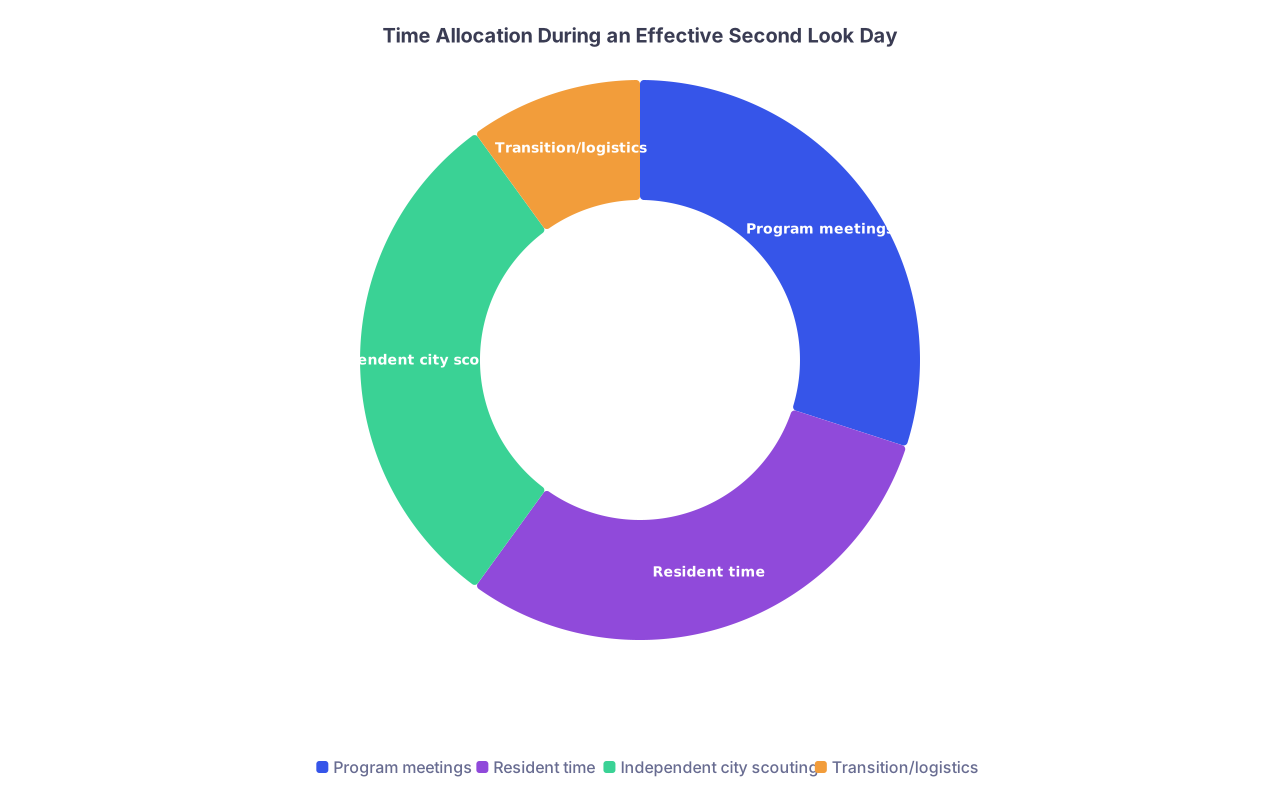
| Category | Value |
|---|---|
| Program meetings | 30 |
| Resident time | 30 |
| Independent city scouting | 30 |
| Transition/logistics | 10 |
Step 6: The City-Level Second Look: Do Not Skip This
For dual-physician couples, the “second look” is often less about the program and more about the metro area. I have seen couples rank a city too high based on a sunny interview day on one campus and regret it for years.
If you are going to spend money, spend it seeing the life, not just the hospital.
You and your partner should:
- Drive or ride between both hospitals during real commute times.
- Walk through at least one neighborhood where you might actually live. Not the aspirational one; the realistic one with your resident salaries.
- Sit in a coffee shop or park near each hospital and just watch who is around, day and evening.
- Check daycare or school waitlist realities if children are in your 3–5 year plan. Some cities are brutal.
You can do all this the same day as your second look, or entirely on your own. Programs do not need to be involved. You do not have to announce to anyone that you are doing a stealth city reconnaissance.

Step 7: Debrief Like Adults, Not Applicants in Panic Mode
Here is where couples often sabotage themselves. They come home from a second look, one person is high on the visit, the other is tired, and a 20-minute conversation locks in a rank order they later regret.
You need a structured debrief. Same day if possible, but not while you are exhausted.
I recommend three rounds:
Individual download (no interruptions)
- Each of you gets 10 uninterrupted minutes to describe your impressions of:
- Your program
- Their program (if you saw it)
- The city and likely neighborhoods
- The other person just listens and takes notes. No debating yet.
- Each of you gets 10 uninterrupted minutes to describe your impressions of:
Domain scoring
- Pull up your comparison grid.
- Independently rate each domain 1–5 for the pair of programs in that city.
- Then compare. Where do you diverge by more than 1 point? That is a sign you are seeing different things.
Tradeoff discussion Now you talk tradeoffs explicitly:
- “In City A, we both get strong programs and a 25–30 minute opposite-direction commute. In City B, one of us gets a dream program and the other gets a solid but not perfect one, but the commute is 10 minutes each. Which scenario do we prefer as a couple for the next 3–5 years?”
- “In City C, the programs are average, but our support system is excellent—family, friends, childcare. Is that worth dropping a star or two on individual program prestige?”
This is the grown-up part. You cannot have everything. But you can decide together which losses you are willing to take.
Step 8: Strategic Communication After Second Looks
A week later, you will have the urge to “signal” programs. Some of that is useful; some of it is fantasy.
For dual-physician couples, post–second look communication should be:
- Honest, but not overcommitted.
- Synchronized, but not copy-pasted.
- Focused on seriousness, not promises.
If both of you are legitimately ranking a city/program combination highly, you can each send a short, individualized email:
- “After a second visit and a better understanding of how my partner’s residency and mine could coexist here, I can say that [Program] will be ranked very highly on my couple’s list. The residents, the ICU training, and the geography all align well with our goals.”
Do not play the “You are my number one” game with multiple programs. And do not overstate your position “just in case.” PDs talk. And frankly, they can smell generic flattery.
If you truly have a clear #1 city/program pair as a couple, it is reasonable—and sometimes helpful—to tell that pair directly and honestly. One program for each of you. Not three.
Step 9: Guardrails in the Era of Virtual and Hybrid Processes
You are applying in a time when second looks are increasingly controversial. Some specialties or institutions discourage them because of equity concerns. Others quietly love them.
A few ground rules:
- If a specialty or specific program explicitly discourages second looks, respect that. You can still do a city-only visit on your own.
- If second looks are allowed but not emphasized, keep them low-key: short, targeted, not “mini-interviews.”
- Virtual second looks (extra Zoom chats with residents) can be useful for content, but not for vibes. Use them to clarify schedule and logistics, not to “read the room” emotionally. Zoom lies.
For dual-physician couples, many of the most important second-look tasks do not involve the program at all. They involve you, a map, and some brutal honesty about your life together.
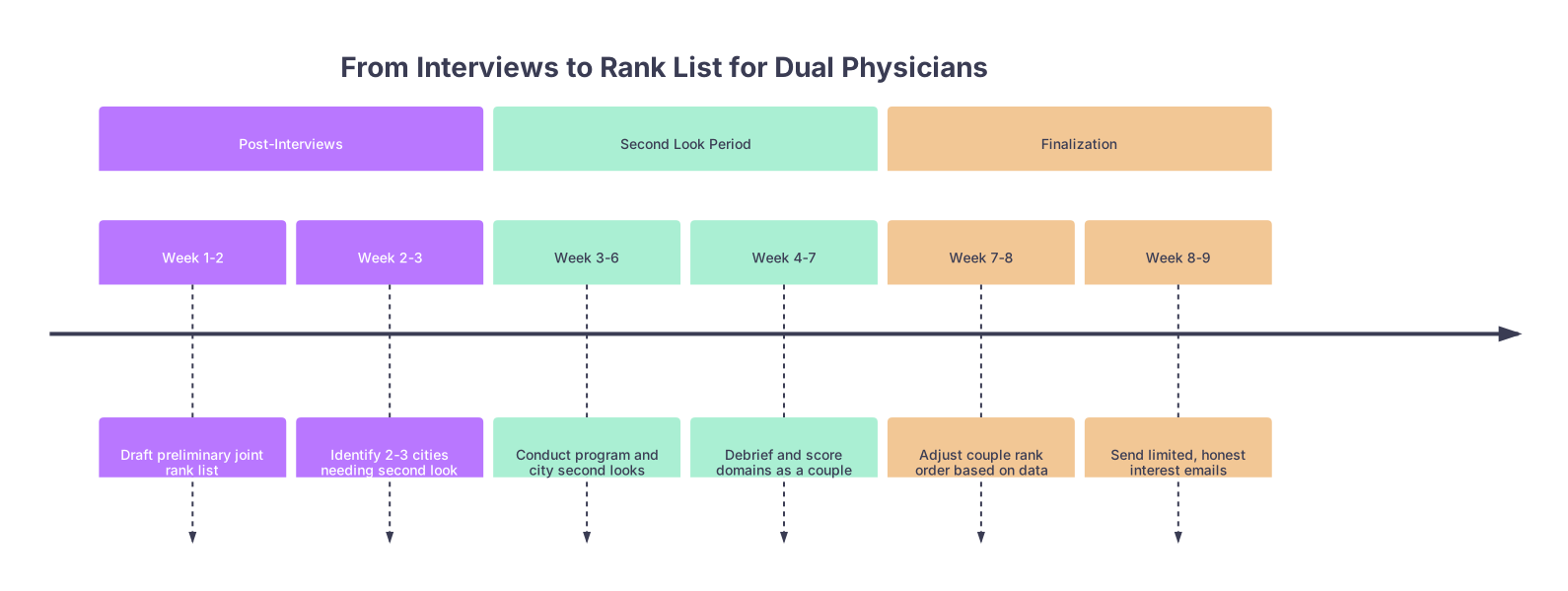
| Period | Event |
|---|---|
| Post-Interviews - Week 1-2 | Draft preliminary joint rank list |
| Post-Interviews - Week 2-3 | Identify 2-3 cities needing second look |
| Second Look Period - Week 3-6 | Conduct program and city second looks |
| Second Look Period - Week 4-7 | Debrief and score domains as a couple |
| Finalization - Week 7-8 | Adjust couple rank order based on data |
| Finalization - Week 8-9 | Send limited, honest interest emails |
A Quick Word on Future-Proofing Your Decision
You are not just picking a 3-year experience. You are picking a launching pad for two careers that may diverge later.
During second looks, consider:
- Fellowship options nearby for either of you. If one of you is fellowship-bound, does staying in that city make sense?
- Moonlighting culture and policies. Two residents, two sets of loans—flexible moonlighting can change your financial trajectory.
- Institutional flexibility for life events: parental leave, medical issues, couples schedule accommodations. Past behavior is the best predictor of future behavior—ask residents what they have actually seen happen.
Second looks let you test whether a place treats residents as disposable labor or as developing colleagues with real lives. You want the second kind. Both of you.
Key Takeaways
For dual-physician couples, second looks are only worth the effort if they answer specific, high-impact questions about program fit and shared life logistics. Cap them to 2–3 serious metro areas and walk in with a written agenda.
Treat each city as a pair problem: your program + your partner’s program + housing + commute + support systems. Use structured scoring and honest tradeoff discussions, not just vague impressions.
Use second looks to clarify, not to charm. Observe quietly, ask pointed questions, scout the city like adults, then communicate your interest honestly and selectively. The goal is not to impress them. The goal is to stop lying to yourselves about what life will actually look like if you both end up there.