
It is late January. You just survived a month of scattered second looks, loosely scheduled “come hang out with us” dinners, and awkwardly enthusiastic tours. Now you are back home, staring at a chaotic notes app: random quotes, vibes, food pics, and “ask about call rooms???” scribbles. You know these visits matter, but you have no idea how to convert impressions into a rational rank list.
This is where a structured second-look scorecard either saves you or you end up ranking programs based on which one had better coffee.
Let me break this down specifically.
Why You Need a Structured Second-Look Scorecard
Unstructured second looks are dangerous. You are tired, anxious, and marinating in confirmation bias. Without a framework, three things happen:
- Recency bias: The last place you saw suddenly feels “better” than it is.
- Charisma bias: One ultra-likeable chief resident warps your entire impression.
- Noise overload: You remember that one off-hand negative comment and forget everything else.
A structured scorecard does three things:
- Forces you to decide what actually matters to you before you walk in the door.
- Standardizes how you compare programs so you are not reinventing the wheel every time.
- Creates a paper trail that you can come back to when your brain is mush the week before rank list certification.
Think of it as building your own “clinical decision rule” for ranking. Same data points. Same scoring method. Less panic.
Step 1: Decide What Second Look Is Actually For
Second looks are not for re-doing the interview. They are for filling the gaps that interviews cannot touch.
Interviews show you:
– Formal curriculum.
– Faculty talking points.
– Polished versions of residents.
Second looks show you:
– How people behave when they are not being watched by PDs.
– Whether residents look burned out or mostly intact.
– How the hospital actually runs at 6 PM when no one is staging it.
So your scorecard must target second-look-specific questions, not re-ask interview questions in a different format.
At a minimum, second looks should focus on:
- Culture: Day-to-day vibe, hidden hierarchy, real attitudes about wellness and support.
- Work reality: True hours, scut work distribution, how much autonomy actually exists.
- Fit: Your comfort level with the city, hospital layout, call rooms, commute, and social life.
- Trajectory: How the program is changing, not just what it is now.
You are not ranking last year’s brochure. You are ranking the next 3–7 years of your life.
Step 2: Pick Your Core Domains (Not 20, Just 5–8)
You need a limited set of domains. If you have 15 categories, you will not actually use them.
For most specialties, 6–8 domains works very well. Here is a solid starting template:
- Resident Culture and Support
- Workload, Schedule, and Autonomy
- Education and Mentorship
- Career and Fellowship Outcomes
- Program Leadership and Responsiveness
- Hospital System, Resources, and Logistics
- City and Lifestyle Fit
- Program Stability and Future Direction
Not all domains carry equal weight. That is fine. We will weight them explicitly later.
First, define what each domain means in your own words, so you do not drift mid-season.
| Domain | What You Are Really Evaluating |
|---|---|
| Resident Culture & Support | Psychological safety, camaraderie, how residents treat each other when leadership is not present |
| Workload & Autonomy | Real hours, call burden, ability to make decisions vs constantly being overridden |
| Education & Mentorship | Teaching on busy days, attendings' interest in teaching, access to mentors who answer emails |
| Career & Fellowship Outcomes | Real fellowship match track record, job placement, alumni support |
| Leadership & Responsiveness | PD/APD honesty, willingness to adapt, responsiveness to resident feedback |
| Hospital & Logistics | EMR, ancillary staff quality, physical layout, call rooms, parking, food access |
| City & Lifestyle Fit | Commute, partner job opportunities, cost of living, social life, safety |
| Program Stability & Future Direction | Financial health, service expansion/contraction, leadership turnover, new ACGME or hospital changes |
You do not need to use exactly these. But you do need to decide on yours before you go.
Step 3: Build a Scoring Scale That Does Not Lie to You
You need a numeric scale that is:
- Simple enough to actually use on-site.
- Granular enough to distinguish “fine” from “excellent.”
A 1–5 scale works well, but you need to define it so you are not grading on vibes.
Example 1–5 scale (use this or something similar):
- 1 – Red flag / deal-breaker level.
- 2 – Below average / uncomfortable; significant concerns.
- 3 – Adequate / acceptable; nothing special, no big concerns.
- 4 – Strong / clearly above average; would be happy with this.
- 5 – Excellent / standout; among the best seen anywhere.
Two key rules:
- Do not be afraid of 1s and 2s. If you felt a serious problem, it goes there.
- Do not give many 5s. If you give everyone all 5s, the scorecard is useless.
Step 4: Weight Your Domains (Before, Not After)
Different applicants prioritize different things. If you are couples matching with a non-medical partner, city fit might be 25% of your decision. If you are 100% fellowship-bound in a hyper-competitive subspecialty, career outcomes might be 30–40%.
You want explicit weights that sum to 100%. Here is a sample weighting scheme for someone fellowship-leaning but not desperate:
- Resident Culture and Support – 20%
- Workload, Schedule, and Autonomy – 15%
- Education and Mentorship – 20%
- Career and Fellowship Outcomes – 20%
- Program Leadership and Responsiveness – 10%
- Hospital System, Resources, and Logistics – 5%
- City and Lifestyle Fit – 5%
- Program Stability and Future Direction – 5%
Total: 100%.
If you are strongly geography-bound, you might bump City and Lifestyle Fit to 20% and shave 5% off education, career, and culture each.
The order that matters:
Decide your weights now.
Do not retro-fit your weights later to justify a gut preference. That is how you fool yourself.
Step 5: Map the Scorecard to Specific Second-Look Tasks
A domain on a spreadsheet is useless unless it tells you what to actually do during the visit.
You need targeted tasks and questions tied to each domain.
1. Resident Culture and Support
What you do:
- Ask senior residents: “If you could go back, would you choose this program again?”
- Pay attention to how interns talk about seniors. Is there joking or quiet resentment?
- Watch how people react when a pager goes off during lunch. Annoyed? Supportive? Checked-out?
What you score:
- Do residents seem like they would have your back on a bad call night?
- Are there any themes of toxicity, favoritism, or chronic understaffing?
- Are people proud of the program, or just surviving?
2. Workload, Schedule, and Autonomy
What you do:
- Ask multiple residents separately: “What does a typical week look like on your worst rotation?”
- Clarify: “What is documented vs what is real” about duty hours.
- Ask junior residents how often they feel safe making decisions without immediately calling an attending.
What you score:
- How honest and consistent are the answers about hours and call?
- Is the balance between service and education tolerable?
- Do they give you real autonomy with backup, or throw you in the deep end?

3. Education and Mentorship
What you do:
- Ask: “Who are the best teachers here, and how accessible are they really?”
- Ask: “How often does teaching get canceled for ‘service needs’?”
- Try to attend a conference or noon report if possible and quietly assess: focused teaching vs filler.
What you score:
- Do residents actually show up for teaching, or is the room half-empty?
- Is there structure: regular didactics, simulation, feedback, protected time?
- Can residents name more than one real mentor?
4. Career and Fellowship Outcomes
What you do:
- Ask: “Where have residents gone in the last 3–5 years?” and get specific names and programs.
- Ask people headed toward your interest: “Did you feel supported for [fellowship/academic/community]?”
- Push on letters: “Who writes the best letters here, and how many people actually get access to them?”
What you score:
- Is there a track record for your intended path?
- Do they have home fellowships and are they friendly vs territorial?
- Are alumni present and active or basically ghosts?
Step 6: Build the Actual Scorecard Template
At this point, you know:
- Your domains
- Your scoring scale
- Your weights
- The practical tasks/questions tied to each domain
Now turn that into something you can physically carry or keep on your phone.
You want a simple table with:
- Program name
- Each domain with a 1–5 score
- Written comments (1–3 lines per domain)
- Weighted total
Here is what the skeleton looks like conceptually:
| Field | Example Entry |
|---|---|
| Program | University Hospital Internal Medicine |
| Resident Culture (20%) | Score: 4 – Residents relaxed, joke about work but not bitter. Seniors protective of interns. |
| Workload & Autonomy (15%) | Score: 3 – Busy but residents say manageable. True 70–80 hr weeks on ICU. Autonomy good by PGY2. |
| Education & Mentorship (20%) | Score: 5 – Very strong conferences, several named mentors, fellows engaged. |
| Career Outcomes (20%) | Score: 4 – Consistent matches to cards/GI, recent alum at major academic centers. |
| Leadership (10%) | Score: 3 – PD nice but evasive on schedule changes; residents mixed on responsiveness. |
| Hospital & Logistics (5%) | Score: 4 – EMR decent, strong ancillary staff, call rooms clean. Parking slightly annoying. |
| City & Lifestyle (5%) | Score: 2 – Partner job market weak, long commute, high COL. |
| Stability & Future (5%) | Score: 3 – Recent chair change, some uncertainty but expanding services. |
| Weighted Total | 3.8 / 5 |
You can build this as:
- A Google Sheet or Excel with built-in formulas.
- A Notion template.
- A printed half-sheet you fill out the same day as the visit and later enter into a digital file.
What matters: you complete it within 24 hours of each second look, before the memory degrades.
Step 7: Do the Math (Yes, Actually Calculate)
Once you have your scores, compute a weighted total.
Take each domain score, multiply by its weight, and add.
Example with the weighting above (weights as decimals):
- Culture: 4 × 0.20 = 0.80
- Workload: 3 × 0.15 = 0.45
- Education: 5 × 0.20 = 1.00
- Career: 4 × 0.20 = 0.80
- Leadership: 3 × 0.10 = 0.30
- Hospital: 4 × 0.05 = 0.20
- City: 2 × 0.05 = 0.10
- Stability: 3 × 0.05 = 0.15
Total = 0.80 + 0.45 + 1.00 + 0.80 + 0.30 + 0.20 + 0.10 + 0.15 = 3.80
You can convert to /100 if you prefer by multiplying all scores by 20 (since 5×20=100), but the ranking order will be the same.
Now line up your programs and compare.
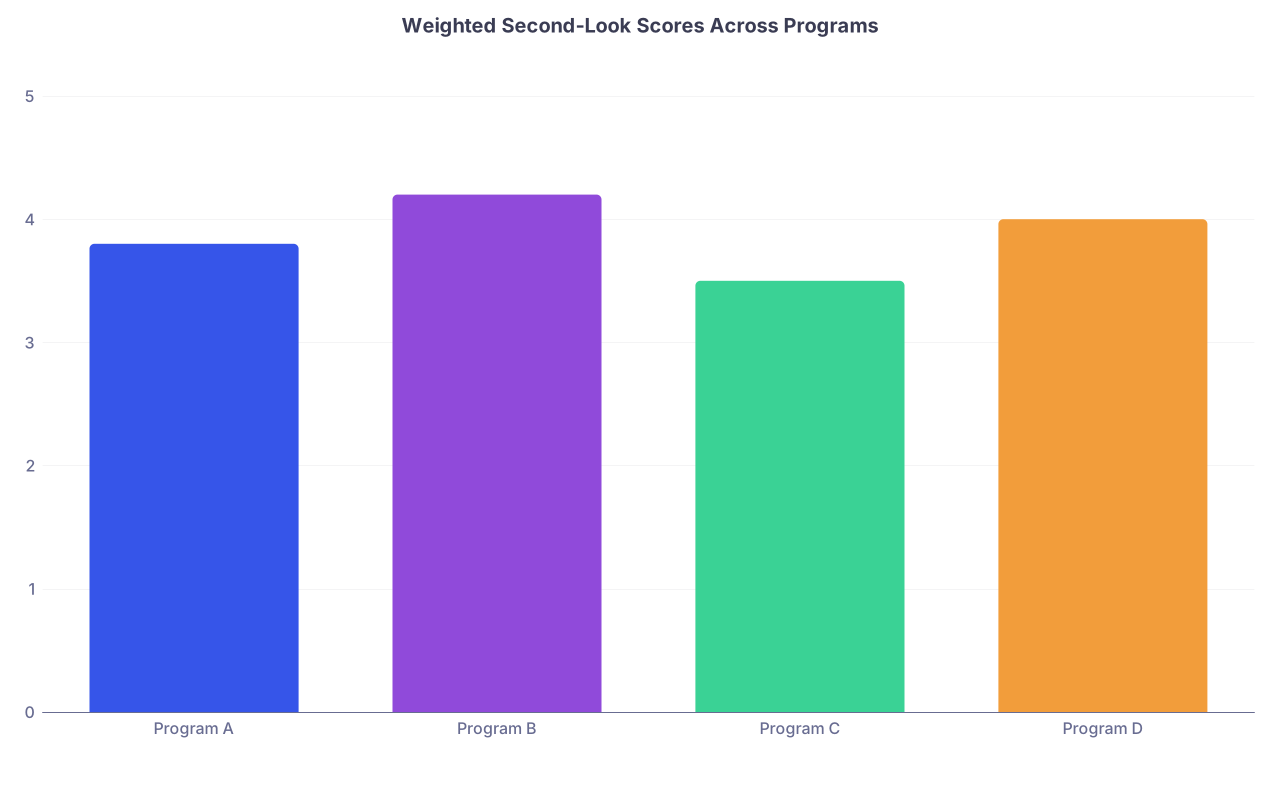
| Category | Value |
|---|---|
| Program A | 3.8 |
| Program B | 4.2 |
| Program C | 3.5 |
| Program D | 4 |
The chart does not tell you everything. But it forces you to confront situations like:
- Program B scored highest overall, but you emotionally want to like Program D. Why?
- Program C tanked on Culture and Leadership but did fine elsewhere. Is that acceptable to you?
Use the numbers as a starting point for reflection, not a replacement for judgment. If you are overriding the scorecard, you better have a clear, written reason.
Step 8: Capture Qualitative “Red Flags” and “Hell Yes” Signals
Numbers are tidy. Human impressions are not.
You need a separate section on your scorecard for:
- Red flags – specific, serious concerns that might overrule a borderline score.
- “Hell yes” signals – rare, powerful indicators of exceptional fit.
Examples of red flags:
- Multiple residents independently hint that leadership punishes feedback.
- PD dodges specific questions about a recent ACGME citation.
- You hear repeated comments about residents leaving mid-year or transferring out.
- Open talk of chronic violation of duty hours with encouragement to underreport.
Examples of “hell yes” signals:
- You meet a mentor who is clearly aligned with your academic niche and has a track record of placing people where you want to be.
- Residents consistently express that they feel protected and supported during their worst rotations.
- You leave the hospital mentally replaying how you would function there tomorrow and it feels natural, not forced.
Write these in full sentences, not cryptic notes. You will forget the context in three weeks.

Step 9: Time and Future-Proofing: How Stable Is This Program, Really?
This part gets ignored, then bites people.
The phase you tagged—“Miscellaneous and Future of Medicine”—is exactly where this matters. Programs are not static. Leadership changes, hospitals merge, service lines appear and disappear. Your second-look scorecard should explicitly check for forward trajectory.
Targeted questions for Program Stability and Future Direction:
- “Have there been any major leadership changes in the last 2–3 years?”
- “Any upcoming expansion or closure of key services (ICU beds, transplant programs, new cancer center)?”
- “Have there been any recent ACGME citations or major curricular overhauls?”
- “Are there any hospital mergers, buyouts, or system changes in progress?”
Why it matters:
- New PD: Could be a huge opportunity or a storm. Assess how residents feel about it.
- Expanding services: More cases and opportunities, but sometimes more service load dumped on residents without support.
- System mergers: EMR changes, contract shifts, even closure of smaller sites.
Capture this in your Stability domain and your red flag section. You are ranking your future experience, not the brochure’s past.
Step 10: Integrate Second-Look Scores With Your Overall Rank Strategy
Second looks are one slice of the decision, not the whole pie. You also have:
- Interview impressions
- Program reputation / name recognition
- Proximity to family or partner
- Financial tradeoffs (housing, cost of living, moonlighting)
So what do you do with the second-look scorecard?
Here is a pragmatic approach:
- Build a master spreadsheet with columns: Program, Interview Score, Second-Look Score, Reputation/Name Score, Geography Score, Final Rank Order.
- Decide approximate weights for each big bucket (for example: 40% second look, 40% interview, 20% name/geography).
- Let the combined weighted score generate an initial numeric order.
- Then adjust only when you have a clear, written reason to override the order.
You are protecting yourself from pure vibe-based ranking while allowing room for genuine insight.

| Step | Description |
|---|---|
| Step 1 | Define Domains and Weights |
| Step 2 | Collect Second Look Scores |
| Step 3 | Compute Weighted Scores |
| Step 4 | Combine With Interview and Other Factors |
| Step 5 | Generate Initial Rank Order |
| Step 6 | Adjust Rank Manually With Written Justification |
| Step 7 | Keep Numeric Order |
| Step 8 | Finalize Rank List |
| Step 9 | Any Strong Red Flags or Hell Yes Signals |
Practical Tips and Common Mistakes I Keep Seeing
A few patterns I have seen year after year:
Over-valuing one hilarious resident
You meet the funniest senior of your entire season on your second look. Great. But if everyone else looks exhausted and disengaged, do not let one personality override a weak culture score.Ignoring conflict between junior and senior narratives
PGY-1s often have a rosier, hopeful view. PGY-3s may be jaded. When the gap is extreme, something is off. Capture that in notes and score Leadership and Culture accordingly.Not adjusting for specialty
Surgical fields: autonomy, case volume, and fellowship support should get heavier weights.
Primary care–leaning IM: outpatient training, continuity clinic culture, and community connections matter more.
Adjust your domains and weights to reflect reality, not a generic template.Doing second looks without a plan
Walking into a second look with no written questions, no domains, and no scorecard is how you end up deciding based on “they had better food” and “the residents seemed nice.” You do not need a PhD-level instrument. But you absolutely need structure.
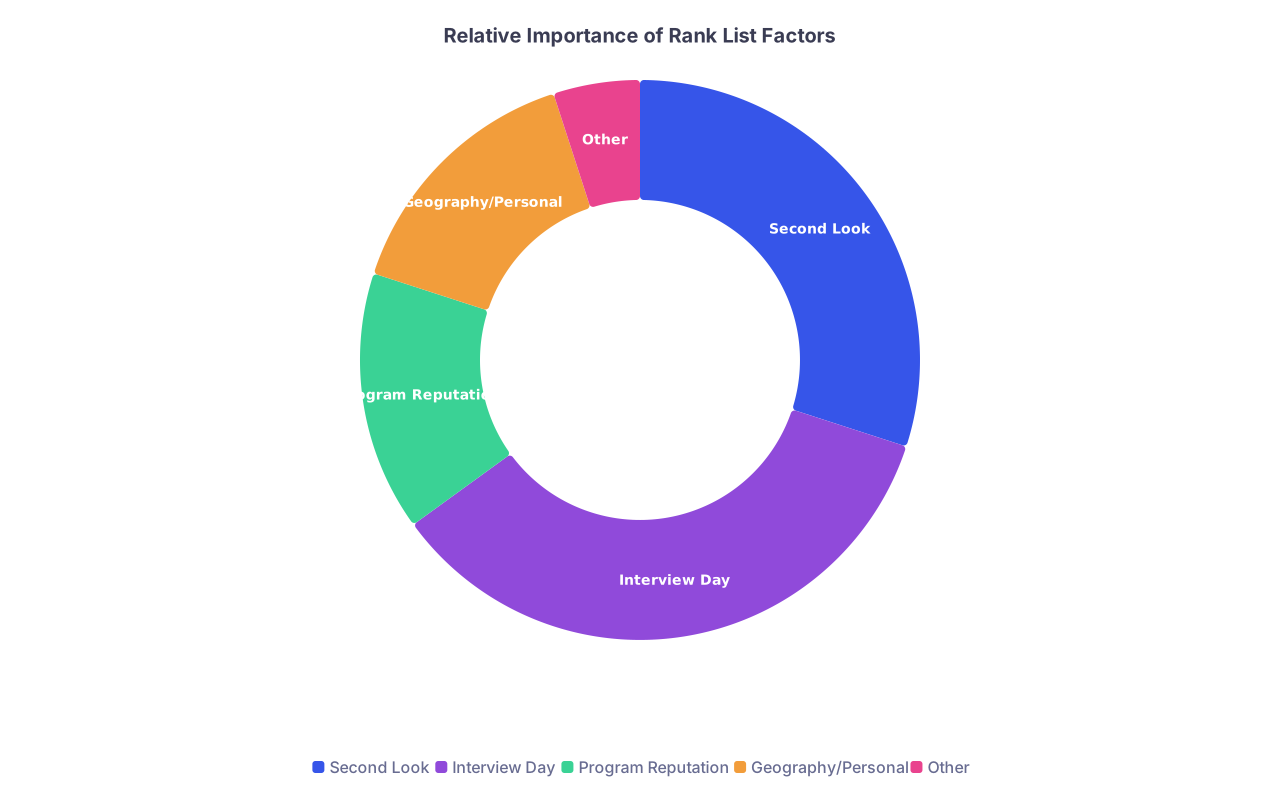
| Category | Value |
|---|---|
| Second Look | 30 |
| Interview Day | 35 |
| Program Reputation | 15 |
| Geography/Personal | 15 |
| Other | 5 |
A Simple Implementation Plan (So You Actually Use This)
You do not need perfection. You need something you will actually fill out.
This week
- Define your 6–8 domains.
- Assign weights totaling 100%.
- Build a one-page scorecard template (digital or printable).
Before each second look
- Review your domains and questions for 5 minutes.
- Add any program-specific questions you want to ask.
During the second look
- Take brief notes in your phone or on paper. Do not try to score in real time.
- Ask the same core questions at each site.
Within 24 hours after the visit
- Sit down for 20–30 minutes and fill in scores + comments.
- Flag red flags and “hell yes” signals.
After all second looks
- Compute weighted scores for all programs.
- Build your combined master sheet with interview impressions etc.
- Use that to construct your rank list, with any overrides justified in writing.
It is not glamorous. But it works.

FAQ (Exactly 5 Questions)
1. Do I really need to go to second looks for every program I am ranking highly?
No. You should prioritize second looks where you have genuine uncertainty or where new information is likely to change your rank position. If a program is clearly low on your list or clearly your top choice already and you have strong, reliable information, a second look may add little. But if you are torn between 3–5 top programs, a structured second look can absolutely break the tie in a rational way.
2. What if programs subtly pressure me to “show interest” by doing a second look?
That is their problem, not yours. The NRMP explicitly discourages using second looks as pseudo-interviews or loyalty tests. Your job is to use them as data-gathering visits, not performative enthusiasm tours. If a program starts hinting that your rank placement depends on a second look, that is a red flag for your Leadership and Culture domains.
3. How do I score a program when answers from residents are wildly inconsistent?
When narratives are all over the place, treat that as a data point. Inconsistency often reflects fragmentation: different attendings, variable rotations, or real internal tension. In your scorecard, you can:
- Average your numeric score for the domain to a 2–3 if you feel uncertain.
- Explicitly write: “Wide variability in experiences; unclear baseline.”
- Ding the Leadership and Stability domains if the inconsistency reflects poor communication or a chaotic system.
4. Should I let program reputation override a weaker second-look score?
Sometimes, but not casually. If a highly reputed academic center scores lower on culture and workload than a more mid-tier but very supportive program, you need to decide if the prestige differential genuinely changes your career trajectory (stronger fellowship matches, research pipeline, niche opportunities). If yes, you might rationally rank it higher. But write down why. If your only reason is “it is a big name,” be honest with yourself about what you are trading away.
5. Can I share my scorecard or notes with other applicants?
You can, but do it carefully. Your weights, values, and tolerances are not the same as your friends’. A miserable call schedule to you might be perfectly acceptable to a surgery-bound colleague. Sharing structured frameworks—domains, sample questions, weighting ideas—helps everyone. Sharing your raw numeric scores without context can be misleading and sometimes unethical if it turns into gossip about specific individuals. Use your scorecard primarily as your own decision tool, not a public review platform.
Key Takeaways
- Build a second-look scorecard with 6–8 clearly defined domains, a 1–5 scale, and explicit weights that match your priorities.
- Tie each domain to concrete tasks and questions during the visit, then score and write comments within 24 hours.
- Use the weighted scores as one structured input—combined with interview impressions, reputation, and personal factors—to create a rank list that reflects both your head and your gut, without being held hostage by vibes.