
How to Critically Evaluate Resident Wellness on a Second Look Day
You are walking behind an intern on a hospital tour. It is your second look day. They are pointing out the call rooms that “got renovated last year” and the wellness room “with snacks and a massage chair.” You glance at their face. Under-eye circles. Thin smile. Pager going off every three minutes.
The PD talk was full of “resident wellness is our top priority.” There is a slide with “Protected Didactics” and “Free Counseling Services.” On paper, they all say this.
You are not here for the brochure.
You are here to answer one question:
If I match here, what will my life actually feel like at 2:37 a.m. on a Tuesday in January?
Let me break down how to evaluate that with a little more precision than, “everyone seemed nice.”
Step 1: Ignore the Scripted Wellness, Watch the Baseline Vibe
Every program now has the same wellness talking points. Free food, EAP counseling, maybe a “Resilience Curriculum.” That tells you almost nothing.
Your job on second look is to read the baseline—what things feel like when no one is trying to impress you.
What to watch in the first 30 minutes
The moment you walk into the resident lounge or workroom, check three things:
Facial expressions and body language
Are people laughing occasionally? Or is it flat, quiet, transactional? Do they look like they live there (blankets, random shoes, personal mugs) or like they’re squatting in someone else’s office?How they talk about their day
Listen for tone.
“It’s been crazy but manageable.” → Normal.
“This month is a bloodbath, but next month is better.” → Also normal.
“It’s like this all the time.” said with a hollow laugh → Problem.Resident-to-resident interactions
Do seniors gently roast interns, or correct them viciously? Does anyone interrupt harshly? Do people help each other with scut (“I’ll discharge that one, you call the family”) or is it every person for themselves?
You are trying to answer:
Is baseline here tense or tired-but-functional?
Quick visual red flags
You are not diagnosing burnout by eyeballing people, but repeated patterns matter. If you see most residents with:
- Visibly poor affect (blunted, disengaged) across multiple PGY levels
- Workrooms that are chaotic, filthy, or clearly neglected
- People ignoring each other and glued to screens
- Chronic gallows humor that never turns off
…that often correlates with weak wellness culture. Not always. But often.
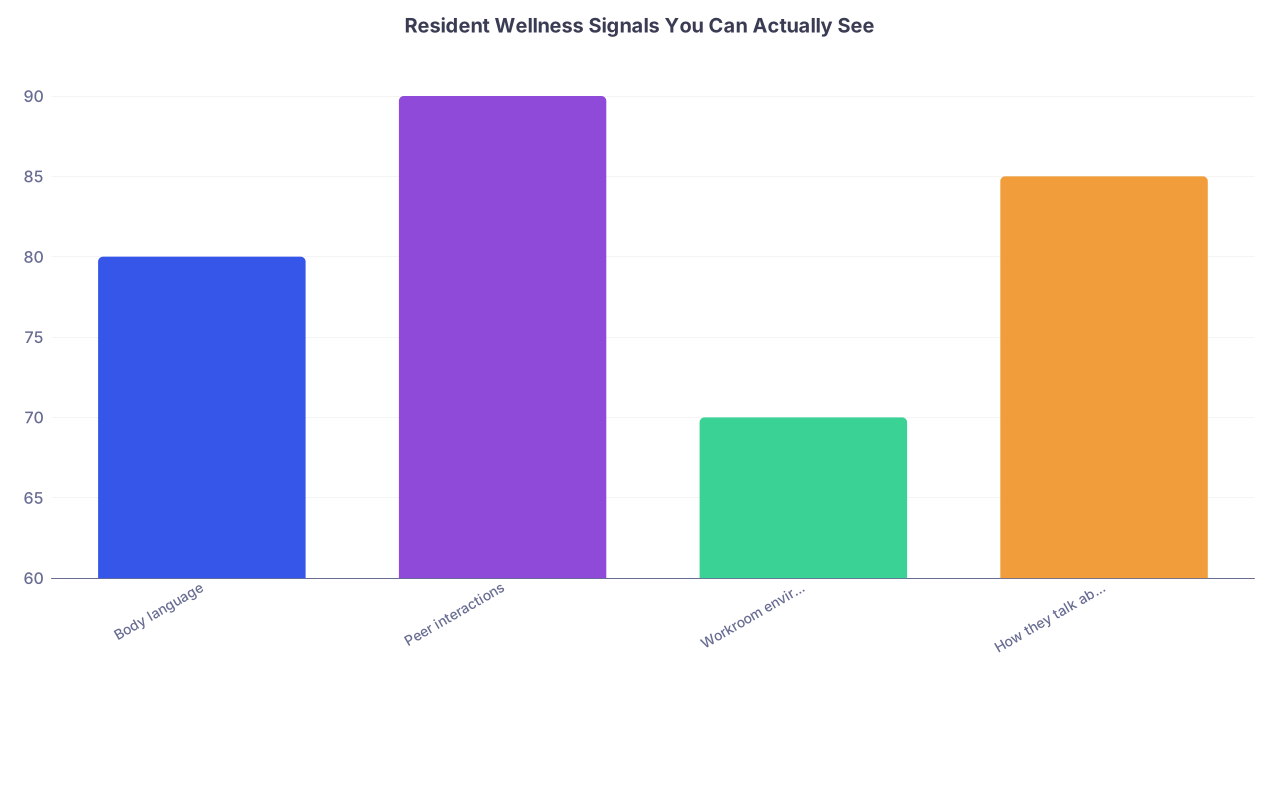
| Category | Value |
|---|---|
| Body language | 80 |
| Peer interactions | 90 |
| Workroom environment | 70 |
| How they talk about leadership | 85 |
(Think of those numbers as “how useful this is as a clue,” not percentages.)
Step 2: Ask About Workload Like You Are Doing a Root-Cause Analysis
Forget the word “wellness” for a minute. Wellness in residency is 70% workload structure and staffing, 30% culture and support. The schedule is the skeleton. Culture hangs on top of that.
You need real numbers.
The four core workload questions
Ask different people variations of these. Juniors and seniors. Categorical and prelim if relevant.
“What does a typical admitting call look like?”
Push for specifics:- Number of patients admitted
- Time they usually leave post-call
- How often they actually get to stop admitting at the cut-off time (e.g., 7 pm hard stop vs “soft” stop that no one respects)
“On your heaviest inpatient month, what does your week look like?”
You want:- How many days in a row
- Whether days off are real or get eaten by notes/studying
- Whether they can do basic life tasks (laundry, groceries) on those weeks
“How often are you here past the scheduled end of the day?”
Concrete:- “Scheduled end is 5, I’m usually out by 5:30.” → Fine.
- “Scheduled end is 5, nobody leaves before 7.” → That is two extra hours × 5 days = 10 hours/week of invisible overtime. Huge difference.
“Do you ever feel like you have to choose between being safe and following the rules?”
This is the quiet one. Does the work volume make them want to under-document, skip discussions, or fudge hours? If yes, wellness is already compromised by system design.
How to detect lying-by-omission about hours
No one is going to say, “Yeah, we violate duty hours all the time.” They will say:
- “We meet duty hours overall.”
- “We might go over occasionally on really busy rotations.”
- “It’s busy, but we are within ACGME limits.”
So you ask follow-ups:
- “On a night float week, when do you actually sleep?”
- “How many golden weekends did you actually get this year?”
- “Has anyone here ever filed a duty hour violation? What happened?”
If they say, “We never file; it creates issues,” that is a bad sign. It usually means:
- Either people are afraid of retaliation
- Or leadership subtly discourages honest reporting
- Or both
A functional program will say something like, “We file all the time; leadership uses it to fix bad rotations.”
Step 3: Translate “Wellness Initiatives” into Actual, Usable Things
Every program advertises wellness initiatives. Very few evaluate whether residents can actually use them.
Your question is not “Do they have wellness stuff?”
Your question is “What percentage of residents actually use this, and does anyone care if they cannot?”
Common wellness claims and what they really mean
| Claimed Feature | What You Need to Clarify |
|---|---|
| Free counseling / EAP | Is it off-site, confidential, and truly accessible? |
| Protected didactics | Are pages filtered? Does it actually stay protected? |
| Wellness days / mental health days | How many? Who approves? Any stigma to using them? |
| Team-building retreats / socials | Are residents excited or dread them as extra work? |
| Free food / snacks | 24/7 access or only at noon conference? |
Key follow-up lines you should use:
“How many people here have actually used the counseling services?”
If they say “we do not really know anyone who has,” it is basically vapor.“When you are on a heavy ICU month, can you realistically go to a doctor’s appointment?”
If the answer is “not really during that month,” wellness is still conceptual.“What happens if someone says they need to step away for mental health reasons?”
Listen for discomfort. Hand-wavy answers = they have no real process, or there is stigma.
Protected didactics is the canary in the coal mine
Ask: “How often is your protected time actually protected?”
Then watch the room.
- If they all say “always,” that is probably an exaggeration. Push: “Even on crazy admits days?”
- A realistic good answer sounds like: “80–90% of the time. On insane code days we miss, but chiefs will try to make it up, and you don’t get punished.”
If they openly state, “We constantly get pulled out of lecture to handle pages,” that tells you where education and wellness rank versus service.
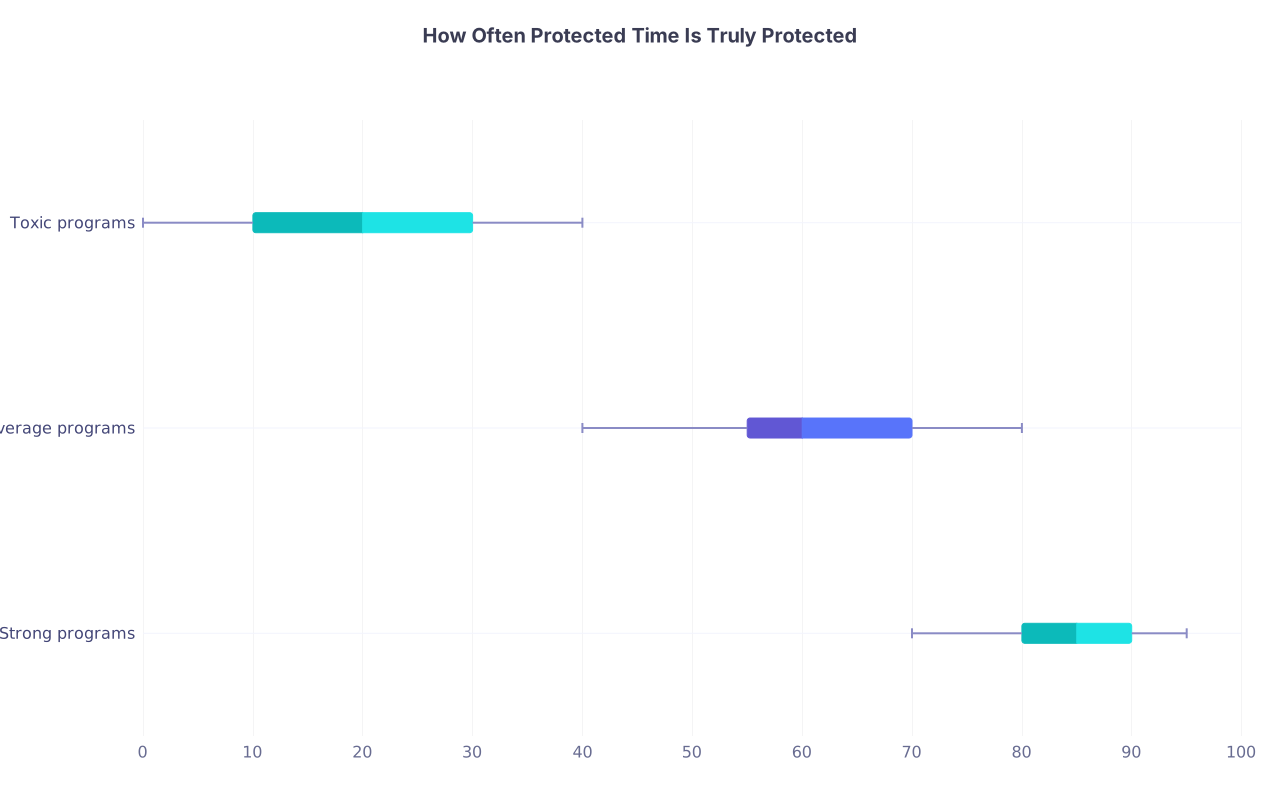
| Category | Min | Q1 | Median | Q3 | Max |
|---|---|---|---|---|---|
| Strong programs | 70 | 80 | 85 | 90 | 95 |
| Average programs | 40 | 55 | 60 | 70 | 80 |
| Toxic programs | 0 | 10 | 20 | 30 | 40 |
Step 4: Probe Culture Around Struggle, Pregnancy, Illness, and Mistakes
Resident wellness is not about free yoga. It is about how the program reacts when things go wrong.
You need to hit four pressure-test scenarios.
1. When someone is struggling academically
Ask: “What happens if a resident is struggling with exams or clinical performance?”
Good programs describe:
- Early feedback
- Structured remediation plans that are transparent
- Faculty mentors assigned, with clear expectations
- The resident ultimately succeeding more often than not
Toxic responses:
- “We do what we can, but some people just aren’t cut out for this.” (Shrug)
- “They get put on remediation, which is… intense.” (awkward silence)
- “We had someone leave; we do not really talk about it.”
You want to hear systems and support, not punishment and gossip.
2. Pregnancy, parental leave, major life events
This is a huge wellness stress-test.
Ask different residents directly (if it feels appropriate, usually a senior or chief):
“How does the program handle pregnancy and parental leave? Has anyone taken leave recently?”
Look for:
- Are they immediately tense/defensive, or do they answer comfortably?
- Do they mention actual numbers (weeks of leave, paid vs unpaid)?
- Do they rattle off specific examples (“Two of our seniors had babies this year, we rearranged schedules, it was annoying but it worked”)?
Red flags:
- “We support it… but it is definitely hard on the rest of the class.”
- “We do what the ACGME requires. Beyond that, it’s complicated.”
- They speak in vague policy language, no real examples.
3. Physical or mental illness
You ask:
“If someone here is dealing with depression, chronic illness, or needs time off for health, how is that handled?”
Strong program answer:
- “We encourage them to get care. Coverage is usually from jeopardy pool. We have had people take time off and come back; it is not career-ending.”
Weak program answer:
- “It is case by case.” (Translation: unpredictable and probably stressful.)
- “We try, but it is very disruptive.” (Translation: the sick resident is a burden.)
If a resident quietly says, “People just push through,” that is the culture. Believe that more than the PD’s email about “prioritizing mental health.”
4. When mistakes happen
Everyone makes errors. The question is: what then?
Ask: “How are errors handled here? Say you miss something on a patient. What happens?”
You want:
- M&M conferences that are system-focused, not blame-fests
- Support from attendings and seniors (“we talk it through, learn from it”)
- Clear processes for debriefing serious events
Bad signs:
- Residents talking about “getting thrown under the bus”
- Fear of documentation because of lawsuits or punitive responses
- People describing M&M with words like “brutal” or “public shaming”
Step 5: Use Informal Time Aggressively and Intelligently
Your biggest mistake on second look will be letting the program run the entire schedule. You need unstructured or minimally structured time with residents, and you need to use it well.
Optimize the pre- and post-event time
Arrive early. Stay after. The best intel often comes:
- Walking between conference and the tour
- At the end of a lunch when PDs/attendings walk out and residents linger
- When you are riding the elevator with one or two residents, no faculty around
Have 3–4 questions ready that you actually care about. For wellness, use variants of:
- “What made you stay here once internship got hard?”
- “What do you complain about most as a class?”
- “If your best friend were ranking this program, what would you tell them honestly?”
- “Where does this program actually fall short on wellness?”
That last one is critical. Do not ask, “What are the weaknesses?” generically. Tie it to wellness. People will often say:
- “Honestly, nights are brutal; we are short staffed.”
- “The off-service rotations are rough because we have less control of the schedule.”
- “Leadership is good, but admin is slow to fix systemic issues.”
Those negatives are data. Nobody has zero problems. You are deciding which problems you are willing to live with.
Watch how residents talk when leadership walks into the room
You will sometimes see this play out in real time:
- Residents animated and open → PD walks in → everyone goes quiet or stiff.
- Conversation goes from real stories to vague platitudes.
That gap between “resident-to-resident mode” and “PD-in-the-room mode” tells you about psychological safety. Massive shift = residents do not trust leadership. Small shift = normal professionalism.

| Step | Description |
|---|---|
| Step 1 | Residents alone |
| Step 2 | High psychological safety |
| Step 3 | Low psychological safety |
| Step 4 | Likely healthier wellness culture |
| Step 5 | High risk of hidden issues |
| Step 6 | PD or faculty enter |
Step 6: Look for Structural Signals Beyond What They Show You
Second look is theater. They will show you their best spaces. You need to scan for things they are not spotlighting.
Physical environment litmus tests
On your walk-through:
Call rooms
Are they actually used? Beds made? Clean sheets? Lockable? Mild mess is fine. Utter neglect is not.Resident lounge
Is it a real space or a repurposed closet? Natural light? Functional fridge/microwave? Whiteboard with schedules and silly doodles = people feel some ownership.Bathrooms
Yes, I am serious. If the resident-level bathrooms are perpetually disgusting, and no one cares, that tells you things about hierarchy and unseen labor.
Staffing and ancillary support
This directly affects wellness and burnout.
Ask:
- “How is nursing support? Do you feel like part of a team, or is it adversarial?”
- “Do you have phlebotomy overnight? Transport? Unit clerks?”
- “Who cleans up after a code or massive transfusion? Is it a team effort or mostly the resident?”
If residents say:
- “We draw all our own labs at night.”
- “We often end up doing transport ourselves when it is busy.”
- “Nursing turnover is high; it can be a struggle.”
This does not automatically kill a program. But if combined with high workload and weak support, that is a triple hit to wellness.
Step 7: Decode Leadership: Do They Have a Spine or Just a Slide Deck?
Program leadership drives culture. You want leaders who will actually take political hits to protect residents. Not just talk nicely.
Questions to ask leaders directly
You can be blunt, politely:
- “What concrete changes have you made to improve resident wellness in the last 2–3 years? And what data did you use to justify them?”
- “Have there been any rotations you had to fix or shut down because residents were burning out?”
- “What do you do when a service is too busy but the hospital is resistant to adding support?”
You are listening for:
- Specific examples (“We added an extra night float,” “We reduced max census,” “We pulled residents off a malignant off-service rotation”).
- Willingness to call out hospital admin conflict (“We had to push back on GME to get X done”).
If everything is generic—“we’re always working to improve wellness, we survey residents annually”—they may not have actual leverage or courage.
Check whether residents believe leadership
Best single question to a resident about leadership:
“If you bring a serious wellness concern to leadership, what actually happens?”
Answers that signal strength:
- “They may move slowly, but they do take it seriously; we have seen changes.”
- “Chiefs are very responsive; PD backs them up.”
Answers that signal weakness:
- “They listen, but nothing really changes.”
- “We vent, but mostly we just deal with it.”
Step 8: Compare Programs Using a Simple, Ruthless Framework
At this point your brain is overloaded. Every program blends together. Time to impose structure.
Divide what you have seen into 3 buckets:
- Workload reality
- Cultural safety and support
- Structural / institutional backing for wellness
Sketch something like this that night:
| Domain | Strong Program Signs | Weak Program Signs |
|---|---|---|
| Workload reality | Predictable, busy but bounded; real days off | Constant overrun, chronic extra hours |
| Cultural safety/support | Open talk about struggle; non-punitive errors | Fear, gossip, shaming, “push through” mentality |
| Structural wellness | Usable counseling, leave, protected time | Wellness “on paper” only, rarely used |
Then score each program you saw that month in each domain from 1–5. Do not overthink the numbers. You are forcing your brain to be explicit:
- Program A: 4 / 5 / 3
- Program B: 3 / 2 / 4
- Program C: 5 / 4 / 4
Program B may have the better name brand. But if its residents look dead and shrug at wellness questions, do not lie to yourself about what that means at 2 a.m. in the MICU.
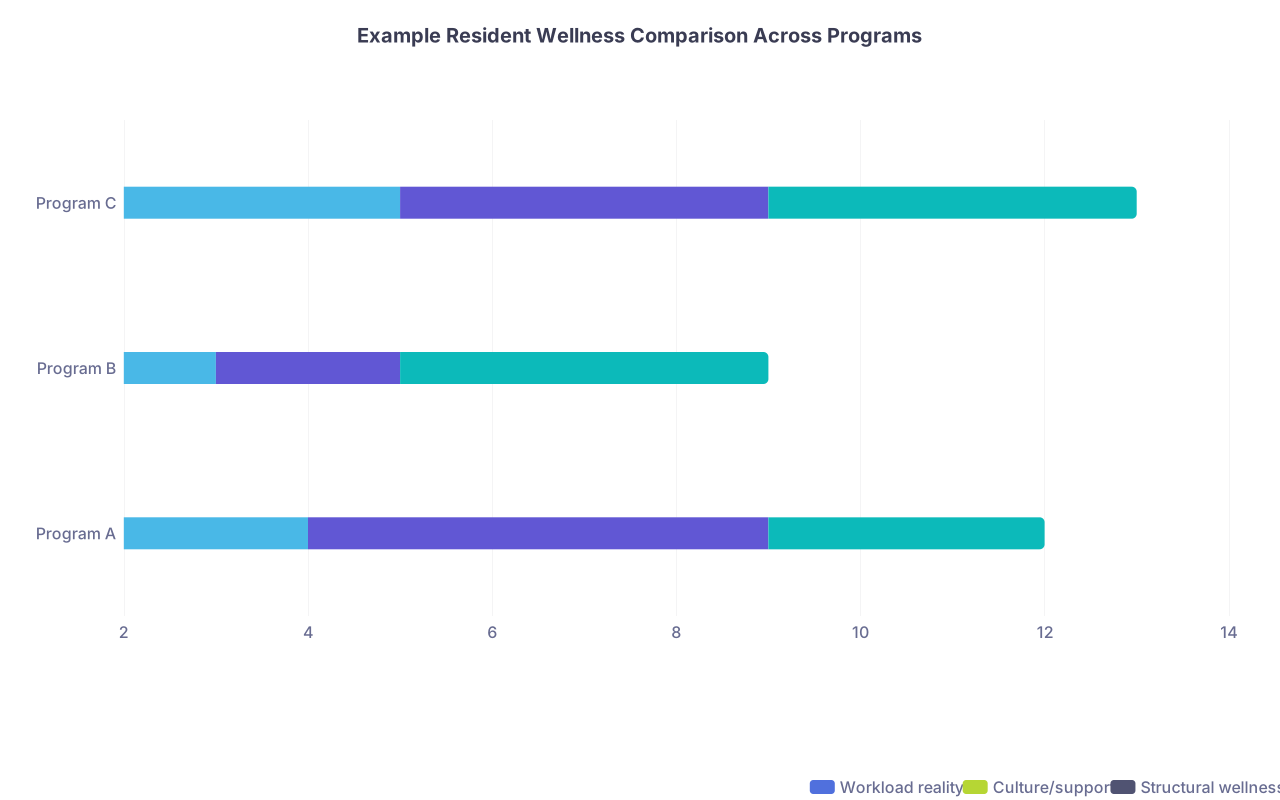
| Category | Workload reality | Culture/support | Structural wellness |
|---|---|---|---|
| Program A | 4 | 5 | 3 |
| Program B | 3 | 2 | 4 |
| Program C | 5 | 4 | 4 |
Step 9: Watch Your Own Internal Reactions
Last piece. Your body often notices before your brain articulates it.
When you left the hospital:
- Did you feel relief to be outside? Or mild sadness because you liked being there?
- On the drive home, were you thinking, “I could handle that,” or “I could grow there”? Those are different.
- Did you find yourself inventing excuses for obvious red flags because the program is prestigious?
Be brutally honest with yourself here. I have watched too many residents ignore that gut discomfort and then spend two years trying to survive malignant culture because “the name is so good.”
Residency will be hard anywhere. The question is not “Will I be tired?” The question is “Will I be tired and alone, or tired and supported?”
There is your decision.
Key Points to Carry Into Second Look
- Ignore the wellness slide deck. Anchor on workload structure, real schedule behavior, and how residents talk when leadership is not nearby.
- Pressure-test culture with concrete scenarios: pregnancy, illness, academic struggle, and mistakes. Wellness is just resilience theater if those are handled badly.
- Compare programs ruthlessly across workload, culture, and structural support—and then listen carefully to your own reaction as you leave the building. That mix will tell you far more than any “we care about wellness” slogan.