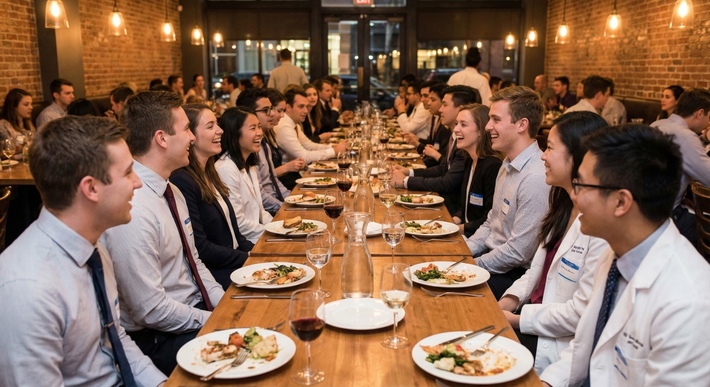
You are sitting in the back row of a noon conference during your second look. You have your visitor badge, a lukewarm coffee, and a program director somewhere in the building who swears this place “really values education.” Up front, a PGY-3 is presenting a case. Two attendings are on their phones. Half the residents straggle in ten minutes late. Someone is literally charting in Epic during the Q&A.
This is where you find out what the program actually is.
Forget the brochure language. Second looks live and die in conference rooms. Morbidity and mortality, noon conference, morning report, grand rounds, journal club—this is where the culture leaks out. If you know how to read it.
Let me break this down specifically.
1. Why Conference Dynamics Are Your Best Second-Look Data
Everyone polishes interviews. No one can fake three conferences in a row.
Teaching conferences are high-yield for one reason: they involve multiple layers of the hierarchy in real time, under only mild social pressure. People forget to stay “on script.” You see:
- How residents treat each other when they are not being observed one-on-one
- How attendings handle being challenged or being wrong
- How program leadership actually prioritizes education versus service
- How psychologically safe it is to speak up, guess, and not know
You are not there just to “watch a talk.” You are auditing culture.
If you walk away from a second look remembering the topic of conference but not how people behaved around it, you missed the main data.
2. The Core Conferences: What Each One Should Reveal
Different conferences show different layers of a program’s DNA. You should not treat them as interchangeable.
Morning Report
This is usually the highest-yield for resident culture.
What you are looking for:
Who runs it
- Best case: A senior resident runs the show, faculty facilitates. Residents own the space; faculty guide.
- Mediocre: Attending talks at residents, calls on them cold like a bad med school small group.
- Red flag: Program director or chief talks the entire time; residents are basically an audience.
How uncertainty is handled
- Healthy room: Intern ventures a wrong answer, people nod, someone builds on it, attending reframes and teaches without humiliation.
- Fragile room: Wrong answers draw visible winces, snark (“we just talked about this last week”), or the classic eye-roll from the back row. I have seen attendings do the slow head shake to a PGY-2. That program bled resident confidence.
Participation spread
- Good sign: Multiple levels talk—PGY-1s, PGY-2s, PGY-3s. Not just the loudest three personalities.
- Subtle red flag: One or two “superstars” answer every question; others lean back, silent, clearly conditioned to opt out.
- Strong program: Mix of bread-and-butter and high-yield zebras, explicitly connected back to common clinical decisions.
- Weak program: Pure zebras chosen to show off how “complex” the service is, with no clear teaching payoff. Lots of “we called all the services and transferred them to tertiary center” endings.
If you only get one conference to attend on a second look, push for morning report.
Noon Conference
Noon conference exposes how much the program really protects education versus just saying they do.
Do not listen to what they tell you about “protected time.” Watch what happens.
Signs of real educational protection:
- Pagers are handed to a jeopardy or float resident before conference starts. You see people physically hand them off.
- Attending or chief comes in and says, “If your pager is going off repeatedly, step outside, but otherwise, be here.” And they enforce it.
- The room fills before the talk starts, not 10 minutes into it. You do not see people trickling in from the ED clearly having just been told to “cover for a bit.”
Signs education is lip service:
- Residents answer multiple pages during conference and repeatedly leave the room, not for codes, just for routine issues.
- You hear, “Sorry, I was on the phone with the ED the whole time” as a normal, accepted thing.
- The attending covering the service barges in mid-conference for non-urgent issues.
Also pay attention to the speaker:
- If residents are mostly scrolling or doing notes, ask yourself: is it the content, or are they exhausted and conditioned that conference is busywork?
- If an outside speaker gives grand rounds quality teaching and residents are glued to the screen, that tells you they are hungry to learn when the content is good.
The dynamic between “we feed you and talk at you” versus “we expect you to think and engage” matters. You are training your clinical reasoning, not just your ability to look at slides.
M&M (Morbidity and Mortality)
M&M is where psychological safety lives or dies.
This is not optional to read correctly. You are looking for:
Who is “on trial”
- Healthy M&M: Focus is system, workflow, communication, handoff failures, unclear protocols. Individual errors are framed in a context of system vulnerability.
- Toxic M&M: A resident case is presented, then they get grilled. Attending uses language like “you should have known,” “this was basic,” or “this is not acceptable.” Everyone else shuts down.
Language choice
Notice words:- “We missed an opportunity to…” versus “You missed…”
- “The system allowed…” versus “The resident failed…”
One word changes everything.
Attending vulnerability
- Green flag: An attending stands up and says, “This was my patient; I made this call; here is where I think I got it wrong and what I would change.” That is gold.
- Red flag: Attending blames “the team,” “bed capacity,” “ED,” “night float,” but never their own cognitive errors.
Outcomes of discussion
If every action item is “residents need to…” (be more vigilant, call earlier, document better), you are in a blame culture. If you see real system fixes proposed—template changes, protocol updates, escalation pathways—you are seeing a learning culture.
If your second look does not include M&M, ask politely whether there is one scheduled and if you can attend. If they seem uncomfortable with that, I pay attention.
Grand Rounds
Less about resident culture, more about intellectual climate.
What you want to see:
- At least some residents asking questions, not just senior faculty.
- Questions that are curious, not performative. “How would you apply this to our population?” is different from “In my experience doing X research…”
The worry sign here is less that no one asks questions, and more that grand rounds clearly feels like an obligation, not a highlight.
3. Micro-Behaviors That Tell You Everything
If you remember nothing else: conference dynamics are about micro-behaviors. One example each.
3.1 How People Sit
Sounds trivial. It is not.
- Residents cluster together and mix across classes → cohesive.
- PGY-3s on laptops along the back wall, interns huddled up front looking tense → stratified, possibly fear-based.
- Attendings sit interspersed among residents, not in a “faculty row” at the back → flatter hierarchy, more approachable.
You can tell, very quickly, whether interns feel comfortable next to attendings or not.
3.2 Who Talks First After a Question
Presenter asks: “What is your differential for this hyponatremia?”
Watch the sequence:
- A PGY-1 whispers to a PGY-2; PGY-2 speaks up. That tells you they buffer their juniors, possibly in a good way or because they are afraid the intern might be humiliated. Context matters.
- Attending answers first, without leaving silence. That is a problem; it kills resident thinking.
- The same “gunner” PGY-3 always jumps in. No one stops them kindly. That speaks to poor facilitation.
The best rooms: the senior resident or faculty waits 3–5 seconds. Lets interns speak first. Then builds.
3.3 How Mistakes are Treated
You will see wrong answers. You should. You are at a training program, not a board review course.
Healthy patterns:
- “I like that you thought about X. That makes sense because Y. In this context, the piece that steers us away from that is…”
- “We used to do that more. Recent data suggests…”
Toxic patterns:
- Sarcasm: “Well, that is one option,” with laughter.
- Public shaming: “We should all know this by now.”
- Visible irritation when the same intern struggles.
You can feel tension in the room when a program is used to humiliation. People literally stop breathing as someone answers.
3.4 Laptop and Phone Culture
Nobody is 100 percent present in 2026. I am not asking for that. But:
- If 80 percent of the room is on laptop, clearly charting, conference is not protected or valued.
- If residents have Epic open but flip to listen during discussion, and no one is rounding during the talk, that is different.
- Watch faculty: if the attending leading the firm is on email the entire time, do you think their residents believe education matters?
I have seen programs where the PD sits up front with a notebook, engaged and asking questions. Residents follow that lead. I have seen others where leadership never shows. That is your signal.
4. What Different Behaviors Actually Predict For You
Step back and translate these signals into your day-to-day life as a resident.
](https://cdn.residencyadvisor.com/images/articles_svg/chart-conference-culture-patterns-and-what-they-predict-9097.svg "Conference Culture Patterns and What They Predict")
| Category | Value |
|---|---|
| Psychological safety | 80 |
| Protected education | 65 |
| Resident autonomy | 70 |
| [Faculty engagement](https://residencyadvisor.com/resources/second-look-visits/assessing-mentorship-strength-using-targeted-second-look-meetings) | 60 |
Those numbers are arbitrary, but the relationships hold.
4.1 Psychological Safety → Your Growth Curve
Programs with safe conferences produce residents who:
- Ask questions on rounds when they do not know
- Call for help earlier without fear of being shamed
- Are willing to acknowledge and analyze their own errors
Those residents get better faster. They make fewer repeated mistakes. They can tolerate feedback because they are not immediately worried it will be used against them.
On the flip side, the “fear conference” places do produce some very polished PGY-3s. But many of them rely on avoidance and self-blame, not on genuine clinical reasoning growth.
4.2 Protected Education → Burnout Risk
If you see that conference is constantly interrupted by pages, admissions, random tasks, you are looking at one slice of a larger pattern: service always wins. Burnout climbs.
Programs that truly protect conference time almost always:
- Have better coverage models
- Have more predictable off-service afternoons
- Honor time off the floor in other contexts too (vacation, interviews)
You cannot “self-care” your way out of a system that will not stop paging you during every teaching session.
4.3 Resident Autonomy in Conference → Autonomy on the Wards
Where senior residents run morning report well, they usually:
- Own the list on rounds
- Triage admissions intelligently
- Shield interns from nonsense they do not need to handle alone
If morning report is always run by attendings because “residents are too busy” or “not ready,” autonomy is often stunted elsewhere. You may get lots of attending-driven decisions, less chance to practice making the call.
4.4 Faculty Engagement → Mentorship
Faculty who show up to conference, ask thoughtful questions, and hang around after to chat are the same ones who invite residents onto research projects, write strong letters, and actually know your name.
If, at your second look, you barely see any consistent faculty faces at education, ask yourself where your mentors are coming from.
5. Watch the Interactions, Not the Slides
You are not there to judge the quality of the actual talk content. You are evaluating the relational behavior around it.
5.1 Presenter–Audience Dynamics
Ask:
- Does the presenter seem terrified of certain attendings? You will see them glance to the back after each slide, waiting for criticism.
- When someone asks a question, does the presenter get cut off mid-answer by a “more correct” attending?
- Are residents allowed to not know? Presenters who say “I am not sure; I looked and did not find a good answer” and are met with “let us find out” instead of “you should have prepared that” are in a better environment.
5.2 Resident–Resident Dynamics
Listen for:
- Quiet side coaching: PGY-3 leaning over to intern, explaining something softly during a sub-specialty-heavy part. That is mentorship.
- Public undermining: “You do not know this? We covered it on day one.” Done by a peer. You will be living with that.
5.3 Leadership Presence and Nonverbal Cues
If the PD or APDs attend, watch them more than the slides.
- Do they smile when interns try, even if they are wrong?
- Do they nod along and amplify good faculty behavior?
- Do they pick up on micro-aggressions or dismissiveness, or do they visibly ignore them?
You are essentially asking: Is there an adult in the room who protects the culture, or is it laissez-faire chaos?
6. Concrete Things to Do During Your Second Look
Let me get very specific. Do not just “observe conferences.” Run a mini field study.
6.1 Before Conference
- Ask the chief or coordinator: “What conferences do residents here value the most?” Their answer tells you something.
- Ask to see the conference schedule. Programs that consistently cancel for service needs? That pattern repeats.
| Item to Watch | What You Want to See |
|---|---|
| Who runs morning report | Senior resident, not PD |
| Pagers during noon conference | Handed off / quiet |
| M&M tone | System-focused, not blame |
| Faculty attendance | Consistent core presence |
| Resident questions | Interns and seniors both |
6.2 During Conference
Pick one or two of these per session, not all:
- Count how many interns speak at least once.
- Note the exact phrases used after a wrong answer.
- Glance at how many screens are clearly Epic versus just note-taking.
- Look at who sits where and whether that changes between sessions.
You are not doing research here. You are just raising your observational resolution.
6.3 After Conference: Ask Targeted Questions
Do not ask, “So how are conferences here?” You will get rehearsed fluff.
Try:
- “What conference do you feel is most high-yield versus most performative?”
- “When someone really messes up, where does that tend to get discussed—M&M, one-on-one, never?”
- “Are there any attendings people try to avoid presenting in front of?” The way they answer is more important than yes/no.
- “Has conference ever changed an actual workflow or policy here?” If they cannot think of a single example, M&M might be theater.
You will see residents either light up and tell you a story (“We changed the sepsis order set after that case…”) or shrug and change the subject.
7. Reading the “Future of Medicine” Angle in Conferences
Your prompt mentions “Miscellaneous and Future of Medicine.” That is not just fluff. Conference dynamics also tell you whether a program is living in 2005 or 2030.
7.1 Evidence Literacy
Journal clubs and case discussions should show you:
- Are residents comfortable critiquing trials, or do they accept “guidelines say so” as the end of discussion?
- Do attendings ask, “What are the limitations of this study?” or just “What did the authors conclude?”
Programs that train you for the future:
- Teach skepticism and nuance
- Emphasize absolute versus relative risk
- Bring in implementation questions: “How do we apply this RCT to our safety-net population?”
Programs that are stuck:
- Read the abstract, then tell you what to do
- Punish dissent from “how we have always done it”
7.2 Technology and Data Culture
Look for subtle things:
- Are they experimenting with decision support tools, quality dashboards, or AI scribes and openly discussing their strengths/limits?
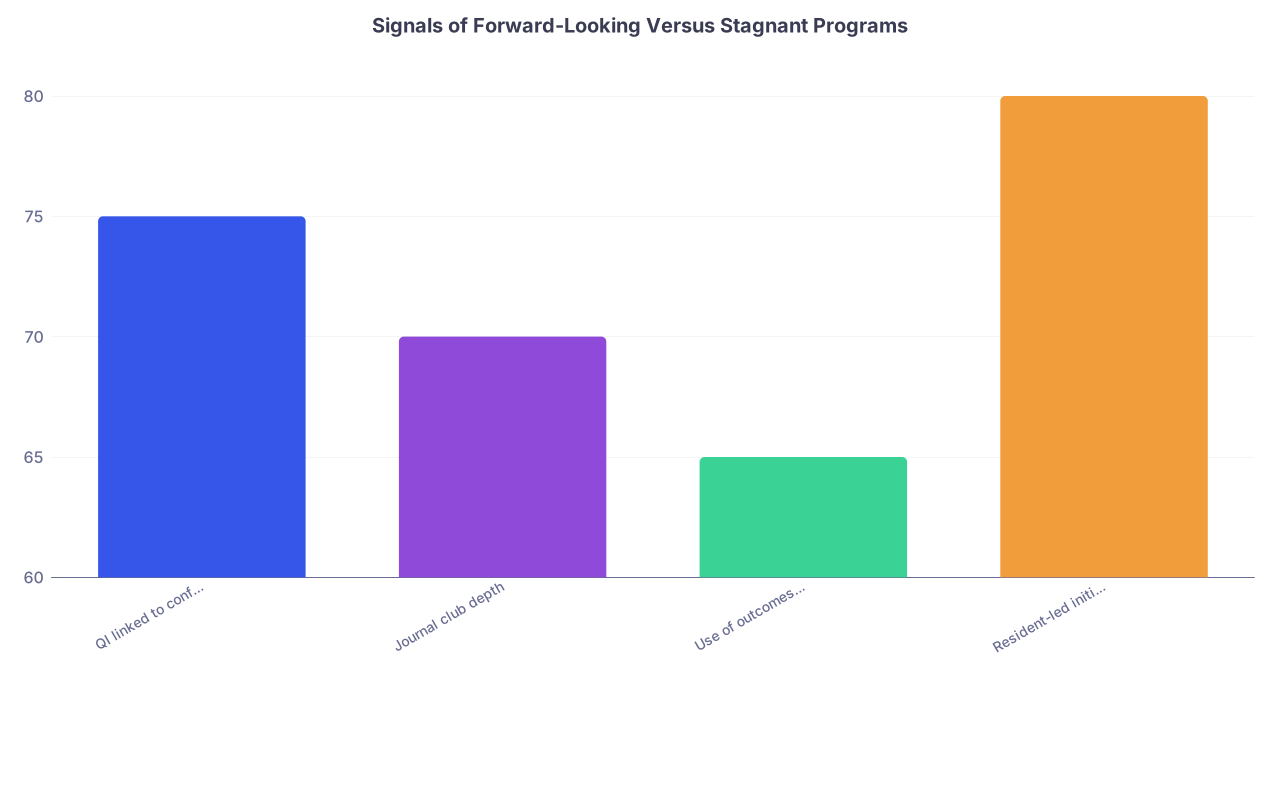
- Are QI projects actually presented and connected to patient outcomes, or just abstract boxes to be checked?
| Category | Value |
|---|---|
| QI linked to conference | 75 |
| Journal club depth | 70 |
| Use of outcomes data | 65 |
| Resident-led initiatives | 80 |
Again, numbers are illustrative. The pattern is not.
If a resident presents a QI project and leadership engages thoughtfully, asks, “What do you need to scale this?”, and a year later they talk about updated data, that is a system investing in the future.
7.3 Interdisciplinary Presence
Future-facing programs blur silos.
In conference, this looks like:
- Pharmacy regularly present and speaking up
- Nursing or case management occasionally part of discussions involving throughput, discharge, safety
- Subspecialists invited to weigh in, but with clear attention to generalist takeaways
If every conference is physician-only, single-discipline, never touches systems-level issues, you are being trained narrowly.
8. Common Patterns and What They Should Trigger in Your Rank List
Let me be blunt. If you see these, think carefully.
Pattern 1: Beautiful Slides, Terrible Room Vibe
- Polished, evidence-heavy talk
- Presenter clearly over-prepared, anxious
- Audience silent, tight, minimal questions
- One or two attendings pounce on small errors
Prediction: You will learn a lot of facts, but at the cost of chronic anxiety. Growth via fear. Burnout risk high. Rank lower unless you are very comfortable in high-pressure, low-safety environments (and even then, I question that choice).
Pattern 2: Chaotic Conference, Everyone Paging, “We’re Just Busy”
- Speaker constantly interrupted
- People wander in and out to answer non-urgent pages
- Leadership shrugs and says, “We are a very busy hospital”
Prediction: Service dominates. You will “learn by doing,” but structured teaching suffers. Rank this lower if you know you need protected cognitive space to consolidate.
Pattern 3: Modest Production Value, Strong Engagement
- Slides are basic, maybe ugly
- Cases are common but framed with good questions
- Many voices contribute; wrong answers are normal and welcomed
- Clear system-changes mentioned as outgrowth of M&M
Prediction: This is often where residents come out the most well-rounded. It does not photograph well for brochures, but your day-to-day is better.
Pattern 4: Faculty-Only Show
- Morning report always led by attendings
- Residents mostly passive
- Questions go from attending to attending; residents are spectators
Prediction: Autonomy may be limited. You might feel “safe” but underdeveloped. Good if you are risk-averse or anxious early, but ask seniors how they feel applying for fellowships or independent jobs.
9. Putting It All Together on Your Second Look
Here is a simple way to integrate what you see, so it actually affects your rank list.

| Step | Description |
|---|---|
| Step 1 | Attend 2-3 conferences |
| Step 2 | High risk for toxic culture |
| Step 3 | Strong consideration high rank |
| Step 4 | Good culture but service heavy |
| Step 5 | Rank lower unless major offset |
| Step 6 | Depends on your tolerance |
| Step 7 | Psychological safety present |
| Step 8 | Education truly protected |
You do not need a rubric with 50 domains. Ask yourself three blunt questions:
- Do I feel comfortable imagining myself asking a question in that room and getting it wrong?
- Would I trust these seniors and attendings to have my back when I am over my head at 3 a.m.?
- Did they clearly prioritize education over service at least some of the time, in real life, not in their brochure?
If the answer is “no” to more than one, you have your answer.
FAQ (Exactly 4 Questions)
1. What if I only get to see one conference during my second look—which should I prioritize?
If you have to choose, push hard for morning report. It gives you the richest snapshot of resident autonomy, psychological safety, and everyday teaching. Noon conference is next best for seeing whether “protected time” is real or not. M&M is extremely high yield if you can attend, but schedules do not always line up with second looks.
2. How do I interpret it if residents are quiet during conference—does that always mean the culture is bad?
No. Silence can mean fear, boredom, exhaustion, or just a bad topic. You have to look at context. If residents are animated and open with you one-on-one, but flat in conference, I start to suspect the power dynamics in that room. If they are quiet everywhere, it may be more about burnout than toxicity. Ask follow-up questions after: “Is conference usually like that?” and judge their reactions.
3. What if the program warns me that “today was abnormal” because of service demands or a weird schedule?
Everyone says that. Treat it like an attending saying “the exam is not that bad.” Maybe true, maybe not. One off day is fine, but specific details matter. A genuine “abnormal day” has concrete reasons (“We had two simultaneous codes; we pulled people mid-conference”). Vague handwaving—“We are usually more engaged”—without any examples from residents of better days is less convincing.
4. Should I tell programs I am evaluating conference culture this closely, or just keep my impressions to myself?
You do not need to advertise that you are dissecting their micro-behaviors. Just ask smart questions and watch. On your side, take notes right after the visit while details are fresh—who spoke, how mistakes were handled, what interruptions occurred. When you sit down to build your rank list, you will not remember the exact slide decks, but you will remember how each room felt. That feeling is often a more reliable predictor of your next three years than almost anything you hear on interview day.
With these conference lenses sharpened, you are no longer just a visitor in a lecture hall. You are reading the room for what it will be like to grow, fail, and eventually teach there yourself. Once you can do that, you are ready for the next step: using those impressions to build a rank list that actually matches where you will thrive—not just where the brochure looks good. But that is another conversation.