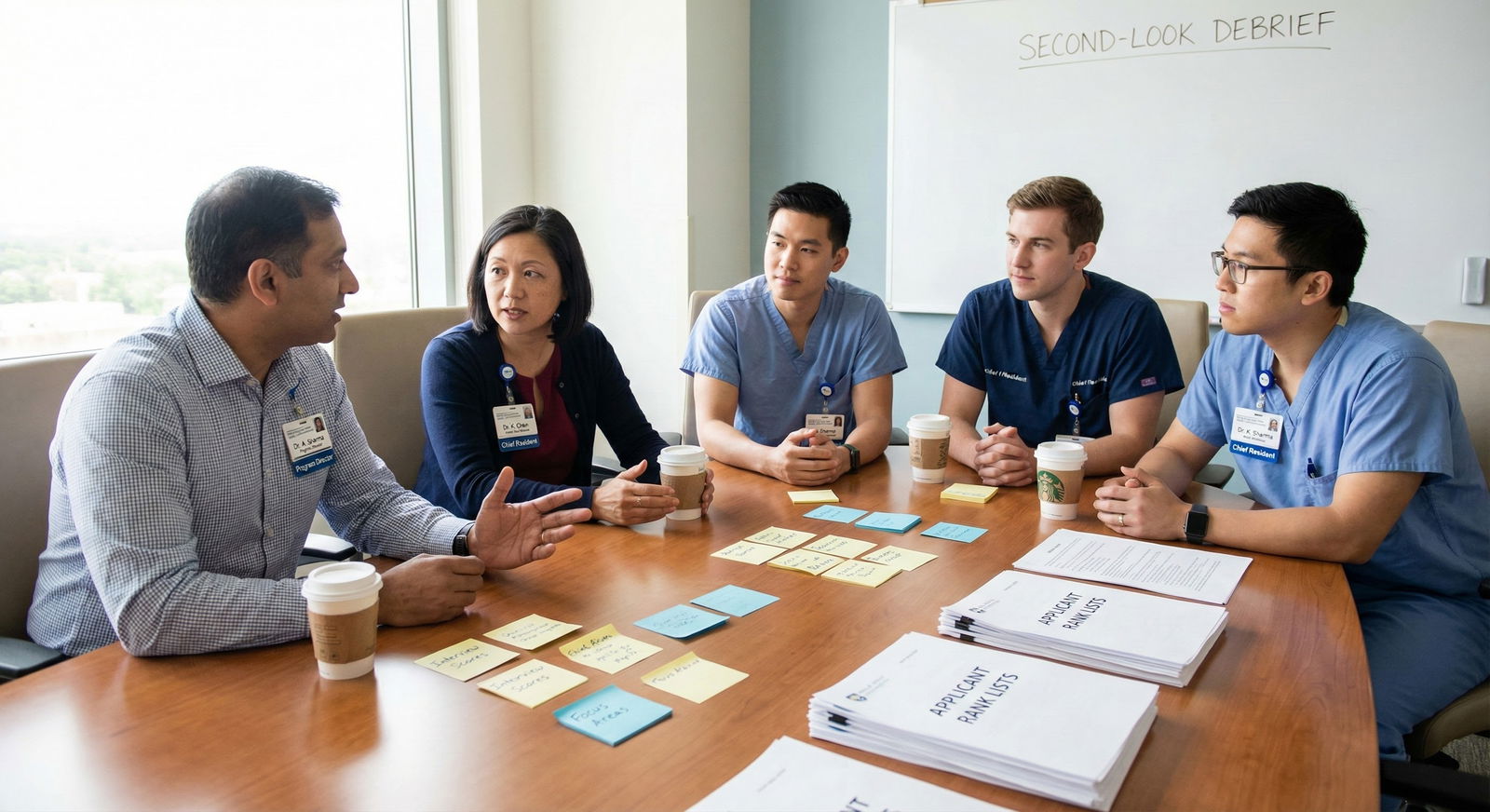
The biggest mistake applicants make at second looks is believing the glossy slide that says “high volume” instead of walking out of that conference room and verifying it with their own eyes.
Let me break this down very specifically: second look visits are the single best chance you will ever have to ground-truth a program’s procedural volume and case mix. Not vibes. Not branding. Actual throughput and complexity. If you use them like a social mixer, you are wasting them.
Why Procedural Volume and Case Mix Should Dominate Your Second Look
If you care about procedural competency—and in any procedural or procedure-heavy field you absolutely should—then three questions dominate:
- How many cases will you personally do?
- What is the complexity and diversity of those cases?
- Who actually gets to do what, and when?
Everything else (lifestyle, location, food stipend) will mean very little if you graduate undertrained and spend your first attending year learning things you were supposed to master as a resident.
Programs will all tell you the same lines:
- “We’re a high-volume Level 1 center.”
- “Our residents are extremely well-prepared for fellowship or practice.”
- “You will get plenty of hands-on experience.”
None of that means anything without context. “High volume” for a small community program may mean 3 lap choles a day. “High volume” for a major tertiary center might mean 10+ complex GI cases running in parallel. Second looks are where you stop trusting adjectives and start collecting numbers, patterns, and specific examples.
Step 1: Prepare a Volume and Case-Mix Checklist Before You Go
You should not walk into a second look hoping to “see what it’s like.” You walk in with a defined checklist focused on volume and case mix, tailored to your specialty. Write it down. Use it.
Think in categories:
- Global program volume
- Resident-level experience
- Case complexity and referral pattern
- Autonomy and case ownership
- Call structure and its impact on cases
- Fellowship vs no-fellowship dynamics
For example, for surgery, EM, anesthesia, OB/GYN, IR, cardiology, GI, etc., you should know the ACGME or board minimums and target well above them.
| Field | ACGME-ish Minimum* | Strong Program Target |
|---|---|---|
| General Surg | ~850 major cases | 1000–1200+ |
| EM (peds) | ~25 peds resusc | 40–60+ |
| Anesthesia | ~40 neuraxial | 100+ |
| OB/GYN | ~145 vaginal deliv | 200–250+ |
| Cards (cath) | ~250 coronary dx/tx | 350–450+ |
*Numbers change; check current requirements for your specialty. The point is the margin above minimums.
Go into the second look with 10–15 specific questions that aim straight at these issues. You do not need to ask all of them to everyone; you do need them in front of you so you do not get distracted.
Step 2: Decode the “High Volume” Claim With Hard Data
You will get some version of a tour, meet-and-greet, and maybe conference. Use each part to extract data. You are not just being polite; you are investigating.
Places to look for real numbers
Resident case logs / board prep binders
- Ask seniors bluntly:
“About how many [key procedure] cases are you logging by graduation?”
“Are people worried about reaching minimums in any category?” - If someone says, “Yeah, hyst cases are a little tight, people have to chase them at the VA,” that is a red flag and a data point.
- Ask seniors bluntly:
OR / procedure room schedule boards
- During the tour, look at the OR schedule boards. How many rooms running? What time of day is it?
- What types of cases are listed? Endless bread-and-butter? Any complex or rare stuff?
- Weekday mid-morning with three out of ten ORs running is not “high volume” for a supposed flagship tertiary center.
ED tracker boards (for EM, off-service rotations)
- How many patients are in beds vs waiting room?
- How many trauma or high-acuity patients?
- Ask EM residents: “On an average shift, how many intubations/procedures do you personally do?”
Didactic schedules and morbidity & mortality (M&M)
- Skim: what kind of cases are discussed? Level of complexity? Only “routine” things, or difficult complications and advanced pathology?
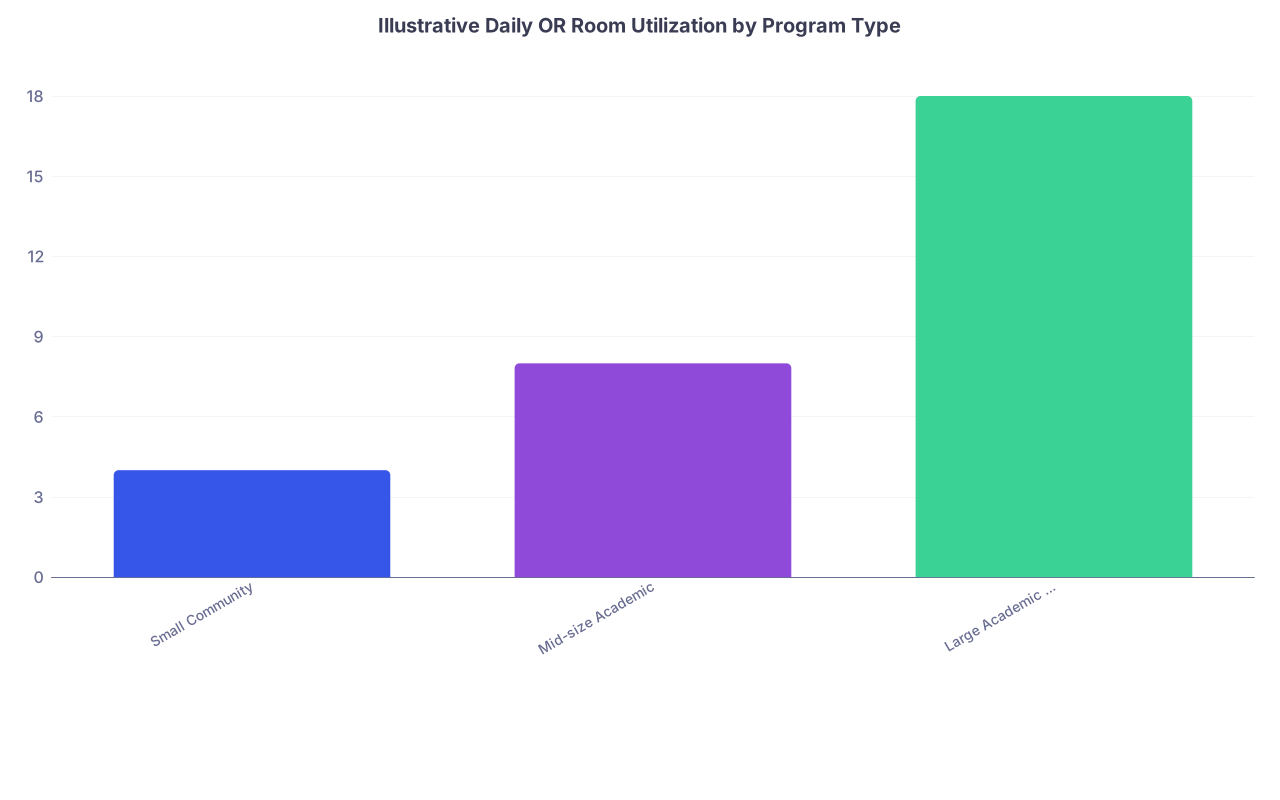
| Category | Value |
|---|---|
| Small Community | 4 |
| Mid-size Academic | 8 |
| Large Academic Tertiary | 18 |
The right questions to ask (with translation)
Here are concrete questions and what you are actually trying to uncover:
“What does a typical OR day look like for a PGY-3 on [key rotation]?”
Translation: How many rooms, how many cases, and how much of the case do they do?“Do you routinely finish your minimums early, or is there a rush at the end to fill certain categories?”
Translation: Are they barely scraping together requirements, or comfortably exceeding them?“Are there any procedures that residents tend to feel weak on at graduation?”
Translation: Where are the holes?“How does the case distribution work when fellows are in the room?”
Translation: Do fellows take all complex cases, or is there meaningful shared autonomy?“Have any residents ever had trouble qualifying for boards because of case numbers?”
Translation: Structural volume problems.
When you hear answers, you are listening for patterns across residents, not one person’s anecdote. One PGY-2 saying “I have not done many [X] yet” is less meaningful than three seniors independently telling you “everyone fights for those cases.”
Step 3: Read the Case Mix, Not Just the Count
High raw volume of simple bread-and-butter cases is not enough for many specialties. You want a mix that builds a full skill set: bread-and-butter + moderate complexity + referral-level pathology.
Signs of a strong case mix
Referral base clearly defined
“We get all the complex hepatobiliary from a 3-state region.”
“We are the only Level 1 trauma for 2 million people.”Specific advanced procedures done in-house
For surgery: complex HPB, esophagectomies, advanced MIS, vascular, redo operations.
For EM: high trauma volume, cardiac arrests, airway challenges, real pediatric acuity.
For cards: CTOs, structural interventions, complex EP cases, device extractions.
For OB/GYN: accreta spectrum, complex MIGS, gyn onc, urogynecology.M&M and conference cases that are not all cholecystectomies and appendectomies
If the “hard case” of the month is a straightforward lap appy with a slightly delayed diagnosis, that tells you something.
Red flags in case mix
Major pathologies routinely transferred out:
- “We send all pediatric cases to another hospital.”
- “We transfer most complex vascular to a nearby private group.”
- “All major gyn onc is done by a separate team without residents.”
Narrow exposure:
- OB program where residents almost never see VBACs, complicated twins, or accreta.
- EM program where trauma is mostly low-mechanism falls and lacerations, with most penetrating trauma going elsewhere.
- Cards fellowship where nearly all caths are stable diagnostic studies, with interventions managed by attendings or structural specialists.
You want to hear things like, “There is nothing we do not do here,” backed by examples. If everyone sings that line but cannot give specific cases they personally handled, question it.
Step 4: Observe Real-Time Workflow and Throughput
Watching one day of operations at a second look can tell you more about volume and case mix than any brochure.
What to watch during OR or procedure observations
If your second look allows OR / cath lab / EP lab / L&D / endoscopy shadowing, pay attention to:
Turnover times
If it takes 90 minutes to turn over a room between lap choles, your “high volume” potential gets crushed. You want to see rooms moving.Concurrency of cases
One attending running one room with long breaks is different from attendings managing two rooms with a steady pipeline.Who is doing the key portions
Watch: is the resident doing the approach, the critical parts, and closure, or are they just holding the camera/scope?Resident presence vs tokenism
If you repeatedly see attendings (or APPs) doing entire procedures while residents stand back, that is a structural autonomy problem.
For EM or ICU, do the same sort of observational scan:
- How many resuscitations in a given shift?
- How quickly are beds turning over?
- Who owns procedures—residents, fellows, or attendings?
L&D specifics (OB/GYN, FM, EM)
On L&D, track a few basic metrics in your head over a few hours:
- How many deliveries during that time block?
- How many C-sections are being done, and who is primary surgeon?
- Any operative vaginal deliveries? Who does them?
If no one has seen an operative vaginal delivery in months, that is a serious gap in exposure in many markets.
Step 5: Dissect Resident-Level Experience and Case Ownership
Program volume does not matter if you never touch the cases yourself. Second looks are when you verify that residents actually own the procedural work.
How to probe autonomy without sounding like a jerk
Try questions like:
- “On a typical day as a senior on [service], what parts of the case are you doing independently?”
- “Are there rotations where you feel like an observer more than an operator?”
- “How often do you run a room / resus by yourself, with attendings available but not scrubbed/in the room?”
Residents will tell you the truth—especially away from faculty.
Key things you want to hear:
Clear graduated autonomy:
- PGY-1: exposure and basic parts of cases
- PGY-3: running rooms, doing full bread-and-butter cases
- PGY-5 chief: primary on complex, with attending unscrubbed or acting as assistant
Explicit expectations:
- “On nights, chiefs are first-call for all emergent laparotomies unless they are drowning, then juniors help.”
- “Third-years run the trauma bay under attending supervision.”
Things that should make you skeptical:
- “It depends on the attending” used too often as a dodge for autonomy.
- “Fellows do the cool parts, we help” as a persistent pattern.
- “We get our numbers, but a lot are double-scrubbed or just assisting” said quietly.
Autonomy is not vibes. It is time at the table, time with the scope, time with the ultrasound probe. Second looks are where you measure that.
Step 6: Understand the Impact of Fellows on Your Case Mix
Fellows are not automatically bad for your operative or procedural volume. But they absolutely change the ecosystem. You need to see how.
Good fellowship-residency dynamics
You want structures where:
Fellows handle the super-niche, residents still get:
- Bread-and-butter + moderate complexity
- Early exposure to high-end cases, later primary operator roles on selected cases
Explicit case assignment policies:
- “All basic laparoscopy is resident-driven. Fellows take the very complex oncologic cases.”
- “Resuscitations are resident-run, fellows are there for advanced procedures or as back-up.”
Residents feel training is better because of fellows:
- “Our fellows teach us the newest techniques.”
- “We get exposure to structural interventions that most programs do not offer.”
Bad fellowship-residency dynamics
Red flags:
Residents repeatedly say:
- “We do not see those cases; the fellows always scrub.”
- “You can get those cases if you aggressively ask, but the default is fellows.”
- “We had to fight to get credentialed for [key procedure] because fellows usually did them.”
Autonomy suppressed:
- Fellows function as junior attendings and push residents to the side.
- Complex or interesting cases are automatically assigned to fellows.
Use second looks to ask both residents and fellows the same questions and see if their stories match.
Step 7: Use Second Looks to Quantify Call-Related Volume
A huge chunk of procedural experience, particularly in procedural specialties, comes from call. Busy nights. Emergencies. Resuscitations. You need to know how often those actually happen and who does what.
What to ask about call and nights
Targeted questions:
- “On a typical 24-hour call as a senior, how many emergent cases do you do?”
- “How many intubations / central lines / chest tubes / emergent C-sections do you personally perform in a busy call month?”
- “Are there ‘dead’ call sites where you mostly sit and wait, or are all sites active?”
You are trying to map:
- Frequency of high-acuity events.
- Degree of resident ownership over those events.
- Whether those events are spread across many residents or concentrated in a few.
Matching self-reported call volume to system data
If the hospital is supposedly a “busiest in the region” Level 1 trauma center, but every resident describes call as “pretty chill,” something is off. Either trauma is not as high as advertised, or residents are not primarily managing it.
Second looks sometimes let you see a call room, ED board, or trauma bay. You do not need hours of observation. Ten minutes can tell you if the place is humming or quiet.
Step 8: Look for Structural Bottlenecks That Kill Volume
Programs may have good pathology and reasonable referral volume, but structural issues choke procedural opportunities. You want to pick up signs of that during your second look.
Common bottlenecks:
Chronic OR or cath lab underutilization because of:
- Staffing shortages (nursing, anesthesiology, techs).
- Poor scheduling.
- Inefficient workflow.
Excessive use of APPs instead of residents:
- APPs consistently doing lines, basic procedures, or OR cases that residents should own.
- Residents complaining they are writing notes while APPs are in rooms doing procedures.
Limited access to key procedural sites:
- Only one robot shared by multiple services.
- Only certain attendings allowed to use residents for specific procedures.
- Community sites where residents are technically “present” but not consistently scrubbed in.
On a second look, listen for residents saying things like, “We lose a lot of cases when the OR runs short-staffed,” or “We fight with APPs for lines in the ICU.” Those comments are telling you about systemic friction that will not be fixed by your arrival.
Step 9: Integrate What You See With Program-Provided Data
Some programs will show you glossy stats: number of cases, trauma volumes, annual procedure counts. Do not dismiss those, but do not worship them either. Reconcile them with what you actually witness on second look.
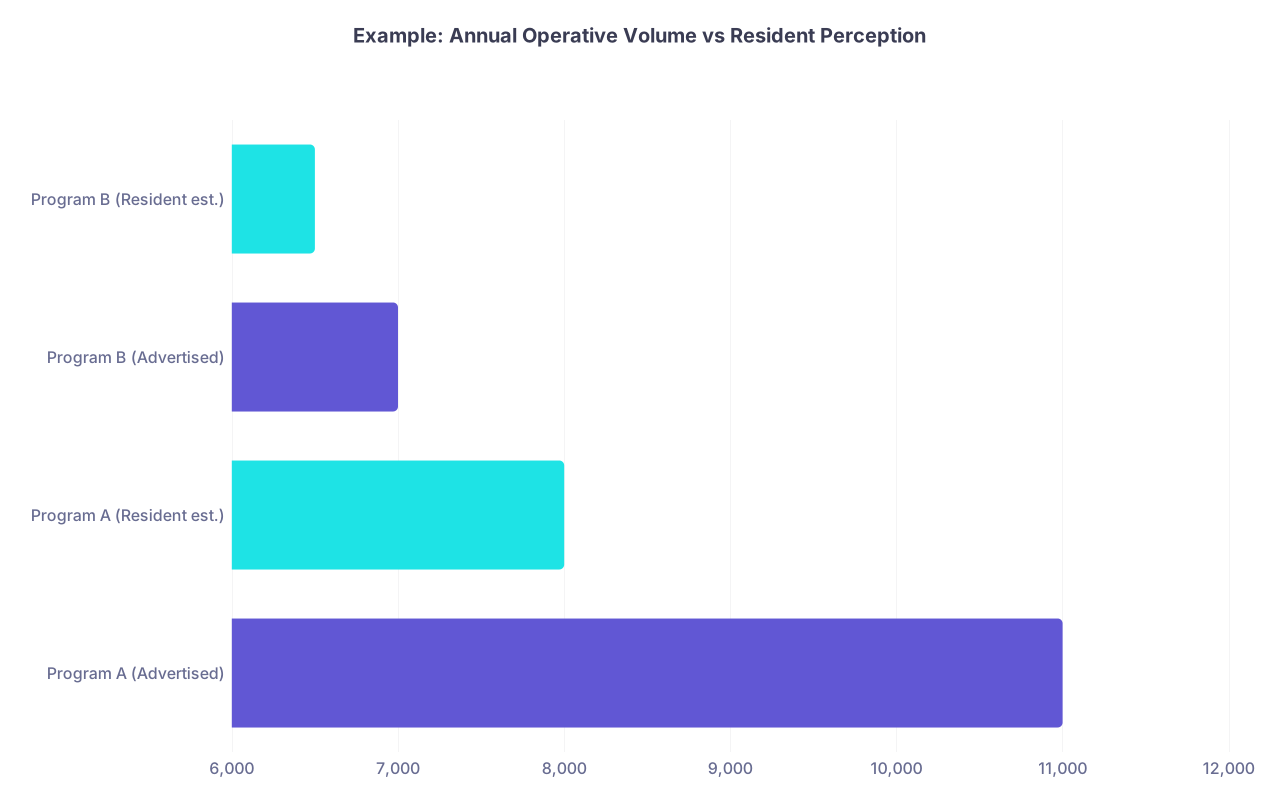
| Category | Value |
|---|---|
| Program A (Advertised) | 11000 |
| Program A (Resident est.) | 8000 |
| Program B (Advertised) | 7000 |
| Program B (Resident est.) | 6500 |
If a program claims 11,000 cases per year but residents feel like they are scrambling to get 900 by graduation, then:
- Volume is heavily concentrated in a few subspecialties.
- Fellows and attendings absorb the majority.
- Or a large fraction of cases are low-yield, non-educational.
Whereas a smaller program with 7,000 cases but residents calmly saying, “Everyone finishes with 1,200+, and chiefs do 40–50 major cases per month,” is probably running a more resident-centered OR.
Use your second look to:
- Verify that numbers align with lived experience.
- Confirm that the volume translates into resident-level opportunities, not just institutional bragging rights.
Step 10: After the Second Look – Turn Impressions into a Concrete Ranking Tool
The danger after two or three second looks is that everything blends together. This program had nice people. That one had good food. Someone said the word “autonomy” a lot. Useless.
You should walk away with a crude but functional scoring system for procedural training:
- Resident case volume (estimated)
- Bread-and-butter coverage
- Exposure to complex and referral-level cases
- Degree of resident procedural ownership (vs fellows/APPs/attendings)
- Call-related volume and resuscitation experience
- Structural strengths vs bottlenecks
Take 20 minutes the evening after each second look and actually write this down. Rate each domain (1–5). Add specific examples you saw or heard.
For example, your notes might look like:
Program X:
- PGY-5 says 1,300 cases, no trouble hitting any minimums.
- ED busy, 3 intubations on a typical night shift for seniors.
- Fellows in HPB, but residents still primary on complex choles and elective colectomies.
- Mentioned OR staffing issues; some cancelled elective days.
Program Y:
- PGY-5 estimates ~900 cases; gyn onc almost entirely fellow-run.
- OB volume high, but almost no operative vaginal deliveries in 2 years.
- EM residents report maybe 1–2 intubations per month each; ICU does many.
- On second look, only 4 ORs running out of 10 at 10:00 am.
You do not need a perfect dataset. You need enough clarity to weigh training quality against every other factor in your rank list. Second looks give you that if you use them strategically.
Key points to keep in focus:
- Treat second looks as a structured investigation of procedural volume and case mix, not as a social courtesy visit. Go in with a checklist, walk out with data.
- Do not trust the word “high volume” without seeing OR boards, talking to multiple residents, and understanding who actually does the cases—residents, fellows, or attendings.
- Autonomy, complexity, and throughput matter more than pretty brochures. Your future competency depends on what you personally do, not what your hospital advertises.