
The biggest lie about mentorship in residency is that you can “just feel it” on interview day. You cannot. You need targeted, deliberate second-look meetings to stress-test it.
You are not evaluating brunch vibes. You are evaluating whether a place will grow you, sponsor you, and protect you for 3–7 years. That requires structure, not impressions.
Let me break this down precisely.
Why Mentorship Assessment Fails On Interview Day
On a typical interview day, mentorship is theater.
You hear scripted lines:
- “We are a very supportive program.”
- “Everyone has access to mentorship.”
- “We have a formal mentor–mentee system.”
Those sentences tell you almost nothing. Every program says them. The weak ones say them louder.
What you actually need to know is:
- Will I get a mentor who invests in me, not just signs a form?
- Will that mentor have time and influence, not just good intentions?
- Will the culture support vertical and horizontal mentorship or leave me to fend for myself?
That does not surface in group tours and 20‑minute interviews.
Second-look visits, if used properly, allow you to run a focused experiment: “Show me how your mentorship really works.” Targeted meetings are your test conditions.
The Real Question: What Does “Strong Mentorship” Look Like?
You cannot assess what you have never defined.
Strong mentorship in residency has three pillars:
Accessible Structure
- Clear process for getting matched to mentors.
- Multiple layers: near-peer, faculty, sometimes external or cross-departmental.
- Regular, expected touchpoints (not “meet if you remember”).
Functional Relationships
- Someone knows your goals by name and timeline.
- They give specific, uncomfortable feedback, not just “You’re doing great.”
- They sponsor you: connects you to projects, letters, opportunities, and people.
Protective Culture
- Mentors can intervene when you are drowning.
- You see examples of residents who were supported through difficulty, not sacrificed.
- There is tolerance for diverse paths: clinician-educator, research-heavy, community, niche subspecialty.
You are trying to test these pillars, not whether a faculty member is “nice.”
Targeted second-look meetings allow you to probe each of these pillars with the right person, in the right setting, with the right questions.
Designing Second-Look Meetings With Intent
Wandering through a second look without a plan is a waste of money and time. You need to pick the right people, ask the right questions, and watch for the right signals.
Who You Should Meet (And Why)
For mentorship assessment, you want at least 4–6 targeted conversations, even if short:
Senior Resident Who Shares Your Interests
- Ideal: PGY-3+ who has done something you want to do: chief role, specific fellowship, QI, education, research.
- Purpose: See what actual mentorship looks like at year 3+, when the shine is gone and the deliverables are real.
Junior Resident (PGY-1 or PGY-2)
- Purpose: Assess how early mentorship starts. Are they already guided, or still drifting?
- Junior residents are more transparent about being lost, burned out, or unsupported.
Program Director or Associate PD
- Purpose: Understand the formal mentorship framework and how seriously leadership takes it.
- Also: watch how they talk about residents’ trajectories. Generic vs highly specific.
Faculty Mentor in Your Projected Niche
- Research, global health, med-ed, health policy, informatics, community practice—whatever matters to you.
- Purpose: Test feasibility. Are they genuinely open to working with new residents?
Key Coordinator or Program Administrator
- Mentorship systems live or die based on admin follow-through.
- They often know who the real mentors are and where the black holes live.
Optional: Recent Graduate (Zoom or phone if not local)
- Purpose: You want someone who has finished and can tell you if mentorship had lasting impact—fellowship match, job placement, career clarity.

| Step | Description |
|---|---|
| Step 1 | Decide to Schedule Second Look |
| Step 2 | Define Career Priorities |
| Step 3 | Identify 4 to 6 Key People |
| Step 4 | Request Specific Meetings |
| Step 5 | Prepare Focused Questions |
| Step 6 | Second Look Day |
| Step 7 | Debrief and Compare Programs |
What To Ask: Precision Questions That Expose Reality
You are not there to be polite. You are there to collect decision-grade information.
With Senior Residents
You want to know: Did mentorship move the needle for them?
Ask things like:
- “Who are your primary mentors and how did you find them? Was that set up formally or did you have to hunt?”
- “Can you give me an example of a time a mentor changed your trajectory here?”
- “What concrete things have mentors here done for you—projects, letters, connections, protecting your time?”
- “Do you feel your mentors actually know your long‑term goals, or mainly check boxes for evaluations?”
- “If you disappeared for 2 months emotionally or academically, who would notice? And what would happen?”
Red flags:
- Long pauses and vague praise: “People are really nice, everyone is approachable.”
- “You kind of have to be proactive and find your own people here” said in a resigned tone.
- No specific examples of mentors making introductions or protecting time.
Green flags:
- They can name 2–3 mentors with different roles (research, wellness, career).
- They cite specific interventions: “My mentor called the chief to pull me from nights to finish this abstract.”
With Junior Residents
You want to know: Does support start early, or only once you prove yourself?
Questions:
- “When did you first meet with a formal mentor here?”
- “Did someone sit down with you PGY‑1 to ask what you want long term?”
- “Have any mentors helped you adjust when you were overwhelmed or burned out?”
- “Who helped you get your first project or committee role?”
Look at their facial expression when they talk about support. I have seen PGY‑1s in strong programs light up when describing how a senior sat with them to map out an 18‑month plan. In weaker programs, you get a chuckle and a shrug: “We’re figuring it out.”
With PD / APD
You want systems, not slogans.
Ask:
- “Walk me through how mentorship is structured here. How is every resident ensured at least one effective mentor?”
- “If a mentorship pairing is not working, what happens? How easy is it to change?”
- “Who tracks whether mentorship meetings actually occur?”
- “Can you describe any time you intervened to improve mentorship for a struggling resident?”
- “How do you ensure residents off the ‘typical research/fellowship track’ still receive strong mentorship?”
Then push:
- “How do you identify residents who are drifting without clear goals and get them connected to someone?”
A strong PD will have:
- A clear map of mentor assignment, monitoring, and troubleshooting.
- Examples of specific residents and how mentorship pivoted their path.
- Awareness of weaknesses (“We improved this 2 years ago by…”) rather than denial.
With Faculty in Your Area
You want to know if they are genuinely investable.
Ask:
- “How many residents do you currently mentor actively?”
- “What typically happens in the first 6–12 months when a new resident wants to work with you?”
- “What has been the trajectory of residents you mentored? Where did they match? What did they publish or build?”
- “What protected time is available for residents doing projects with you?”
- “What are the common reasons mentorship relationships fail here?”
If the faculty member cannot name concrete resident outcomes tied to their mentorship, treat that as weak evidence.
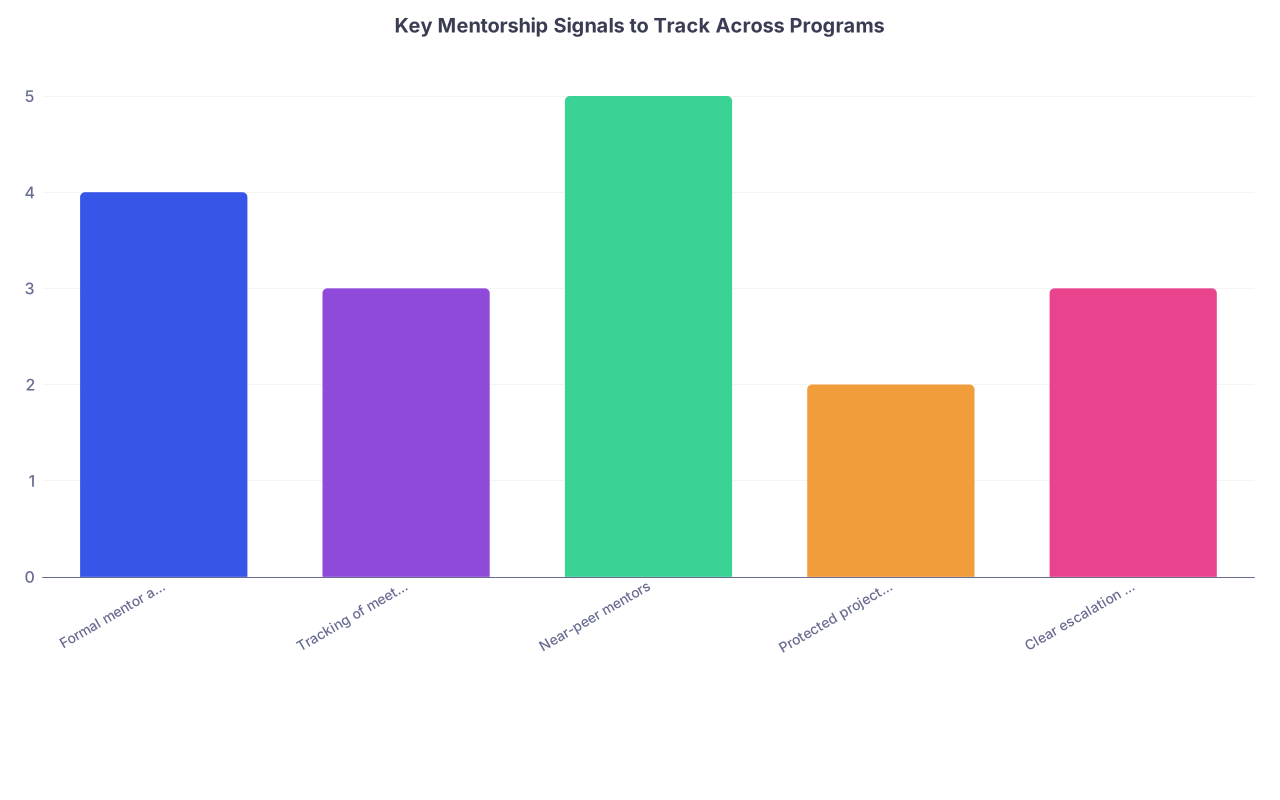
| Category | Value |
|---|---|
| Formal mentor assignment | 4 |
| Tracking of meetings | 3 |
| Near-peer mentors | 5 |
| Protected project time | 2 |
| Clear escalation path | 3 |
(Example: scoring 0–5 across programs you visit; not actual program data)
Using Second Look To Stress-Test Mentorship Culture
You are not only assessing individual mentors. You are stress-testing the culture.
Here is how to do that systematically.
1. Ask the Same Question to Multiple People
Pick 3–5 mentorship-focused questions and ask them repeatedly across different roles.
For example:
- “If a PGY‑2 tells you they feel lost and do not know their career path, what typically happens next here?”
Ask:
- One junior resident
- One senior resident
- One faculty mentor
- The PD or APD
You want consistency.
If you get:
- PD: “We have a robust career advising process.”
- Senior resident: “They will probably pair you with X or Y, they are great.”
- Junior resident: “I told someone I felt lost and they helped me meet with Y.”
That is alignment.
If you get:
- PD: “We assign formal mentors; no one falls through the cracks.”
- Residents: “You have to be really proactive; those who are quiet tend to drift.”
That gap matters. Believe the residents.
2. Test The “Hard Case” Scenario
Mentorship is most valuable in bad situations, not good ones. Use hypotheticals:
- “Imagine a resident is repeatedly underperforming on a high-acuity rotation and is scared. What structures exist to support them?”
- “What happens if a resident’s main mentor leaves mid-residency?”
- “How are residents supported when a big plan falls through—a fellowship they did not match, a grant that failed, a project that died?”
Watch how candid people are.
Programs with real mentorship:
- Mention concrete remediation or support processes.
- Reference resident wellness combined with performance coaching.
- Can name one or two anonymized examples.
Programs without:
- Deflect to “we only take strong residents.”
- Talk vaguely about “support” without detailing actions.
3. Look for Evidence in the Environment
During your second look, look around:
- Are resident conferences showcasing resident projects? Who is listed as mentor?
- Are there visible bulletin boards or online portals listing pathways, mentors, and projects? Or does everything sound “word of mouth”?
- Check any resident research or scholarship lists: Are they spread across many trainees, or only “golden children” mentored by 2–3 faculty?
I have been in programs where every poster board at grand rounds had the same 4 faculty names. That is not a mentorship culture. That is a bottleneck.

Structuring Your Second Look Day Around Mentorship
If you have only one second look, you cannot see everything. You need to design it like a targeted consult, not a general physical.
Before You Go
Clarify Your Top 2–3 Career Priorities Examples:
- Academic cardiology with clinical research
- Community EM with strong teaching skills
- Primary care with policy / advocacy focus
Email the Program With Specific Requests Something like:
“For my second look, I am most interested in understanding how mentorship works here, particularly for residents pursuing X. If possible, I would like to:
- Meet with a senior resident who has pursued X path
- Meet with a junior resident to hear how mentorship starts PGY‑1
- Meet with faculty who mentor residents in X
- Briefly touch base with the PD or APD about formal mentorship structures.”
This does two things:
- Forces the program to reveal how easily they can connect you with real mentors.
- Signals that mentorship is a core decision factor for you (which it should be).
- Build a Simple Comparison Sheet
Create a 1‑page grid you will fill out after each second look:
| Factor | Program A | Program B | Program C |
|---|---|---|---|
| Formal mentor assignment | |||
| Near-peer mentor availability | |||
| Protected time for mentorship | |||
| Evidence of resident outcomes | |||
| Ease of switching mentors |
Leave it mostly blank. Fill it out the same evening when details are fresh.
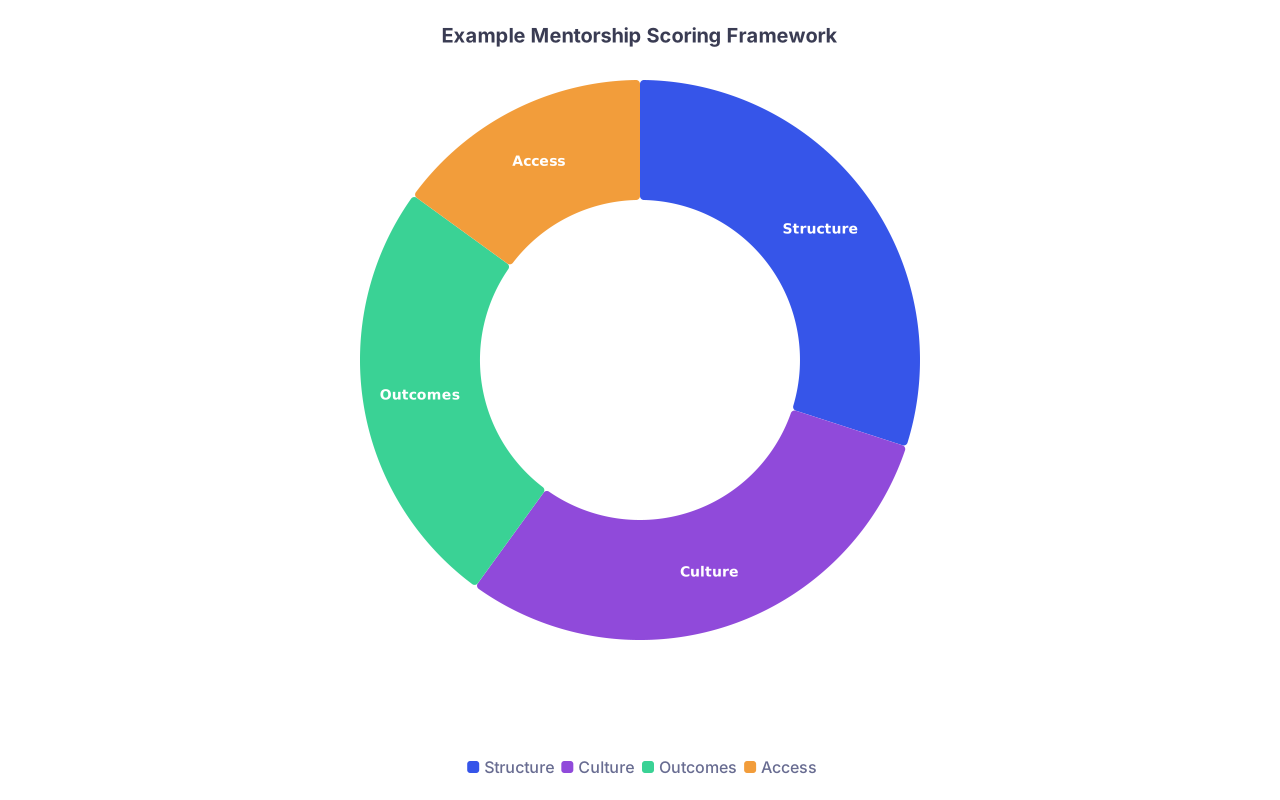
| Category | Value |
|---|---|
| Structure | 30 |
| Culture | 30 |
| Outcomes | 25 |
| Access | 15 |
(Example weighting for decision-making; you can adjust for your own priorities.)
Advanced Tactics: Reading Between the Lines
There are a few subtler moves that give away a program’s mentorship reality.
1. Ask About Residents Who Struggled
You are not there to get gossip. You are trying to measure whether the system supports people at the margins.
Try this with a senior resident or PD:
- “Without naming names, can you think of someone who was initially struggling or unsure of their path, but ended up successful here? What helped them get there?”
Listen for:
- Specific references to mentorship meetings, PD involvement, changed rotations, added support.
- Timelines: “We picked it up early PGY‑1” vs “By PGY‑3 we realized…”
If all their success stories start with high-achievers, you have a selection effect, not a mentorship effect.
2. Check How They Talk About Non-Traditional Paths
Ask:
- “How are residents interested in less traditional paths—like clinician-educator roles without fellowship, industry, or rural practice—mentored here?”
Weak programs:
- Politely dismiss or redirect: “Most of our residents go straight to fellowship.”
- Have no examples outside the main pipeline.
Strong programs:
- Can name residents pursuing varied careers and which mentors helped them.
- Have frameworks or electives that support those paths.
3. Watch Scheduling Behavior
How hard was it to arrange those second-look meetings?
- If the program quickly coordinates multiple conversations with the right people, it signals organizational competence and willingness to invest.
- If they struggle to find a single faculty mentor in your area, or your only meeting is with a generic “interested in mentoring” person, treat that as a data point.
I take seriously any program where the coordinator writes back within a day with a detailed, thoughtful schedule that aligns directly with your goals. That is mentorship energy before you even start.

Common Mentorship Myths You Should Ignore
Let me call out a few bad ideas I hear every season.
Myth 1: “Strong brand name equals strong mentorship.”
No. Prestige does not guarantee mentorship. I have seen top‑tier, research-heavy programs where residents sink or swim alone, and mid-tier community programs where mentorship is outstanding and personal.
You are evaluating function, not reputation.
Myth 2: “If there is a formal mentoring program, that means it works.”
Box-checking is real. Ask:
- “How do you know your mentoring program is effective? What has changed because of it in the last 3 years?”
If the answer is some version of “we assign people and have an annual evaluation,” that is not proof of impact.
Myth 3: “I can create my own mentorship network; I am very proactive.”
Proactivity helps. It does not replace system support.
The quiet, overworked, or uncertain resident is the one who most needs protective mentorship. Ask yourself honestly: Do you want to rely on heroic self-advocacy at 2 a.m. on week 6 of nights?
Programs that assume “the strong will find mentors” are pushing responsibility downstream. That is laziness disguised as autonomy.
Myth 4: “I will only be here 3 years; mentorship is less important for me.”
Wrong. Strong mentorship:
- Affects whether you match into the fellowship or job you want.
- Affects whether you burn out, stagnate, or build a coherent narrative.
- Affects whether setbacks knock you off course or become part of your story.
Three years with good mentorship can equal a decade of wandering without it.
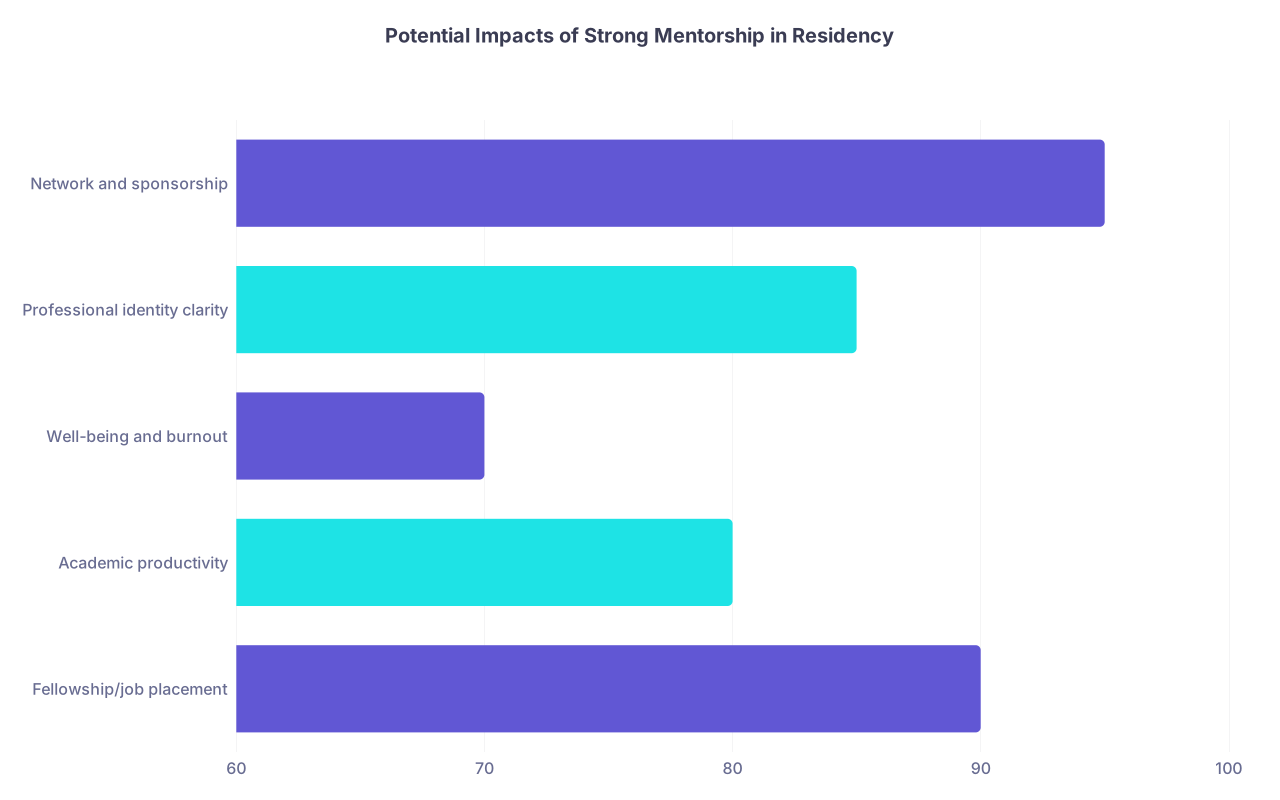
| Category | Value |
|---|---|
| Fellowship/job placement | 90 |
| Academic productivity | 80 |
| Well-being and burnout | 70 |
| Professional identity clarity | 85 |
| Network and sponsorship | 95 |
(Values represent relative perceived impact out of 100, not measured data.)
Making The Call: How To Use What You Learn
After your targeted second looks, you will have fragments. You need to compress them into a decision.
Here is how I recommend you do it.
- Write a One-Paragraph Mentorship Summary for Each Program
Right after each visit, while details are hot, answer in free text:
- “What would mentorship actually look like for me here over 3 years?”
Force yourself to be concrete:
- “I would likely work with Dr. X and Y on Z projects, meet quarterly with APD A, and have close senior resident B guiding day-to-day decisions.”
If you cannot write that paragraph, your understanding is too vague.
- Score Practical Dimensions (Even Roughly)
On your comparison sheet, rate each program (1–5) for:
- Structural mentorship (systems, tracking, assignment).
- Cultural mentorship (residents feel seen and supported).
- Outcome mentorship (evidence of residents achieving goals with help from mentors).
You are not building a publication. You are forcing yourself to compare apples to apples.
- Trust Tension, Not Just Warmth
Ask yourself:
- “Where did I feel both supported and challenged in conversation?”
Good mentors do not only make you feel comfortable. They:
- Push you to clarify your goals.
- Ask what you want and then say, “If that is true, you should be doing X in year 1.”
If you left a second look with at least one uncomfortable realization—“I need to clarify my priorities, I need to start earlier on projects, I underestimated this”—that is a good sign. Someone was actually mentoring you already.
- Align Mentorship Strength With Your Risk Profile
If you:
- Have a very clear and well-supported path already, you may tolerate softer structures.
- Are changing directions, uncertain, or carrying academic risk, you need robust mentorship more than you need prestige or city preference.
Be honest about which camp you are in. You know.
FAQ: Targeted Second-Look Mentorship Assessment
1. Do I really need a second look just to assess mentorship, or can I rely on virtual follow-up calls?
If travel is prohibitive, you can approximate this with structured Zoom meetings. However, in-person second looks give you access to informal spaces—hallways, workrooms, conferences—where you see mentorship in action, not just described. If you skip the in-person visit, compensate by speaking to at least 2–3 residents at different levels and one faculty mentor, and ask very concrete questions about examples and outcomes.
2. How do I avoid coming across as “high maintenance” when I request mentorship-focused meetings?
Frame your request as career-focused and appreciative, not demanding. Something like: “Mentorship is the main factor in my final decision because I am very committed to pursuing [X path]. I would be grateful for the chance to understand how it works here in practice.” Strong programs will see this as maturity, not neediness. If a program is annoyed by a thoughtful request about mentorship, that is already an answer.
3. What if my interest is very niche and the program has no obvious mentor in that area?
That is not necessarily a deal-breaker, but it changes what you are looking for. In that case, you are testing whether the program is good at building networks: connecting you to mentors at other institutions, in national organizations, or via virtual collaborations. Ask, “Can you give an example of a resident with unusual interests and how you helped them find support?” If they never do this, and your niche is central to your long-term plan, think carefully.
4. How do I weigh mentorship strength against factors like location, prestige, or case volume?
I rank mentorship just under safety and baseline training quality. If a program is unsafe, toxic, or underexposed clinically, mentorship will not fix that. But once you clear those thresholds, mentorship often matters more than brand name or marginal differences in volume. A mid-tier program with excellent mentorship can beat a top-tier name where you will be anonymous, especially for long-term career trajectory and well-being.
5. Is it a bad sign if residents say mentorship “depends on who you work with”?
It depends how they say it. If they mean “there are a few absolutely outstanding mentors; everyone wants them; others are fine but not proactive,” then you are looking at a mentorship concentration problem. If they add, “but leadership helps pair people and keeps an eye on it, and most residents end up with at least one strong mentor,” that is manageable. If they shrug and say, “you just have to figure it out,” with no mention of systems or support, that is a red flag, especially if you know you will need more guidance.
If you use your second look as a rigorous mentorship stress test rather than a social encore, you will see differences that were invisible on interview day. And once you train yourself to spot real mentorship—systems, culture, outcomes—you are not just choosing a program. You are choosing the people who will shape your next decade.
With that lens in place, you are ready for the next step: turning what you learned into a rank list that reflects what your future self will actually care about. But that is a separate conversation.