
Pass/Fail Step 1 did not kill “gun-gunners.” It just forced them to evolve.
We did not abolish the arms race. We changed the scoring system.
The culture of hyper-competitive, hyper-optimized med students—what everyone loves to call “gunners”—is alive and well in the Step 1 pass/fail era. It’s just less obvious to preclinical faculty, more obvious to program directors, and more exhausting for students stuck inside it.
Let me show you what actually changed, what did not, and why blaming everything on “gunners” misses the point.
What Everyone Thought Would Happen vs What Actually Happened
The fantasy version of pass/fail Step 1 went like this:
Remove the three-digit score → reduce anxiety → preclinicals become more humane → students focus on learning medicine rather than test-taking → residency selection becomes more holistic.
Nice story. It just does not match the data or what I hear from real students and PDs.
Here is the hard reality:
- Residency slots did not increase.
- Applicant volume and competitiveness did not decrease.
- Programs still need a way to screen thousands of applications.
If you keep the bottleneck but remove one filter, you are not making the system kinder. You are just forcing everyone to use different—and often worse—filters.
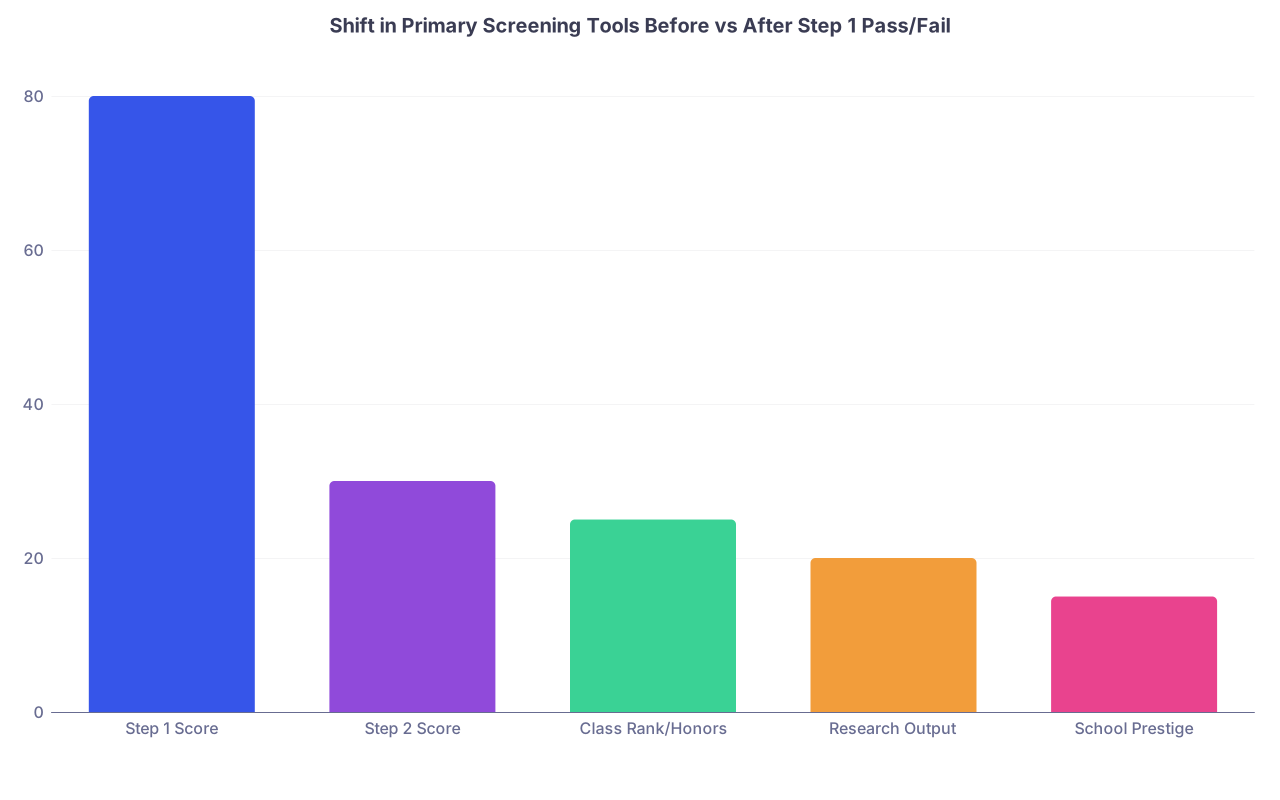
| Category | Value |
|---|---|
| Step 1 Score | 80 |
| Step 2 Score | 30 |
| Class Rank/Honors | 25 |
| Research Output | 20 |
| School Prestige | 15 |
Interpretation (based on surveys and PD commentary, not exact percentages carved in stone): step scores dropped as a primary tool, Step 2 and school signals surged, and everything else inflated to fill the vacuum.
The pressure did not vanish. It moved.
Myth: “Pass/Fail Step 1 Ended the Gunner Culture”
No. It decentralized it.
Before:
The gunner template was obvious. First- and second-years living in UWorld, Boards & Beyond, Anki, doing NBME after NBME 6 months out. Everyone knew who they were. They bragged (or “casually mentioned”) their 265+ practice scores in the PBL room. The metric was singular and legible.
Now:
The new “gun-gunners” are spreading their effort across a portfolio:
- Research early and often, especially in competitive specialties.
- Networking with faculty from M1 week one.
- Step 2 prep starting while Step 1 is still months away.
- Over-optimizing elective choices to impress a tiny subset of programs.
- Pursuing every “distinction track,” “scholarly concentration,” and “leadership title” the school offers.
Same personality, different battlefield.
I have watched this play out at multiple schools: the keeners who would have been Step 1 machines five years ago are now simultaneously first-author on a case series, running a student interest group, cold-emailing faculty for multi-center projects, and already discussing away rotations in the first month of M2.
They did not retire. They retooled.
Where the Goalpost Actually Moved
Step 2 CK is the New Step 1—With Worse Timing
Program directors did not forget that they liked numbers. They just migrated.
Most of the big PD surveys since the change show the same pattern: Step 2 CK jumped several spots in “importance” for screening. Many PDs explicitly say Step 2 is now their primary objective metric.
The twisted part? The timing.
Step 1 (scored era):
You usually had your number in hand before ERAS. Programs screened you on something already done.
Step 2 CK (now):
Many students do not have a Step 2 score ready when applications go out. Programs either:
- Demand a Step 2 score before ranking, or
- Implicitly favor applicants with an early high Step 2 score, or
- Use other cruder filters (school name, research, AOA, etc.) if Step 2 is missing.

| Step | Description |
|---|---|
| Step 1 | Preclinical Years |
| Step 2 | Old Era - Step 1 3-digit |
| Step 3 | New Era - Step 1 Pass Fail |
| Step 4 | Score known before ERAS |
| Step 5 | Score irrelevant if pass |
| Step 6 | Programs rely on Step 2 |
| Step 7 | Score often not known at ERAS |
| Step 8 | Use school, research, honors as proxy |
So now the “gun-gunner” who wants to separate themselves has to:
- Still secure an early, strong Step 2 score, and
- Build an impressive CV in parallel because there is a risk their Step 2 is not fully visible at application time.
The anxiety did not disappear—in many ways it got worse because the main number comes later, closer to application deadlines, with less room to recover if something goes wrong.
Research Arms Race: Now With 50% More Desperation
In the scored Step 1 era, research mattered most to ultra-competitive specialties. High Step 1 + okay research could still get you plenty of interviews for mid-competitive fields, especially from solid but not top-tier schools.
Now, without a visible Step 1 score to flex early, research volume and type look even more tempting as screening criteria.
You see this clearly when you compare typical expectations:
| Metric | Scored Step 1 Era | Step 1 Pass/Fail Era |
|---|---|---|
| Step 1 | 250+ | Pass (no differentiation) |
| Step 2 CK | Nice-to-have high score | Primary numeric filter |
| First-author pubs | 1–2 helpful | 2–4+ increasingly common |
| Total pubs/abstracts/posters | 5–8 strong | 10–20+ not unusual at top |
| “School prestige” weight | Moderate | Heavier for screening |
Are these numbers rigid cutoffs? No. But they reflect what I keep seeing on matched applicant CVs in derm, ortho, plastics, ENT, radiation oncology, neurosurgery. When one clear quantitative metric dies, the others mutate.
Students get this message fast. I have heard M1s literally say:
“If Step 1’s just pass/fail, I need at least 10 pubs for derm.”
Is that precise? No. Does it drive behavior? Absolutely.
School Prestige Got Louder
Program directors are not saints; they are busy. When Step 1 scores evaporated as a fine-grained filter, guess what slid back into the foreground?
- Name recognition of the med school
- Historical trust in certain schools’ grading and honors
- Signal that “if you got into X, you’re probably strong”
Students at less famous schools feel this intensely. Before, you could argue, “I’m at a mid-tier state school but I nailed a 260+ Step 1, look at me.” Now? That lever is smaller. Step 2 can help, but it’s later, and Step 1 no longer lets you advertise early that you’re punching above your school’s reputation.
So what do ambitious students at non-elite schools do? They overcompensate:
- Extra research, often via remote collaborations
- Multiple away rotations (if they can afford it)
- Massive effort in networking and email outreach
- Hyper-curated CVs to look indistinguishable from T20 peers
“Gunner” behavior didn’t die; it just got more resource-dependent. The students with money and connections can chase more away rotations, more unpaid research, more flying around for in-person networking. The ones without those resources suffer or get filtered out earlier.
The Hidden Casualties: Normal Students and Late Bloomers
The old system had a lot wrong with it. But it had one underrated virtue: it gave late bloomers and non-traditional students a clean, visible way to surprise people.
You could be:
- First-generation
- From a non-name undergrad
- At a newer or lower-ranked MD/DO program
…and still drop a big Step 1 score that forced programs to take a serious look at you. Was it fair? Not fully. But it was a crack in the wall.
Pass/fail Step 1 sealed some of those cracks.
Normal, solid students who would have quietly put up a strong Step 1 and ridden that number into a decent match now find themselves in a noisier, more opaque system:
- Harder to stand out numerically early
- More pressure to “brand” themselves with niche projects, longitudinal tracks, and leadership roles
- Less clear messaging on how good is “good enough”
And because the culture still celebrates the same top 5–10% “gun-gunners,” the middle majority feels more confused and more behind, earlier. I have had M1s tell me they already feel “late” because they do not have a research mentor by October.
Step 1 pass/fail was sold as reducing stress. For the students predisposed to obsess, it simply forced them to obsess earlier and about more variables.
What Actually Needs to Be Debunked
Let’s kill some of the lazier narratives.
“Gunners are the problem”
No. The structure is the problem. Gunners are just the most visible symptom.
As long as:
- residency spots are scarce relative to applicants,
- programs get flooded with applications, and
- we demand objectivity and “fairness” from PDs who have limited time,
you will get arms races. If you removed every “gunner” tomorrow, the system would manufacture a new top 10% to chase slightly different signals.
Blaming neurotic high-performers for playing the game that exists is lazy. They did not build the scoring ladder. They just climb it more aggressively than you like.
“Step 1 Pass/Fail Made Things More Holistic”
No, it made things more multidimensional and more chaotic. Those are not synonyms.
Holistic would mean:
- Fewer arbitrary cutoffs
- Serious, structured review of non-numeric attributes
- Real attempts to understand context and potential
What we mostly got instead was:
- More weight on Step 2 CK, clerkship grades, and school name
- Burnout-level emphasis on research productivity
- Programs doing “holistic review” on maybe a subset after various numeric and institutional filters
There are some genuinely thoughtful programs experimenting with truly holistic review. They are the exception, not the rule.
“Students can finally focus on learning medicine, not just Step”
Nice line. Reality: many students now feel they must master both the exam world and the CV-building world simultaneously.
Before, some people admittedly over-indexed on Step 1 questions at the expense of clinical reasoning. That was a problem. But now, some are underprepared for foundational knowledge because they split their cognitive bandwidth between:
- keeping up with preclinical curriculum,
- pass-level Step 1 prep,
- early Step 2 and shelf strategy,
- longitudinal research,
- leadership nonsense that reads well on ERAS,
- and networking.
The myth that we “freed up” time is exactly that—a myth. The time was reallocated, not returned.
So What Do You Actually Do With This?
You are not going to fix the system during your M1 year. But you can stop being delusional about it.
Here is the blunt version.
If you are competitive by nature—the “gunner” archetype—admit it and be strategic. Do not play the old game in a new era. Step 1 pass/fail means:
- You still need a strong Step 2 CK.
- You cannot coast on “I’ll crush one exam and ignore the rest.”
- Research and genuine specialty engagement matter earlier, especially for the highly competitive fields.
If you are not that person—and you do not want to be—then you need to stop measuring yourself against the person with 18 posters and 3 first-author papers by MS3. That is not the median, and it is not the requirement for the majority of specialties.
For both groups, the core move is the same: understand the new goalpost instead of pretending the field is empty now.
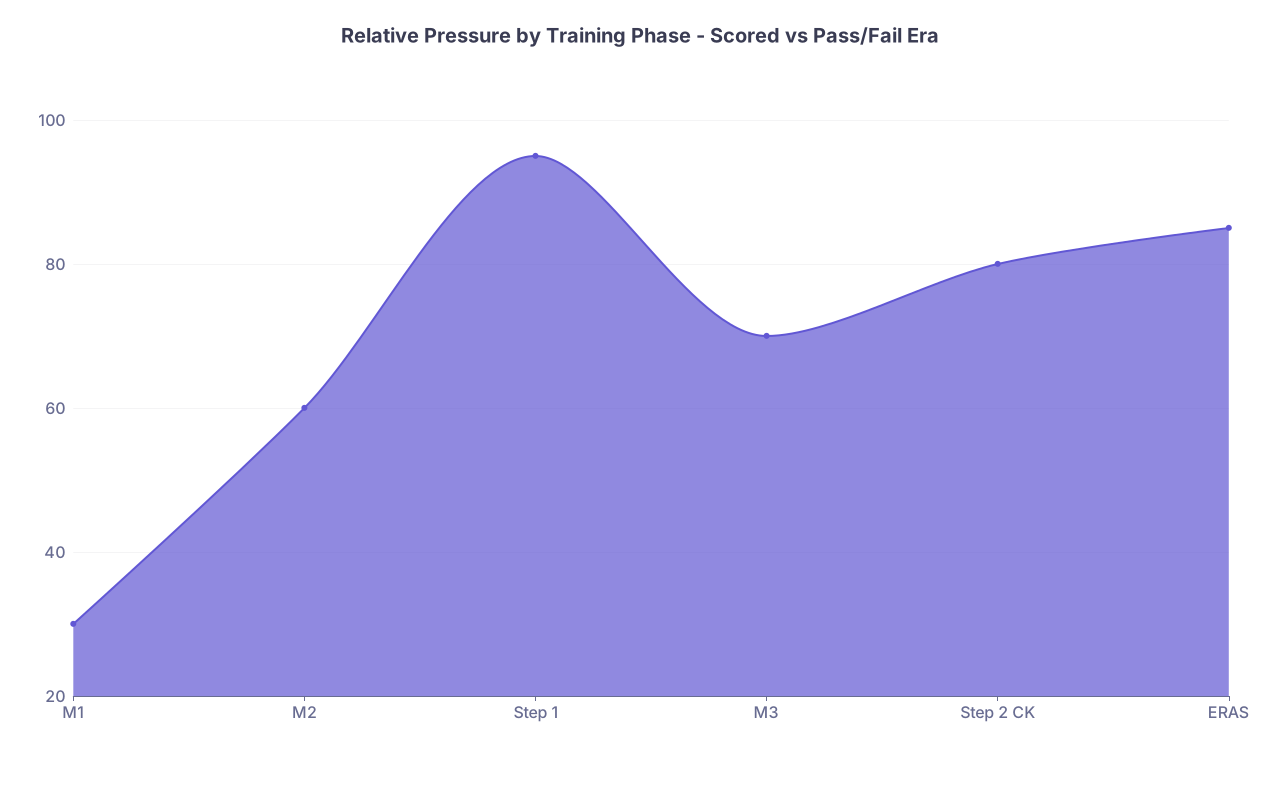
| Category | Value |
|---|---|
| M1 | 30 |
| M2 | 60 |
| Step 1 | 95 |
| M3 | 70 |
| Step 2 CK | 80 |
| ERAS | 85 |
The burden shifted later and spread wider. That is the landscape you are walking into.
The Bottom Line
Step 1 pass/fail did not cure the culture of overachievement in medicine. It just changed the scoreboard.
Key takeaways:
- The “gun-gunners” are still here—they are just optimizing for Step 2 CK, research, school prestige, and curated CVs instead of a single three-digit Step 1 flex.
- Pressure did not disappear; it moved later in training and into more opaque metrics, hurting normal students and late bloomers more than the already advantaged.
- If you want to survive this era, stop pretending the arms race ended. It did not. You either learn the new rules and decide how much you are willing to play, or the game plays you.