
It’s July of your MS4 year. Your classmates are trading horror stories about “away rotations” and “sub-Is” like they’re gladiator games. You’re staring at your schedule thinking: do I really need to kill myself doing multiple subinternships to match well, or is this all hype?
Here’s the answer you’re looking for: subinternships are important, but not equally important for everyone, every specialty, or every school. They can absolutely move the needle. They can also be an enormous time sink and stressor if you use them wrong.
Let’s go through where they matter a lot, where they’re optional, and how to use them strategically instead of just copying what your classmates are doing.
1. What a Subinternship Actually Does for Your Application
Strip away the mythology. A subinternship (sub-I, acting internship, AI) mainly affects your application in four concrete ways:
- It generates a powerful, detailed clinical letter of recommendation.
- It shows you can function near intern level.
- It gives programs a “test drive” if it’s an away sub-I.
- It can help you decide if you actually like that specialty and that program.
If you’re not getting at least two of those four from a given sub-I, you’re wasting it.

How programs really use sub-Is
Program directors do not have time to romanticize your rotations. They mostly care about:
- What your sub-I attending wrote in your letter.
- Whether your MSPE and evaluation comments back that up.
- Whether, if you rotated there, the residents/attendings said, “We’d hire this person.”
The label “subinternship” alone doesn’t impress anyone. A mediocre or generic sub-I is less impactful than a strong, detailed letter from a core clerkship or longitudinal mentor.
So the point is not “Do a sub-I.”
The point is “Use sub-Is to create undeniable evidence that you’re ready for residency.”
2. How Important Are Subinternships by Specialty?
This is where people get confused. The value of sub-Is is extremely specialty-dependent.
| Specialty | Importance of Sub-I | Typical Expectation |
|---|---|---|
| Neurosurgery | Critical | 2–3 aways + home sub-I |
| Orthopedic Surgery | Critical | 1–3 aways + home sub-I |
| ENT / Plastics / Urology | Very High | Multiple aways common |
| Dermatology | High (for exposure) | 1–2 aways often |
| Internal Medicine | Moderate | Home sub-I expected |
Let’s sort it more clearly.
A. “You basically must do them” group
These are the highly competitive, smaller fields where away sub-Is are a core part of the game:
- Neurosurgery
- Orthopedic surgery
- ENT (otolaryngology)
- Plastic surgery
- Urology
- Some competitive surgical fellowships (via gen surg route) care a lot about where you rotated
In these fields:
- Home sub-I: Non-negotiable. You need a strong letter from your home specialty department.
- Away sub-Is: Often 1–3. Programs use these as extended interviews. Not doing any aways is a red flag unless you’ve got unique circumstances.
If you’re in this group and you’re asking “Are subinternships important?” the honest answer is: they’re central. You can’t skip them and expect to be competitive at most programs.
B. “Strongly recommended but not make-or-break” specialties
- Dermatology
- Emergency Medicine
- General Surgery (for most applicants)
- Anesthesiology (for top programs especially)
- OB/GYN (varies by region/program competitiveness)
Here the hierarchy looks more like:
- A very strong home sub-I with a stellar letter can be enough.
- One away at a realistic target program can help you a lot, especially if your paper stats are average.
- Doing three aways “just because” is almost never worth the burnout.
Programs in this category care more about: your overall profile, research (for derm/EM in particular), and strong letters. Aways are leverage, not a requirement.
C. “Nice but optional” or “mainly for letters and maturity” group
- Internal Medicine
- Pediatrics
- Family Medicine
- Psychiatry
- Neurology
- PM&R (still helpful but less rigid than ortho/neurosurg)
For these fields:
- A home sub-I in your chosen specialty (or a closely related inpatient service) is usually expected.
- Aways are useful if:
- You don’t have a home program in that specialty.
- You’re geographically targeting a region where you have no connections.
- Your application needs another strong clinical letter from that field.
But the difference between zero away sub-Is and one away in these fields is usually smaller than people think. Nobody in community IM is outraged that you didn’t do three away sub-Is.
3. How Many Subinternships Do You Actually Need?
Here’s a simple framework that works better than random guessing.

| Step | Description |
|---|---|
| Step 1 | Choose Specialty |
| Step 2 | Plan 1 home + 1-3 aways |
| Step 3 | Do 1 home sub-I |
| Step 4 | Do 1-2 aways for exposure/letters |
| Step 5 | Target realistic programs |
| Step 6 | Focus on strong letter |
| Step 7 | Competitive field? |
| Step 8 | Have home program? |
Baseline rule
- Nearly everyone should do at least one sub-I in their target field or a closely related inpatient service (e.g., IM sub-I if you’re applying cards or heme/onc later).
Then adjust:
Competitive surgical subspecialty
- 1 home sub-I in the field
- 1–3 aways at realistic, not fantasy, programs
- Extra aways beyond 3 rarely add value and often hurt your Step 2 studying and sanity
Moderately competitive specialties
- 1 home sub-I
- 0–1 away focused on either:
- Dream geographic region, or
- A program where your school’s graduates historically match
Less competitive / broad specialties
- 1 strong home sub-I
- Optional away if:
- You have no home program
- You’re coming from a lower-ranked school and want visibility at a specific place
Do not fill your MS4 with four straight inpatient, high-intensity sub-Is “to show work ethic.” Programs will not be impressed that you torched your Step 2 score and your personality.
4. How Much Do Sub-I Evaluations and Grades Matter?
More than most shelf exams. Less than Step 2 and your overall pattern of performance. That’s the honest ranking.
Here’s what PDs actually look for from sub-Is:
- “Can this person function safely on day one?”
- “Do residents like working with them?”
- “Would I trust them with my sick patients at 2 a.m.?”
Not: “Did they get Honors vs High Pass on one arbitrary month?”
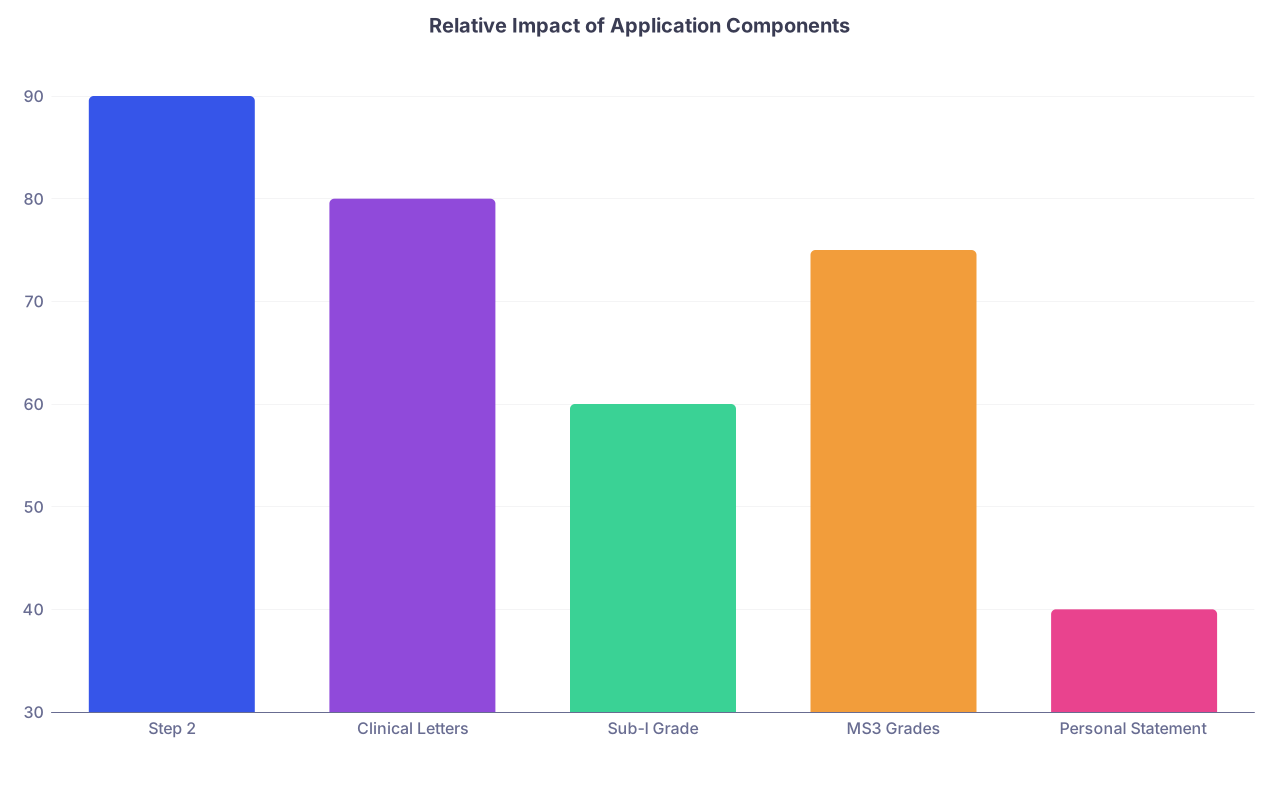
| Category | Value |
|---|---|
| Step 2 | 90 |
| Clinical Letters | 80 |
| Sub-I Grade | 60 |
| MS3 Grades | 75 |
| Personal Statement | 40 |
Rough practical impact (not exact, but directionally right):
- Step 2: Still king for many fields, especially since Step 1 went pass/fail.
- Clinical letters from sub-Is: Heavy weight, especially field-specific ones.
- Sub-I grade: Matters if it’s an outlier (fail, low pass, or narrative comments about professionalism).
- Narrative comments: A single line like “Residents expressed concerns about reliability” is a bomb.
What hurts you:
- Poor teamwork comments.
- Concerns for safety, judgment, or reliability.
- A big mismatch between your self-presentation and what the sub-I team wrote.
What helps you:
- Clear statements like “Already performing at an intern level.”
- “Top 10% of students I’ve worked with in the last 5 years.”
- “We ranked this student to match.”
So: yes, sub-Is matter, but mostly through letters and narrative comments, not the line item grade.
5. When Skipping an Away Sub-I Is Totally Fine
There’s a quiet truth a lot of students figure out too late: some of you don’t need away sub-Is at all.
You can safely skip aways if most of this is true:
- Your specialty is not one of the very small, hyper-competitive ones.
- You have a home program in your specialty with faculty who know you.
- You already have or will easily get:
- 1 strong letter from that department
- 1 additional clinical letter from a relevant field
- You’re not geographically dead-set on a place where your school never sends graduates.
I’ve seen many IM, peds, psych, and FM applicants match at excellent university programs with zero away rotations. They focused on:
- Crushing core clerkships and Step 2
- One very strong home sub-I
- Solid, personal letters
- A believable, coherent story in their application
And then they watched classmates who did three away EM sub-Is burn out, get average evaluations, and end up with “fine” but not amazing letters.
So don’t do an away “just to do one.”
Do an away only when you have a specific, realistic goal.
6. How to Maximize the Value of a Subinternship
If you’re going to endure the long hours and the stress, make it count.

Before the rotation
- Decide your primary aim: letter, exposure to a program, or skill-building.
- Tell your resident/attending on day 1: “I’m applying to X. I’m hoping to earn a strong letter, and I’d appreciate feedback along the way.”
This is not pushy. It’s how adults signal expectations.
During the rotation
Basic but crucial:
- Show up early, not just on time. Residents notice.
- Own your patients. Know their labs, imaging, updates before rounds.
- Write notes that are concise, accurate, and on time.
- Ask for feedback mid-rotation: “What’s one thing I can do this week to function more like an intern?”
Do not:
- Disappear early every day “because you’re just a student.”
- Compete with other students in front of residents. They hate that.
- Try to show off obscure knowledge in rounds while missing your basic tasks.
After the rotation
- If the rotation went well, ask directly for a letter:
“I really enjoyed working with you and I’m applying to X. Based on your experience with me, would you feel comfortable writing a strong, supportive letter of recommendation?”
If they hesitate or hedge? Thank them and do not use that letter. A lukewarm letter can quietly sink you.
7. Red Flags and Common Mistakes with Subinternships
A few patterns I’ve seen repeatedly that hurt more than they help:
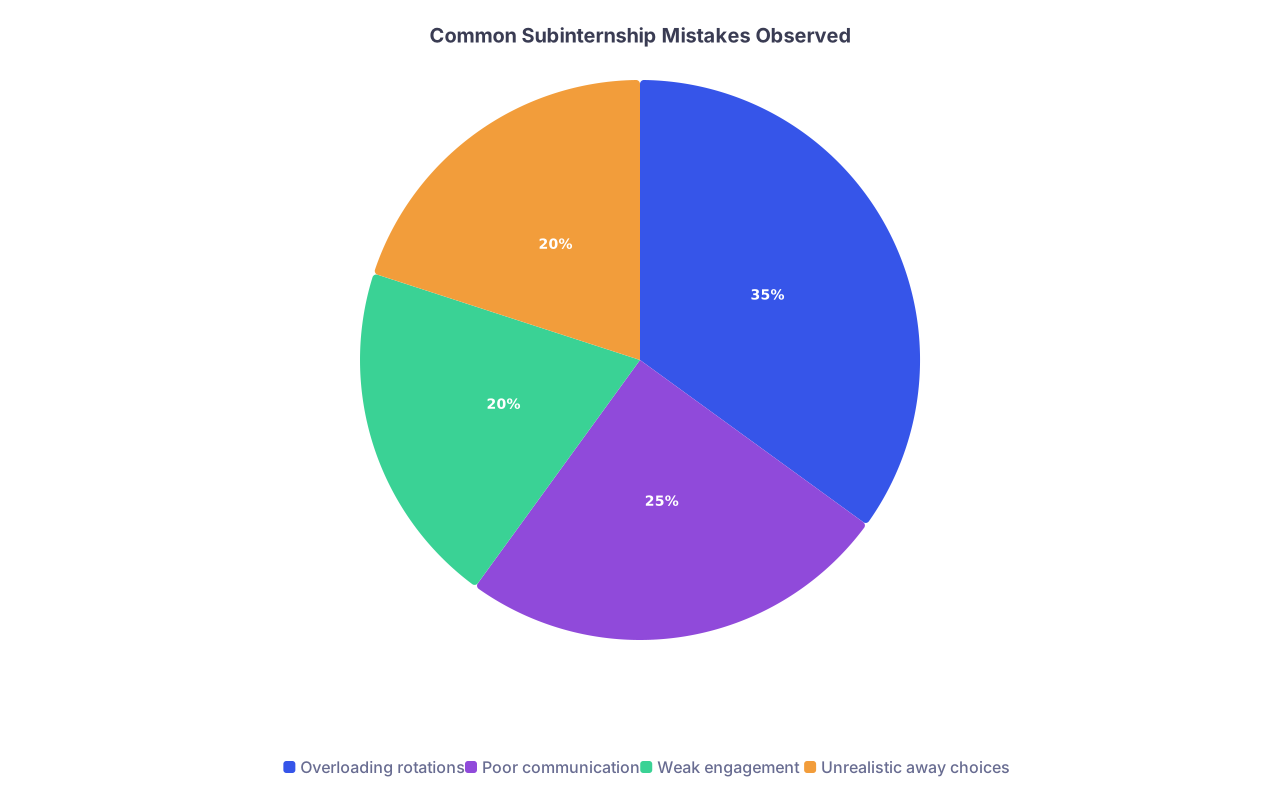
| Category | Value |
|---|---|
| Overloading rotations | 35 |
| Poor communication | 25 |
| Weak engagement | 20 |
| Unrealistic away choices | 20 |
Overloading with 3–4 demanding sub-Is in a row
You end up exhausted, your performance declines, and your evaluation language goes from “outstanding” to “solid” to “adequate.” Programs read that progression.Using aways as vacations
Some students think smaller or “chill” programs mean they can coast. Word gets around faster than you think, especially in small specialties.Choosing only “reach” away sites
Rotating at Mass General, UCSF, and Penn when you have a very average application and no geographic ties is not a strategy. It’s wishful thinking.Ignoring your Step 2 timeline
If sub-Is crush your study time and Step 2 tanks, that’s a net negative. Many PDs will pick the solid Step 2 + strong home sub-I applicant over the tired, over-extended person with five fancy aways and a mediocre score.Not fixing the basics
If you’ve had professionalism or communication flags earlier, you need a squeaky-clean, glowing sub-I to counter that narrative. Skipping sub-Is in that situation is dangerous.
8. So, How Important Are Subinternships Overall?
Boiled down:
For competitive surgical subspecialties:
Subinternships (especially aways) are mission-critical. They’re how you get seen, get letters, and get ranked.For most other specialties:
A strong home sub-I is important. Aways are tools, not requirements. Use them selectively.For your overall application:
Sub-Is are in the “major supporting evidence” category, not the main headline. Your Step 2 score, MS3 performance, and letters as a whole still carry more weight than one month of heroics.
If you treat sub-Is as high-yield opportunities to generate powerful, specific clinical letters and to prove you’re intern-ready, they’ll help you. If you treat them as resume decoration, they’ll just make you tired.

FAQ: Subinternships and Your Residency Application
If I’m going into Internal Medicine, do I need an away sub-I?
Usually no. A strong home IM sub-I plus solid letters is enough for most IM programs, including many university programs. Do an away only if you lack a home IM program, are targeting a specific region where your school has no presence, or need another strong IM letter due to earlier weaker evaluations.How many away rotations are too many?
For most people, more than two aways is overkill. In hyper-competitive fields (ortho, neurosurg, ENT, plastics, urology) three can be reasonable. Four or more is rarely justifiable and usually hurts your Step 2 prep, your energy, and sometimes the consistency of your evaluations.What if my sub-I goes badly—will it ruin my chances?
One mediocre sub-I with bland comments usually won’t kill you, especially if you do not use that letter. A truly bad one (professionalism issues, safety concerns) can be very damaging. In that case, you need subsequent rotations with clear, strong comments to counter the narrative and you should talk to your dean or advisor immediately.Is it better to do a sub-I at a top-10 program or a realistic mid-tier where I might match?
If your primary goal is matching, choose the realistic mid-tier where you could actually land. Rotating at a place that will never rank you highly is an ego trip, not strategy. One “reach” away is fine; your other choices should be places where your stats and background fit their usual match list.Do subinternships matter more than research in competitive specialties?
Depends on the field. In ortho, neurosurg, ENT, plastics, and urology, both are important, but sub-Is and letters often edge out research when it comes to final rank decisions. Programs want to know: can I work with you at 3 a.m.? Derm leans more heavily on research; EM cares a lot about SLOEs and performance on rotations.Can I ask my sub-I attending for a letter before the rotation ends?
Yes, and you should if things are going well. In the last week say, “I’ve really appreciated working with you. I’m applying to X and would be grateful if you’d consider writing a strong letter if you feel you can.” This gives them time to think and may prompt them to pay closer attention to your performance in the final days.What’s one concrete way to know if my sub-I is going well enough for a strong letter?
Ask directly for formative feedback mid-rotation: “Based on how I’m doing so far, am I functioning at the level you’d expect of an incoming intern in this specialty?” If they immediately say yes and add specifics, you’re in good shape. If they hesitate or list multiple basic concerns (reliability, knowledge gaps, communication), that’s probably not your letter writer.
Today, pull up your fourth-year schedule and your specialty choice. For each month labeled “sub-I” or “away,” write down the single main goal of that rotation (letter, exposure to a specific program, or skill-building). If you cannot name a clear goal for a given month, change that rotation now—before the calendar locks you into a high-stress, low-yield month.