
It’s late November of your MS3 year. You’re staring at your Step 2 CK score report, your research “section” on ERAS is thin, and people in your class keep casually dropping phrases like “I’m taking a research year” and “I added a chief year in the lab.”
You’re asking yourself the real question: Is taking a gap year actually worth it for my residency application, or is it just expensive procrastination?
Here’s the answer:
A gap year can absolutely transform a weak or mediocre application into a competitive one.
It can also be a complete waste of time and money if you do it for the wrong reasons or structure it poorly.
Let’s sort out which side you’re on.
1. When a Gap Year Is Worth It
A gap year is worth it when it clearly fixes a problem programs actually care about. Not the problem in your head. The one in your file.
These are the big, valid reasons to seriously consider a gap year:
- You’re aiming for a competitive specialty with a weak application.
- You had major academic or personal setbacks that need explanation and repair.
- You need a strong US clinical experience (for IMGs).
- You’re switching specialties late and your application doesn’t match your new goal.
Let’s break those down.
Reason 1: You’re targeting a competitive specialty with gaps
If you want dermatology, plastics, ortho, ENT, ophtho, rad onc, neurosurgery, or integrated plastics and your application currently looks like “generic solid student,” that’s a problem.
A gap year is often worth it if:
You have:
- Average or slightly below-average Step 2 CK for that specialty
- Minimal or no specialty-specific research
- Few or no strong letters from faculty in that field
But you’re willing to:
- Commit a full year to a structured research position or fellowship
- Work your tail off and actually produce something (abstracts, posters, papers)
- Build real relationships with faculty who will fight for you on rank day
Programs in these fields expect people to take research years. In derm, ENT, plastics, neurosurgery — it’s almost part of the culture. If your peers applying in these specialties have 8–15 abstracts/pubs/presentations and you have 0–2, a research gap year can be the difference between 0 interviews and a reasonable list.
Reason 2: You had academic or life disruptions
A gap year is often worth it when you need to show:
- You’ve recovered from poor academic performance
- You can handle demanding responsibilities now
- You’re more than your transcript
Good use cases:
You failed Step 1 or a major clerkship, but later passed and want to demonstrate consistency and maturity with:
- A structured research year with daily responsibilities
- A clinical fellowship or longitudinal clinical role with documented performance
You had serious personal/health/family issues that derailed a semester or year, and you now:
- Take a year to work in a predictable, structured role
- Get strong letters speaking to your reliability and growth
Programs are fine with past problems if you show a clear upward trajectory. A well-structured gap year can be that bridge.
Reason 3: You’re an IMG needing US clinical and research
For IMGs, a “gap year” is often really a US integration year. This can be extremely high-yield if done right.
Worth it when:
You can secure:
- US-based research positions (ideally paid, but unpaid can still help if structured)
- Hands-on or at least meaningful US clinical experiences (observerships, externships, fellowships)
- Direct supervision from attendings who write strong, detailed US letters
And your goals are:
- Building US-based letters from academic faculty
- Understanding the US system
- Showing programs “I can function in your environment”
If you spend the year in a random observership with no responsibility, no continuity, and no letters? Not worth it.
Reason 4: You’re changing specialties late
You decide in late MS3 or early MS4 that you’re switching from, say, surgery to radiology, or from internal medicine to anesthesia.
You should consider a gap year if:
- Your current experiences, letters, and research are all tailored to your old specialty
- You have minimal exposure, mentorship, or letters in the new specialty
- You’d otherwise be applying with essentially a mismatched application
A well-done gap year could include:
- Targeted rotations (sub-I’s, electives) in the new specialty
- Specialty-specific research
- New mentors who can explicitly say, “They’re a great fit for this field”
2. When a Gap Year Is Probably Not Worth It
Here’s where people waste time and money.
I get asked this every year: “Should I take a gap year to be more competitive for internal medicine / family medicine / peds even though I already have decent scores and solid clinical evals?”
Usually: No.
Bad or low-yield reasons for a gap year:
- “Everyone else is taking one.”
- “I feel behind; my classmates have more research.”
- “I want to take a year to think about what I want to do.”
- “My application is fine, but I want it to be amazing.”
- “I hate school; I just want a break but will call it a research year.”
Let me be blunt:
For less competitive specialties (FM, IM, peds, psych, neurology, pathology, prelim/transitional years for non-competitive matches), a gap year rarely changes your outcome if you already have:
- Passing USMLEs (ideally Step 2 CK in a reasonable range)
- Solid clinical performance
- Thoughtful personal statement and well-aligned program list
A weak, unstructured gap year:
- With vague “research assistant” duties
- No major projects or tangible output
- No strong letters
is just a 12-month delay in your career and income.
If your file is already good enough to match into what you want with a reasonable program list, you don’t win a trophy for delaying your life to look “more competitive.”
3. What Actually Makes a Gap Year Impressive to Programs
Not all gap years are equal. Programs don’t care that you “took a research year.” That phrase alone means nothing.
They care about what you did and whether it proves you’ll be a strong resident.
Here’s what makes a gap year high-yield:

Structured, full-time position
- Official research fellowship, post-doc, or clinical research coordinator role
- Clearly defined responsibilities and expected output
- Consistent supervision from faculty who later write detailed letters
Tangible scholarly products
Programs care far more about “output” than about how fancy your title sounds.High-impact outcomes:
- First- or second-author manuscripts (submitted, accepted, or published)
- Multiple abstracts/posters at major national conferences
- Book chapters or major review articles
- Quality improvement projects with implemented changes (not just proposals)
Strong letters from reputable faculty
Gold standard gap year letter:- “I worked with them for 12 months, saw them in clinic and the lab, they own projects from design to analysis, they’re reliable, hardworking, and absolutely ready for residency. I will take them in my own program if I can.”
Mediocre:
- “They helped collect data in my lab. They were pleasant, punctual, and contributed to several manuscripts.”
The first letter moves the needle. The second is wallpaper.
Clinical relevance
Bonus points when your work clearly links to your chosen field, e.g.:- You want cardiology → spent a year doing outcomes research on heart failure readmissions
- You want ortho → worked on surgical outcomes, registries, biomechanics labs
- You want EM → did ED-based research, operations, QI
Coherent narrative
Your gap year has to make sense in your story. Programs want to hear something like:- “I recognized that to be competitive for ENT and to be an effective academic surgeon, I needed more depth in research and stronger mentors. That led me to a one-year research fellowship where I…”
Not:
- “I didn’t feel ready so I did a year of random stuff.”
4. How to Decide: Gap Year vs Apply Now
If you want a framework, use this.
| Situation | Gap Year Usually Worth It? |
|---|---|
| Competitive specialty + weak research | Yes |
| Competitive specialty + major red flags | Often yes |
| Non-competitive specialty + solid record | Usually no |
| IMG with no US experience | Often yes |
| Late specialty switch | Sometimes |
Now, a more structured way:

| Step | Description |
|---|---|
| Step 1 | Want to Match This Cycle? |
| Step 2 | Strongly Consider Gap Year |
| Step 3 | Apply This Cycle |
| Step 4 | Consider Gap Year with Plan |
| Step 5 | Competitive Specialty? |
| Step 6 | Scores/Research Below Average? |
| Step 7 | Any Major Red Flags? |
Ask yourself:
What specialty am I realistically targeting?
Compare your stats and experiences to published NRMP and specialty-specific data. Do not compare yourself only to your friends.Do I have any major red flags?
- Exam failures
- Multiple low clerkship grades
- Massive inconsistencies
Would another year realistically fix those gaps?
If all you’d do is “maybe get a poster and a generic letter,” that’s not fixing anything.Can I afford it financially and personally?
You’re delaying a resident salary for a full year. That’s easily a six-figure swing when you consider lost income and extra interest on loans.
If after this you still aren’t sure, that’s when you talk to people who actually know your file.
5. How to Structure a High-Yield Gap Year (If You Take One)
If you’re going to do it, do it right.
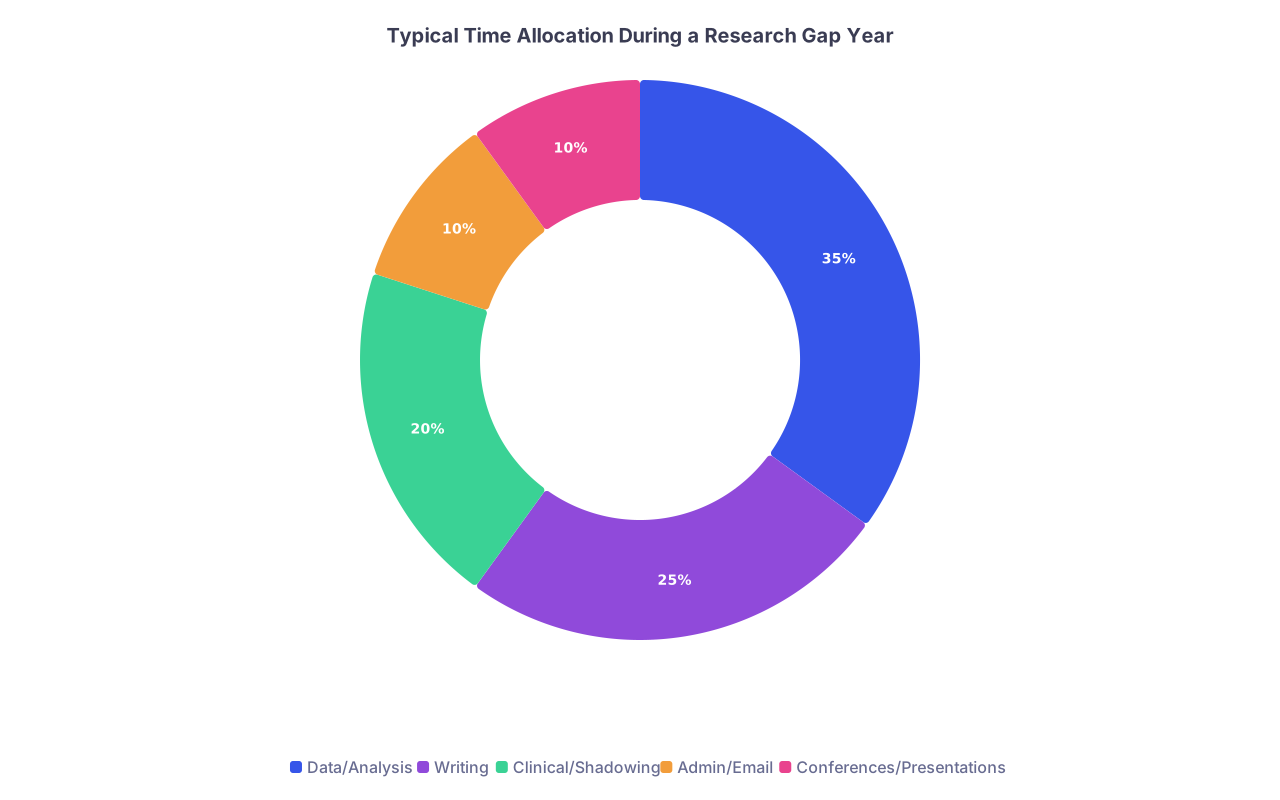
| Category | Value |
|---|---|
| Data/Analysis | 35 |
| Writing | 25 |
| Clinical/Shadowing | 20 |
| Admin/Email | 10 |
| Conferences/Presentations | 10 |
Here’s the basic structure that works:
Get a defined position before you commit to the year
Not “I’ll move to City X and see what I find.”
You want an actual role:- Research fellow
- Clinical research coordinator
- Post-doc
- Funded research year through your med school or an academic department
Choose your mentor very carefully
You’re not just choosing a project. You’re choosing a boss.Look for:
- Prior track record of students getting pubs and matching well
- People who answer emails, set expectations, and advocate for mentees
- Someone who actually matches in your specialty of interest
Red flag:
- “Yeah, I sometimes take students. We’ll see what projects are around.”
Define deliverables up front
Have a real conversation:- “If I work full-time for 12 months, what’s a realistic expectation for output?”
- Aim for: 2–3 abstracts, at least 1 strong manuscript, and a couple of presentations.
If the answer is “Maybe a poster by the end of the year,” that’s not great.
Protect some clinical exposure
If possible:- One half-day clinic per week
- Occasional call/OR time
- Longitudinal involvement with a clinical team
This keeps you clinically sharp AND helps with letters.
Plan your ERAS timeline around the year
Depending on when you start:- Early-year output may not be published by ERAS opening, but:
- “Submitted” and “in preparation” sections still matter
- Abstract acceptances and pending presentations still look good
Keep a clean, updated CV. Programs hate guesswork.
- Early-year output may not be published by ERAS opening, but:
6. Common Pitfalls That Make a Gap Year Useless
I’ve seen people sink a year and come out basically where they started.
Avoid these mistakes:
- Vague, unstructured “research” with no ownership
- Saying yes to every side task but never driving one project to completion
- Working for a PI who disappears, never meets with you, or constantly changes priorities
- Doing purely remote work with no meaningful connection to a department or team
- Letting the year become a “life break” instead of a deliberate building year
If you hit the end of a year and your strongest line is “I assisted with data collection on three projects,” that’s not a successful gap year.
7. How Programs Actually View Gap Years
Most program directors don’t care that you took a gap year. They care whether the year made you:
- More productive
- More mature
- More reliable
- More connected to their field
Neutral or positive scenarios:
- “They did a research year with Dr. X, have three publications, and Dr. X wrote them a glowing letter.” → Good.
- “They took a year for family reasons, then came back strong, no further issues.” → Fine.
Negative:
- “They took a research year, have nothing to show, and no one is really vouching for them.” → Raises questions about work ethic and follow-through.
So yes, people read your gap year as a signal about how you’ll show up as a resident.
FAQ: Gap Years and Residency Applications
Will a gap year hurt my chances because I’m “older”?
No. A well-explained, productive gap year doesn’t hurt you age-wise. Programs care more that your story makes sense and you’ve stayed clinically and academically engaged. A one-year delay with clear benefits is not a problem.Is an unpaid research year still worth it?
Sometimes. If it’s your only option, the mentor is excellent, and the projects and letters will be strong, an unpaid year can still be high-yield. But you need to be very honest about the financial hit and make sure you are not being used for grunt work with no meaningful credit.Do I need a gap year for internal medicine or family medicine?
Usually not, unless you have major red flags (exam failures, big gaps, limited clinical exposure, or are an IMG with no US experience). For most applicants targeting these fields with passing scores and solid evaluations, a thoughtfully chosen program list matters more than an extra year of research.What if I already took one gap year before med school — is another one bad?
Not automatically. Pre-med and pre-residency gap years serve different purposes. If your residency gap year is clearly focused (research, clinical work, meaningful responsibilities) and explained well in your application, programs will not penalize you just for having multiple breaks as long as there’s no pattern of aimlessness.Can I combine Step studying and a research gap year?
Yes, but be realistic. A “research year” where you actually intend to study full-time for Step 2 or 3 and do minimal research usually fools nobody. Either carve out a defined, short study block at the start, or build a schedule with your mentor that balances both, and still commit enough time to create real research output.How many publications make a research gap year ‘worth it’?
There’s no magic number, but for most competitive specialties, a successful year looks like at least 1–2 first-/second-author manuscripts plus several abstracts or posters. The exact value depends on project quality, your role, and the letters your mentors write about you. A single low-impact case report after a full year is weak.Who should I ask for advice before committing to a gap year?
Three groups: (1) A program director or APD in your target specialty (even at your home institution), (2) a faculty mentor who knows your actual file and competitiveness, and (3) a recent graduate who matched into your target specialty and has seen what did and didn’t work for classmates. If all three say you’re competitive already, be very cautious about delaying a year.
Key takeaways:
- A gap year is worth it when it directly fixes a real weakness for your specific target specialty—especially for competitive fields, major red flags, IMGs needing US experience, or late specialty switches.
- The year only matters if it’s structured, productive, and leads to concrete outputs plus strong letters; vague “research years” with nothing to show are a waste.
- If your application is already strong for a non-competitive specialty, you’re far more likely to benefit from applying strategically than from pausing your life for an extra line on your CV.