
You’ve been lied to about what “kills” your residency chances.
Everyone acts like no AOA and no honors = game over. Like there’s some invisible door that slams shut if you’re not at the very top of your class. And if you’re reading this, I’m guessing your brain is already running the worst-case scenario: “I’m screwed. I’ll never match where I want. I might not match at all.”
Let’s say this bluntly: not being AOA and not having a transcript full of honors is not the end of your residency dreams. It does mean you’re going to have to be more strategic, more honest with yourself, and more intentional about every part of your application.
But doomed? No. That’s drama your anxiety is feeding you.
Let me walk through what actually matters, how programs really look at you, and how you can build a legitimately strong file even when your evaluations are… painfully average.
Reality check: how much do AOA and honors actually matter?
Here’s the ugly truth first, so we’re not sugarcoating anything.
AOA and honors matter most for:
- Hyper-competitive specialties (derm, ortho, plastics, ENT, neurosurgery, integrated PRS)
- Big-name academic programs that want “shiny” applicants
- Distinguishing between already strong candidates
If you’re aiming at Harvard Ortho with no honors, yeah, it’s an uphill climb. I’m not going to pretend it’s not.
But the anxiety thought of “no AOA = no good residency” is just wrong.
Let’s put some structure on this.
| Specialty Type | AOA/Honors Impact | Realistic Outcome Without Them |
|---|---|---|
| Hyper-competitive surgical | High | Need other *very* strong pillars |
| Competitive cognitive | Moderate | Still very possible with strengths |
| Mid-competitive | Low–Moderate | Common to match without AOA/honors |
| Primary care | Low | Many residents without either |
Are there residents in strong academic IM programs with no AOA and no honors? Yes.
Are there anesthesia residents who were straight “Pass” with one or two “High Pass” and still matched well? Also yes.
Residency directors aren’t sitting there saying, “No AOA, trash pile.” They’re asking: “Does this file give me enough reasons to believe this person will:
- Take good care of patients?
- Work hard without drama?
- Learn fast?
- Not fail boards or drop out?”
AOA is just one quick heuristic for “this person did really well on paper.” If you don’t have that shortcut, you just have to show your value in a different way.
The 4 pillars you can still control (even with average grades)
Here’s the message your anxiety doesn’t want to hear: your application is not one thing. It’s a composite. Programs look for patterns. And you can absolutely stack the deck in your favor even without honors.
There are 4 pillars you should obsess over if your transcript doesn’t sparkle:
- Step 2 CK / COMLEX 2 (if applicable)
- Letters of recommendation
- Clinical narrative (MSPE + evaluations)
- Demonstrated fit and commitment to the specialty
Let’s go one by one.
1. Step 2 CK: your biggest academic salvage tool
If you’re not AOA and your clerkship grades are average, Step 2 CK becomes disproportionately important. It’s basically your one clean, objective number that can say: “Hey, I can handle complex medical knowledge.”
If you’re already done with Step 2 and your score is average, don’t panic. There are still ways to build strength elsewhere. But if you haven’t taken it yet, this is your shot to offset a mediocre grade sheet.
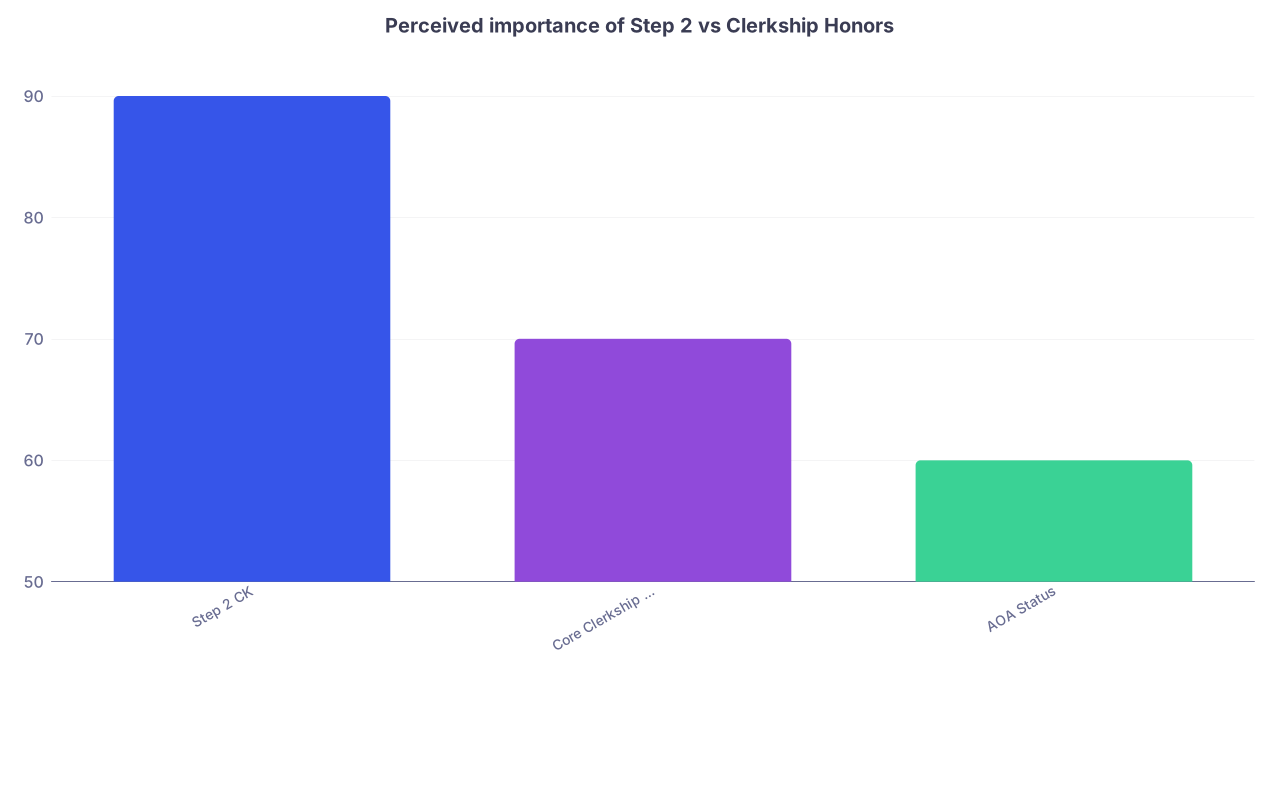
| Category | Value |
|---|---|
| Step 2 CK | 90 |
| Core Clerkship Honors | 70 |
| AOA Status | 60 |
Is that exact data scientific? No. But it does reflect reality I’ve seen: a strong Step 2 makes faculty much more forgiving of “High Pass” instead of “Honors,” especially if you improved over time.
If your Step 1 was pass/fail and your preclinical years were shaky, Step 2 is where you show you grew up academically. Think of Step 2 as the “second impression” after your transcript.
What if your Step 2 is solid but not amazing? Then your strategy shifts: you use every other part of your file to show reliability, work ethic, and fit. Not star power. Stability. Programs love stable.
2. Letters of recommendation: the thing that can absolutely override lack of honors
This is where students without AOA underestimate their power.
I have seen “average” students get interviews over objectively stronger applicants because their letters were ridiculous. Stuff like:
“I would take this student as my resident over many of our current interns.”
or
“Top 5% of students I’ve worked with in 15 years of teaching.”
Programs know grading systems are messy and political. But when an attending goes out of their way to rave about you, that cuts through the noise.
You want letters that say:
- You show up early.
- You own your patients.
- You respond to feedback.
- Nurses like you.
- Residents trust you.
If you didn’t get honors in a rotation where someone liked you, it’s still fine to ask for a letter. Honors doesn’t always equal “this attending knows you well.” Sometimes the student with honors just had fewer awkward moments.
The key move you can make now: identify 2–3 attendings or program directors who actually saw your growth. Not just the rotation where you got your single Honors. The people who saw you on bad days and still liked you.
Ask them explicitly for a strong letter. If they hesitate, pivot to someone else. A tepid letter hurts more than no letter.
3. MSPE and narrative comments: how to avoid death by “solid, adequate, satisfactory”
Here’s what freaks a lot of us out: those dreaded “average” phrases in narratives. Stuff like “pleasant to work with,” “willing to learn,” “reliable performance.” You read that and think: I’m toast.
Residency committees read hundreds of these. They know most comments are bland. What actually stands out are:
- Clear red flags (unprofessionalism, poor communication, lack of insight)
- Repeated patterns (3 different rotations calling you “disengaged” = yikes)
- Or, on the flip side, repeated praise for specific traits (team player, hard worker, strong ownership of patients)
You can’t rewrite your MSPE. But you can do two things:
Make sure your personal statement and letters reinforce your strengths in the same language. If your MSPE says you’re “reliable and compassionate,” your personal statement shouldn’t be all about “brilliant independent researcher.” Lean into the strengths you’ve actually shown.
Be ready to address any real issues during interviews. If you had a bad rotation, a professionalism comment, or needed remediation, own it. “I struggled early on with X, got feedback, did Y differently, and now my later rotations show that growth.” That storyline plays better than pretending nothing happened.
Programs don’t expect perfection. They expect insight and a learning curve. Lack of honors is not a red flag. Dishonesty and zero self-awareness are.
4. Fit and commitment: the underrated advantage you still have
If your application isn’t “stats-flex” material, your edge has to come from being a scarily good fit for the program and specialty you’re applying into.
You’re not trying to be the flashiest person they interview. You’re trying to be the one where they say, “This person will quietly do the work, get along with everyone, and stick around.”
This is where you can actually beat out an AOA superstar who interviews like a robot or gives off “I’m above this place” vibes.
You show fit through:
- Your personal statement being specific to the kind of program you want (academic vs community, underserved vs subspecialty heavy)
- Your experiences aligning with that story (volunteering, QI projects, research in the field, teaching)
- How you talk on interview day: asking questions that show you understand what their residents actually do, not just what’s on the website
Think: “convincing them you’ll thrive here,” not “convincing them you’re the best on paper.”
Where not being AOA really hurts (and what you can still do about it)
Let me not gaslight you: there are places where lack of AOA and honors will sting more.
Suddenly getting insecure about:
- Derm at top-10 programs
- Ortho in big coastal academic centers
- ENT, neurosurg, PRS at super elite places
That’s not your anxiety; that’s reality.
But here’s the part the catastrophizing brain skips: most specialties and most programs are not at that ultra-elite tier. And even in competitive fields, there are ways to make yourself viable.
You may need to:
- Apply more broadly
- Emphasize home program and away rotation performance
- Pick mentors who will really go to bat for you
- Be brutally honest about reach vs realistic vs safety

| Step | Description |
|---|---|
| Step 1 | No AOA / Few Honors |
| Step 2 | Target mid & some high-tier programs |
| Step 3 | Focus on mid/safety + strong fit |
| Step 4 | Maximize letters & specialty involvement |
| Step 5 | Apply broadly & tailor personal statements |
| Step 6 | Step 2 CK Strong? |
Is it fair that AOA gives others a head start? No. But medicine isn’t fair, and you already know that from rotations.
Your job now is not to rant about the system. It’s to squeeze every ounce of advantage out of what you do have.
How to keep your anxiety from quietly sabotaging your file
There’s one more thing that nobody talks about: being anxious about not being AOA can make you come across as… weird.
I’ve seen it:
- Over-explaining every single grade on the application
- Apologizing constantly for “only” getting Pass
- Writing personal statements that read like legal defenses instead of human stories
- Interview answers that keep circling back to “I know my grades aren’t the strongest, but…”
Program directors smell insecurity. It doesn’t make them think, “Wow, so self-aware,” it makes them question how you’ll handle stress as a resident.
You don’t need to pretend your record is perfect. But you do need to act like you believe you belong in the specialty you’re applying to.
If you consistently:
- Show you understand the work
- Have people backing you in letters
- Have a Step 2 that’s at least decent
- Communicate like a functioning adult who can self-reflect without self-destruction
You can absolutely build a strong residency file.
Not flawless. Strong.
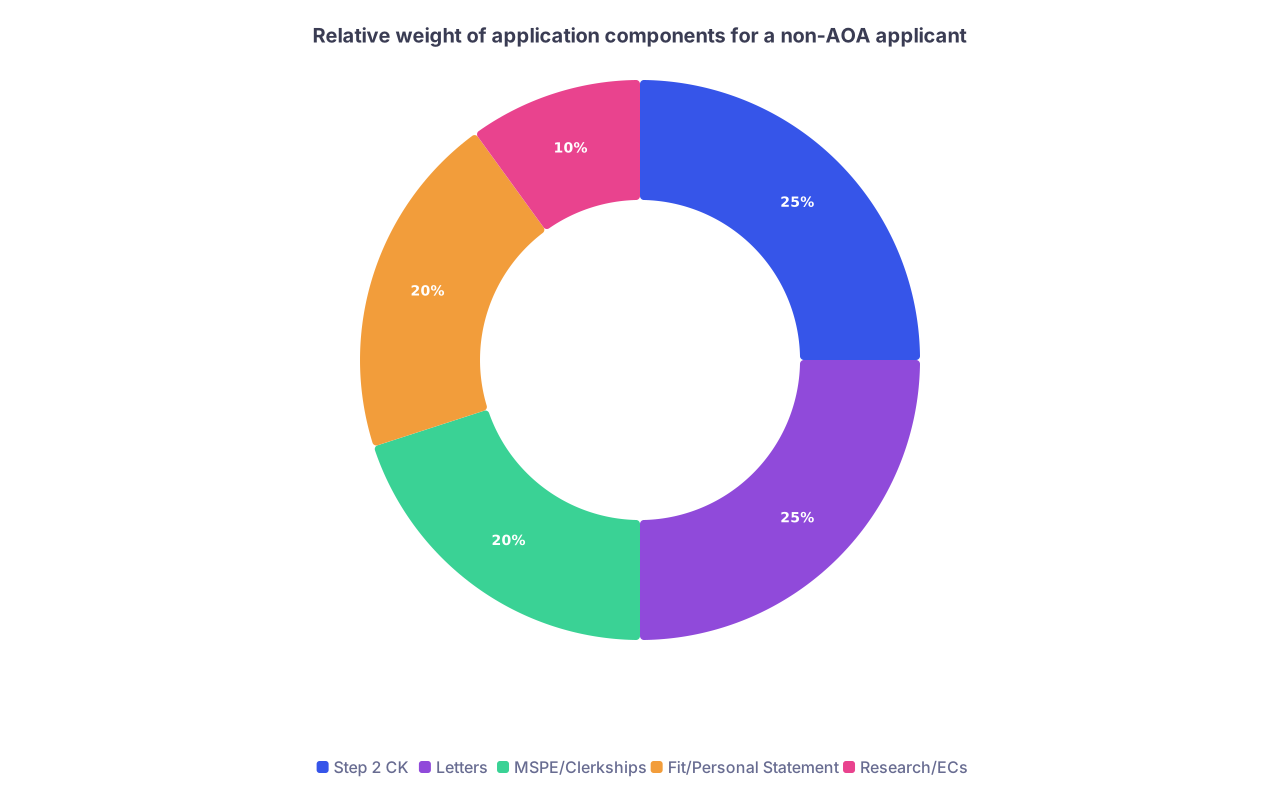
| Category | Value |
|---|---|
| Step 2 CK | 25 |
| Letters | 25 |
| MSPE/Clerkships | 20 |
| Fit/Personal Statement | 20 |
| Research/ECs | 10 |
That’s your game board now. AOA is off the table. Honors are limited. Fine. You put your energy into what’s left.
Quick gut-check: are you actually “in trouble” or just spiraling?
Ask yourself some brutally honest questions:
- Did at least a few attendings or residents like working with you enough that they’d vouch for you?
- Do you have at least one or two rotations where you felt, “I actually did well here”?
- Is your Step 2 at least around or above the national mean for your specialty?
- Can you name 2–3 concrete reasons you’re drawn to your specialty that aren’t cliché?
If you’re answering “yes” to most of those, then your problem is not that your file is dead. Your problem is that your brain is only looking at the weakest pieces and ignoring the rest.
You don’t need to turn yourself into a superhero applicant. You need to make sure no part of your file is actively dragging you underwater, and you highlight the stuff that actually shows you’re ready.
FAQs (the things you’re probably still panicking about)
1. If I’m not AOA and have no honors, should I even apply to competitive specialties?
You can, but you need to be strategic and brutally honest. If you’re talking derm, ortho, ENT, plastics, neurosurg, or urology, then without AOA or honors you must have other major strengths: strong Step 2, legit research, away rotations where people will go to war for you, and very realistic expectations about where you’ll be competitive.
If your Step 2 is average and you have zero honors and minimal research, then yeah, applying exclusively to a hyper-competitive specialty is basically gambling your career. Dual applying is not a sign of weakness. It’s survival.
2. Should I address my lack of honors directly in my personal statement?
Usually, no. Unless there’s a real story, like a major health issue, family crisis, or something that clearly impacted your performance and shows growth, rehashing “I didn’t get honors because I was adjusting to third year” just makes your statement about your insecurities.
Use the personal statement to sell your fit and your trajectory, not to litigate your transcript. If there’s something that truly needs context (like a failed course, leave of absence, or pattern that’ll raise eyebrows), your advisor or dean’s letter is usually the better place to handle that.
3. Will programs toss my application if they see mostly “Pass/High Pass” and no AOA?
Some might. A few big-name places will screen hard on AOA or number of honors. But most programs don’t have that luxury, and many don’t care nearly as much as students think they do.
What they will do is look for whether your performance is at least consistent and free of big red flags. A transcript of steady “Pass/High Pass,” a solid Step 2, and strong letters is not an auto-reject. It’s actually very normal.
4. Do I need to do an away rotation to make up for not having honors?
If you’re applying to a competitive field or you don’t have a strong home program, yes, an away rotation can help a lot. It gives you a chance to show your work ethic in real time and earn a powerful letter, which can partially compensate for lack of formal honors.
For less competitive specialties or if you have a good home program where people already know you and like you, away rotations are more optional. Nice to have, not mandatory. But if you’re feeling like your transcript underrepresents your effort, an away gives you one more shot to prove yourself.
5. How many programs should I apply to if I’m worried about my grades?
More than you think, but not blindly. If you’re below-average on paper, applying to only 20–30 programs in a competitive specialty is asking for pain. Talk to your school’s advising office and get real data from prior years.
As a rough idea: if you’re non-AOA, few or no honors, and average Step 2, it’s common to see people apply to 40–60+ programs in moderately competitive fields, and more in very competitive ones. But don’t just spam every program. Prioritize places where your profile actually makes sense: community programs, mid-tier academics, regions where you have ties.
6. What’s one thing I can do today to make my application stronger despite no AOA/honors?
Identify one attending who genuinely liked working with you and email them today to set up a meeting about a letter. Not a mass email. A specific, “I really valued working with you on X rotation, and I felt I grew in Y ways. Would you be comfortable writing a strong letter of recommendation for my residency application?”
If you get even one truly standout letter, that can do more for you than any single honor could’ve.
So do that now. Open your email, pick that attending, and send the message before you talk yourself out of it.