
Most physicians choose fellowship with their hearts and deal with their loans with whatever is left. That is backwards.
If you have six figures of debt, your fellowship timing is a financial decision just as much as a training decision. Over a 10‑year window, small shifts—when you start fellowship, which repayment plan you pick, whether you chase PSLF or refinance—can be the difference between financial stability and quiet panic at 38.
Let me lay this out the way nobody does for you: as a year‑by‑year, then phase‑by‑phase, timeline.
The 10‑Year Frame: What You Are Actually Trying To Align
You are not just “paying loans.” You are trying to line up three moving parts:
- Income trajectory
- Repayment strategy (PSLF vs. private practice / refinance)
- Training path (residency → fellowship → attending)
Over 10 years, that typically looks like:
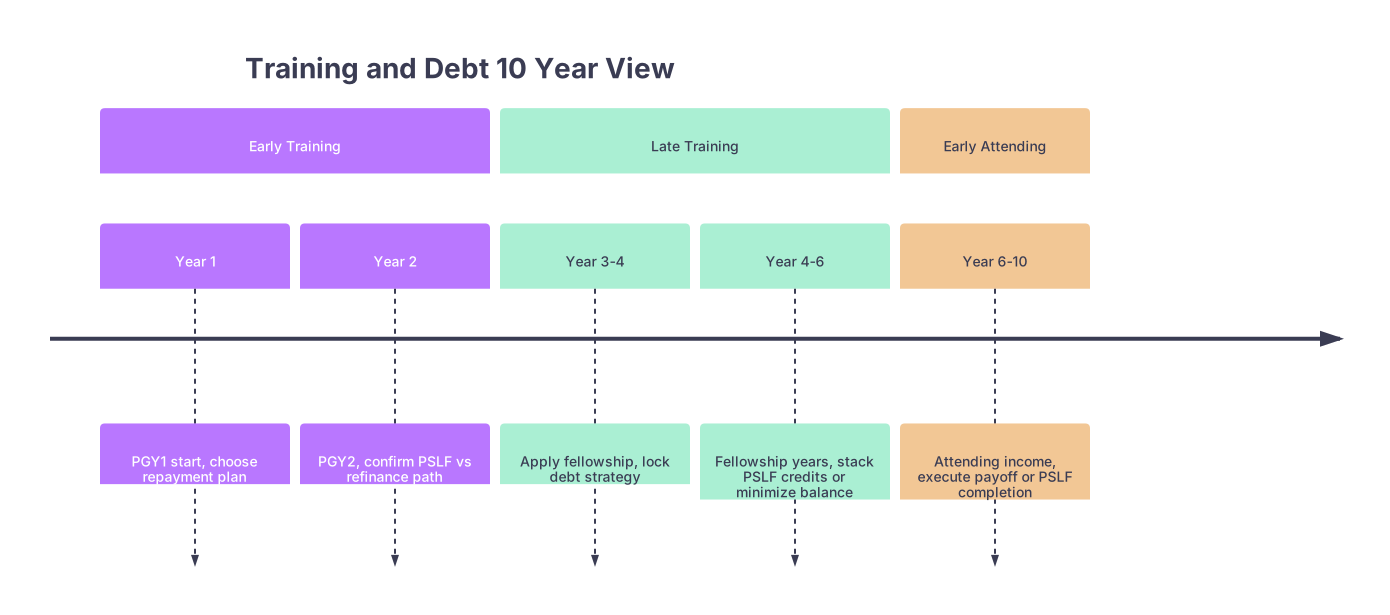
| Period | Event |
|---|---|
| Early Training - Year 1 | PGY1 start, choose repayment plan |
| Early Training - Year 2 | PGY2, confirm PSLF vs refinance path |
| Late Training - Year 3-4 | Apply fellowship, lock debt strategy |
| Late Training - Year 4-6 | Fellowship years, stack PSLF credits or minimize balance |
| Early Attending - Year 6-10 | Attending income, execute payoff or PSLF completion |
Your job: choose a path where your training choices support your debt plan, not fight it.
At this point you should be clear on one thing: you cannot optimize for everything. You pick a lane.
- Lane 1: Public Service Loan Forgiveness (PSLF) maximizer
- Lane 2: Aggressive payoff / refinance maximizer
- Lane 3: “Hybrid” (often the messiest, occasionally useful)
We will walk the decade assuming you decide which lane by mid‑PGY2 at the latest.
Year 0–1: MS4 to PGY1 – Stop the Bleeding and Choose Your Default
Goal for this phase: Do not make irreversible mistakes. Set your loans on a path that you can adjust once you see your residency reality.
Late MS4 (6–3 months before intern year)
At this point you should:
- Inventory every loan. Federal vs private, interest rate, balance, and whether any are already in repayment.
- Decide your default repayment plan for intern year.
Usually:- Federal loans → an IDR plan (SAVE for most; PAYE only if grandfathered and PSLF‑oriented)
- Private loans → usually defer, unless balance and rate are brutal
| Option | Best For | PSLF Eligible | Risk Level |
|---|---|---|---|
| SAVE | PSLF path, cash-poor | Yes | Low |
| PAYE | Older borrowers | Yes | Low |
| REPAYE | Legacy borrowers | Yes | Medium |
| Standard | No PSLF, short term | Yes | High |
| Refinance | Stable attendings | No | Very High |
If you are even 1% interested in PSLF, you set up:
- Consolidation of federal loans after graduation
- Enrollment in SAVE or PAYE
- Employment certification form once residency starts
You do not refinance as an MS4. You are guessing on your entire future.
PGY1 (Intern year)
At this point you should:
- Be in an IDR plan with payments tied to your resident income, not your theoretical attending income.
- Submit your first PSLF Employment Certification Form if you are at a qualifying nonprofit hospital. (Most academic centers and many community programs qualify.)
Your focus this year is not choosing fellowship. It is choosing a PSLF‑leaning vs non‑PSLF worldview:
- If you are at a 501(c)(3) and plan academic or hospital‑based careers → PSLF likely makes sense.
- If you are headed to private EM, anesthesia, derm, ortho at a for‑profit group → PSLF usually dies after residency anyway.
You do not need final answers yet. But you should feel which direction you are leaning by the end of PGY1.
Years 2–3: Early Residency – Lock Your Lane Before Fellowship Chaos
This is where most people screw it up. They focus on Step 3, research, and fellowship applications and let their loans drift. Bad move.
PGY2: Commit to a Lane
By mid‑PGY2, at this point you should consciously choose:
PSLF Lane
You expect:- 10 years at qualifying employers (residency + fellowship + attending)
- High debt relative to income (e.g., $300k+ med school debt)
- Specialty likely in academic / hospital employment
Aggressive Payoff / Refinance Lane
You expect:- Private practice or for‑profit group after training
- Comfortable ratio of debt to future income
- Willingness to live relatively lean in early attending years
Hybrid Lane
You will:- Collect PSLF‑qualifying years during training
- But are not fully counting on PSLF; you want the option to pivot to payoff
Hybrid can work, but if you are not careful it becomes “indecision plus interest.”
How Fellowship Timing Fits Here
PSLF lane:
– Fellowship at a nonprofit adds cheap PSLF credit years where payments stay low but the clock runs.
– Longer training is actually financially helpful if PSLF is real for you.Refinance lane:
– Fellowship means more years of low income while interest accrues.
– The shorter the total training, the faster you can refinance and crush the balance.
So, in PGY2:
- If you are PSLF‑leaning, you should be happy that an extra 2–3 years of fellowship = 2–3 more years of PSLF credit at low payments.
- If you are refinance‑leaning, you should be skeptical about long fellowships unless the specialty income justifies the delay.
Years 3–6: Fellowship Decision and Training – The Critical Alignment Window
This is where the fellowship timing and debt strategy either harmonize or fight each other.
Step 1: Before Applying for Fellowship (1–1.5 years before start)
At this point you should:
- Run two or three concrete 10‑year scenarios:
- Scenario A: No fellowship, generalist attending after residency
- Scenario B: 1–2 year fellowship then attending
- Scenario C: 3+ year fellowship then attending (cards, heme/onc, GI, etc.)
Use rough but realistic numbers:
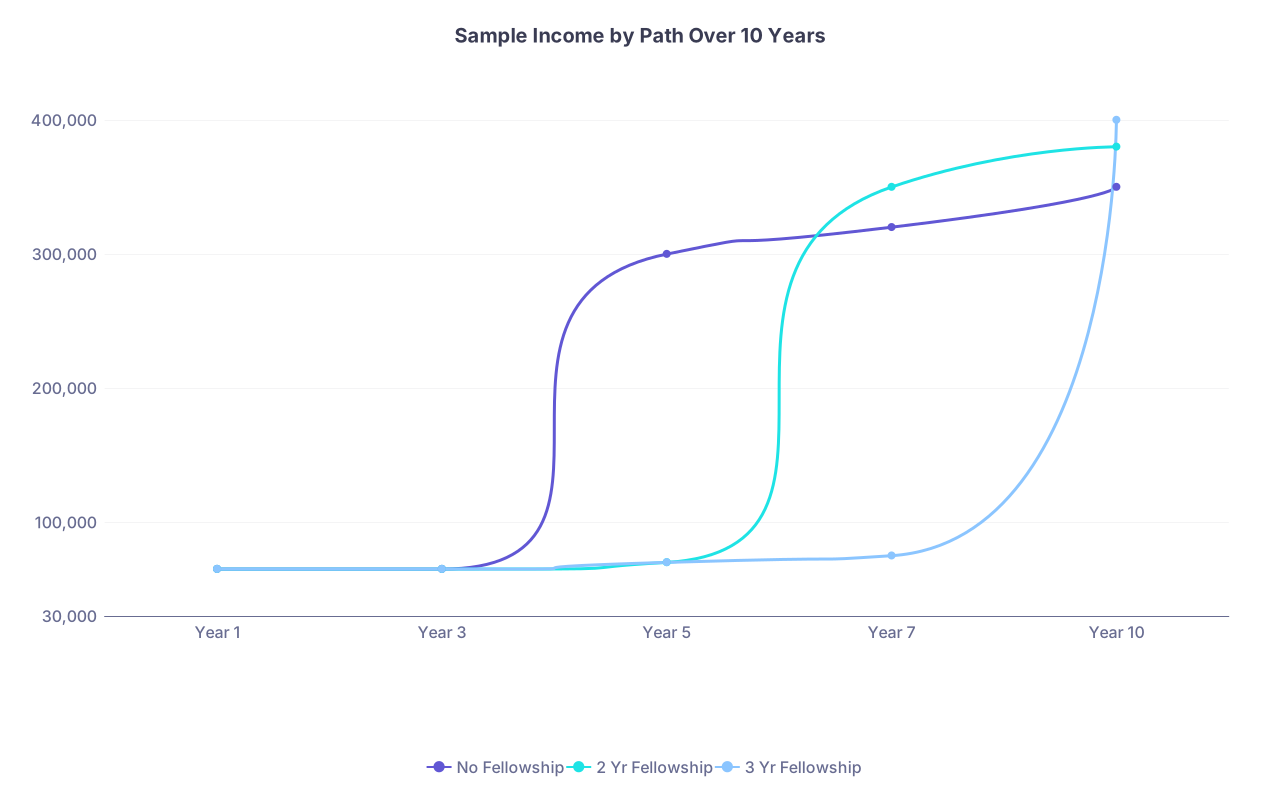
| Category | No Fellowship | 2 Yr Fellowship | 3 Yr Fellowship |
|---|---|---|---|
| Year 1 | 65000 | 65000 | 65000 |
| Year 3 | 65000 | 65000 | 65000 |
| Year 5 | 300000 | 70000 | 70000 |
| Year 7 | 320000 | 350000 | 75000 |
| Year 10 | 350000 | 380000 | 400000 |
Then overlay your debt strategy on each:
- How many PSLF‑qualifying years will you have at each point?
- When can you refinance safely in each path?
- What is your estimated remaining balance if PSLF fails vs if you refinance and pay hard?
Step 2: If You Are a PSLF Maximizer
For PSLF, the math is often misunderstood. The main levers:
- You want 10 total years of qualifying employment.
- You want payments as low as legally possible during those years.
- You do not care about the growing nominal balance if forgiveness is credible.
So:
- Residency (3–4 years) + Fellowship (2–3 years) + Early attending (3–5 years) = 10+ PSLF years.
- Your fellowship timing sweet spot:
- Start fellowship as soon as you finish residency. Do not take “gap” attending years at high income with higher PSLF payments unless tied to a PSLF‑qualifying employer and necessary for your career.
- Choose fellowships at nonprofit, PSLF‑qualifying centers whenever possible.
During fellowship you should:
- Stay on SAVE or PAYE.
- File taxes strategically (often Married Filing Separately if spouse has high income and you are PSLF‑oriented).
- Keep submitting annual PSLF certification.
If, for example:
- You start PGY1 in Year 1
- Do 3 years of IM, then 3 years of cardiology fellowship
- Then 4 years as an academic cardiologist at a 501(c)(3)
By Year 10 you:
- Have 10 PSLF years
- Have made very low payments for 6 of those years (residency+fellowship)
- Blow off the ballooned remaining balance with PSLF
In this lane, more fellowship is not a financial penalty. It is an asset.
Step 3: If You Are a Refinance / Payoff Maximizer
Very different playbook.
Your priorities:
- Reach high attending income as early as rational for your career.
- Keep your principal from ballooning out of control during training.
- Refinance the second income and job stability justify it.
At this point you should evaluate fellowships with two specific questions:
Does the fellowship significantly increase long‑term income vs going straight into practice?
- Example: Cards / GI → yes, often.
- Example: 1‑year hospitalist fellowship purely for “extra training” → often no.
How many extra years of low income will it add before you can refinance and pay aggressively?
During fellowship in this lane:
- You may still use SAVE / PAYE simply to survive cash‑flow wise, but you are doing it with the expectation of no PSLF.
- You aggressively pay extra when possible to limit growth of principal, especially if your rate is high.
- You do not add unnecessary years to training for “prestige” alone. That is how you quietly add $50k–$100k of lifetime interest for a line on the CV nobody cares about in practice.
Timing tip in this lane:
- If you are going into a lucrative subspecialty, the delay might still be worth it. Cards or GI attending at 35 with $350k salary and $350k debt you refinance and hammer can be fine.
- What you avoid is:
IM → 1 year chief → 1–2 year hospitalist fellowship → 2–3 years “junior attending” with mediocre pay → suddenly you are 38 and just now starting serious payoff.
Years 6–10: Early Attending Years – Execution, Not Theory
By the time you finish fellowship (or skip it), your options narrow. The window for clever optimization is mostly over. Now it is execution.
If You Are in the PSLF Lane
At this point you should:
- Be counting your qualifying PSLF years very deliberately.
- Choose attending jobs with PSLF status front and center:
- Nonprofit hospital or academic center
- W‑2 employment with clear PSLF‑eligible status
If you have:
- 6–7 PSLF years (residency + fellowship) behind you
- 3–4 more to go
You must ask: “Is this next job PSLF‑eligible?” If not, you are voluntarily walking away from a six‑figure tax‑free write‑off.
In these years:
- Keep payments low under SAVE.
- Avoid lifestyle inflation that makes you dependent on future income.
- Once PSLF hits (often around years 8–10 in the training+practice sequence), your loans vanish and the “debt strategy” chapter closes.
If You Are in the Refinance / Payoff Lane
First 3–5 attending years decide everything.
At this point you should:
- Refinance promptly once:
- Training is complete
- Your income is stable
- You are confident PSLF path is dead
- Set a clear payoff timeline: typically 3–7 years, not 20.
Your fellowship timing shows up here as:
- Earlier finish → more years of high‑income payoff in your 30s
- Later finish → compressed payoff window unless you are willing to extend into your 40s
Example:
- No fellowship: finish residency year 3 → refinance year 4 → pay off by year 10.
- 3‑year fellowship: finish residency year 3 + fellowship to year 6 → refinance year 7 → to finish by year 10, your annual payments must be much higher. Otherwise you push payoff to year 12–13.
So in your first attending contract negotiation, you should:
- Consider sign‑on bonuses and loan repayment incentives as tools to shorten that payoff window.
- Avoid taking lower‑pay “dream jobs” that destroy your ability to execute your payoff plan, unless you consciously accept a slower financial trajectory.
Putting It Together: A Sample 10‑Year Alignment
Let me give you one concrete timeline for each lane so you see the alignment.
Example A: PSLF + 3‑Year Fellowship (IM → Cards)
- Year 1: PGY1, SAVE, start PSLF clock at nonprofit hospital.
- Year 2: PGY2, confirm PSLF lane, adjust taxes (MFS if married with high‑earning spouse).
- Year 3: PGY3, apply for cardiology fellowship, stay PSLF‑eligible.
- Years 4–6: Cards fellowship at academic center, continue SAVE, 6 total PSLF years by end of fellowship.
- Year 7–9: Academic cardiologist at 501(c)(3), higher income but still PSLF‑eligible. SAVE payments go up, PSLF clock reaches 9 years.
- Year 10: Hit 10th PSLF year, remaining balance (often substantial) forgiven tax‑free. You are 35–38 with zero federal debt.
Fellowship timing here supports PSLF: more low‑payment qualifying years.
Example B: Refinance + Shorter Training (EM, no fellowship)
- Year 1: PGY1 EM, SAVE. PSLF possible but you lean toward private group EM.
- Year 2: PGY2 EM, commit to non‑PSLF lane, focus on keeping interest in check, maybe small extra principal payments.
- Year 3: PGY3 EM, line up high‑paying group job starting year 4 (often $350k+).
- Year 4: First attending year, refinance immediately (fixed rate, 5–10 years), set aggressive payment (e.g., $4–6k/month).
- Years 5–8: Maintain lifestyle discipline; push every raise and bonus toward loans.
- Year 8–9: Loans gone. Now capital for down payment, retirement, etc.
Skipping fellowship here accelerates payoff dramatically. You trade some potential subspecialty upside for 2–3 extra years of attending income.
FAQ (Exactly 2 Questions)
1. If I am unsure about PSLF, should I delay fellowship until I “figure it out”?
No. Indefinite delay is usually the worst of all worlds. If PSLF is even a moderate possibility, you should enroll in SAVE, certify employment, and let the PSLF clock run during residency. When fellowship time comes, choose based on career fit and whether the fellowship institution is PSLF‑eligible. You can always abandon PSLF later and refinance, but you cannot retroactively create qualifying years you threw away.
2. Should I ever refinance during fellowship?
Only in narrow situations: very high certainty of no PSLF, strong partner income or family stability, and an unusually high fellowship stipend or moonlighting income that lets you afford the private payments. For most fellows, refinancing before you are a stable attending is reckless. Keep flexibility, protect your downside, and let the decision wait until your post‑training income path is real, not hypothetical.
Key points: Decide your PSLF vs refinance lane by early residency. Time fellowship so it either stacks cheap PSLF years or does not unreasonably delay aggressive payoff. And treat your first 3–5 attending years as a focused execution window, not a victory lap.