
The biggest threat to future physician financial freedom is not lifestyle creep. It is the math of medical school tuition inflation.
The Core Problem: Tuition Is Growing Faster Than Physician Income
The data shows a simple but brutal spread:
- Median four‑year med school cost (tuition + fees + living) at many private schools is now crossing $400,000.
- Average medical student debt at graduation (among borrowers) hovers around $200,000–$250,000, with a growing tail over $400,000.
- Nominal physician incomes are rising, but nowhere near the rate of tuition inflation plus interest on federal loans.
That wedge between tuition growth and income growth is exactly what erodes future financial freedom. If your “starting line” is negative $400k instead of negative $150k, all the classic advice—max your 401(k), live below your means, avoid a Tesla—becomes necessary but not sufficient.
Let’s quantify what is actually happening.
What Tuition Inflation Really Looks Like
National data over the past two decades show med school tuition increasing at roughly 4–7% annually, depending on school type and state. Faculty salaries and clinical pay have not kept up at that slope.
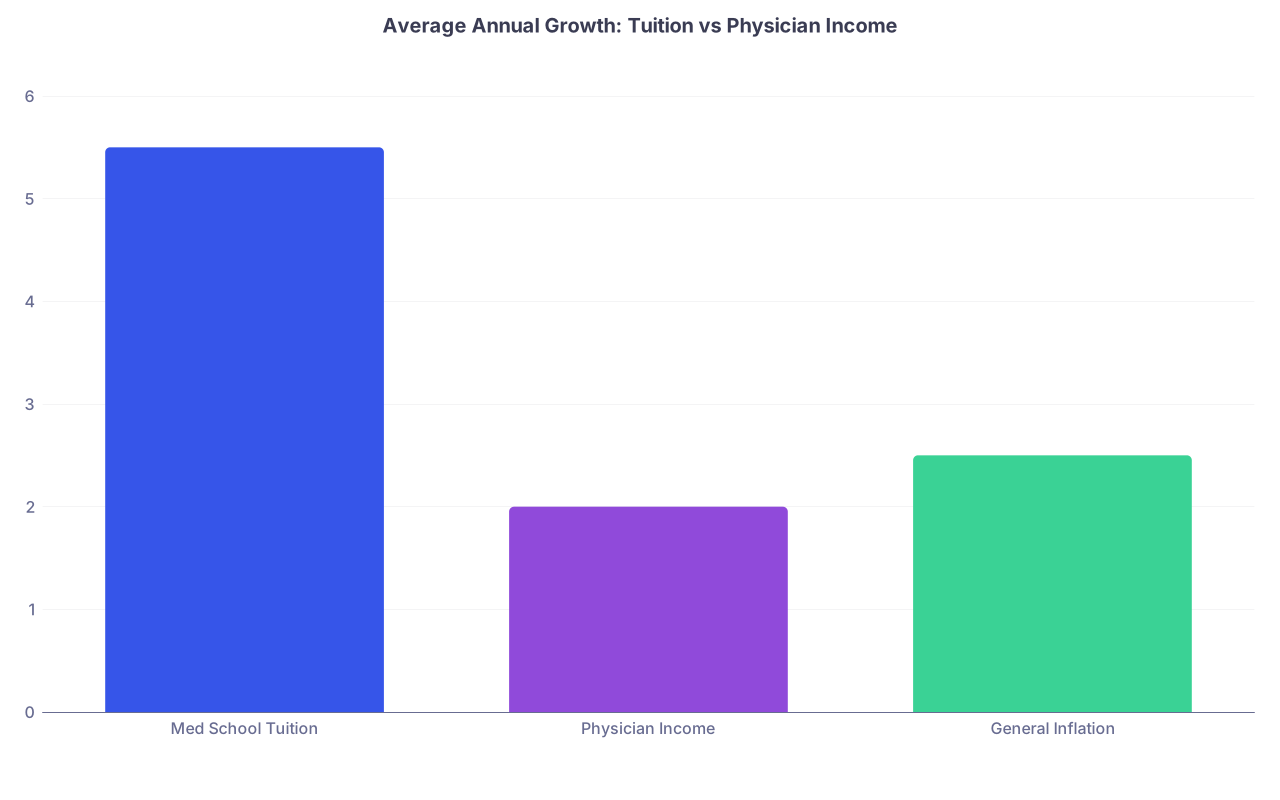
| Category | Value |
|---|---|
| Med School Tuition | 5.5 |
| Physician Income | 2 |
| General Inflation | 2.5 |
Where do those numbers come from?
- Many public med schools that charged ~$15k–$20k per year in-state in the early 2000s now charge $40k–$50k+.
- Private schools that used to be $30k–$35k are now routinely in the $60k–$70k range.
That is roughly 2–3× nominal growth in about 20 years, which corresponds to annualized rates north of 4%. Some specific institutions have run much hotter.
Now combine that with:
- Physician compensation growing more like 1.5–2.5% per year in many specialties.
- Federal loan interest rates for grad / med borrowers clustering around 6–8% for much of the last decade.
Result: Your debt grows faster in training than your income will afterward, unless you are unusually aggressive.
How Debt Levels Translate to Real Life
Let’s move from abstraction to cold numbers. Consider three typical debt scenarios at graduation (principal only):
| Scenario | Total Debt | Typical Path |
|---|---|---|
| Low | $150,000 | In-state public, family help |
| Medium | $300,000 | Mix of public/private, full borrowing |
| High | $450,000 | Private school, high COL city, full borrowing |
Assume:
- Federal Direct Unsubsidized + Grad PLUS blended rate: 6.5%
- Four years of med school borrowing, interest accruing as you go
- Standard 10‑year repayment after training
By graduation, actual balances will already be higher than amounts borrowed because of accrued interest. By the end of residency, they are significantly higher.
What balances look like at key milestones
Assume a 4‑year medical school and a 3‑year residency. Use simple approximations (reality is a bit messier but directionally similar).
- At graduation: interest has been accruing for an average of ~2 years on what you borrowed.
- End of residency: another 3 years of growth, assuming you are on $0 or very low REPAYE/PAYE payments that do not cover interest.
Approximate balances:
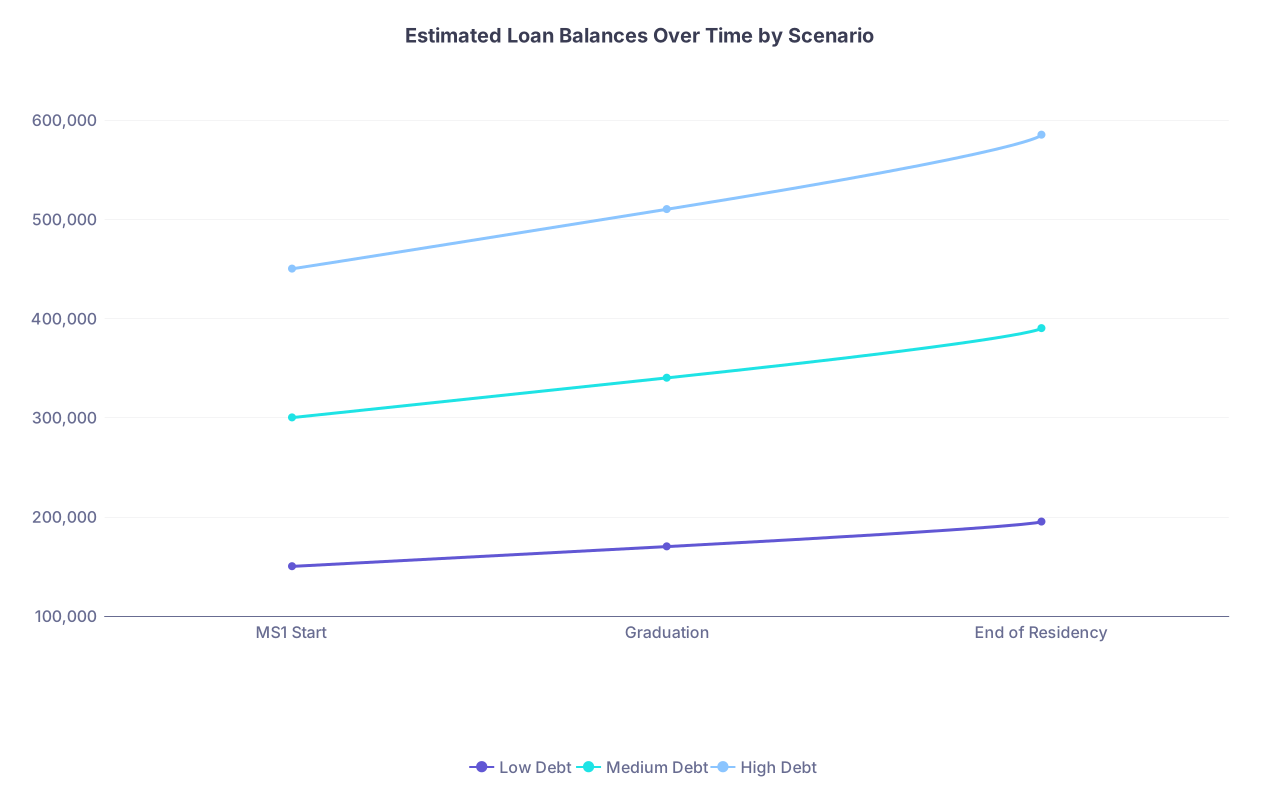
| Category | Low Debt | Medium Debt | High Debt |
|---|---|---|---|
| MS1 Start | 150000 | 300000 | 450000 |
| Graduation | 170000 | 340000 | 510000 |
| End of Residency | 195000 | 390000 | 585000 |
These estimates assume:
- All borrowing at the start (for modeling simplicity).
- Interest accrual at 6.5% with almost no principal reduction in residency.
So the “high” borrower walks into attending life with something like $550k–$600k in federal loans. That is not rare anymore. I have seen multiple PGY‑1s with NSLDS screenshots in the $600k–$650k range.
What monthly payments actually look like
Now translate that into the standard 10‑year federal repayment plan once you are attending.
If you want the debt gone in 10 years at 6.5% interest:
- $200k balance → around $2,270/month
- $300k balance → around $3,410/month
- $450k balance → around $5,120/month
- $600k balance → around $6,830/month
Rule of thumb: every $100,000 of debt at 6–7% is roughly $1,100–$1,200/month on a 10‑year term.
You can stretch to 20–25 years, but then:
- Monthly payment drops, sure.
- Total interest explodes.
Example: $450k at 6.5% over 25 years is roughly $3k/month and over $450k in total interest. You pay for med school twice.
That is the freedom killer: not the principal alone, but the interest tail anchored to your income over decades.
The Income Side: Are Doctors Keeping Up?
Now, what are you earning on the other side?
Median attending salaries by broad specialty buckets (recent surveys; round numbers):
| Specialty Category | Median Income |
|---|---|
| Primary Care | $260,000 |
| IM Subspecialties | $350,000 |
| Surgical Fields | $450,000 |
| High‑end Procedural | $600,000+ |
Regional, practice, and productivity differences are massive. But the pattern holds:
- Most new attendings land in the $220k–$350k band.
- A smaller slice in $400k–$600k+.
Now add taxes. A reasonable composite effective tax rate (federal + state + payroll) for a single or married physician in a medium‑to‑high tax state is often in the 30–40% range once they are attendings.
Let’s run a few concrete scenarios.
Scenario A: $300k income, $450k loans (common combination)
Assume:
- Household income: $300,000
- Taxes (all‑in effective): ~35% → take‑home ≈ $195,000 or $16,250/month
- Loans: $450k at 6.5% on 10‑year repayment → ≈ $5,120/month
Result:
- Loan-to-take‑home ratio ≈ 31% of net income.
- Remaining ≈ $11,100/month for:
- Housing
- Childcare
- Retirement savings
- Cars
- Everything else
Is that livable? Of course. But it caps your optionality:
- Harder to shift to part‑time.
- Harder to walk away from a toxic job.
- Harder to switch to a lower paying but more fulfilling specialty or academic gig.
Financially, your “fixed obligations” are high. You are locked to the treadmill for at least a decade if your goal is to be debt‑free.
Scenario B: $260k income, $300k loans
Now take a primary care doc:
- Income: $260,000
- Effective tax rate: say 30% → ≈ $182,000 or $15,170/month net
- Loans: $300k at 6.5% on 10‑year term → ≈ $3,410/month
Now:
- Loan share ≈ 22% of take‑home.
- Remaining ≈ $11,760/month.
This is actually a healthier profile, despite earning less, because the debt‑to‑income ratio (DTI) is lower.
Rule of thumb in this world:
- DTI < 1x (debt smaller than annual income) = manageable, strong path to freedom.
- DTI 1–2x = constraining; aggressive strategies needed.
- DTI > 2x = you are basically forced into PSLF or long‑term IDR unless you are in a very high‑pay specialty.
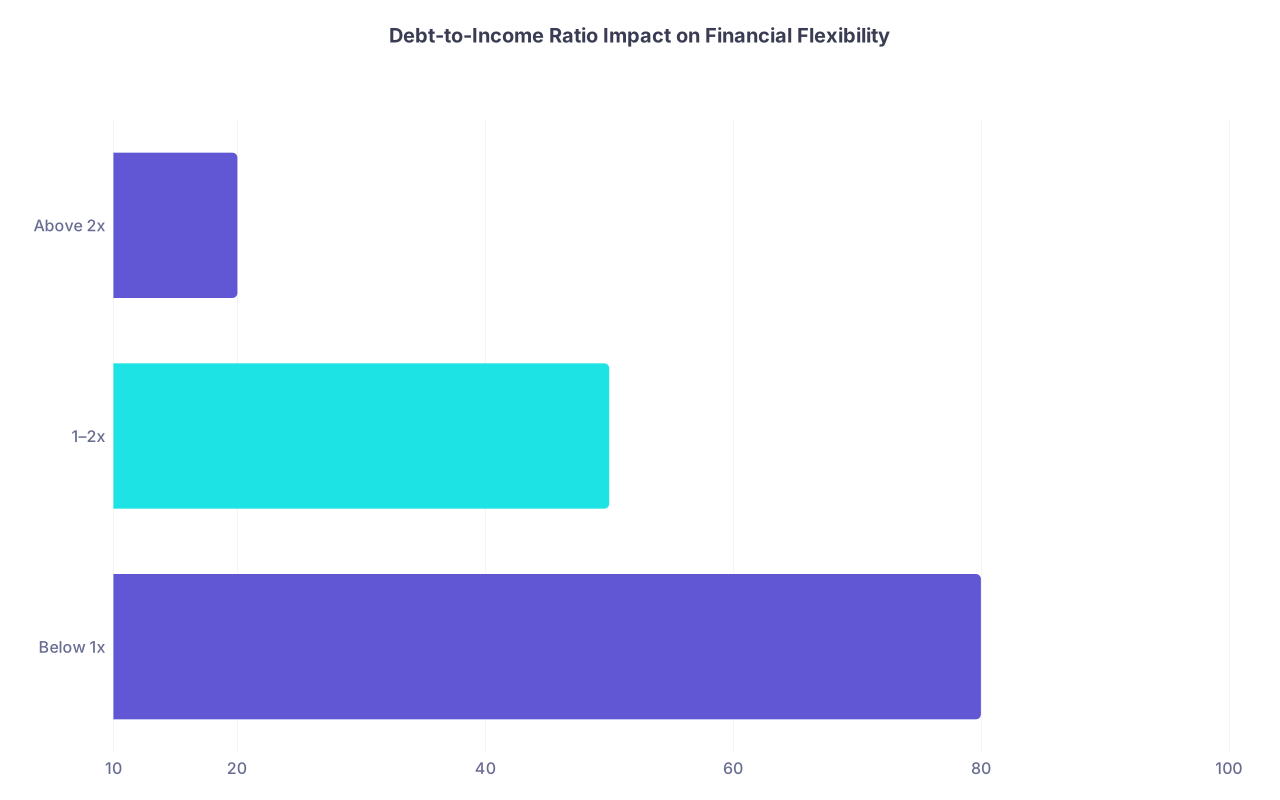
| Category | Value |
|---|---|
| Below 1x | 80 |
| 1–2x | 50 |
| Above 2x | 20 |
Interpretation:
- “80” here can represent relative financial flexibility (high flexibility at DTI <1x).
- “20” at >2x shows the extreme constraint zone.
This is where tuition inflation hits the hardest. It pushes new grads from the <1× zone into the 1–2× or >2× zones, before they even match.
The Silent Multiplier: Interest and Time in Training
The data that med students regularly underestimate: how much interest accrues before they ever earn attending pay.
Quick example with a “medium” borrower:
- Total borrowed: $300,000 over 4 years
- Average interest rate: 6.5%
- Weighted average time outstanding by graduation: around 2 years
- Rough accrued interest by graduation: ~ $40,000
- Balance at graduation: ≈ $340,000
Then a 5‑year surgical residency with low IDR payments:
- Starting residency balance: $340,000
- 5 years at 6.5%: interest ≈ $22k/year
- Total interest: ≈ $110,000
- If payments cover half of that, unpaid interest is ~ $55,000 and some may capitalize.
End of residency:
- Balance nudges toward $380k–$400k.
So, even though you “borrowed” $300k, you start attending life near $400k. Those extra $100k are pure interest, powered by time and rate. Tuition inflation raises the principal; long training and high rates multiply it.
Freedom Metrics: How Inflation Delays Key Milestones
If you want to measure “financial freedom” in something more concrete than vibes, look at time‑to‑event metrics:
- Time to net‑worth zero
- Time to “Coast FI” (where investments can grow to cover retirement without additional contributions)
- Time to plausible early retirement target (e.g., enough to safely draw $120k/year)
1. Time to net‑worth zero
Two stylized attendings:
- Both start with –$400k net worth at end of residency.
- Both earn $300k gross, $195k net.
- One commits to $7k/month toward debt and nothing to investments until debt is gone.
- The other splits $3.5k/month to debt, $3.5k/month to investments earning 5% after inflation.
Outcome:
- Aggressive debt payoff: loans gone in roughly 7–8 years; net worth ≈ $0 at that point, then accelerates.
- Split strategy: loans persist longer, but investments are growing simultaneously.
But here is the problem introduced by tuition inflation: push the starting debt from $200k to $400k and everything shifts right by 5+ years. You are in the hole much longer before your balance sheet even hits zero.
2. Impact on Coast FI
Say a physician wants to retire at 60 with an inflation‑adjusted income of $120k/year. Using a simple 4% real withdrawal rate, that requires a portfolio of:
- $120,000 / 0.04 = $3,000,000 in today’s dollars.
If you hit Coast FI at 40, you need a portfolio such that, with no further contributions, it compounds to $3M by 60.
Assume 5% real return. To grow to $3M in 20 years:
- Needed at 40: $3,000,000 / (1.05^20) ≈ $1.13M.
Now imagine two physicians, same income, same savings rate, different debt:
- Doctor A: starts attending life at –$200k; pays off in ~5 years while saving modestly; hits $1.13M by 40.
- Doctor B: starts at –$500k; needs ~10–12 years to be debt‑free at a similar lifestyle; might not get to $1.13M until mid‑40s, or at all if savings are delayed.
Tuition inflation alone can add 5–10 years to your Coast FI timeline if you treat loans as a background nuisance rather than a primary design feature of your financial plan.
How Loan Management Strategy Changes the Game
You cannot control tuition inflation retroactively, but your strategy post‑graduation either amplifies or dampens its impact.
Broadly, you have three main archetypes:
- Public Service Loan Forgiveness (PSLF) / IDR‑forgiveness path
- Aggressive pay‑off (non‑forgiveness)
- Long‑term IDR as a de facto tax (least efficient, most common by accident)
PSLF / IDR Forgiveness
If you work for a 501(c)(3) or government employer, PSLF is often mathematically dominant at high debt levels. The more tuition inflation pushes your debt up, the more valuable PSLF becomes.
- 10 years of qualifying payments on an IDR plan.
- Remaining balance is forgiven tax‑free under current law.
A high‑debt primary care doctor at $260k working at an academic center may see a six‑figure balance vaporize in year 10. That reduces the freedom loss considerably because:
- You do not have to pay off the full inflated principal + interest.
- Your monthly payment is proportional to income, not balance.
Aggressive Payoff
If you are in private practice or non‑qualifying roles, and especially if your DTI is below ~1.5×, an aggressive payoff strategy restores freedom fastest.
Structure looks like:
- Live like a resident for 2–5 years.
- Direct $5k–$10k/month to loans.
- Refinance strategically when rates make sense.
- Kill the loans in 3–7 years.
The earlier tuition inflation is confronted head‑on, the less compound interest gets to grow on top of it.
Mediocre IDR: The Default Trap
The worst outcome, and the most common in practice: drifting into REPAYE/SAVE or PAYE, making minimum payments that barely dent interest, without a clear forgiveness or payoff endpoint.
What happens:
- Balance creeps up or stagnates for 10–20 years.
- Psychological burden lingers.
- Total out‑of‑pocket over a career becomes enormous.
Tuition inflation makes that trap deeper. A $600k starting balance is unforgiving if you do not pick a strategy on day one.
Why Specialty Choice and School Choice Matter More Than Ever
Tuition inflation amplifies the consequences of two early decisions:
- Which medical school you attend.
- Which specialty you enter.
The raw numbers are blunt.
Comparing “cheap school + lower pay” vs “expensive school + higher pay”
Consider:
- Path 1: In‑state public, total debt $200k, ends up in primary care at $260k.
- Path 2: Private med school in high‑cost city, total debt $450k, ends in a mid‑pay specialty at $320k.
At 6.5% interest, debt service cost per $100k over 10 years ≈ $1,150/month.
Difference in monthly payments:
- Path 1: ~$2,300/month
- Path 2: ~$5,175/month
- Gap: ≈ $2,875/month → $34,500/year
Income difference:
- $320k – $260k = $60k before tax.
- After 35% tax: ≈ $39k.
So the net advantage for Path 2, after paying extra on loans, is on the order of $4k–$5k/year for a decade. One mediocre lifestyle decision easily consumes that.
This is what tuition inflation does: it compresses the payoff of “going big” on an expensive school unless it changes your trajectory dramatically (elite program → derm / ortho with $600k+ compensation and strong job leverage).

Legal and Policy Angles: How Rules Shape Freedom
Because you asked in the context of “financial and legal aspects,” let’s be explicit: the legal framework around federal loans is central to how tuition inflation hits you.
Key elements:
- Federal Direct Loans: Unlimited Grad PLUS borrowing up to cost of attendance enables schools to raise prices. Demand is inelastic; you still come.
- Income‑Driven Repayment (IDR): SAVE (successor to REPAYE), PAYE, IBR. These cap payments based on income and family size, not debt amount.
- PSLF: Tax‑free forgiveness after 120 qualifying payments for qualifying employment.
- Tax law: Long‑term IDR forgiveness outside PSLF is currently taxable under some schemes (though policy is fluid).
The perverse incentive:
- Schools know students can access essentially unlimited federal credit at above‑market rates.
- IDR and PSLF blunt the immediate pain, making higher tuition “feel” less impossible in the short term.
- The cost is shifted to future taxpayers and to those physicians who do not strategically exploit forgiveness programs.
So your freedom is partly a function of:
- Regulatory risk (will PSLF rules stay favorable?).
- Interest rate policy (higher rates → worse compounding).
- Employment choices (nonprofit vs private).
Med school tuition inflation has been politically possible mostly because the federal loan system absorbs it. You are the collateral.
Practical Guardrails for Future Freedom
I am not going to insult you with “budget carefully.” Here are quantified guardrails that actually change the slope of your outcomes.
Target Debt‑to‑Income Ratio ≤ 1×
- If projected total debt > projected starting attending income, be on high alert.
- Above 1.5×, you should be explicitly planning for PSLF or a very aggressive payoff strategy.
Compare schools on 10‑year cost, not just tuition
- Create a spreadsheet for each acceptance:
- Tuition/fees × 4
- Realistic living cost
- Scholarships
- Convert into projected loan balance at graduation including interest. Then run a 10‑year repayment simulation.
- Create a spreadsheet for each acceptance:
Lock in a strategy at PGY‑1, not PGY‑5
- Run PSLF vs private practice payoff scenarios early.
- If PSLF is likely: keep loans federal, optimize IDR, commit to 501(c)(3) or government path.
- If payoff is likely: consider refinancing as an attending, front‑load payments aggressively.
Treat every extra $100k borrowed as a 5‑figure annual decision
- $100k at 6.5% over 10 years → ≈ $1150/month → ≈ $13,800/year.
- Over 10 years that is ~$138k in nominal cash flow.
- That is what “one more year at a pricey city with no roommates” actually costs you, in simple terms.

FAQ (4 Questions)
1. Is it still financially rational to go to medical school given current tuition inflation?
For most applicants, yes, but the margin of safety has shrunk. The data still show physicians earning substantially more over a lifetime than other professionals with similar undergraduate records. However, the spread between low‑cost and high‑cost paths is now enormous. Attending an expensive private school at full freight, then landing in a lower‑paid specialty without using PSLF or aggressive payoff strategies, can crush your flexibility. Med school is not automatically a “good deal” anymore; it depends heavily on school cost, debt‑to‑income ratio, and how intelligently you manage loans.
2. How much med school debt is “too much”?
Once your projected debt exceeds roughly 1–1.5× your realistic starting attending income, you are in the danger zone. Above 2×, you are functionally forced into either PSLF or decades‑long IDR unless you land in a very high‑pay specialty. For a typical internal medicine or pediatrics trajectory (starting $220k–$260k), crossing $350k–$400k of debt should trigger serious reconsideration of school choice, scholarship opportunities, or long‑term forgiveness strategies.
3. Does PSLF completely solve the problem of tuition inflation?
PSLF softens it but does not “solve” it. For high‑debt physicians in qualifying employment, PSLF can remove hundreds of thousands of dollars of principal and interest, which is financially powerful. However, it also constrains your employment options for at least a decade and exposes you to legislative risk. Tuition inflation has been partially enabled by the existence of IDR and PSLF, because they mask the true cost. You benefit individually if you use PSLF correctly, but structurally the system remains distorted.
4. What single decision has the biggest impact on my future financial freedom as a physician?
Mathematically, it is the combined choice of medical school cost and your eventual debt‑to‑income ratio. Choosing a significantly cheaper school (or earning strong scholarships) can reduce your lifetime loan cost by six figures. Second to that is whether you commit early to a coherent strategy—PSLF with IDR or rapid payoff—rather than floating on minimum payments. The tuition inflation train is already moving; your leverage is in reducing principal now and shortening the time that high‑interest debt lives on your balance sheet.
Three key points, stripped of niceties:
- Med school tuition inflation is outpacing physician income growth, and the math is eroding your future flexibility more than any lifestyle choice.
- Your debt‑to‑income ratio at the start of attending life is the critical metric; keep it under 1× if you value freedom, and have a deliberate strategy if it is higher.
- School cost, specialty choice, and an early, explicit loan strategy (PSLF vs payoff) are the levers that determine whether you are financially free in your 40s or still paying for your MD in your 60s.