
It’s late January. You’ve done the interviews, smiled through the Zoom socials, listened to every "we’re very busy, you’ll get great operative experience" pitch. Now you’re staring at your rank list, stuck between three surgical programs that all sound the same on paper. Everyone claims “high volume,” “great autonomy,” and “our residents graduate very comfortable operating.”
You know that’s not all true.
Here’s the answer you’re actually looking for: how to cut through the marketing and figure out a program’s real surgical volume before you lock in that rank list.
This isn’t about vibes. It’s about data, patterns, and the right questions.
Step 1: Learn the Hard Truths About “High Volume”
First, reset your expectations.
Programs lie. Sometimes blatantly, often by omission. “High volume” can mean:
- One or two superstar services are slammed while others are dead.
- Staff are doing most of the cases while residents retract.
- Cases are high volume but low complexity or repetitive.
- Chiefs operate a lot, but juniors barely touch the knife.
You care about your hands-on case volume, across the years, not how many cases the hospital bills.
So your core questions are:
- How many cases will I personally do?
- How early will I start operating?
- How complex will those cases be?
- Are there structural barriers to me getting on the field? (Fellows, PAs, culture.)
If a program can’t give you clear, concrete answers around those, be suspicious.
Step 2: Use Public and Semi-Public Data (Quietly but Aggressively)
You can get a surprising amount of information without asking a single question on interview day.
1. ACGME Case Logs (What They Say and Don’t Say)
ACGME sets minimum case requirements, and programs track their chief residents’ numbers. You usually won’t see a full table per program, but you can:
- Ask programs directly: “What was the median total case number for your last three graduating classes?”
- Ask: “Any residents below ACGME minimums in the last 5 years?” (They’ll squirm if yes.)
To anchor your expectations:
| Specialty | Solid Volume (Chief Year) | Red Flag Volume (Chief Year) |
|---|---|---|
| General Surgery | 900–1200+ total | < 750 total |
| Orthopedic Surgery | 2000–2500+ total | < 1700 total |
| Neurosurgery | 1400–1800+ total | < 1200 total |
| OB/GYN | 1300–1600+ total | < 1000 total |
| ENT (Otolaryngology) | 1400–1700+ total | < 1100 total |
If they refuse to give any numbers and only speak in vague “we’re very busy” language, that’s not a good sign.
2. Hospital-Level Surgical Metrics
Look at the hospital, not just the residency website.
You can:
- Google: “<Hospital Name> annual surgical volume” or “quality and outcomes data.”
- Browse state or regional hospital report cards (some states publish OR volume by hospital).
- Look at specific service lines: “<Hospital> cardiac surgery outcomes,” “transplant volume,” etc.
Then ask yourself:
- Is this a Level I trauma center? (Huge plus for trauma-heavy fields, obviously.)
- Is there a children’s hospital or cancer center with dedicated ORs?
- Are they advertising being “the busiest in the region” with numbers to back it up?
High institutional volume doesn’t guarantee high resident volume, but low institutional volume almost always caps your ceiling.
Step 3: Interrogate the Structure: Who Actually Operates?
You can have a busy hospital with terrible resident volume because of one thing: competition for cases.
Pay attention to:
Fellows
Ask bluntly:- “On X service, who typically does the key parts—fellows or residents?”
- “Do chiefs ever get pre-empted by fellows on index cases?”
Programs where residents consistently say “we fight with fellows for cases” are a problem unless the volume is enormous.
PAs and NPs in the OR
On some private-heavy or community-heavy services, PAs scrub more than residents because they’re faster and billable. That’s a massive red flag.Ask:
- “Do PAs/NPs regularly first-assist on major cases instead of residents?”
Community vs University Mix
Community rotations can be gold or garbage. They’re gold if:- You’re the only learner in the room.
- Attendings rely on you as their main assistant. They’re garbage if:
- It’s a glorified shadowing rotation.
- You barely scrub.
Ask current residents:
- “Which outside rotations give you the most cases?”
- “Any where you basically just observe?”
If they hesitate, that tells you plenty.
Step 4: Ask Residents the Right Questions (Not the Polite Ones)
On interview day and second looks, you need to stop asking, “Is the operative experience good?”
Everyone will say yes. It’s useless.
Ask specific, non-leading questions that are hard to spin.
Here are the ones that work:
“How many cases do you have logged so far, and what PGY level are you?”
- If a mid-PGY2 in general surgery is sitting at ~150 cases, you’re probably fine.
- If a PGY3 is under 200, that’s trouble.
“How many times per week do you scrub a case where you’re actually the primary surgeon or doing key portions?”
Not “in the room.” Operating.“What’s a typical OR day like for a PGY2 on [core service]?”
You’re listening for:- Number of cases
- Complexity
- Whether they’re just closing skin.
“Which rotations feel light for cases?”
Every program has weak spots. You want to know where they are and if they’re patching them.“When do you start doing laparoscopic cholecystectomies/ORIFs/C-sections/etc. mostly yourself?”
If the answer is “well, really as a senior,” that’s late.
Early autonomy is a good sign of both volume and trust.
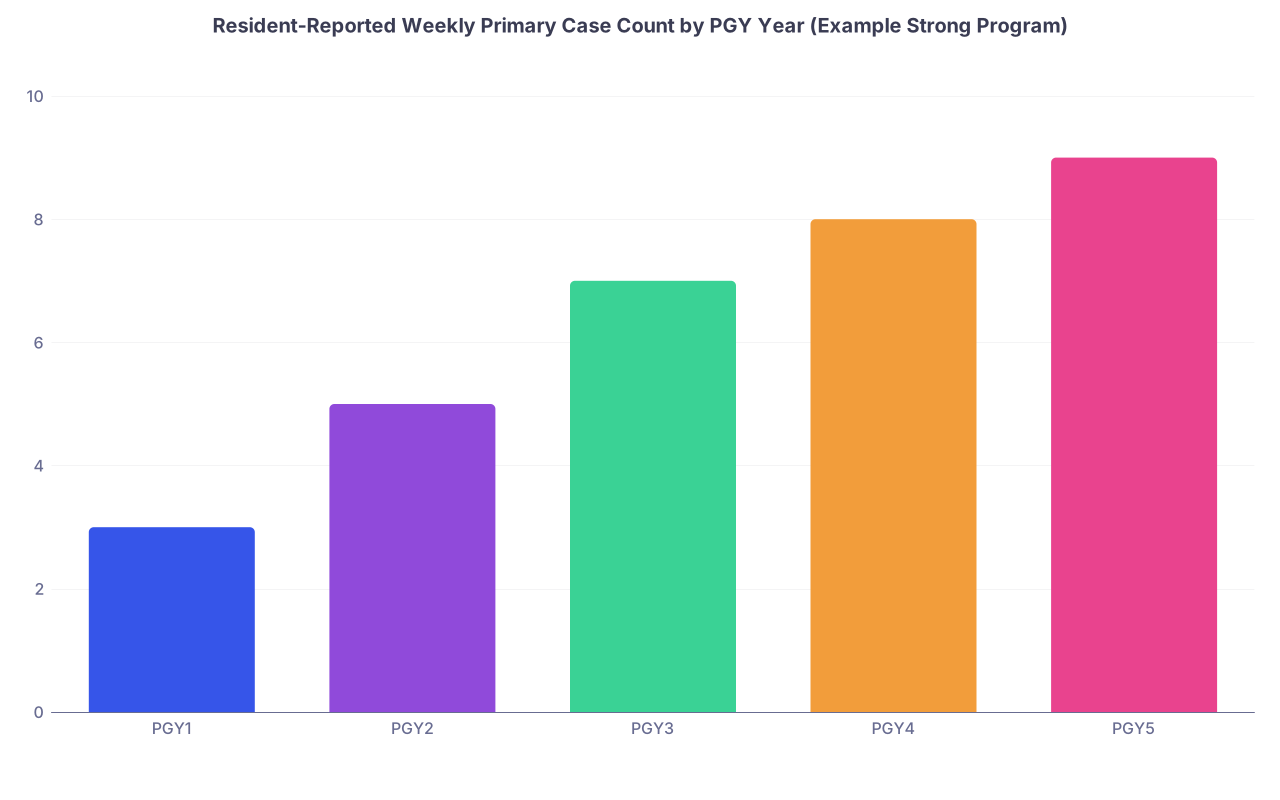
| Category | Value |
|---|---|
| PGY1 | 3 |
| PGY2 | 5 |
| PGY3 | 7 |
| PGY4 | 8 |
| PGY5 | 9 |
You want curves that look something like that over the week. Not flat lines at 1–2 cases.
Step 5: Decode Schedules, Call, and OR Access
Volume isn’t just about how “busy” the service is. It’s time + access.
Look at:
1. OR Block Structure
Ask:
- “Do residents have assigned OR blocks vs just jumping onto cases?”
- “Do junior residents have guaranteed OR time, or are they mostly floor work and consults?”
If juniors are living on the floor and doing scut while seniors and fellows own the ORs, the total program volume doesn’t help you.
2. Call Type and What Actually Happens
Call can be a volume engine or a black hole.
- In trauma-heavy programs, night float or in-house call can mean multiple emergent cases per shift. That’s gold.
- In some places, call means running around the ED and floors with zero OR time.
Ask:
- “On a typical call night, how many cases do you scrub?”
- “Does the on-call resident routinely get to operate, or is it all handled by nights/fellows/attendings?”
3. Clinic vs OR Balance
You need clinic for continuity and indications. But if the clinic burden is crushing, it steals case time.
Ask:
- “How many half-days of clinic per week for a typical junior and senior?”
- “Are you ever pulled from OR for clinic?”
If residents keep getting yanked from OR to sit in clinic, your case numbers will suffer.

Step 6: Watch for Cultural Red Flags That Kill Volume
Numbers matter, but culture decides who actually gets the knife.
Here’s what I’ve consistently seen:
1. Attending Attitude
On interview day and second looks, pay attention to how attendings talk:
Bad signs:
- “We let you watch a lot of complex cases.” (Watch is the key word.)
- “Fellows are very involved; you’ll learn a ton by observing.”
- “We care a lot about efficiency, so often the attending or PA will do the tough parts.”
Good signs:
- “By PGY3, I expect my resident to do most of a lap chole/lap appy independently.”
- “I staff the key steps, but residents are operating almost the whole time.”
2. Resident Confidence
Listen to residents describe their experience:
- Do they say “I’ve seen a lot of X” or “I’ve done a lot of X”?
- Do chiefs sound like early attendings or like advanced assistants?
You want chiefs saying things like:
“I’m comfortable taking trauma laparotomies from skin to skin,”
not:
“I’ve done a bunch, but I still feel like I haven’t done the truly hard parts.”
3. Board Pass Rates and Fellowship Placement
This is indirect, but programs with chronically weak operative exposure usually show it:
- Multiple residents needing extra training to feel ready for practice.
- Graduates consistently doing fellowships they didn’t originally want “to get more operative experience.”
You can ask:
- “Any residents in the last few graduating classes who felt underprepared to go straight into practice?”
They’ll either dodge or tell you the truth.
Step 7: Use Social Media and Alumni the Right Way
You can learn a lot outside the official pipeline.
1. Instagram and Program Socials
Most residencies plaster social media with:
- Case photos (HIPAA-safe),
- Resident in the OR shots,
- Service “takeovers.”
Scan a few months of posts. Look for patterns:
- Are junior residents ever pictured at the field, or always in the background?
- Any evidence of big cases with residents scrubbed vs just attendings and fellows?
Yes, social is curated, but absence of residents operating in their own content is… telling.
2. Alumni and Off-the-Record Conversations
The most honest data comes from people who have nothing to lose.
If possible:
- Reach out to recent alumni via email or LinkedIn.
- Ask for a 10-minute call and say directly: “I’m trying to understand how strong the true operative volume was for you compared to your peers.”
Ask them:
- “Did you feel ready to go straight into practice?”
- “Anything you wish you’d known about case volume before ranking?”
People are much more blunt once they’re out.

| Step | Description |
|---|---|
| Step 1 | Identify Programs |
| Step 2 | Review Hospital and Service Volume |
| Step 3 | Ask Residents Specific Case Questions |
| Step 4 | Assess OR Access and Call Structure |
| Step 5 | Evaluate Culture and Autonomy |
| Step 6 | Cross Check With Alumni and Social Media |
| Step 7 | Decide if Volume Meets Your Goals |
Step 8: Put It All Together: A Simple Decision Framework
Here’s a practical way to decide if a program has good enough surgical volume for you.
Score each program (1–5) on:
Total Chief Case Numbers (Data or Best Estimate)
- 1: Barely meeting ACGME mins or they won’t share numbers.
- 3: Solid, around national averages.
- 5: Clearly above-average volume with transparent data.
Early Hands-On Experience (PGY1–2)
- 1: Juniors mostly floor/ICU/clinic; very few primary cases.
- 3: Some early OR, but still heavily service-based.
- 5: PGY1/2 routinely scrub, close, and do basic cases with real autonomy.
Fellows/PA Competition
- 1: Multiple fellow-heavy services, PAs first-assist often, residents sidelined.
- 3: Mixed bag; some competition but offset by high volume.
- 5: Residents clearly prioritized in the OR; fellows are additive, not competitive.
Call-Generated Volume
- 1: Call is mostly scut; few emergent OR cases for residents.
- 3: Some OR at night, depends on the day.
- 5: Regular emergent/urgent OR cases with residents leading.
Resident Confidence and Culture
- 1: Residents sound hesitant, say things like “I’ve seen” more than “I’ve done.”
- 3: Mixed confidence; clearly adequate but not outstanding.
- 5: Chiefs talk like young attendings; juniors confident at their level.
If a program is consistently:
- 4–5 across the board → rank it high if location and personality fit.
- 2–3 territory → acceptable if everything else is outstanding and you plan a fellowship that compensates.
- Multiple 1s or low 2s → you’re gambling with your operative future. I wouldn’t risk it.

Step 9: What About the Future — Robotics, Sim, and Changing Volume?
You’re in the “future of medicine” era, which complicates this.
Robotics and minimally invasive surgery can cut open-case volume and centralize complex cases at tertiary centers. So you also ask:
- “How many robotic cases does an average chief log?”
- “Do residents get console time or only bedside?”
- “Do simulation and skills labs translate into earlier autonomy in the real OR?”
Simulation doesn’t replace real cases. It just lets you use your real OR time better. Programs that brag only about their sim center without solid case numbers are selling you polish without substance.
You want:
- Strong robotic exposure plus robust open and laparoscopic numbers.
- Clear policies about when residents take the console vs attendings and fellows.
FAQ: Seven Common Questions About Evaluating Surgical Volume
1. What’s a “good” total case number for a graduating general surgery resident?
In real-world terms, I like to see 900–1200+ total logged cases for general surgery chiefs, with a solid spread of bread-and-butter (cholecystectomies, hernias, appendectomies, bowel resections) and a decent number of complex cases. If they’re barely scraping by ACGME minimums (~850 total) and residents seem anxious about autonomy, that’s not ideal.
2. Is a program with lots of fellows always bad for operative volume?
No. High-volume quaternary centers with fellows can still have tremendous resident experience if the culture is resident-first and the volume is massive. It’s bad when:
- Volume is only moderate, and
- Fellows habitually take key parts, and
- Residents describe constantly losing cases.
If residents say, “The fellows do the cutting, we retract,” you have your answer.
3. How much should I trust what PDs and faculty say about volume?
Treat it like an attending’s “this will just take 20 minutes.” Sometimes true, often optimistic. Take their comments as context, but anchor on residents’ stories and numbers. PDs rarely say, “Our volume is borderline.” Residents sometimes will, if you ask them off-script and one-on-one.
4. I didn’t get specific numbers on interview day. Can I email and ask now?
Yes, you can — and you should. A simple, direct email like:
“Could you share the average or median total operative case number for your last few graduating classes?”
Programs that take themselves seriously usually have this readily available. If you get silence or vague fluff, interpret that accordingly.
5. What’s worse: lower total volume or late autonomy?
Late autonomy is usually worse. You can have decent total numbers but still feel unprepared if you were a spectator or assistant for most key parts until late in residency. Early, graduated autonomy with slightly lower total numbers can still produce a confident surgeon. Ideally, you get both high volume and early autonomy, but between the two, I’d rather see progressive responsibility.
6. Do community-heavy programs always have better operative volume?
Not always, but they often have less competition for cases. Community attendings without fellows may rely heavily on residents. The flip side: some community rotations are service-heavy with limited case complexity. You want to know:
- How many cases are you doing there?
- Are they meaningful (not just skin closures)?
- Do chiefs still meet or exceed national norms?
7. What’s one single question that cuts through the noise the fastest?
Ask a mid-level resident (PGY2–3):
“Exactly how many cases do you have logged right now, and how many of those were you actually primary on for at least part of the case?”
Then shut up and listen. Their number, their tone, and how fast they answer will tell you almost everything you need to know.
Open your interview notes or email inbox right now and pick one program you’re unsure about. Send a two-sentence email asking for recent chief case averages and when residents typically start doing key procedures independently. How they answer — or if they dodge you — should immediately reshuffle how you see that program’s “high volume” claim.