
Planning electives without staring at your case log is malpractice against your own career.
If your surgical log has holes—and most residents’ do—you do not fix it accidentally. You fix it with a deliberate, targeted elective strategy. Which almost nobody teaches you.
Let’s change that.
You want a clear, step‑by‑step method to:
- Identify the right gaps (not all gaps matter)
- Choose electives that actually translate into logged cases
- Structure those electives so you are scrubbed in, not holding the iPad
- Document and protect your volume for boards, jobs, and fellowships
This is the playbook.
Step 1: Audit Your Log Like a Program Director
Do not start by asking, “What electives are available?” Start by asking, “What would make my case log look weak to someone judging me?”
Pull your current log (ACGME, e-Value, MedHub, whatever you use) and sit down with it for 30–45 minutes. No distractions.
Look at three things:
- Total numbers by category
- Minimum requirements vs your current count
- Patterns of missing or skewed experience
1. Compare against explicit requirements
Your board or accrediting body almost certainly has published minimums by category.
For a general surgery resident, that might include buckets like:
- Hernia
- Breast
- Endoscopy
- Complex laparoscopy
- Vascular
- Thoracic
- Pediatric
- Trauma / critical care
Make a simple comparison table.
| Category | Required | Current | Gap |
|---|---|---|---|
| Endoscopy | 130 | 55 | -75 |
| Complex laparoscopy | 85 | 40 | -45 |
| Vascular | 44 | 18 | -26 |
| Pediatric surgery | 40 | 12 | -28 |
| Breast | 40 | 29 | -11 |
You do not need perfect numbers here. You just need to know:
- Where you are clearly under
- Where you are borderline
- Where you are already secure (and can stop stressing)
Circle any category where:
- You are below 60–70% of required volume and
- You have less than 18 months left in training
Those are “high-risk” gaps that electives must target.
2. Look beyond raw numbers
Some gaps are hidden inside categories that look “fine” on paper.
Ask yourself:
- Are you mostly assistant, not primary surgeon?
- Are your cases clustered in low complexity work (e.g., only simple hernias, no complex abdominals)?
- Are there specific procedures you rarely see (e.g., carotids, thoracotomies, pediatric laparotomies)?
Sort your log by:
- CPT / procedure type
- Role (primary vs assistant)
- Year of training
Patterns I have seen over and over:
- Residents who are “good” on total endoscopy but light on colonoscopy as primary
- Huge numbers of bread‑and‑butter lap choles, but very little complex laparoscopy
- Tons of adult trauma but almost no operative pediatric trauma or pediatric emergencies
- Vascular log inflated with AV fistulas but almost no open bypass
Write a second list: specific procedures you want more of, apart from generic categories.
For example:
- Colonoscopy as primary
- Lap Nissen / bariatric / complex foregut
- Open AAA or infrainguinal bypass
- Thyroid / parathyroid
- Pediatric appendectomy / pyloromyotomy
Now you have:
- Category gaps
- Procedure‑level gaps
- Role‑based gaps (assistant vs primary)
This is your target map.
Step 2: Translate Gaps into Elective Objectives
You do not choose electives by label (“I will do a vascular elective”). You choose them by output: what exact log entries you intend to generate.
Write down for each target gap:
- How many additional cases you realistically need
- What kind of rotation predictably produces those cases
Example:
Endoscopy gap: 75 more scopes
- Objective: 45 colonoscopies, 30 EGDs as primary or first operator
- Best source: Dedicated GI endoscopy elective with high volume and flexible staffing
Complex laparoscopy gap: 45 more cases
- Objective: Foregut / bariatric / advanced lap cases
- Best source: Bariatric / MIS service, not just “general surgery”
Pediatric gap: 28 more cases
- Objective: Pediatric appendectomies, hernias, pyloromyotomies
- Best source: Dedicated pediatric surgery elective at children’s hospital
Now prioritize. You probably get:
- 2–4 meaningful elective blocks in senior years
- Maybe 1–2 “customizable” months earlier
You cannot fix everything with electives. So rank each gap by:
- Board / accreditation risk (if you miss it, are you in trouble?)
- Fellowship relevance (does it matter for your future subspecialty?)
- Employability (do you want this skill in practice?)
If you are going into vascular, being light on endoscopy is annoying but not fatal. If you are going into general surgery in a community job, a weak endoscopy and hernia log is a real liability.
Use that to decide:
- Must-fix this year
- Nice-to-fix if space allows
Step 3: Time Your Electives for Maximum Case Yield
A “perfect” elective blocked in a dead part of the year will not fix your log. Timing matters.
You need to know your institution’s case flow. Ask chiefs and recent grads, not just faculty who say “it is always busy.”
When to schedule high-volume electives
In most places:
- Endoscopy is less seasonal; volume stays relatively steady
- Vascular, trauma, and emergency general surgery surge in certain months
- Pediatric electives may spike around school breaks or respiratory seasons
- Oncologic volume may ebb and flow with referral patterns, but often steady
You want your “gap-fixing” electives:
- In months known to be busy for that service
- In PGY years where you will actually be allowed to operate meaningfully
If you are PGY2 trying to fix complex laparoscopy with a MIS elective while the PGY5 is still around, you will spend half the cases holding the camera. That will not rescue your log.
General rule:
- Schedule high‑value operative electives (lap, vascular, peds, onc) in late PGY3–PGY5
- Use earlier electives (PGY2–early PGY3) for foundational skills (endoscopy, ultrasound, clinic-heavy subspecialties) where junior level does not cripple your role
Step 4: Choose Electives That Actually Generate Cases
Not all electives are created equal. Some are famous for teaching, others for scut. Some are volume machines; some are consult hell.
You are planning strategically. So you must ask the right questions before locking your choice.
Here is the decision framework.
1. Match elective type to gap
Common pairings:
Endoscopy gap
- GI endoscopy elective (if you get to scope, not just observe)
- General surgery endoscopy month (if your residency controls the list)
- Rural / community hospital elective with high volume of bread‑and‑butter scopes
Complex laparoscopy / MIS
- Bariatric / foregut service
- MIS fellowship site (but clarify resident role)
- Community MIS surgeon with high elective case volume
Vascular
- Dedicated vascular service at your home or affiliated hospital
- External rotation at a vascular-heavy center
Pediatric surgery
- Children’s hospital rotation where general surgery residents are primary operators, not just shadowing fellows
- Community hospital that does a lot of pediatric hernias and appendectomies
Breast / endocrine
- Breast surgery elective with consistent OR days
- Endocrine surgeon who runs a high-volume neck practice
2. Investigate the service culture
You need intel from people who actually did the rotation in the last 1–2 years. Ask them, bluntly:
- How many cases did you actually log in a 4-week block?
- How many were you primary or first assistant?
- Did fellows push residents out of cases?
- Who controls the schedule—attendings, fellows, or some chaotic nurse coordinator?
- How often did you get bumped from OR to floor/clinic duty?
A vascular rotation where a PGY4 logs 40–50 operative cases as primary/first assistant in a month? Gold.
A bariatric rotation where the fellows do everything and residents are camera holders? Useless for gap-fixing.
3. Beware the three common traps
I have seen residents fall into the same holes repeatedly:
“Name brand” elective with no volume
Big‑name transplant or complex oncologic service at a prestigious center sounds great on a CV. But if you are third in line behind two fellows and a senior resident, your log will not move.Clinic-heavy elective when your problem is OR numbers
Surgical oncology clinics are educational. They do not fix low OR volume. If your primary problem is case count, choose rotations where you physically spend most days in the OR or endoscopy suite.Elective during heavy call / cross-coverage
If your elective month still saddles you with Q3 home call for other services, you will miss cases. A “24-hour call” day can wipe out an entire elective OR day you counted on.
Step 5: Design Your Elective Week-by-Week
Once the elective is scheduled, you are not done. You need to structure it so each week produces measurable log gains.
Start before the rotation begins.
Pre-rotation setup
Two weeks before the elective:
- Email the service chief or main attending:
- Tell them your training level
- Explicitly state your goals: “I am aiming to increase my endoscopy volume by ~40 cases and improve my independence with colonoscopy.”
- Ask:
- On which days is the highest volume OR / endoscopy?
- Are there particular rooms or attendings you should preferentially work with?
- Request to be placed in:
- High-volume rooms
- Blocks where residents historically get to operate, not just observe
This is not overstepping. This is professional.
Structure of a high-yield elective week
Your goal: maximize time in rooms where your hands are on the instruments.
A good week usually looks like:
- 3–4 full OR or endoscopy days
- 1 half‑day clinic (only if it feeds your cases or is mandatory)
- 1 half‑day for admin / research / recovery
If you find yourself:
- Rounding endlessly on a low‑acuity floor population
- Doing discharge summaries and social work all day
- Spending 3+ half‑days in clinic with minimal operative payoff
You need to intervene by end of week 1.
Step 6: Aggressively Protect Your OR / Scope Time
Here is where a lot of residents quietly lose the game. They schedule the right elective. Then they let everyone else steal their cases.
You cannot be passive.
1. Clarify your role on day 1
On the first morning, tell your main attendings:
- “I am on this elective specifically to build my [endoscopy / vascular / pediatric] volume.”
- “My goal is to be in the OR or endoscopy suite as much as possible.”
- “If there are cases where I can be primary operator or first assistant, I would like to be in those whenever appropriate.”
Most surgeons respect that clarity. Some will actively help you.
2. Control your schedule in real time
Every afternoon:
- Check the next day’s schedule yourself
- Identify:
- Highest-yield cases
- Rooms where your presence matters
Then:
- Confirm with the chief or fellow which cases you are assigned to
- If conflicts arise, advocate for staying in the room that serves your elective goal, unless there is a clear program-level priority that requires otherwise
3. Minimize elective-killing distractions
Common distractions:
- Being pulled to cover another service’s clinic
- Floor calls and consults that could be handled by another team member
- Administrative tasks that expand to fill your OR time
Work with your chief:
- Create clear expectations: during cases, someone else fields non-urgent pages when possible
- If you must cover something, negotiate: “I will do the consult after this lap case finishes; does that work?”
You will not win every battle. You just need to win enough to keep your log moving.
Step 7: Log in Real Time and Track Progress Weekly
If you do not measure it, you will overestimate what you are accomplishing.
During your elective:
- Log cases daily. Same day or next morning. No exceptions.
- Tag each case carefully with:
- Your role (primary vs assistant)
- Correct category/subcategory
- Approach (open vs lap vs endoscopic)
At the end of each week:
- Run a mini-report of your log
- Compare against your pre-rotation gap numbers
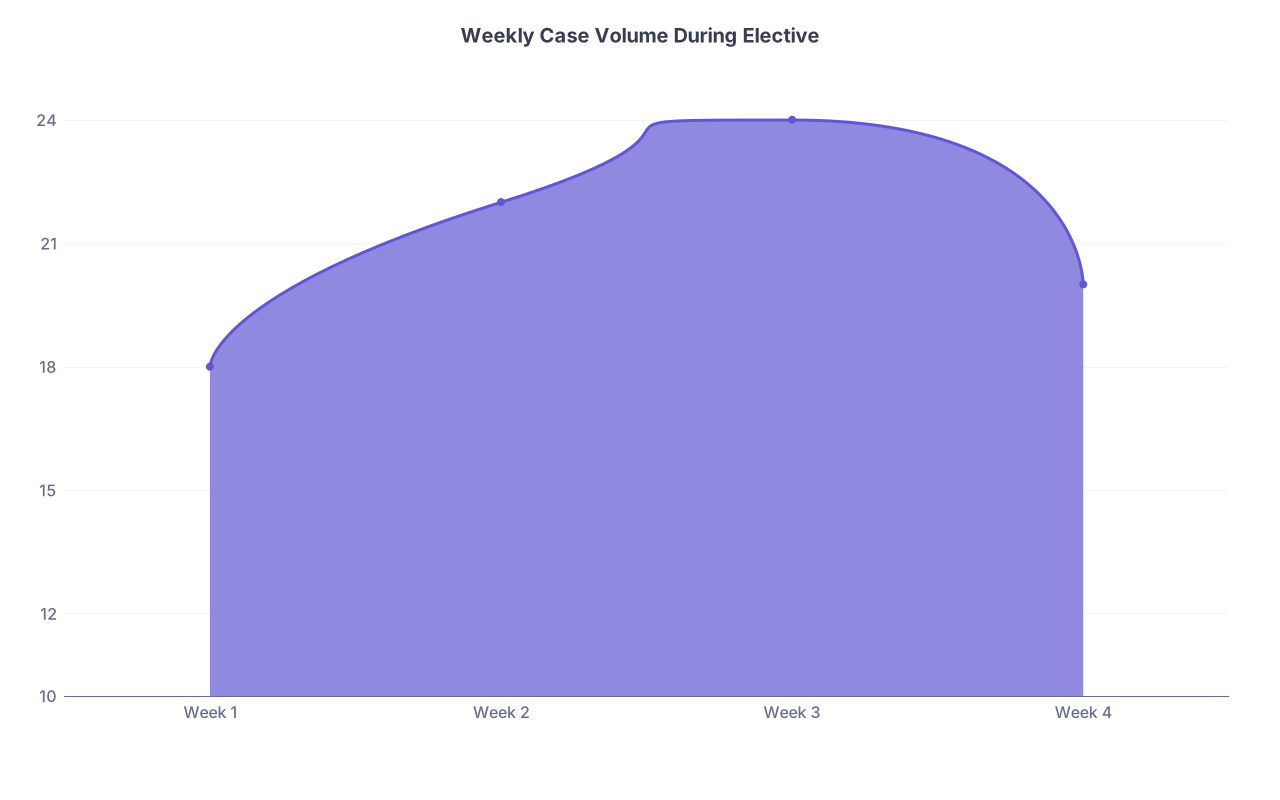
| Category | Value |
|---|---|
| Week 1 | 18 |
| Week 2 | 22 |
| Week 3 | 24 |
| Week 4 | 20 |
Ask:
- Did this week move the needle?
- Am I mostly assistant or actually primary?
- Do I need to adjust my case selection for next week?
If you are three weeks into a four-week elective and have only added 10 meaningful cases, you do not wait and “hope” the last week is magically better. You talk to the service and adjust.
Step 8: Use External Rotations and Community Sites Strategically
The future of surgical training is increasingly distributed—more community affiliates, private hospitals, and ambulatory centers. Used correctly, these can be your secret weapon for log gaps.
Why community sites can be high-yield
- Less competition from fellows
- Higher volume of bread‑and‑butter cases (hernia, endoscopy, cholecystectomy)
- Attendings more accustomed to residents doing the entire case
Residents often return from a 4-week community general surgery rotation with:
- 40–60 logged cases
- Majority as primary surgeon on straightforward operations
For someone lagging in core numbers, this can rescue an entire log.
How to avoid getting burned externally
Before you agree to an away/community elective, verify:
- How many cases did the last 2–3 residents log?
- Were they primary or assistant?
- Was there any issue with case logging (CPT codes not entered, no resident access to the system, etc.)?
- Is there a clear policy on resident role vs physician assistants / NPs in the OR?
If you hear:
- “You will help when you are not in clinic.”
- “Sometimes the PA does the easier cases.”
Walk away. That will not fix your log.
Step 9: Align Electives With Your Future Practice, Not Just Minimums
You are not just trying to hit ACGME minimums. You are building a skill set that matches how you want to practice.
Think ahead.
If you are going into fellowship
Vascular fellowship
- Priority: open vascular exposure, basic lap and endoscopy enough to function but not obsessive
- Electives: vascular-heavy months, ICU/trauma exposure, minimal time wasted in low-yield electives that do not affect your fellowship prospects
MIS / bariatric fellowship
- Priority: complex laparoscopy numbers, basic endoscopy, foregut expertise
- Electives: high-volume bariatric and foregut, advanced lap community surgeon, endoscopy-rich rotations
Surgical oncology fellowship
- Priority: complex resection cases, multidisciplinary clinic experience, some endoscopy
- Electives: hepatobiliary, colorectal oncology, breast, minimal time on low-volume niche procedures you will rarely do
If you are going into community general surgery
Your log should scream: “I can handle the bread‑and‑butter of a small hospital.”
That means:
- Solid numbers in:
- Endoscopy
- Hernia (open and lap)
- Cholecystectomy (including acute)
- Basic colorectal
- Some exposure to:
- Simple vascular (e.g., access), if relevant to job
- Basic thoracic (chest tubes, simple resections)
- Minor pediatric emergencies (appendectomy, hernia)
Electives should tilt:
- Strongly toward volume in these bread‑and‑butter areas
- Away from highly specialized, low-frequency procedures you will never see again
Step 10: Get Your Program On Board Early
You might be reading this as a PGY4 with a scary log. That is not ideal, but still fixable. If you are PGY2 or early PGY3, you can be proactive.
Here is how to bring your program into the loop without sounding accusatory.
The conversation script
Book 20 minutes with your program director or associate PD.
Bring:
- Your current log summary by category
- The requirements / benchmarks
- A simple one-page plan of “Gaps and proposed electives”
Say something like:
“I pulled my case log and compared it to the board minimums. I am currently under target in [endoscopy, complex lap, pediatric cases]. I would like to be deliberate about electives so I am fully prepared by graduation. Here is what I am proposing.”
Then show:
- The electives you want
- The timing you suggest
- The expected case volume those rotations have generated for prior residents
You are not asking, “What should I do?” You are saying, “Here is my data-driven plan; can we tweak and approve it?”
Most directors will love this. You are making their job easier and reducing the risk of a last‑minute panic about your numbers.
Example: Putting It All Together
Let me give you a concrete scenario.
You are a PGY3 in general surgery. You pull your log:
- Endoscopy: 42/130
- Complex laparoscopy: 30/85
- Pediatric: 18/40
- Vascular: 25/44
You have:
- One 4‑week elective in late PGY3
- Two 4‑week electives in PGY5
- One optional away rotation
Your plan:
PGY3 elective (home endoscopy month)
- Goal: +50 endoscopy cases as primary (30 colon, 20 EGD)
- Target: Endoscopy suite where senior residents usually run a room
- Strategy:
- Email endoscopy director: state goals clearly
- Protect 3 dedicated scope days per week, minimal clinic
- Track weekly: aim for 12–15 cases/week
PGY5 elective #1 (bariatric / MIS service)
- Goal: +30–35 complex lap cases as primary or first operator
- Timing: Early PGY5 when you are de facto primary operator
- Strategy:
- Confirm fellows’ impact on resident role beforehand
- Structure week with 3–4 full OR days
- Ask to be assigned to larger cases (foregut, bariatric, revisional when appropriate)
PGY5 elective #2 (pediatric surgery at children’s hospital)
- Goal: +20–25 pediatric operative cases (appy, hernia, pylorus)
- Strategy:
- Rotate in high-volume months (ask chiefs when it is busiest)
- Clarify resident vs fellow role
- Prioritize OR over consults where possible
Away rotation (community general surgery, end of PGY3 or PGY4)
- Goal: Mixed—hernia, lap chole, basic endoscopy, some vascular
- Strategy:
- Confirm prior residents logged 40–60 cases in a month
- Ensure you are not competing with PAs for cases
- Focus on bread‑and‑butter cases you will do as an attending
By the time you graduate:
- Endoscopy: 42 + 50 + ~15 community = ~107 (plus incidental scopes on other services—easily over 130)
- Complex lap: 30 + 30–35 + community work = >85
- Pediatric: 18 + 20–25 = near or above minimum
- Vascular: 25 + community + ongoing call/trauma = cross the threshold
You did not just hope. You engineered it.
Do Not Wait Until It Is Too Late
The biggest mistake I see is residents waking up in the last six months of training and suddenly noticing they are short 40 scopes or 20 vascular cases. That is a miserable scramble.
You are in a better position than that because you are thinking about it now.
To keep this tight:
- Audit early, audit often. Pull your log at least twice a year, compare against requirements, and identify high‑risk gaps.
- Design electives as tools, not vacations. Every elective should have a clear numerical goal for your case log and a realistic path to hitting it.
- Protect your operative time ruthlessly. Once you are on a gap‑fixing elective, your job is simple: be in the room where the case is happening, with your hands on the instruments, and log everything accurately and promptly.
Do that consistently, and your surgical log stops being a liability. It becomes evidence that you are exactly what you claim to be: ready.