
The blunt answer: refusing a case purely to protect your surgical log strategy is usually a bad move—and occasionally career suicide.
Let’s walk through when protecting your log is smart, when it’s petty, and when saying “no” is exactly what a responsible surgeon should do.
The Real Question Behind “Should I Refuse This Case?”
You’re not really asking about one case.
You’re asking:
“Is it ever okay to turn down a case assignment or scrub opportunity because it doesn’t fit my operative log needs, fellowship goals, or board requirements?”
Here’s the framework I use when residents and fellows bring me this exact problem:
- Is this refusal about patient safety?
- Is it about duty hours / fatigue / competence?
- Is it about education fairness / chronic misuse?
- Or is it about gaming numbers and optics?
The first three can be absolutely defensible.
The fourth will get you a reputation you really don’t want.
What Actually Matters for Your Surgical Log
Before you decide whether a case helps or hurts your “strategy,” you need to know what the game actually is.
1. Program and board minimums
Your case log isn’t Instagram. Nobody cares if it looks pretty. They care if it meets:
- ACGME minimums for your specialty
- Board eligibility requirements (e.g., ABS for gen surg, ABOG, ABOS, etc.)
- Program-specific expectations for case mix and progression
If you don’t know these numbers cold, that’s step one.
| Specialty | Common Log Stressor | Typical Resident Worry |
|---|---|---|
| General Surgery | Advanced laparoscopy | Too many open, not enough lap |
| Orthopedics | Arthroplasty vs trauma | Wrong mix for desired fellowship |
| OB/GYN | Hysterectomy types | Not enough minimally invasive |
| ENT | Otology vs sinus | Case mix skewed by service |
| Neurosurgery | Spine vs cranial balance | Fellowship competitiveness |
The trap: residents think “more of my favorite cases = better.” Boards don’t care that you did 200 inguinal hernias and ducked 50 wound debridements.
2. Logs are about patterns, not one-off cases
One random debridement, wound vac change, or “boring” lap chole isn’t going to ruin your surgical narrative.
What matters is pattern:
- Are you consistently avoiding certain case types?
- Are you consistently poaching others from co-residents?
- Does your log show normal progression of responsibility?
Refusing an occasional case to address a clear deficiency or duty-hour problem? Fine.
Repeatedly refusing because “this doesn’t help my log”? That will be noticed.
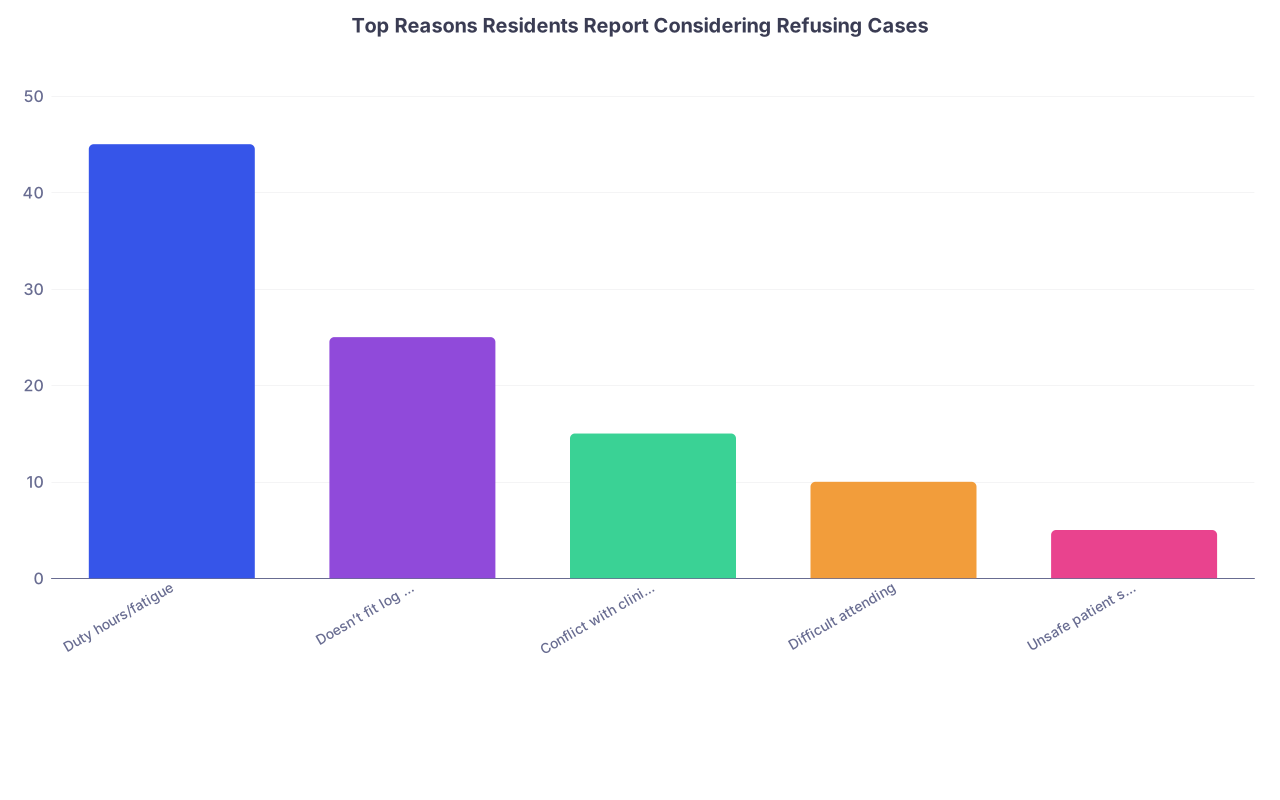
| Category | Value |
|---|---|
| Duty hours/fatigue | 45 |
| Doesn’t fit log goals | 25 |
| Conflict with clinic/teaching | 15 |
| Difficult attending | 10 |
| Unsafe patient setup | 5 |
When You Should Refuse or Redirect a Case (And Not Feel Guilty)
Here’s where I’m firmly on your side saying “no.”
1. You’re unsafe from fatigue or duty hour violations
You’re post-call, haven’t eaten, and can’t think straight. The chief tries to throw you on a long elective case “to get you more numbers.”
You are absolutely justified in saying:
“I’m at 26 hours, haven’t had a break, and I don’t feel safe taking primary responsibility. I’m happy to assist briefly if needed, but I can’t safely be the main operator for this case.”
That’s not about log strategy. That’s about not making a terrible decision that ends up in M&M with your name all over it.
2. There’s a direct conflict with a higher-yield educational responsibility
Example: You’re scheduled to be primary on a Whipple you’ve been waiting months for. Suddenly someone asks you to skip it and instead go do a quick port placement “because we’re short.”
You can—and should—push back:
“This Whipple is a critical case for my senior experience and my log. I’m the assigned resident and have been preparing. I can help find coverage for the port but I shouldn’t be pulled from the index case.”
That’s not selfish. That’s rational educational triage.
3. Chronic misuse as “extra hands” with no educational value
If you’re repeatedly being pulled just to retract on low-value cases, while others are getting primary experience, you’re allowed to protect your log and training.
This is where you don’t say, “I refuse this case.”
You say:
“I’ve noticed over the last month I’ve had limited primary operator roles, especially on [key case types]. My log shows I’m behind on [specific category]. Can we be intentional about assigning me more primary cases in those areas instead of just assisting?”
This is a refusal by redirection. You’re not ditching the patient; you’re aligning your assignment with training goals.

| Step | Description |
|---|---|
| Step 1 | Offered Case |
| Step 2 | Refuse or Limit Role |
| Step 3 | Advocate to Stay on Key Case |
| Step 4 | Discuss With Chief/PD and Redirect |
| Step 5 | Do Not Refuse |
| Step 6 | Accept Case |
| Step 7 | Safety / Fatigue Issue |
| Step 8 | Direct Conflict With Key Case |
| Step 9 | Chronic Educational Misuse |
| Step 10 | Purely Log Optics? |
When Refusing for “Log Strategy” Is Actually Dumb
Now the part you might not want to hear.
Here are the scenarios where refusing looks bad and usually is bad.
1. You’re chasing aesthetics, not outcomes
“I don’t want more open hernias, I want another lap colectomy for my fellowship app.”
Fellowship directors aren’t idiots. They know:
- Case logs are partly about what your hospital gets, not just what you choose
- Certain institutions skew heavy toward particular techniques
- Letters and interview performance matter more than whether you have 32 vs 38 laparoscopic colectomies
If you start ducking “less sexy” cases and cherry-picking advanced ones, attendings will notice you’re more obsessed with optics than learning.
2. You’re undermining your team
Saying “no” in a way that dumps work on juniors or co-residents because it’s not “good for your log” makes you look self-serving.
If a case truly doesn’t make sense for you, the right move is:
- Offer a solution: “Can X take this? They need more cases in this category.”
- Be transparent: “I’m already primary on two big cases today; I don’t want to short-change this patient.”
What you don’t do:
“Yeah I’ll pass. It doesn’t help my numbers.”
That sentence will follow you for years.
3. You’re overestimating how precisely anyone reads your log
Honestly? Most people scan:
- Total volume
- Whether you met minimums
- Whether your mix looks generally appropriate for your program
Nobody is counting your 14th vs 15th robotic case. You’re far more aware of the micro-detail than any reviewer ever will be.
Protecting that level of “strategy” by refusing cases is not worth the political or ethical cost.

How to Protect Your Log Without Burning Bridges
Here’s the smarter approach: shape your log proactively so you almost never have to outright refuse.
Step 1: Know your numbers and gaps
Once or twice a year, sit down and compare:
- Your case log vs ACGME / board minimums
- Your log vs your co-residents at similar level (quietly, not competitively)
- Your log vs your career goals (e.g., MIS vs trauma vs vascular)
Then define specific needs:
- “I need 15 more basic laparoscopic cases where I’m surgeon junior or chief.”
- “I’m light on open vascular exposure before fellowship apps.”
- “I’m weak on certain index OB/GYN procedures.”
Vague anxiety doesn’t help you advocate. Concrete gaps do.
Step 2: Communicate early with leadership
Bring this to your program director, APD, or chief before it’s a crisis.
Script you can basically steal:
“I reviewed my log and I’m on track for most categories, but I’m a bit light on [X] as [PGY level]. I don’t want to be scrambling later. Can we be intentional about placing me on more of those cases the next few months?”
This gets you help without refusing cases in the moment.
Step 3: Trade and negotiate, don’t outright refuse
A better way to handle in-the-moment conflicts:
Instead of:
“I don’t want that case, it’s bad for my log.”
Try:
“I’m primed for that advanced lap case this afternoon—could [co-resident] take this add-on debridement and I’ll cover their clinic later? It’ll improve both of our logs.”
Win–win. Patient covered. You don’t look like you’re ducking work; you look like you’re thinking like a chief.
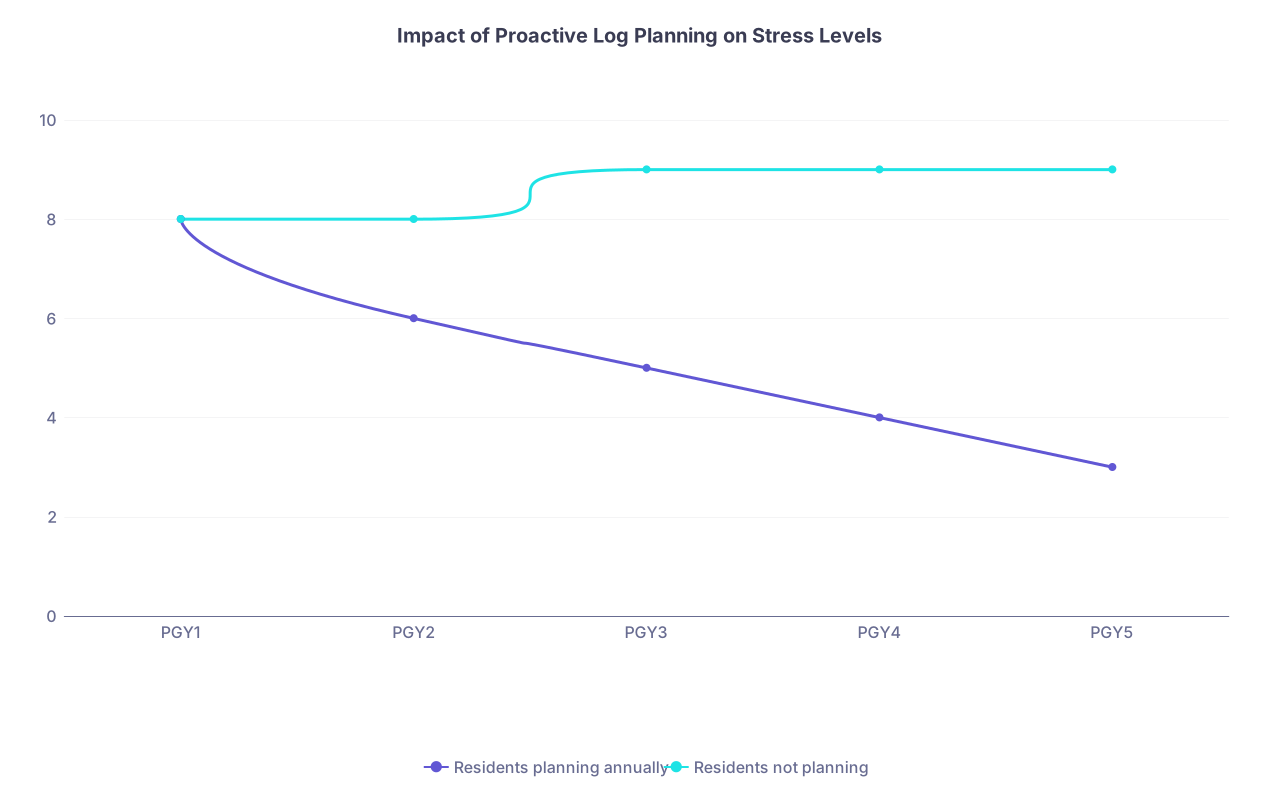
| Category | Residents planning annually | Residents not planning |
|---|---|---|
| PGY1 | 8 | 8 |
| PGY2 | 6 | 8 |
| PGY3 | 5 | 9 |
| PGY4 | 4 | 9 |
| PGY5 | 3 | 9 |
(Stress level 1–10, based on informal survey patterns I’ve seen. Planning doesn’t fix everything, but it reduces late-residency panic.)
The Ethics Layer You Can’t Ignore
We have to call this out clearly: patients are not props for your log strategy.
Saying “no” because:
- You’re unsafe
- You’re being misused in a way that undermines your training
- There’s a better-qualified or more appropriate operator
…is ethically sound.
Saying “no” because:
- The case is “boring”
- It doesn’t impress a fellowship director
- You already have “enough of that type” and just don’t feel like it
…puts your priorities in the wrong order.
Patients deserve a surgeon (or supervised trainee) who wants to be in the room, owns the case, and isn’t mentally keeping a running scorecard of how many colectomies vs cholecystectomies they’ve done.

How This Plays With Your Future Career
Attending surgeons and fellowship directors don’t just care about skills. They care about:
- Reliability
- Team orientation
- Judgment
You know what they ask current faculty about you?
- “Do they show up for the unglamorous cases?”
- “Are they dependable when it’s 3 a.m. and it’s a washout or bowel obstruction?”
- “Do they help juniors or cherry-pick the fun stuff?”
If you become known as the person who:
- Skips debridements
- Bails on middle-of-the-night ex-laps that “don’t help my numbers”
- Only appears for robotic or complex lap cases
You’ll get labeled as self-serving. That reputation leaks into your letters, even if nobody writes it outright.
On the flip side, someone who:
- Shows up consistently
- Occasionally advocates for key index or career-shaping cases
- Is transparent and strategic without being entitled
…that person is described as “mature,” “thoughtful,” “excellent judgment.”
Which side you land on comes down to how you handle exactly this question.

Bottom Line
Should you ever refuse a case to protect your surgical log strategy?
- If “protect” means maintain safety, fight chronic educational misuse, or avoid being pulled from essential index cases, yes—there are times you should say no or redirect.
- If “protect” means polish the aesthetics of your case log or avoid unglamorous work, then no—you’re hurting your reputation more than you’re helping your future.
Your surgical log is evidence of your training, not a curated portfolio. Use it as a guide, not as a reason to abandon patients or your team.
FAQ (Exactly 7 Questions)
1. Will one “low-yield” case really hurt my surgical log?
Almost never. One wound debridement, one washout, one open case when you wanted lap—none of that meaningfully changes your log. What matters is overall volume, mix, and meeting minimums. People overestimate the impact of individual cases and underestimate how bad they look when they start refusing them.
2. Can I refuse a case if I’m post-call and exhausted?
Yes, and you should if you’re truly unsafe. The right way is to frame it in terms of patient safety and competence: “I’m beyond 24 hours and not confident I can safely be primary.” That’s not gaming your log; that’s practicing responsible medicine. Document duty hour issues through your program systems as well.
3. What if my program isn’t giving me enough of a certain case type?
Bring this to your PD or APD early. Show your log, point to specific deficits, and ask for intentional assignment. Also talk with chiefs about getting on certain services or lists. Don’t silently accumulate resentment and then start refusing anything that’s not your favorite case type.
4. Is it okay to trade cases with co-residents for log reasons?
Yes, if it’s fair, agreed upon, and doesn’t harm patient care. Quietly swapping so someone who needs OB hysterectomies gets them while you get more trauma—totally fine. Doing it in a way that dumps undesirable cases repeatedly on the same people? That’s how you fracture a program’s culture.
5. Do fellowship directors really look that closely at my case log?
They look enough to see if your experience is broadly appropriate and if there are major red flags. They’re not usually counting your 11th versus 12th robotic colectomy. Letters, interviews, and reputation carry more weight than micro-differences in log composition.
6. How often should I review my case log during residency?
Once or twice a year is reasonable for deep review. More often in your last 1–2 years, especially if you’re worried about meeting minimums. Beyond that, obsessing weekly over the exact numbers tends to create anxiety without adding much value.
7. What’s a clear red flag behavior around case logs?
Patterns like: consistently refusing unglamorous cases, only showing up for advanced lap/robotic work, complaining that certain cases are “beneath” you, or openly saying you won’t take something because it “doesn’t help your numbers.” Those get remembered—and discussed—when people are deciding whether to hire or recommend you.
Key points:
- Say “no” or redirect when safety, duty hours, or serious educational fairness are at stake—not to polish optics.
- Use your log as a planning tool with your PD and chiefs, so you almost never have to refuse cases in the moment.
- Your reputation for reliability and judgment will matter more than squeezing in a few extra “perfect” cases.