Only 11% of pediatric telemedicine calls happen during regular clinic hours; the rest hit you after 5 p.m. when support is thin, kids are sicker, and parents are more anxious.
If you are thinking about an after‑hours pediatric telemedicine role post‑residency, you are not joining a cushy video‑triage side gig. You are stepping into a liability‑dense, context‑poor, communication‑heavy practice environment that looks nothing like your continuity clinic. The work can be satisfying and flexible. It can also be career‑ending if you underestimate the risks.
Let me break this down specifically.
1. What After‑Hours Pediatric Telemedicine Actually Looks Like
Forget the glossy recruiter pitch. Real after‑hours peds telehealth has a very particular shape.
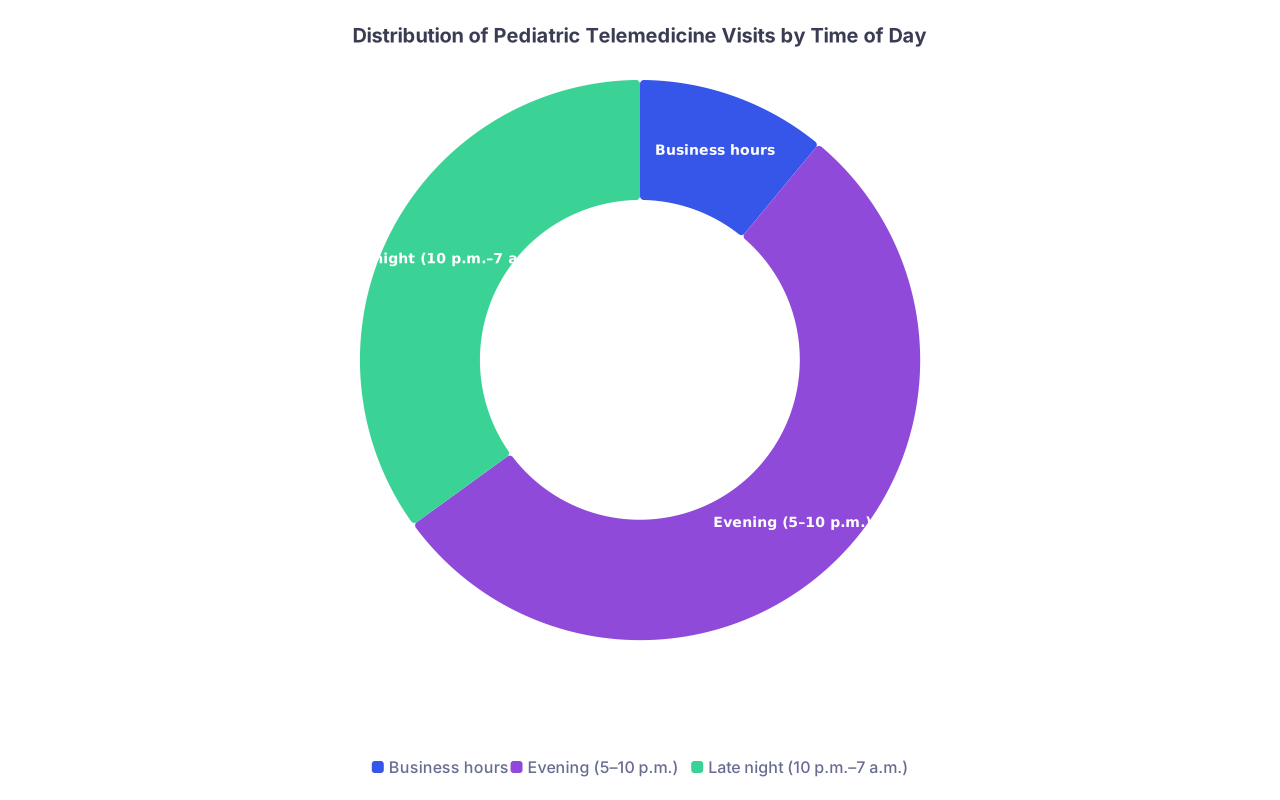
| Category | Value |
|---|---|
| Business hours | 11 |
| Evening (5–10 p.m.) | 54 |
| Late night (10 p.m.–7 a.m.) | 35 |
You are mostly dealing with:
- Fever in the middle of the night.
- Breathing concerns that may or may not be real distress.
- Rashes via awful low‑light smartphone photos.
- Vomiting/diarrhea with dehydration worries.
- Medication questions and dosing errors.
- Behavior and mental health escalation in teens.
You have:
- No hands on the child.
- Often no vital signs.
- Sometimes no reliable history (“I think he had all his shots?”).
- Parents who waited 6 hours before calling. Then want an answer in 6 seconds.
And you are frequently seeing:
- Families who have never met you.
- EMR fragments from multiple health systems.
- Walk‑in‑clinic notes that may or may not exist.
The job is not “outpatient pediatrics but over video.” It is closer to structured pediatric telephone triage with the thin veneer of video and e‑prescribing layered on top.
2. Unique Clinical and Legal Risks After Hours
The clinical risk profile at 2 a.m. is not the same as a Tuesday 10 a.m. well‑visit. If you think it is, you are the liability.
2.1 Diagnostic risk: what burns telepediatricians
These are the big categories of misdiagnosis or delay that cause trouble later:
Subtle but serious respiratory distress
The kid “looks comfortable enough” on camera, but:- Camera is chest‑up, you never saw belly breathing.
- Parent holding the phone does not show suprasternal or intercostal retractions.
- You underestimate work of breathing and do not send them in.
- They decompensate at home.
Early sepsis / invasive bacterial infection
Classic story: “High fever but still drinking, kind of fussy, no focal source.”
On exam in clinic, you would have a gestalt from tone, cap refill, perfusion, toxic vs non‑toxic appearance. On video at 1 a.m., with a parent more worried about the number on the thermometer than anything else, you are operating mostly on pattern recognition and bias.Surgical abdomen and testicular torsion
These are nightmares in telemedicine if you are not disciplined. There is no reliable abdominal exam through a screen. Period. Same for testicular torsion. Any equivocal story should be treated as “I cannot safely exclude it” → in‑person care.Non‑accidental trauma and safety issues
After hours, parents may call from bathrooms, cars, parking lots. You will occasionally get the “fell down the stairs” story that makes zero sense, or the “I am afraid to go home” teen. These cases are harder to detect when you are wedged between 20 other calls and a timer on your workflow.
2.2 Legal and regulatory landmines
After‑hours multiplies the typical telemedicine compliance problems:
Licensure
Families travel. A parent with a pediatrician established in New York calls you from a vacation rental in Florida. Where is the patient legally located? Florida. Are you licensed there? You better know before you give anything beyond generic first‑aid advice.Standard of care ambiguity
Plaintiffs’ attorneys love this space, because the “standard of care” in pediatric telemedicine at 11 p.m. is fuzzy, jurisdiction‑dependent, and evolving. If your group has not defined internal standards (which complaints you must refer in, what minimal data are required), you are exposed.Prescribing limitations
Some states restrict controlled substances via telehealth, especially without prior in‑person evaluation. That matters when a teen with severe anxiety or depression is spiraling at midnight and you are pressured to “do something now.”Documentation as your only shield
In telemedicine, the video feed disappears. The note and any saved images are what the board and lawyers will see. If your documentation reads like “fever, likely viral, advised home care,” you are in trouble.
| Scenario | Safe Telehealth Management? | Default Disposition |
|---|---|---|
| Suspected bronchiolitis < 3 mo | Rarely | ED / in‑person |
| Abdominal pain with vomiting | Unreliable | In‑person same day / ED |
| Fever > 5 days, no source | Questionable | In‑person within 24 hours |
| Head injury with red flags | No | ED immediately |
| New suicidal ideation | Tele triage only | Local ED / crisis resources |
If your employer has not given you a table like this in onboarding, that is a red flag.
3. Risk‑Management Mindset: How You Stay Out of Trouble
A lot of new grads approach after‑hours telepeds with the wrong default question: “How can I solve this completely over video and avoid sending them in?”
Flip it: “Can I safely keep this child at home, and can I prove that decision was reasonable later?”
Three pillars: thresholds, structure, and documentation.
3.1 Set hard thresholds in advance
You cannot improvise your risk tolerance at 1 a.m. Your brain will under‑call to avoid conflict and save time.
You need non‑negotiable “send in” criteria you follow regardless of how much the parent argues. Examples (not exhaustive, but concrete):
- Any infant < 3 months with:
- Rectal temp ≥ 38°C (100.4°F), or
- Poor feeding, or
- Lethargy reported by caregiver.
- Any child with:
- Difficulty breathing that limits talking or feeding.
- Color change (blue/pale/gray) now or recently.
- Recent head injury plus vomiting or altered behavior.
- New onset confusion, not acting themselves.
- Any suspicion of:
- Testicular torsion.
- Appendicitis or surgical abdomen.
- Non‑accidental trauma.
If you cannot get adequate history or exam due to language, tech failure, intoxicated caregiver, or screaming chaos, your threshold drops even further. When in doubt and no safe alternative: in‑person.
3.2 Structured tele‑exam: what you actually look for
You do not “wing” the tele‑exam. You run a checklist in your head fast.
A minimalist but effective pediatric tele‑exam framework:
General appearance
- Interaction: tracking, smiling, consolable?
- Tone: floppy vs stiff vs normal.
- Cry: strong vs weak vs high‑pitched.
Breathing
- Ask caregiver to completely uncover chest/abdomen.
- Count visible respirations for 15 seconds. Multiply by 4.
- Ask them to hold the camera profile‑view at chest and neck level; note retractions, nasal flaring, grunting.
Circulation / perfusion
- Have parent press on sternum or fingernail for cap refill on camera if possible.
- Check for mottling, cyanosis around lips/eyes.
Hydration
- Ask to show mouth: moisture, tears when crying, eyeballs sunken or not.
- Ask frequency of last wet diapers, in specific numbers.
Focal exam as appropriate
- Rash: have them move the camera close, in good light, press on rash to see blanching.
- Ear pain: you cannot see the TM, so you are relying on history and risk factors. Aggressive tele‑treatment of “ear infections” is exactly how resistance and mis‑treatments climb.
You will not hit all of this on every call, but this is the internal map. When things go south in retrospect, plaintiffs’ experts point to the missing pieces.
4. Communication Tactics That Actually Work (and Protect You)
Your primary instrument after hours is not your stethoscope. It is your language. Bad communication produces angry parents, complaints, and lawsuits. Good communication does the opposite and also improves clinical accuracy.
4.1 Open like a professional, not a rushed triage nurse
Parents are already stressed. They have probably waited in a queue or navigated an app. You set the tone in 20 seconds:
Confirm identity and location first: “Can you confirm your child’s full name and date of birth, and the address where you are right now?”
You need this clinically, legally, and for EMS if things go sideways.Then normalize and orient:
“I am Dr. X, a pediatrician. I will ask you several specific questions and then we will decide together if it is safe to manage this at home or if your child needs to be seen in person tonight.”
That last clause is non‑negotiable. It plants the idea that an ED/urgent care visit is a legitimate and expected outcome, not a failure.
4.2 Use tight, directive questions before open‑ended ones
Parents at 1 a.m. will give you stream‑of‑consciousness narratives with no structure. If you start with “Tell me what is going on,” you will get a 3‑minute monologue about daycare and grandma’s cough.
Instead:
Start with three high‑yield direct questions:
- “What is the one thing that is worrying you the most right now?”
- “How is your child breathing – normal, a little fast, or struggling to catch breath?”
- “Right now, if we were in the ER and I walked in, what would I see your child doing?”
Then you can say: “Okay, walk me through when this started and what has changed since then.”
This hybrid approach gives you an immediate risk stratification while still letting them tell the story.
4.3 Verbalizing your thought process (without sounding unsure)
Parents want to know you are actually thinking, not reading from a script. You can externalize your reasoning in a way that builds trust and covers you:
Example for fever:
“I am looking for signs that this fever might be from something serious like a blood infection or pneumonia. Things that worry me are trouble breathing, confusion, not waking up, not drinking at all, or very poor color. So far I am not seeing those on the video or from what you told me, which is reassuring.”
You have now:
- Educated the parent on red flags.
- Documented in the note what you said.
- Framed any future deterioration as recognized risk that was shared.
4.4 Saying “go to the ED” without destroying rapport
A lot of physicians hesitate to send kids in because they anticipate pushback: cost, wait times, distance. The solution is not to cave. It is to explain your limits concretely.
The script I have seen work repeatedly:
“I know the ER is not fun: it is expensive, it is a long night, and nobody wants to go there if they do not have to. The problem is that on video I cannot [listen to lungs / feel the belly / measure oxygen / examine the injury safely]. Without those pieces, I cannot be sure this is safe to keep at home. I would rather be overly cautious tonight than risk missing something serious.”
Then be silent. Let them react. Do not negotiate against yourself.
5. Documentation: Exactly What You Need to Capture
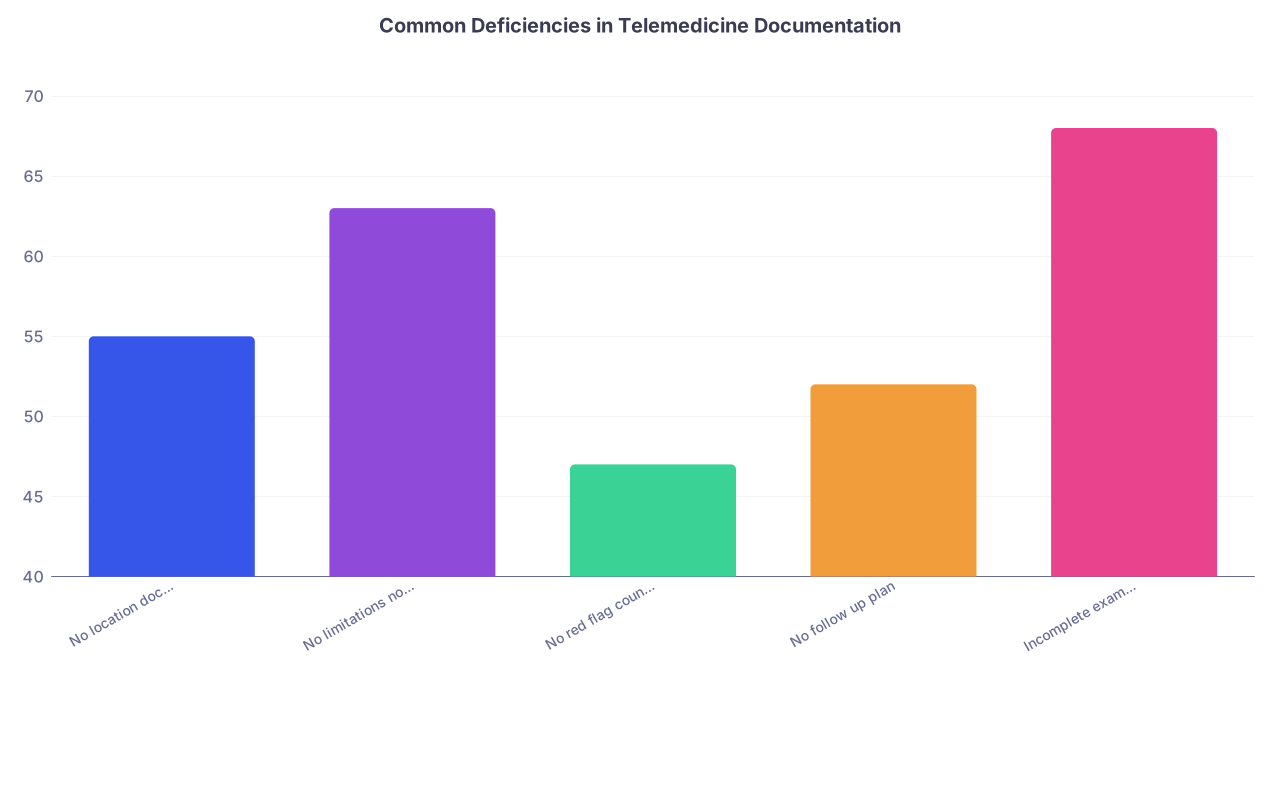
Telemedicine documentation has to do three jobs: communicate to the next clinician, defend you legally, and satisfy regulatory requirements. After hours, you will be tired and tempted to write short, lazy notes. That is how you end up in front of a board.
| Category | Value |
|---|---|
| No location documented | 55 |
| No limitations noted | 63 |
| No red flag counseling | 47 |
| No follow up plan | 52 |
| Incomplete exam description | 68 |
At minimum, every high‑risk visit should show:
Location and context
“Child located at home address in [state], parent present and providing history.”Technical limitations
“Video quality fair; lighting limited. No home vital signs available. Tele‑exam unable to assess lung auscultation or abdominal tenderness.”Specific tele‑exam findings
Not “appears well.” Instead:
“Alert, smiles at camera, strong cry when upset, no nasal flaring, no suprasternal or intercostal retractions observed on video, RR by visual count ~32/min, color pink, cap refill on sternum ~2 seconds by parent demonstration.”Differential – even a brief one
“DDx includes: viral URI, early bronchiolitis, early pneumonia less likely given absence of tachypnea and good appearance; no signs of respiratory distress at this time.”Shared decision‑making and red flag counseling
Explicit phrases help you later:- “Discussed that telemedicine cannot replace in‑person exam for X.”
- “Advised ED/urgent evaluation if any of the following: … Parent verbalized understanding and repeated return precautions.”
Follow‑up plan with timing
“Recommended in‑person pediatric evaluation within 24 hours if symptoms persist or earlier if any red flags. Parent agrees to call PCP office when they open.”
You may feel this level of detail is excessive. It is not. It is your malpractice insurance discount in written form.
6. Operational Realities: Schedules, Workflows, and Burnout
Let us talk about the job market and the day‑to‑day reality. A lot of post‑residency pediatricians look at telemedicine for flexibility: side income, childcare‑compatible shifts, geography independence. Reasonable. But you need to know what you are buying.

6.1 Typical schedules and models
Common patterns:
Staffing for health systems
You cover calls for a children’s hospital network or large pediatric practice group, usually 5–10 p.m. or 5 p.m.–7 a.m., mix of synchronous video, phone triage, and portal messages. Often W2 with benefits, structured protocols, more support.National telehealth platforms
High‑volume, shorter visits (8–12 minutes), RVU or per‑visit pay. You see kids from multiple states if you hold multiple licenses. Protocols may be loose. The pressure to “solve over video” can be high.Hybrid urgent care / tele‑urgent care chains
You alternate between in‑person urgent care and after‑hours tele‑urgent shifts. Can be stable income, but you are working in a volume‑driven environment where clinical nuance is sometimes crushed by metrics.
6.2 Workflow pitfalls that increase risk
Three operational choices by employers that should make you nervous:
Visit timers and hard caps
Thirty back‑to‑back 10‑minute video visits for “fever, cough, rash, vomiting, behavior” after 8 p.m. is a setup for error. If your platform literally counts down your visit time on screen, you will cut corners on exam and documentation.No formal escalation pathway
If you have no way to directly connect to an ED physician, on‑call subspecialist, or primary pediatrician, you are improvising in a vacuum. That is not acceptable for complex or borderline cases.Pressure to prescribe
I have heard versions of this sentence too many times: “Parents expect antibiotics; we see better satisfaction scores when we just treat.”
That is how you breed resistance, side effects, and board complaints. If your employer punishes you for appropriate non‑prescribing, consider leaving. Quickly.
7. Building a Sustainable, Safe Telepeds Career Post‑Residency
If you still want to do this work—and many should; access for kids after hours is a real need—then you need a deliberate approach, not a casual moonlighting mentality.
7.1 Choose employers and platforms ruthlessly
Ask specific questions before signing anything:
“Show me your protocols for fever under 3 months, respiratory distress, head injury, and abdominal pain.”
If they cannot, or will not, share them, that is a problem.“Who covers me for backup when I encounter a case that exceeds telemedicine scope?”
Names, not vague “we have support.”“What is your policy on when we must direct to ED/urgent care?”
If the answer is “Use your judgment,” clarify whether there is any metrics pressure against that.“What percentage of your pediatric telehealth encounters result in in‑person referral?”
Extremely low numbers (~1–2%) in a high‑acuity after‑hours practice may mean they are under‑referring.
7.2 Train yourself deliberately for this environment
Most residencies barely cover telemedicine beyond “be professional on camera.” So you teach yourself:
Run mock tele‑exams with co‑residents, friends, or even your own family members to practice instructing lay people to do parts of the exam.
Build your own personal “red flag” and “can manage at home” checklists in a simple note template or text expander. Something you can drop into each chart and customize quickly.
Maintain an updated file of local EDs, urgent cares, crisis lines, and poison control in each state you practice in. When you tell someone to “go in,” you want to be specific: where, roughly how long, and what they should say at triage.
7.3 Protect your mental health and boundaries
Telemedicine after hours has a quiet, invisible burnout of its own:
You are often alone, at home, dealing with distressed families without the camaraderie of a night‑shift team.
The moral distress of telling uninsured or under‑insured families “You need to go to the ER” at midnight, knowing the bill will crush them, is real.
The constant switching between minor complaints and rare, genuinely life‑threatening situations taxes your cognitive bandwidth in a unique way.
Set hard rules:
No endless post‑shift charting. If the platform demands 1–2 hours of extra unpaid documentation per shift, push back or reconsider.
Clear separation of “on” and “off.” Turn off the telemedicine app notifications the second your shift ends. The blurring of availability will eat you alive.
Peer support: debrief tricky cases with a small circle of trusted colleagues. Not in a gossipy way; in a structured, learning‑oriented way. This is how you maintain calibration of your risk thresholds.
8. High‑Stakes Communication Scenarios: Concrete Phrases to Use
Let me give you some specific scripts you can adapt. These small language choices matter.
8.1 When a parent underestimates severity
You see clear increased work of breathing on video, but the caregiver says, “He is fine, just a little fast.”
Try:
“I am watching his breathing very closely, and I am seeing signs that suggest he is working harder to breathe than is safe for home. You may be used to seeing him like this, but as a pediatrician, I know that this level of effort can change quickly and become dangerous. That is why I am recommending the emergency department tonight, not as an option, but as the safest next step.”
8.2 When you are refusing to prescribe requested antibiotics
Parent: “Last time they just gave her amoxicillin and she got better. I do not want to go in; just call it in.”
You:
“I understand wanting to avoid a visit. The reason I am not calling in antibiotics tonight is that based on her symptoms and what I can see, this looks like a viral infection. Antibiotics do not help viruses and can cause side effects and resistance. More importantly, if I tried to treat this without examining her in person for ear infection, pneumonia, or other causes, there is a risk I could miss something serious. That would not be safe care.”
8.3 When a teen discloses self‑harm or suicidal thoughts
You must be direct and calm:
“Thank you for telling me that; it takes courage. Any time someone is thinking about hurting themselves, that is an emergency. I cannot keep you safe over video alone. The safest plan is for you to go to the nearest emergency department now so a team can assess you in person. I am going to stay with you for a moment while we talk about how you can get there and who can go with you.”
Then you involve parent/guardian as appropriate, activate local crisis protocols, and document every step.
9. Quick Process Map: From Call Start to Disposition
To make this concrete, here is a lean process you should have burned into your brain.

| Step | Description |
|---|---|
| Step 1 | Start visit |
| Step 2 | Verify identity and location |
| Step 3 | Chief concern and top worry |
| Step 4 | High risk screen - breathing, mental status |
| Step 5 | Direct to ED now |
| Step 6 | Focused history and tele exam |
| Step 7 | Urgent care or ED recommendation |
| Step 8 | Home care plan |
| Step 9 | Document risks and counseling |
| Step 10 | Close visit with return precautions |
| Step 11 | Immediate red flags? |
| Step 12 | In person exam needed? |
You are essentially making two big decisions every time:
- Is this an emergency right now?
- If not, can we reasonably and safely manage at home, or does this still warrant in‑person evaluation soon?
The quality of your work comes from how you justify and communicate those decisions, not from clever differential diagnosis lists alone.
FAQ (exactly 6 questions)
1. Is after‑hours pediatric telemedicine safe for infants under 3 months?
Mostly no, not for anything beyond very minor issues. Fever in this age group, poor feeding, lethargy, or breathing concerns should almost always prompt in‑person evaluation, usually in an ED. Telemedicine can help with initial triage and counseling but should not replace hands‑on examination and appropriate labs for young infants.
2. How many states should I be licensed in to work for a national telehealth company?
More is not always better. Each additional state increases your regulatory burden and legal exposure. Early in your telemedicine career, focusing on 1–3 states you know well (including their ED/urgent care landscape and child welfare rules) is safer than collecting 10 marginal licenses for a few extra shifts.
3. What malpractice coverage do I need for telepediatrics?
You need a policy that explicitly covers telemedicine, the states you practice in, and after‑hours / urgent care‑type work. Do not assume your standard outpatient pediatrics tail covers this. Ask for written confirmation of telehealth coverage and clarify whether you are covered as an employee (W2), contractor (1099), or both.
4. Can I manage asthma exacerbations safely via telemedicine at night?
Mild exacerbations in known asthmatics with home meds and functioning spacers / nebulizers can sometimes be managed at home with clear instructions and strict return precautions. Any significant work of breathing, inability to speak in full sentences, use of accessory muscles, or lack of improvement after home treatments should push you firmly toward in‑person care, often ED.
5. How do I handle parents who record or stream the visit?
Assume every visit may be recorded. Maintain professional language and demeanor. If you are in a state with specific consent requirements for recording, you can state clearly, “You may not record this visit without informing me,” but practically, many already are. Good communication and documentation are your main defenses, not trying to police recordings.
6. Is after‑hours pediatric telemedicine a good full‑time career or just a side gig?
It can be either, but it suits different personalities. Full‑time after‑hours telepeds fits physicians who tolerate night work, like high‑acuity decision‑making, and are disciplined about boundaries and routines. For many, it works better as a substantial side practice (e.g., several evening shifts a week) combined with daytime clinic, locums, or other roles, to reduce burnout and social disruption.
Key points to keep in your head:
- After‑hours pediatric telemedicine is high‑risk, high‑communication medicine, not “easy work from home.”
- Safety comes from hard thresholds, structured tele‑exams, disciplined documentation, and clear, firm communication—especially when sending kids to the ED.
- Choose employers and workflows that support clinical judgment over throughput, or you will eventually pay for their priorities with your license, not theirs.