
The most dangerous misconception about tele‑psychiatry is that you can “just do what you do in clinic, but on Zoom.” That attitude is how people end up with bad documentation, unsafe crisis handling, and malpractice exposure they never saw coming.
You are not just moving visits online. You are changing the entire risk structure of your practice.
Let me walk you through how to do this like a professional, not like someone improvising with a webcam.
1. Core Tele‑Psychiatry Practice Models After Residency
Tele‑psychiatry is not one thing. You have several distinct practice models, each with different implications for evaluation, follow‑up, and crisis handling.

A. Employment vs. Independent Practice
Broadly, you will fall into one of three buckets:
- Employed by a telehealth company
- Employed by a health system / clinic doing tele‑psych
- Independent contractor / your own virtual practice
Here is how they actually differ in the real world:
| Model | Control Over Protocols | Typical Panel Size | Admin Support |
|---|---|---|---|
| Big telehealth company | Low | High (2–3x clinic) | High |
| Health system tele-psych | Medium | Standard | High |
| Small / boutique platform | Medium–High | Variable | Medium |
| Solo virtual private practice | Very High | You decide | Low |
The more control you have over protocols, the more you are personally responsible for getting them right. That especially applies to new evaluations and crisis protocols.
B. Synchronous vs. Asynchronous Models
For psychiatry, the anchor must be synchronous video for:
- New evaluations
- Med changes with significant risk (e.g., antipsychotic starts, lithium titration)
- Active suicidality, psychosis, or safety concerns
Asynchronous messaging has a place, but only layered on top of a defined synchronous relationship. If a job description is 80–90% “message‑based care” for psychiatry, be skeptical. That usually means unsafe volume, poor structure, and a company trying to squeeze psychiatric care into a primary‑care‑style chat model.
C. State Licensure and “Where the Visit Happens”
One non‑negotiable: you practice where the patient is physically located at the time of the visit, not where you are.
That affects everything:
- Which license applies
- Which emergency number and crisis resources you must know
- Whether you can legally see them at all
If a platform plays games with this (“Just list your address as…”) walk away. That is how you get dragged into a board investigation early in your career.
2. Structuring Tele‑Psychiatric Evaluations: Not Just a Zoom H&P
The initial evaluation in tele‑psychiatry is where clinicians cut corners the most. They assume the only difference is video quality. That is wrong.
You need a tele‑specific structure that bakes in risk management, identity verification, location, and contingency planning.

| Step | Description |
|---|---|
| Step 1 | Start Video Visit |
| Step 2 | Verify identity |
| Step 3 | Confirm physical location |
| Step 4 | Establish emergency contacts |
| Step 5 | Assess technology and privacy |
| Step 6 | Psychiatric history and MSE |
| Step 7 | Risk assessment |
| Step 8 | Diagnosis and plan |
| Step 9 | Safety and follow up plan |
A. Pre‑Visit Infrastructure (You Must Control This)
Minimal professional setup:
- Dedicated telehealth platform with BAA (not FaceTime)
- Integrated or parallel EHR
- Reliable audio and backup communication (phone)
- Standard pre‑visit intake forms (PHQ‑9, GAD‑7, etc.)
You should also have:
- Tele‑psychiatry informed consent template
- Documented telehealth policies (no‑show rules, message turnaround, refill policies)
- A standard “new eval” template that forces you to hit crucial tele elements
If the company or clinic does not have this, build your own.
B. The Opening Script That Actually Protects You
The first 3–5 minutes of a new tele‑psych eval need to look different from in‑person.
You want a script you can say without thinking:
Identity confirmation
“Please confirm your full name and date of birth.”
Match against what you see in the chart. If the platform allows, visually confirm a government ID at least for some higher‑risk patients (substance use, controlled meds, legal involvement).Location and environment
“Where are you physically located right now?”
You want: city, state, and whether they are in a private space. Document this every visit.
Ask: “Is anyone else in the room or able to hear us?”
If someone else is present, clarify who they are and document.Emergency contact and backup
“If we get disconnected and I am concerned about your safety, what is the best number to reach you?”
“Who is your emergency contact and what is their number?”
Confirm these at least annually and at any high‑risk visit.Privacy and consent
“Do you consent to receiving psychiatric care by video today?”
Briefly mention limitations: technology failures, inability to do full physical exam, what happens in a crisis. Your documentation should reflect that this was discussed.
These 60–90 seconds matter a lot more for you legally than whether you asked three or four SIGECAPS questions.
C. History and Mental Status: What Truly Changes Online
The psychiatric content itself does not change, but several things require more attention:
- Appearance / behavior: lighting, camera angle, freezing video. You must be explicit in describing limitations: “Video intermittently freezing, limiting observation of psychomotor activity.”
- Speech: lag can mimic latency. Note if pauses appear tech‑related.
- Affect: more difficult to observe subtle shifts; be conservative in your conclusions.
- Perceptions and thought content: tele‑eval is fine for hallucinations, delusions, obsessions, etc., as long as the patient can engage.
Where I become conservative:
- Borderline intellectual functioning where you cannot fully gauge adaptive functioning
- Suspected neurocognitive disorders where a hands‑on neuro exam would change management
- Complex movement side‑effects assessment (mild TD, akathisia) if video quality is poor
You may decide to do a hybrid model in these cases: initial tele‑eval, then one in‑person or local consult to complement.
D. Risk Assessment in a Tele Setting
This is where you need a structured approach. On new evals, I recommend a standard set of questions documented under a clear “Risk Assessment” header:
- Passive SI vs. active SI
- Plan, intent, access to means
- History of attempts (methods, lethality, timing)
- Self‑harm behaviors
- Homicidal ideation or violent behavior
- Substance use (especially disinhibiting agents: alcohol, benzos, stimulants)
- Protective factors: supports, reasons for living, treatment engagement
Then one more layer that is tele‑specific:
- “If you started feeling much worse tonight, what would you actually do?”
- “Are there weapons, large amounts of medications, or other means immediately accessible in your home?”
And you tie that to location: “Given you are in X City, if I were concerned about your safety, the nearest emergency services are [ED/911].”
E. Documenting Tele‑Specific Elements
Your note for an initial tele‑psychiatric evaluation should always include:
- Modality: “Synchronous video telehealth visit”
- Platform (at least “HIPAA‑compliant video platform”)
- Patient location (city, state, setting)
- Provider location (city, state)
- Identity verification
- Emergency contact and backup phone
- Statement that telehealth risks/benefits were discussed and consent obtained
- Any limitations to exam due to technology
If your current templates do not force this, fix them.
3. Follow‑Up Structures That Actually Work in Tele‑Psych
Once you clear the hurdle of the evaluation, the next trap is follow‑up. Tele makes over‑scheduling and under‑monitoring incredibly easy.
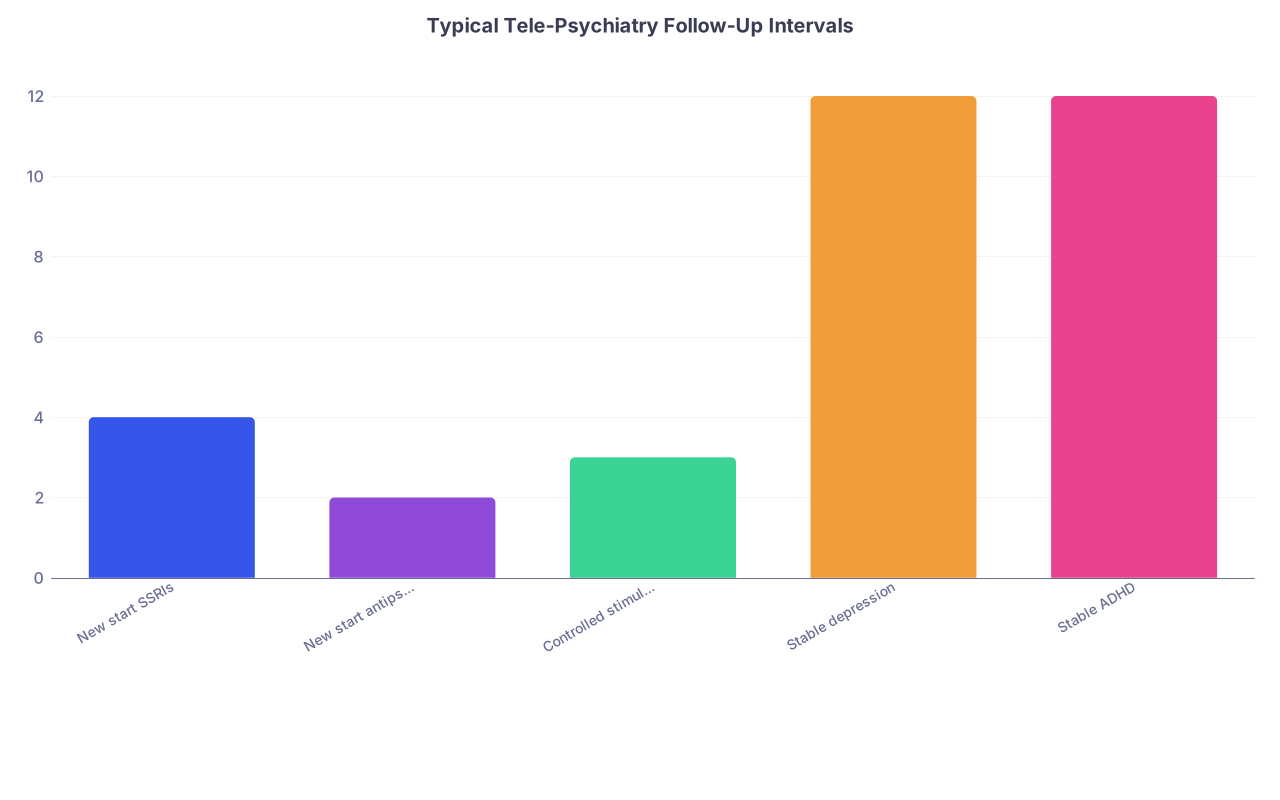
| Category | Value |
|---|---|
| New start SSRIs | 4 |
| New start antipsychotic | 2 |
| Controlled stimulant | 3 |
| Stable depression | 12 |
| Stable ADHD | 12 |
(Numbers above are weeks between visits in a cautious, real‑world tele practice.)
A. Visit Cadence by Clinical Scenario
I will be blunt: many tele platforms compress follow‑ups to a dangerous degree (15‑minute med checks every 3 months on complex patients; sometimes worse).
Reasonable baselines:
- New start SSRI / SNRI:
- First follow‑up in 3–4 weeks
- Then 4–8 weeks, depending on response and risk
- New start antipsychotic for psychosis or bipolar:
- 1–2 weeks for first follow‑up (earlier if severe)
- Consider brief weekly contacts early in titration
- Stimulants / controlled ADHD meds:
- Initial follow‑up 3–4 weeks
- Then every 3 months if stable and low risk
- More frequent if comorbid substance use or cardiovascular risk
- Chronic, stable depression/anxiety on long‑term meds:
- Every 3–6 months depending on severity/history
- High‑risk patients (recent attempt, ongoing SI):
- Weekly or more until stable, then stretch carefully
Tele‑only jobs suggesting yearly follow‑ups for controlled meds should set off alarms.
B. Combining Video, Phone, and Messaging
Professional structure:
- Medication management and significant clinical decisions: video (or at least phone with documentation of limitations).
- Brief symptom checks, side‑effect follow‑up, lab reminders: can sometimes be phone.
- Messaging: adjunct only. Clarity in your policies matters.
You need written, communicated rules like:
- “Messaging is for non‑urgent questions and clarifications. It is not monitored in real time. For urgent or safety concerns, call [number] or 988 / 911.”
- “Medication changes usually require a scheduled visit.”
And document enforcement. If you make a major med change purely via message, you should have a very good reason, and you should document it clearly.
C. Refill and No‑Show Policies in a Virtual World
Refills are where tele‑psych care quietly erodes. You must be explicit with patients and yourself:
- Example expectation:
“I generally provide enough medication until your next scheduled visit, plus a small buffer. If you miss visits and run out of medication, I may provide a short emergency refill once, but we will need to meet before further refills.”
No‑show rules:
- You need clear time windows for late joins (e.g., 10–15 minutes)
- Document failed connection attempts (screenshot or EHR log if available)
- Many systems will require you to document whether it was a patient tech failure, provider platform failure, or mutual issue
For high‑risk patients, multiple no‑shows in a row should trigger escalation: outreach, certified letter, or referral to local services. In tele, it is extremely easy for a suicidal patient to quietly disappear. Your system must anticipate that.
D. Care Coordination at a Distance
Tele‑psychiatry amplifies fragmentation. So you over‑correct with proactive coordination:
- Get explicit consent to communicate with:
- PCP
- Therapist
- Case manager, if present
- Use templated letters or secure messaging with each new med start or major change
- If you are seeing a high‑risk patient exclusively virtually, someone local must know they exist (PCP, therapist, or CM). Lone‑wolf, no‑collateral tele‑management of high‑risk cases is a setup for disaster.
4. Crisis Protocols: You Cannot “Wing It” When the Patient Is 600 Miles Away
This is the part companies often get completely wrong. You cannot afford to.

A. You Need a Crisis Playbook, Not Just “Call 911”
For every tele‑psychiatry role, you should either receive or build a written crisis protocol that includes:
- Stepwise response to:
- Active suicidal ideation with intent/plan
- Imminent risk of harm to others
- Severe agitation / psychosis with safety concerns
- How to:
- Keep the patient on video/phone while activating emergency services
- Use local crisis lines, mobile crisis teams, or 988 in addition to 911
- Document the entire sequence
If a job cannot show you their crisis policy during hiring, that is a red flag.
B. Location, Location, Location
You cannot do crisis work without knowing exactly where the patient is.
In a crisis assessment, you must be more granular:
- Ask: “What address are you at right now?”
- Confirm: apartment number, known landmarks if needed.
- If they are in a vehicle: where is it parked or traveling, and with whom.
Document this explicitly. If you decide to call EMS or police, give them detailed, accurate information.
C. Decision‑Making Framework for Suicide Risk in Tele‑Psych
You need a mental model you can run in seconds.
Roughly:
- Is there active suicidal ideation?
- Is there a specific plan?
- Is there intent (do they actually intend to act)?
- Do they have access to lethal means now?
- Are there impairing factors: intoxication, psychosis, severe agitation?
Then layer in tele factors:
- Are they alone or is a responsible adult present?
- How far are they from an ED?
- Is there any local support (family, friend) you can bring into the plan right now?
If you conclude imminent risk (active SI + plan + intent + means + little protective structure), you must:
- Keep them on video/phone.
- Tell them clearly what you are doing:
“Given your level of distress and your intention to hurt yourself, I am worried you are at immediate risk. I am going to contact emergency services in your area to help keep you safe.” - Activate 911 or local EMS in their jurisdiction.
- Contact the emergency contact if appropriate and not contraindicated.
- Document each step and all times.
D. Working With 988 and Local Crisis Lines
988 is useful, but it is not a magic wand. It does not replace your duty to act.
Reasonable uses:
- As part of a safety plan for moderate‑risk patients:
“If your thoughts get worse between now and our next appointment, you can call 988 any time.” - As an adjunct when you are not in an imminent risk situation but want immediate counseling support.
Do not offload an imminent risk patient to 988 as your primary safety measure while you sign off. That is shallow risk management and will not look good in a chart review.
E. Psychosis and Violence Risk at a Distance
Tele complicates assessment of agitation and potential for violence.
Warning scenarios:
- Command hallucinations to harm others
- Well‑formed violent delusions tied to specific targets
- Explicit threats to named individuals
Your responsibilities:
- Clarify target, intent, means, and history of violence
- If you determine a credible, specific threat:
- This may trigger duty‑to‑warn (Tarasoff‑type) obligations, which are state‑specific
- Coordinate with local law enforcement or crisis teams, and document why
Do not assume that because you are out‑of‑state you have no duty. Your board and a plaintiff’s lawyer will not see it that way.
F. When the Patient Refuses Help
This is common in tele‑psych because patients feel “less real” on screen.
If risk is high:
- Continue trying to engage them: “My job is to help you stay safe. What is the least restrictive option you are willing to consider right now?”
- Involve family or support persons when possible (with consent, or under implied consent if imminent risk).
- If they still refuse, and you still judge imminent risk:
- You may still need to activate emergency services against their wishes.
- Document their refusals, your counseling, and your rationale.
5. Practical Infrastructure: What You Should Demand From Any Tele‑Psych Job
Before you sign a tele‑psychiatry contract, you want to see how seriously they take evaluation standards and crisis protocols.

A. Questions to Ask in Interviews
Do not be shy about this. You are the one whose license is on the line.
Ask:
- “Show me your standard new patient evaluation template for tele‑psychiatry.”
- “How do you document patient location, consent, and emergency contacts?”
- “Walk me through your protocol for managing active suicidality on video.”
- “Who actually calls 911 or local EMS in a crisis—the psychiatrist, centralized team, or someone else?”
- “What is the typical visit length for new evals and follow‑ups?”
- “How many patients per day are your psychiatrists expected to see?”
If they cannot answer clearly, run.
B. Red Flags in Tele‑Psych Roles
Patterns I have personally seen:
- 20‑minute new evaluations for complex patients
- 5–10 minute follow‑ups with no formal risk assessment
- No explicit crisis protocol or reliance solely on “call 911” boilerplate
- No check of patient location or emergency contact in the intake
- Pressure to prescribe controlled substances on first visit with limited assessment
- Asynchronous‑only psychiatry with no video visits at all
You do not want your first board complaint to be about a patient you saw for 9 minutes on a glitchy video call while you were double‑booked.
C. Building Your Own Tele‑Psych Toolkit (If You Go Independent)
If you are setting up your own virtual practice, you need at minimum:
- HIPAA‑compliant telehealth platform (Doxy.me Pro, Zoom for Healthcare, VSee, etc.)
- EHR with telehealth fields (Kareo, SimplePractice, etc.)
- Customized note templates with tele‑specific elements baked in
- Standardized risk assessment and safety plan forms
- Written crisis protocols by state of licensure, including:
- Local EDs
- Crisis lines / mobile crisis teams
- Procedures for involuntary evaluation where applicable
Plus solid malpractice coverage that explicitly includes tele‑psychiatry and all states in which you practice.
6. Putting It All Together: A Realistic Tele‑Psych Workflow
To make this concrete, here is what a well‑structured tele‑psychiatry workflow looks like for a typical new patient and follow‑up.
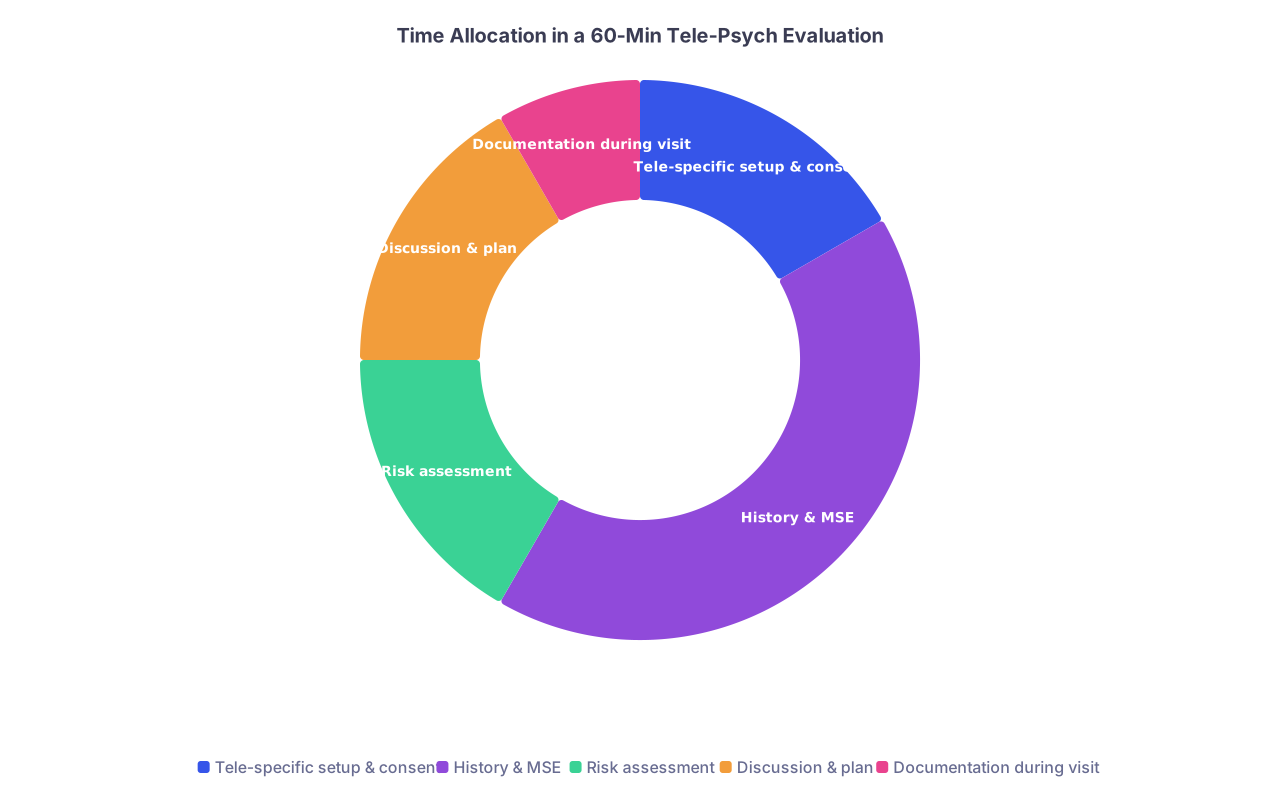
| Category | Value |
|---|---|
| Tele-specific setup & consent | 10 |
| History & MSE | 25 |
| Risk assessment | 10 |
| Discussion & plan | 10 |
| Documentation during visit | 5 |
New Patient Evaluation (60 minutes)
Rough breakdown:
- 5–7 minutes: identity, location, consent, emergency contacts, tech/privacy check
- 25–30 minutes: history and MSE
- 8–10 minutes: focused risk assessment, including tele‑specific elements
- 10–12 minutes: explanation of diagnosis, treatment options, side effects
- 3–5 minutes: safety planning and follow‑up timeline
Document during or immediately after with a template that forces:
- Location and modality
- Consent
- Risk assessment details
- Safety plan and crisis instructions
Follow‑Up Visit (20–30 minutes)
- 2–3 minutes: reconfirm location and any change in emergency contacts, quick tech check
- 10–15 minutes: interval history, side‑effects, functioning, adherence
- 5–8 minutes: focused risk check, especially if there is any SI history
- 3–5 minutes: plan, lab work, coordination with other providers
For a high‑risk patient, that follow‑up might be weekly for a while, supported by clear messaging limits and a written safety plan.
FAQs
1. Can I safely prescribe controlled substances (like stimulants or benzos) in a fully remote tele‑psychiatry practice?
Yes, but only if you respect both federal and state rules and keep your standards high. Post‑COVID, Ryan Haight enforcement is evolving, and many states have their own tele‑prescribing rules. For stimulants, I recommend at least one thorough video evaluation, verified identity, some objective data (school records, prior testing, or at least consistent collateral), and a clear controlled‑substance agreement. For benzodiazepines, be even more conservative: limited indications, time‑bound plans, regular monitoring, and low tolerance for early refill patterns or concomitant substance use.
2. How do I handle patients who want to text or message in crisis instead of calling 911 or 988?
You set the rules before the crisis. From day one, you tell patients: “Messaging is not for emergencies and is not monitored in real time. If you are in immediate danger, you must call 988 or 911.” You repeat this in your written policies and after‑visit summaries. If a patient still messages you in crisis and you see it in time, you respond briefly and act: try to get them on video/phone, assess quickly, and if you assess imminent risk, contact emergency services. Then document that you redirected them to appropriate crisis resources and why.
3. What do I do if I realize in the middle of a tele‑visit that the patient is actually in a state where I am not licensed?
Stop. You cannot ethically or legally continue providing medical care in that visit. You can do a brief, non‑treatment conversation: explain that you are not licensed in their current state, that continuing would be outside your scope. If they are stable, help with referrals or suggest they return to their licensed state for ongoing care. If they are acutely unsafe, you are still a human being: you can call 911 in their area, stay on the line, and do what any reasonable person would do in an emergency. Then you document the entire sequence and report the incident internally if you are employed.
4. How many tele‑psychiatry visits per day is reasonable without compromising safety?
For full‑time outpatient tele‑psych, a sane range is about 10–14 patient visits per day, depending on mix of new and follow‑ups and how strong your support staff is. Once people push you into 18–22 short visits a day with complex pathology, safety and documentation quality will erode. I have seen platforms expect 15+ back‑to‑back 15‑minute med checks. That might technically be “doable” on paper, but your risk assessment becomes superficial, your crisis response gets sloppy, and your notes become copy‑paste. If the volume makes it impossible to do thorough tele‑specific setup and risk assessment, it is not a safe job.
Key points: Tele‑psychiatry is not just psychiatry over video; it has its own legal, clinical, and risk architecture. Your evaluations must include location, identity, consent, and structured risk assessment. And your crisis protocols must be explicit, written, and executable—long before the first emergency appears on your screen.