It’s 11:30 p.m. You’re post-call, scrolling job postings on your phone, and every other listing seems to say some version of: “Hybrid role, heavy telemedicine, optimize virtual workflow, remote consult coverage.” You keep thinking:
“So… are they eventually going to replace actual hospital docs with some central telemedicine command center and a few bedside nurses? Are my skills going to be outdated before I even finish my first contract?”
Let me just say this out loud because I know it’s running in circles in your head:
“Will telemedicine make me obsolete in hospitals?”
Short answer: no.
More honest answer: it will change what “being a hospital doctor” looks like, and if you pretend it won’t, that’s how you actually get left behind.
Let’s unpack this without sugarcoating it.
What Telemedicine Is Actually Doing in Hospitals (Not the Sci-Fi Version)
People picture a robot rounding instead of you. That’s not what’s happening in real life.
Right now, in hospitals, telemedicine mostly shows up as:
- Tele-ICU: Remote intensivists monitoring several ICUs overnight, doing consults, guiding local teams.
- Tele-stroke: Rapid neuro consults to small hospitals to decide tPA / thrombectomy, transfer decisions.
- Tele-psych: Psychiatry coverage for EDs, inpatient units, crisis units.
- Night coverage / cross-cover: Some hospitals use remote nocturnists for pages, orders, triage.
- Virtual specialist consults: Derm, ID, heme-onc, etc. evaluating images/labs remotely.
So who’s getting “replaced”? Usually:
- A second in-person specialist at a smaller site
- An on-site night doc at low-volume hospitals
- Extra coverage in places that couldn’t afford in-person specialists in the first place
In other words, telemedicine isn’t usually kicking someone out of a job; it’s either:
- Covering hospitals that could never hire that specialty locally
- Offloading some grunt work from the physical team
- Letting systems centralize certain services across multiple sites
Is that great and fair and perfect? No. But it’s not “we’re closing the hospitalist office and replacing you with a webcam.”
Where You Are Actually Replaceable… and Where You’re Not
Let me be a little harsh here, because it’s the reality:
The parts of your job that are replaceable by telemedicine (or even algorithms) are the parts that are already being undervalued by everyone.
Replaceable-ish things:
- Mindless order entry that follows a strict protocol
- Standardized triage decisions based on checklists
- Reading a normal lab panel and saying “continue same plan”
- Writing generic progress notes that say “no overnight events”
That stuff can be done by:
- A remote doc
- A midlevel with a protocol
- Decision support embedded in the EMR
- Eventually some AI that pre-populates half your note
But you know what absolutely cannot be done fully remotely?
- Actually examining a crashing patient and noticing they look wrong before the vitals change
- Very real family meetings where a spouse sobs in your arms while you explain code status
- Doing procedures. Obviously. Intubations, chest tubes, lines, paracenteses, reductions, etc.
- Dealing with complex, messy patients where the story doesn’t match the labs and you have to synthesize 20 subtle things
- Corralling an entire care team (nurse, RT, social work, case manager, consultant) in a hallway huddle to make a decision in 3 minutes
Telemedicine can support a lot of that. It can’t replace bodies in the building.
If you turn yourself into a “note-writing, box-checking, order-placing machine” and nothing more, yeah, you are the easiest target for being partially replaced by remote coverage and automation.
If you lean into the parts of medicine that physically require you, emotionally require you, and logistically require you, you’re not obsolete. You’re essential.
Who’s Actually at Risk with Telemedicine?
Let’s be brutally honest about which physicians feel the pressure most and which don’t.
| Role | Relative Risk of Being Replaced |
|---|---|
| Pure remote-only doc | High |
| Night cross-cover only | Moderate |
| Procedure-heavy inpatient | Low |
| ED physician | Low to Moderate |
| Outpatient generalist | Low to Moderate |
The ones most at risk aren’t the hospitalists in the building. It’s:
- People whose work can be chopped into tiny, protocol-driven tasks
- Roles that are already remote-only with no local presence
- Physicians in systems that view them as interchangeable shift-workers, not as leaders
Ironically, a lot of the telemedicine docs are in the more fragile spot.
If a corporate group decides, “We can hire three cheaper remote docs in a different state/time zone,” they do it. They don’t care that you’re a nice person who answers messages fast.
On the other hand, your local hospital administration still panics if you threaten to leave when you’re the one people trust on the floor, leading a strong service with good outcomes.
What Systems Are Really Trying to Do With Telemedicine
Hospitals aren’t sitting around plotting, “How can we crush early-career docs?” They’re thinking:
“How do we:
- Avoid paying for an extra full FTE at a small site?
- Cover nights/weekends cheaply?
- Say we have 24/7 specialist coverage without recruiting ten people?
- Handle rising volume without building a new tower and hiring 50 nurses?”
Telemedicine is their Swiss Army knife for:
- Cost savings
- Coverage gaps (rural, small hospitals)
- Branding: “We have 24/7 XYZ service!”
- Risk mitigation: having an intensivist or stroke doc on instantly
So yes, they will centralize some decisions. Yes, they’ll put a tele-neuro in a central hub instead of paying for two full-time on-site neurologists in two small hospitals. Yes, they will push hospitalists and ED docs to use tele-consults more.
But look at the pattern: telemedicine tends to amplify the physicians on the ground, not erase them. If anything, they pile on more responsibility for you locally:
- “Tele-ICU will cover orders, but you’re still the one responding when the nurse says, ‘I don’t like how she looks.’”
- “Tele-stroke will give recs, but you’re the one dealing with the family, code status, transfers, complications.”
You become the hands, eyes, and often the emotional core. The remote doc is the voice on the cart.
The Skills That Will Keep You Non-Obsolete
This is where your anxiety can actually help you. Because you’re already thinking: “What do I need to avoid being replaced?”
Good. Here’s where to push yourself.
1. Get Really Good at What Telemedicine Can’t Physically Do
This means things that involve:
- Procedures
- Rapid bedside assessment
- High-acuity decision-making in real time
If you’re in a field where procedures are optional, don’t let them be optional. Volunteer. Ask to be credentialed. Be the person nurses call when the central line is “impossible” or the paracentesis is “too hard.”
If you’re in EM or hospitalist medicine: own resuscitations. Take charge codes. Run the sickest cases. That presence can’t be virtualized.
2. Develop Leadership on the Floor
Telemedicine can’t lead a team huddle in the hallway.
Be the person who:
- Orchestrates dispo plans with case management
- Calms down the surgeon, cardiologist, and intensivist who all disagree
- Has the trust of nurses and RTs
Hospitals notice when you are the glue. That’s not something they cavalierly replace with someone in a control room 3 states away.
3. Get Comfortable With Telemedicine Instead of Fighting It
Weirdly, one way to not be displaced is to become the person who knows how to use telemedicine well.
Be the doc who:
- Knows how to quickly get tele-neuro or tele-ICU on for the right cases
- Can troubleshoot the tech enough that nurses stop hating it
- Gives reasonable feedback about workflows instead of blanket complaining
That makes you indispensable in a very different way. You’re not “old school and resistant”; you’re “on the ground, modern, and realistic.”
What the Next 5–10 Years Probably Look Like (Not the Nightmare Version)
Let me paint a more boring, realistic picture than the doomsday one your brain keeps looping.

| Step | Description |
|---|---|
| Step 1 | Residency Finished |
| Step 2 | First Hospital Job |
| Step 3 | Traditional In Person Role |
| Step 4 | Hybrid Role |
| Step 5 | On Site Care Team Leader |
| Step 6 | Adopt Tele Consults |
| Step 7 | More Procedures and Bedside Work |
| Step 8 | Learn Systems and Workflows |
| Step 9 | Local Expert in Tele Integration |
| Step 10 | Non Replaceable Skill Set |
| Step 11 | Telemedicine On Site? |
What’s likely:
- More hospitals using tele-ICU/tele-stroke, especially at night.
- Telehospitalist services covering small/rural sites overnight with maybe an NP/PA in the building.
- Big systems centralizing some services (like virtual cross-cover or virtual triage).
- You, in a lot of jobs, doing a mix: in-person rounding, plus coordinating with tele-specialists.
You’re not sitting at home on a webcam for 12 hours while robots push the beds. You’re still there, hearing the alarms, feeling the tension, walking into actual rooms.
Could jobs with heavy tele-components feel worse, more impersonal? Sure. Could admin try to push ratios harder because “the tele-doc can help”? Absolutely. That’s the real danger: not that you’re obsolete, but that they use tech to squeeze you.
So your career question isn’t “Will I exist?” It’s:
“Do I want a job where telemedicine supports me, or a job where telemedicine is used to justify overworking me and cutting corners?”
Very different question. Much more actionable.
How to Protect Your Career When You’re Job Hunting Now
You’re entering the job market in a world where “telemedicine” is going to be in contracts and job posts. You don’t have to run from it, but you should interrogate it.
Ask directly in interviews:
- “How is telemedicine used here—does it replace in-person shifts, or support them?”
- “Who’s physically in the building overnight?”
- “What’s the escalation process when tele-ICU or telehospitalist disagrees with on-site staff?”
- “Has your use of telemedicine changed physician staffing levels in the last few years? How?”
If they get cagey, that’s a red flag.
If they say, “We’ve actually been able to scale safely while maintaining on-site coverage,” that’s more reasonable. Still not perfect. But more honest.
Also, look at what you’ll actually be doing:
- Are you the on-site physician everyone relies on, with tele support as a tool?
- Or are you basically a body doing scut while a remote doc makes all the big calls?
You want the first scenario. The second is where you start to feel like the trainee in your own job.
A Quick Reality Check on “Obsolete”
You’re probably picturing this: 10 years from now, you send your CV to a hospital and they say, “We don’t hire hospital-based doctors anymore; we have a tele-hub and robots.”
That’s not where we’re going in the next decade. Even the most aggressive corporate systems haven’t tried that because:
- Liability nightmares
- Patient satisfaction would tank
- Nursing and other staff would revolt
- Accreditation and regulatory bodies still expect physician presence
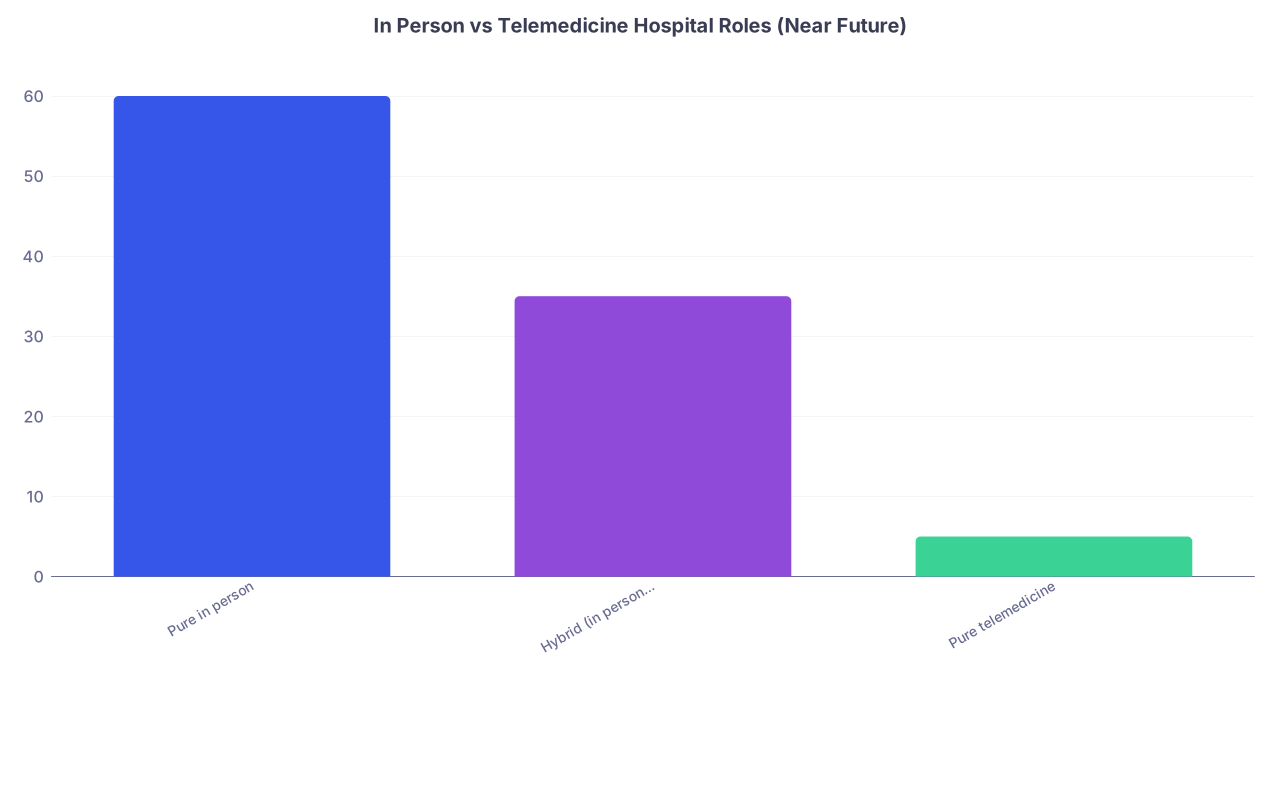
| Category | Value |
|---|---|
| Pure in person | 60 |
| Hybrid (in person + tele) | 35 |
| Pure telemedicine | 5 |
Most likely breakdown for physician roles in hospitals over the next few years looks a lot like that: majority still in person, a big chunk hybrid, a small percentage fully remote.
So no, you’re not going extinct. But the job description is mutating. If you cling to a 1990s picture of hospital medicine, you’ll be miserable. If you evolve a bit and lean into the stuff tech can’t do, you’ll be fine. More than fine—you’ll be in demand.
How To Use Telemedicine To Your Advantage (Instead of Letting It Happen To You)
Instead of just fearing it, there’s a smarter play: position yourself as the doc who actually understands and can lead with telemedicine in the mix.
Concrete things you can do:
- During early jobs, volunteer to be part of “tele-ICU rollout” or “virtual consult workflow” committees. You’ll see exactly how admin thinks and what they’re planning.
- Pay attention to which tasks telemedicine doesn’t do well: messy social situations, mixed-urgency cases, language barriers without good interpreters, weird undifferentiated complaints.
- Collect examples where in-person presence clearly saved the day. Those stories matter when policy gets written.
You want to be the person in the room saying, “Here’s why you still need us physically here, and here’s how telemedicine can actually improve care without replacing us.” Not the person ranting in the lounge about “the damn robots.”
Hospitals love “bridge” people. The ones who speak both clinical reality and system/tech reality. That’s job security in 2026 and beyond.

FAQ (Exactly The Things You’re Afraid To Ask Out Loud)
1. Should I avoid jobs that mention telemedicine in the posting?
Not automatically. A job that says “collaborates with tele-ICU” could be totally fine. The red flags are:
- “Primarily virtual coverage of multiple sites” with minimal on-site support
- Ratios that feel unsafe because “tele can help”
- Vague descriptions like “innovative care model leveraging remote resources” without details
Ask very specific questions about who is on-site, who writes orders, who carries liability, and volumes per shift.
2. If I take a telehospitalist or tele-ICU job now, am I setting myself up to be easier to replace later?
You might be. Purely remote roles are the easiest for corporations to move, automate pieces of, or outsource. If you go that route, I’d:
- Keep some in-person work on your CV (locums, PRN shifts, etc.)
- Stay procedurally and clinically current
- Use that job to learn systems and operations, not just crank shifts
Don’t let your skills atrophy to “I click boxes from home in pajama pants.” That’s the doc version of being an easily replaceable call-center worker.
3. Will AI plus telemedicine just finish the job and make bedside doctors unnecessary?
AI will absolutely eat some parts of the job: note drafting, some triage, maybe even initial interpretations of imaging or labs. Combined with telemedicine, it’ll make some remote workflows smoother.
But AI still can’t:
- Walk into a chaotic room and calm everyone down
- Physically examine someone, pick up on smell, subtle signs, body language
- Have a real, human conversation about death, disability, or uncertainty
So what happens? The cognitive grunt work gets automated or outsourced; the high-stakes, relational, embodied parts get more concentrated in you. That’s where you need to aim your growth.
4. I feel behind already—anything I can do this year to feel less doomed?
Yes. Three practical moves:
- Pick one area of non-tele-replaceable skill and lean hard into it: procedures, codes, complex dispo, end-of-life talks—something.
- In your current or next role, ask how telemedicine is used and volunteer to learn it well instead of ignoring it.
- Start thinking of yourself not just as “a worker” but as “part of how this system functions” — know the workflows, understand who does what, notice gaps.
You can’t stop systems from adopting telemedicine. But you can absolutely make yourself the kind of physician that systems are afraid to lose, not eager to replace.
Bottom line:
- Telemedicine isn’t going to erase hospital doctors; it’s going to reshape the mix of in-person, hybrid, and remote work.
- The more your day is about physical presence, procedures, leadership, and real human conversations, the harder you are to replace.
- Instead of running from telemedicine, learn it, shape it, and make it work for you—so you’re not obsolete, you’re essential.