
It’s 9:45 p.m. You’ve just finished a full day of mostly telehealth visits—med refills, rashes over video, follow ups—and you realize something kind of horrifying: you barely touched a patient all day.
You think back to residency. Suturing at 2 a.m. in the ED. LPs with your senior talking you through hand position. Ultrasound-guided lines. Joint injections in continuity clinic. All that sweat you put into becoming “procedurally competent.”
And now you’re staring at your weekly schedule that’s creeping toward 60–70% telehealth and this thought hits you like a truck:
“Am I about to lose my procedural skills? And if I do… am I basically unemployable in a few years?”
Let me be blunt: that fear is not crazy. It’s not overreacting. It’s actually one of the few things people don’t talk about enough when they sell you on “the flexibility of telemedicine.”
But you’re not helpless here. You just need to stop pretending it’ll work out magically and start treating your hands-on skills like what they are: perishable, strategic assets you actively maintain.
Let’s walk through how to do that without torching your sanity or your career.
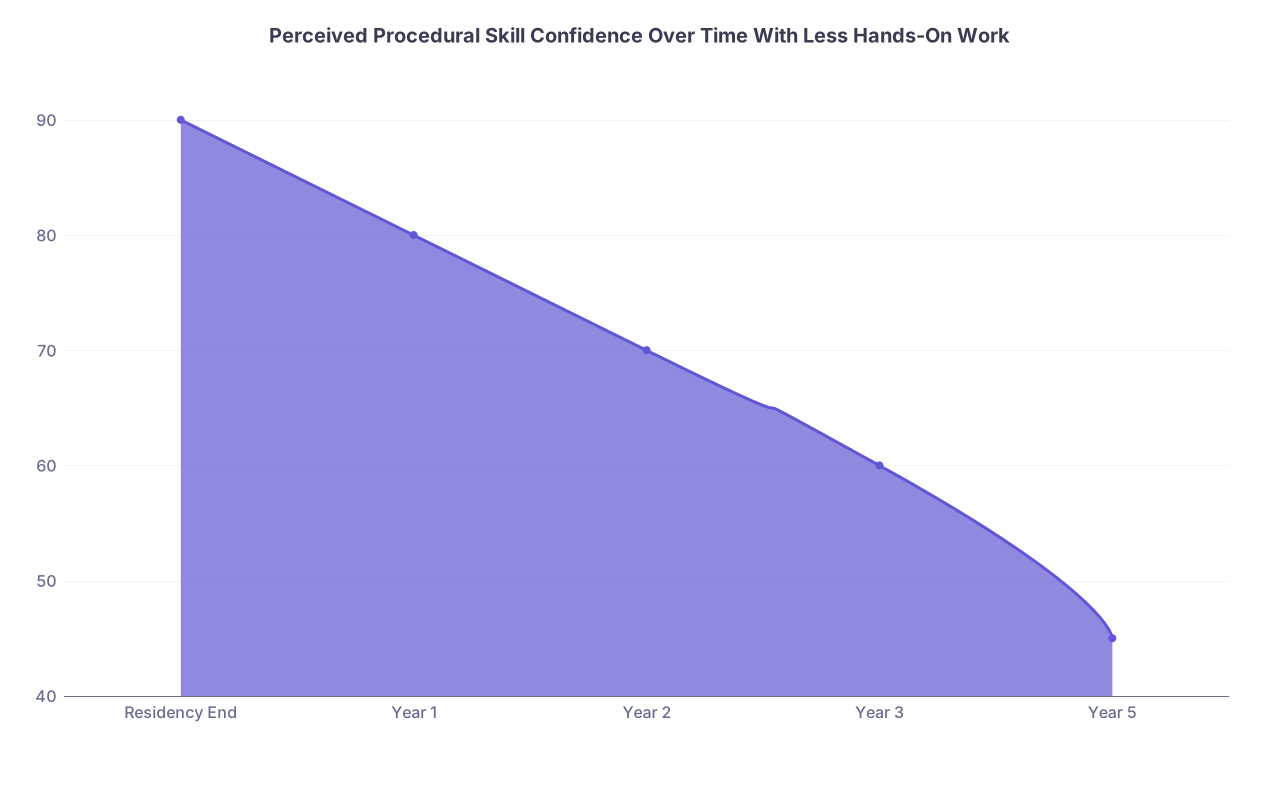
Reality check: how fast do procedural skills actually decay?
| Category | Value |
|---|---|
| Residency End | 90 |
| Year 1 | 80 |
| Year 2 | 70 |
| Year 3 | 60 |
| Year 5 | 45 |
You probably already feel it. You go 6 months without doing a certain procedure, and the next time it shows up you’re… hesitant. You still know it, but your muscle memory is sluggish and your risk radar is louder.
From what I’ve seen (and heard over and over in hallways):
- Basic office procedures (skin biopsies, joint injections, IUD insertions) start to feel rusty after about 6–12 months of low volume.
- Emergency/critical procedures (intubations, lines, LPs) feel shaky much faster if you’re not doing them—more like 3–6 months.
- Ultrasound skills evaporate frighteningly quickly without repetition.
The worst mix? A job that’s:
60% telehealth
- Minimal in-person panel continuity
- No formal procedural expectations or support
That’s the slippery slope. You don’t notice it week to week. Then suddenly it’s year three and you’re Googling “how many intubations to be competent” alone at midnight.
The good news: you can keep them. But you can’t do it passively. You need deliberate structure.
Step 1: Decide which skills you actually want to protect
Here’s where people screw up: they say “I want to keep all my procedural skills” while working a nearly full-time telehealth job with no dedicated in-person days.
That’s like saying, “I want to keep marathon shape” while never running more than 2 miles. Nice idea. Not reality.
You need to choose your core procedural identity for this phase of your career.
Ask yourself brutally:
- If I changed jobs in 3–5 years, what procedures would a future employer realistically expect me to do?
- Which procedures actually bring me joy / meaning vs just stress?
- What aligns with my specialty and job market?
For example, a family med doc might narrow to:
- Office procedures: skin biopsies, simple excisions, I&Ds
- MSK: knee/shoulder injections, trochanteric bursa
- Women’s health: IUD insertions/removals, endometrial biopsies
An EM-trained physician doing tele-urgent care might focus on:
- Procedural sedation (if they do in-person shifts)
- Intubations, central lines (if they still moonlight)
Write this down. As in, literally on paper.
Then accept this hard truth: you probably won’t maintain every skill you had at peak residency. And that’s ok. You’re not failing; you’re specializing.
Step 2: Build structure into your job (or admit you need another one)
You can’t keep procedural skills with “I’ll just pick some up when they come.” Telehealth funnels the procedural cases away from you by design.
You need to bake procedures into your schedule like they’re non-negotiable.
Some realistic structures that actually work:
Protected in-person days each week
Negotiate something like:- 2–3 days telehealth
- 1–2 days in-person clinic with blocks specifically reserved for procedures
Not, “I’ll squeeze procedures in.”
More like: 9–11 a.m. Tuesday and Thursday are procedure blocks. Booked only with cases that match your core list.Urgent care or ED moonlighting
This is what a ton of people quietly do to not lose their hands. One shift every 2–4 weeks in an urgent care or ED where you:- Sew lacs
- I&D abscesses
- Splint fractures
- Manage simple procedures you’ll never see on a screen
Is it exhausting? Sometimes. But it protects your skill set and your future options.
Blended role by design
When you negotiate a new job, stop just asking “What’s the telehealth percentage?”
Ask:- “What procedures do your clinicians commonly perform?”
- “Do you support and incentivize in-office procedures?”
- “Is there a dedicated procedure clinic?”
- “Do you have ultrasound access and time to use it?”
If they just stare and say “Most of our doctors do virtual care now,” that’s your answer. They’re not set up to help you protect your skills.

Step 3: Use telehealth strategically to feed your procedure volume
Telehealth doesn’t have to be your enemy here. If you’re smart, it becomes your triage funnel for procedures.
This is where most people just… don’t think ahead.
During telehealth visits, train yourself to:
Identify conditions that can and should become in-person procedures
- Suspicious skin lesions → schedule biopsy with you
- Recurrent effusions → bring them in for aspiration/injection
- Chronic shoulder/knee pain → schedule ultrasound-guided injection (if that’s in your toolkit)
Stop reflexively referring everything out
When you refer to derm or ortho for basic stuff you can safely do, you’re handing away both RVUs and skills.Create mini “pipelines”
For example:- Monday telehealth: evaluate knee OA → conservative talk, then schedule them for an injection on your Thursday in-person block.
- Follow-up telehealth after to monitor response.
Telehealth becomes your feeder system, not your competitor.
Step 4: Accept that “competence” isn’t just muscle memory
This is the part that calms people down when they’re spiraling about skills decaying.
Procedural competence has a few layers:
- Cognitive – choosing the right procedure, on the right patient, for the right indication, and knowing when not to do it.
- Technical – hands, instruments, angles, landmarks.
- Safety – consent, risks, managing complications, backup plans.
Telehealth actually keeps your cognitive and safety muscles very active:
- You’re constantly risk stratifying from limited data.
- You’re deciding who needs in-person evaluation or procedure vs who can be managed conservatively vs who needs ED.
- You’re counseling on risks and alternatives nonstop.
So no, you’re not becoming “a worse doctor” just because your hands are on a keyboard more than a scalpel. But you are at risk of losing that technical smoothness unless you create reps.
Think of it like this: the mental part of the procedure lives in your telehealth brain. The hand part still needs separate training time.
Which means…
Step 5: Get over the ego hit and practice like you’re a resident again
If you’re worried you’re rusty… you probably are. That doesn’t mean you’re unsafe. It means you need low-stakes reps.
Options that I’ve seen actually help:
Simulation centers
Many hospitals and academic centers have sim labs they barely use. Ask:- “Do you allow community physicians to book time?”
- Or connect through alumni channels and see if you can get access quarterly.
Yes, it feels weird as an attending to “practice” central lines on a mannequin. Do it anyway. Nobody cares as much as you think.
Skills refresher courses
There are actual multi-day courses:- Office procedures for primary care
- Ultrasound-guided procedures
- Derm surgery basics
They’re not cheap. But neither is losing a key part of your scope and then being limited in future job negotiations.
Deliberate practice on real cases
When you do get a procedure:- Slow down and be intentional.
- Run your mental checklist.
- Ask a colleague to observe if you’re truly anxious about rust.
Better to have an awkward “Hey, mind watching me do this LP? I haven’t done one in a year” than silently white-knuckling through it.

Step 6: Use data to see if you’re actually losing ground
Your brain is wired to catastrophize: “I’m not doing any procedures, I’m losing all my skills.”
But is that… true?
| Procedure Type | Year 1 Count | Year 2 Count | Target/Year |
|---|---|---|---|
| Skin biopsies | 45 | 38 | 30–40 |
| I&D abscess | 20 | 16 | 10–20 |
| Joint injections | 35 | 30 | 25–35 |
| IUD insert/remove | 22 | 18 | 15–20 |
| Simple laceration | 28 | 24 | 20–30 |
Even a basic spreadsheet with:
- Procedure type
- Date
- Any issues/complications
…will keep you grounded. If you see your numbers freefall over 12–18 months, that’s a signal, not a moral failure.
Signals can be acted on:
- Add another in-person half day
- Pick up a monthly urgent care shift
- Sign up for a refresher course
- Clean up your telehealth pipeline to route appropriate cases to you
Without data, you’re just marinating in vague dread.
Worst-case scenarios (and how to not let them become real)
Your brain probably goes here at 3 a.m.:
- “What if I lose all my procedural skills and no one will hire me later?”
- “What if I hurt someone because I’m rusty?”
- “What if I’m stuck in telehealth forever because I can’t go back?”
Let’s walk those out.
1. “No one will hire me later”
Reality: tons of outpatient jobs are already minimally procedural. Many internists and family docs do almost no procedures beyond basic stuff and still have solid careers.
What does happen is this: your options narrow. You might not be competitive for:
- Procedure-heavy positions
- Rural jobs expecting broad skill sets
- ED/urgent roles wanting lots of hands-on comfort
But if you keep even a focused set of well-maintained procedures, you’re far from unemployable. You’re just… specialized.
2. “I’ll hurt someone”
If you’re genuinely worried, your threshold should shift:
- Say no when you’re not comfortable. “I’m not currently doing that procedure; I’d like to refer you to X who does this frequently.”
- Don’t let pride override your risk assessment.
- Get help for higher-risk cases until you’re back in your groove.
It’s not malpractice to not do a procedure. It’s malpractice to persist when you know you’re not safe.
3. “I’m stuck in telehealth forever”
This one’s dramatic but very common. Telehealth can feel like quicksand.
Ways out (that I’ve actually seen people pull off):
- Hybrid roles within the same system (they carve out in-person days if you’re valuable)
- Side-gig procedural shifts that gradually become your main work
- Pivot to a job that explicitly wants someone to build a procedure clinic
But that pivot is much smoother if you’ve kept some volume instead of going procedural-zero for five straight years.

| Step | Description |
|---|---|
| Step 1 | Telehealth-Heavy Job |
| Step 2 | Hybrid In-Person Days |
| Step 3 | Procedural Moonlighting |
| Step 4 | Schedule Procedure Blocks |
| Step 5 | Track Volumes and Outcomes |
| Step 6 | Maintain Current Plan |
| Step 7 | Add Training or More In-Person Time |
| Step 8 | Define Core Procedures |
| Step 9 | Volume Adequate |
Emotional side: grieving the “hands-on” you thought you’d be
There’s another layer nobody really warns you about.
You might feel:
- Like you “wasted” all those miserable 2 a.m. procedural nights.
- Embarrassed to admit to co-residents that you’re mostly tele and not “in the trenches.”
- Guilty that your day is 80% talking and 20% touching, when you trained to be technical.
You’re allowed to grieve that. To say, “I thought I’d be doing X, and my career looks different.”
But don’t confuse that grief with failure.
Telehealth is medicine. It’s not fake. It requires a ton of clinical skill, just a different kind. The trick is to decide—deliberately—how much of your old procedural self you want to carry forward and then structure your life to support that.
Not cling to some fantasy version where you do one telehealth day a week from a beach and still magically retain your trauma-line skills.
You get to design something in between.

How to start changing things in the next 30 days
Concrete moves. Not someday ideas.
Week 1–2
- Write your short list of core procedures. No more than 5–8.
- Pull your last 6–12 months of procedure data if you can. Or make your best estimate.
- Look at your schedule: what percentage is telehealth vs in-person?
Week 3
- Talk to your supervisor/medical director about:
- Adding one half-day of procedure-friendly in-person time
- Creating procedure slots in your existing in-person days
- Clarifying what the group wants you to be able to do
Week 4
- Set up a simple spreadsheet or log.
- Book one deliberate learning activity:
- A sim lab session
- A refresher course
- Or a conversation with a colleague who runs procedure clinics to see if you can join them.
Is that going to turn you back into a PGY-4 procedural machine overnight? No.
But it gets you off the “I’m quietly panicking and not doing anything” treadmill.
FAQ (Exactly 6 Questions)
1. How many procedures per year do I actually need to stay competent?
There’s no magic universal number, but the idea that “one or two a year is fine” is fantasy. For common primary care procedures, I’d aim for:
- 20–30 per year per core procedure (e.g., joint injections, biopsies) to feel truly comfortable
- 10–15 per year as an absolute floor before I’d start questioning whether I should still be offering it
For rare higher-risk things (like intubations), I wouldn’t rely on low volume at all unless you’re also doing sims and have strong backup. It’s not just about counts; it’s about how you’re doing them and whether you’re seeing a variety of cases.
2. Is it better to give up some procedures entirely than to be “kind of” competent at a lot of them?
Yes. Half-competence spread across ten procedures is a liability. I’d much rather see someone who’s rock solid on 4–6 core procedures and openly doesn’t do the others, than someone who “sort of” still does everything they learned in residency once every few years.
Patients don’t usually care about the exact list. They care that:
- You know what you’re doing.
- You’re honest about your limits.
- You refer appropriately when something’s outside your wheelhouse.
3. If I already feel really rusty, should I stop doing all procedures immediately?
Not necessarily. What you should stop are high-risk procedures you haven’t done in a long time without backup. For lower-risk, bread-and-butter things, you can:
- Do a quick mental or written checklist before starting
- Ask a colleague to be nearby or available to assist
- Book lower-complexity cases first as you rebuild your comfort
If you’re feeling full-body dread before routine procedures, that’s a sign to pause, get some practice (sim, course), and then come back with intention.
4. Will employers judge me for having a telehealth-heavy past few years on my CV?
Some will. Especially for roles that are procedure-heavy or inpatient. But a lot won’t, if you can clearly articulate:
- What you have been doing (volume, complexity, mix of cases)
- What procedures you’ve maintained and roughly at what volume
- Any moonlighting, sim work, or courses you used to keep skills current
What looks bad is: “I did nothing hands-on for 4 years and also took no steps to keep up.” What looks fine: “I worked a hybrid telehealth role and kept a focused set of procedures going through in-person days and urgent care shifts.”
5. How do I bring this up with my boss without sounding like I’m criticizing telehealth?
Try something like:
“I’m really glad I can do telehealth—it’s been great for patients. But I’m concerned about letting my procedural skills atrophy because they’re important for my long-term career and for our patients who need in-office care. Can we look at carving out a half day weekly or biweekly that’s focused on procedures so I can keep those skills strong and serve more of our patients in-house?”
Frame it as:
- A benefit for patients (fewer referrals, more comprehensive care)
- A retention issue (you want to grow with the practice)
- Not an indictment of telehealth, just a scope-of-practice question
6. What if I realize I actually don’t like procedures and I’m only scared of losing them because of sunk cost from residency?
Then, honestly? That’s incredibly valuable self-knowledge. You’re allowed to pivot. Just be clear with yourself:
- Are you afraid of losing career options, or do you genuinely want to do these procedures?
- If it’s just sunk cost (“I suffered for this skill, so I must want it”), that’s not a good enough reason to grind yourself maintaining it.
You can choose a career that’s largely telehealth and cognitive. You’ll still be a real physician. You just need to stop pretending you’re going to be procedure-heavy later if you never actually liked it.
Years from now, you won’t remember the exact number of knee injections or biopsies you did in 2026. You’ll remember whether you were honest about the kind of doctor you wanted to be—and whether you built a career that matched that, instead of letting fear quietly shrink your options.