
The idea that telemedicine is a “one-way door” out of traditional practice is flat-out wrong.
But I get exactly why you’re worried it might be.
You’re staring at job listings, or maybe already in a full-time telemedicine role, thinking: “If I do this for a year… or three… am I basically telling every hospital and clinic in the country that I’ve given up on ‘real’ medicine? Am I killing my procedural skills? Am I going to look lazy? Damaged goods? Non-clinical? Unhirable?”
You’re not crazy for thinking this. You’re just a doctor living in 2026, watching the ground shift under your feet.
Let’s walk through what really happens to your career options after telemedicine—and what you have to do now if you want the option to go back to traditional practice later.
The Ugly Truth First: Yes, You Can Go Back… But Not On Autopilot
Here’s the blunt version:
You absolutely can return to traditional in-person practice after telemedicine. People do it every year. I’ve seen hospitalists go from full-remote urgent care telehealth back to inpatient jobs. I’ve seen primary care docs go from asynchronous tele-derm and tele-psych support back to brick-and-mortar clinics.
But.
You can make it hard on yourself if you treat telemedicine like a clinical sabbatical and stop thinking about:
- Procedural exposure
- Recency of in-person experience
- Ongoing CME and board status
- How your tele role will look on paper to a skeptical hiring committee
The worst stories I’ve heard weren’t “they did telemedicine and no one would hire them.”
The worst stories were “they did telemedicine, let their in-person skills atrophy, didn’t plan, and by the time they wanted to come back, they were competing with people who looked fresher, more current, and frankly more attractive on paper.”
So the question isn’t “Is telemedicine a permanent door out?”
The real question is: “How do I do telemedicine without quietly resigning from traditional practice by accident?”
How Hiring Committees Actually See Telemedicine On Your CV
Let me be honest about the paranoia in your head, because it’s not 100% wrong.
You’re probably asking yourself:
- “Will they think I went into tele because I couldn’t hack ‘real’ medicine?”
- “Will they assume my skills are rusty?”
- “Will they think I’m just trying to get an easy lifestyle?”
- “Will they ask why I left my last in-person job… and assume the worst?”
Here’s what I’ve actually heard behind closed doors in committee rooms:
- “They’ve been all tele for three years—how current are they with procedures?”
- “Do they still know how to manage really sick patients if they’ve mostly been low-acuity tele-urgent?”
- “Have they kept up with CME and QI projects?”
- “This looks interesting—telemed experience could be useful for our growing virtual clinic.”
So it’s not all negative. But they do worry about recency and depth. They want to know: can you hit the ground running safely?
If you want to go back to traditional practice, you have to make it easy for them to say yes.
That means your telemedicine years can’t just be an empty black box on your CV. You need to build a story that says:
“I wasn’t hiding. I was still very much a clinician.”
Concrete Career Paths After Telemedicine
Let’s go through actual directions people go after a stint (or several years) in telemedicine. This is where it helps to see it laid out, not just in your brain at 2 a.m. spiraling.
| Path | How Realistic It Is |
|---|---|
| Outpatient clinic (PCP) | High |
| Hospitalist / inpatient | Moderate |
| Urgent care (in-person) | High |
| Academic position | Moderate |
| Procedural specialty return | Variable / Low |
| Hybrid tele + clinic | Very high |
1. Outpatient Primary Care / Ambulatory
This is the easiest re-entry for most telemedicine docs, especially if your tele work is primary-care-like (chronic disease management, refills, acute complaints).
If your tele job has you:
- Managing diabetes, HTN, depression
- Doing longitudinal care
- Ordering labs, imaging
- Documenting like a real visit
then it’s not a huge logical jump for an outpatient clinic to say, “Sure, let’s bring you in.”
Where you’ll get questions:
- How long since you physically examined patients?
- Are you comfortable with procedures (Pap smears, joint injections, etc.)?
- Why did you leave brick-and-mortar initially—and what’s changed?
Those are answerable. Especially if during your tele stint you:
- Kept up CME in primary care and physical exam
- Did any in-person per-diem or PRN work
- Stayed board certified and engaged
2. Hospitalist / Inpatient Work
This is where things get trickier, especially if your tele role is low acuity.
If you’re doing something like:
- Tele-hospitalist (consults, admissions, cross-coverage)
- Tele-ICU support
you’re still deeply in the inpatient world, just not physically there. Programs may actually love this, because remote coverage is becoming standard and you understand those workflows.
But if you’ve been doing:
- Tele-urgent care
- Direct-to-consumer symptom visits
- Prescription refills, simple rashes, UTIs, URIs
and then you say, “I want to be a full-time hospitalist again after 4 years away from the bedside” — they will hesitate. Not because tele is bad, but because you’re asking them to trust your comfort with acutely ill patients after a long gap.
Can it be done? Yes. But expect to have to “re-prove” yourself more than someone who went straight from residency to hospitalist and stayed there.
3. Urgent Care (In-Person)
Tele-urgent → Brick-and-mortar urgent care is a very common path back.
You’ll actually look more attractive to some urgent care chains because:
- You’ve likely seen massive volume
- You’ve practiced risk stratification fast
- You’re good with documentation and protocols
You’ll still get questions about procedures (suturing, I&Ds, splinting). If you’ve been working tele only, you’ll want to be honest about needing some ramp-up or supervision early on for hands-on stuff. Many centers are okay with that if they like you and you’re upfront.
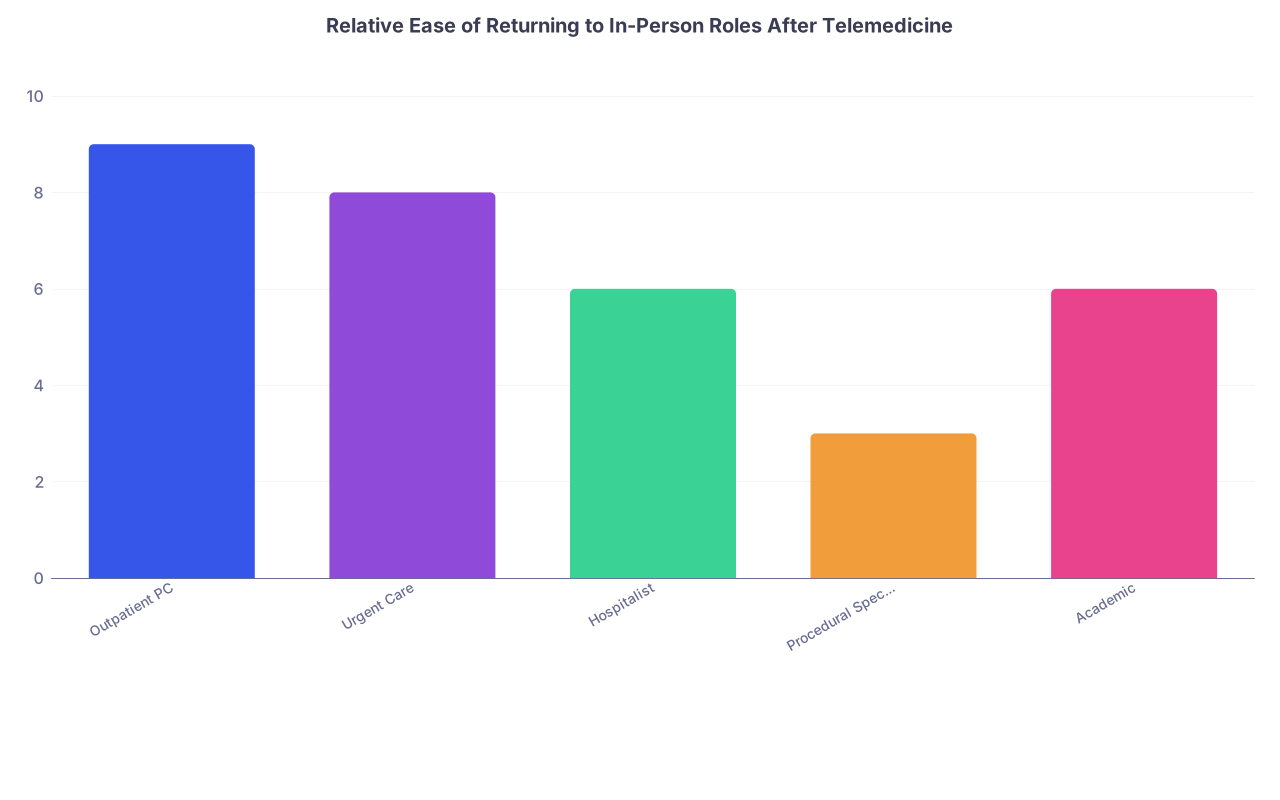
| Category | Value |
|---|---|
| Outpatient PC | 9 |
| Urgent Care | 8 |
| Hospitalist | 6 |
| Procedural Specialty | 3 |
| Academic | 6 |
4. Academic Jobs
This is all over the map and heavily depends on the institution.
Academic centers like:
- People who can teach residents about virtual care (because everyone’s doing it now)
- Faculty who can help build telemedicine curricula and programs
- Clinicians who’ve worked in different practice environments
Your risk here is if your tele years look like you “checked out” of anything scholarly: no QI, no teaching, no committees, no leadership.
But if during tele you:
- Took on a lead clinician role
- Helped develop tele protocols or workflows
- Gave talks or helped train new hires
- Participated in QI or outcomes projects
you can absolutely spin that into an academic narrative. Not fake spin. Real, “I did things that matter to an academic center” spin.
5. Procedural Specialties (The Hardest to Go Back To)
This is where worst-case thinking is actually a bit justified.
If you’re in something like:
- EM
- Anesthesia
- Surgery
- Interventional fields
and you step away from the physical bedside, procedures, and acute resuscitation for several years to do low-acuity tele… yeah, it’s a steeper uphill climb to go back.
Not impossible. But you’ll likely need:
- A structured re-entry or “refresher” program
- Proctored cases
- Possibly lower level of initial responsibility
The longer you’re out of in-person work, the more this becomes an issue. If you’re in a procedural field and want to keep the door open, you almost have to blend tele with some ongoing in-person shifts.
How To Protect Your Ability To Go Back (Starting Now)
This is what you actually need: a safety net you build for yourself.
1. Maintain Some In-Person Clinical Time If At All Possible
Even 1–4 shifts a month helps tremendously.
- Per diem ER shifts
- PRN urgent care
- One day a week in a clinic
- Occasional inpatient coverage weekends
This solves 80% of the credibility issue. On your CV, you can show overlapping tele + in-person roles. And in interviews you can say, “I never stopped seeing patients in person; I’ve stayed comfortable clinically.”
If you’re already full-time tele and locked in, start quietly looking for small PRN roles now, not later.
2. Keep Your Boards, CME, and Licenses Squeaky Clean
Programs freak out if they see:
- Lapsed board certification
- Narrowed licenses (only one tiny state)
- Gaps in CME that look like you checked out mentally
You need to stay boring and safe on paper:
- Make sure you’re current on MOC / recert
- Get more CME than required, especially in your hoped-for future setting (inpatient, outpatient, whatever)
- Keep multiple state licenses if you can; they signal flexibility and ongoing engagement
3. Build a Story, Not Just a Timeline
Random tele job from 2024–2027 with no explanation looks like “I hid from real medicine for three years.”
Tele job + increasing responsibility + specific skills looks like “I pivoted into a growing field, built experience, and now I bring something extra.”
Keep receipts:
- Leadership roles (team lead, QA reviewer, training)
- Any QI/QA work
- Work on clinical guidelines or playbooks
- Experience with specific platforms or systems
Those details become your narrative in future interviews: “Here’s what I actually did for three years beyond clicking eRx buttons.”

| Step | Description |
|---|---|
| Step 1 | Residency Graduation |
| Step 2 | In-person Job |
| Step 3 | Full-time Telemedicine |
| Step 4 | Add PRN In-person Shifts |
| Step 5 | Hybrid Tele + Clinic |
| Step 6 | Return to Full Clinic or Hospital |
Red Flags That Really Do Make Returning Harder
I’m not going to sugarcoat everything. There are choices that seriously complicate going back.
- Doing only low-acuity DTC tele for 4–5+ years with zero in-person shifts
- Letting boards lapse, then trying to re-enter a competitive hospital job
- Moving into purely non-clinical tele roles (only admin/ops) and listing yourself as “physician” but not actually seeing patients
- Switching tele companies constantly so it looks unstable or chaotic
None of these are instant death. But they’re like tying sandbags to your ankles right before you try to swim back to shore.
If you’re already in one of these categories, the fix isn’t panic. It’s structure:
- Get a re-entry plan written down
- Talk to one or two medical directors in your target field and ask, “What would you need to see from me to hire me safely?”
- Work backwards: CME, shadowing, supervised shifts, refresher courses
The Hybrid Future: Not Either/Or, But Both
One thing you’re probably underestimating: a lot of “traditional” jobs are quietly becoming hybrid anyway.
I’ve seen:
- Hospitalist jobs with tele-admission coverage options
- Primary care clinics carving out half-day virtual sessions
- Academic centers building tele electives and leadership roles
Your tele experience could actually differentiate you if you frame it right.
Imagine an interview:
Them: “We’re trying to expand virtual follow-ups for complex patients, but none of our current staff has much tele experience.”
You: “I spent three years in a high-volume tele program, helped write protocols for virtual chronic care, and trained new hires on remote documentation and triage. I’d love to help you build that here.”
That doesn’t sound like “ran away from real medicine.” That sounds like “exactly the person we need.”
FAQ (The 2 a.m. Panic Edition)
1. How long can I do telemedicine before it “hurts” my chances of going back?
There’s no magic number, but here’s the pattern I’ve seen:
- 0–2 years of tele, with some in-person PRN sprinkled in: easy story to tell, minimal skepticism.
- 3–5 years, no in-person work: programs start asking more pointed questions, especially for inpatient or procedural roles.
- 5+ years out of bedside with only low-acuity tele: you’re probably looking at a structured re-entry, maybe starting in lower-intensity roles or needing supervised time.
The clock matters less if you stay clinically active in-person even at a low volume.
2. Will programs judge me for choosing telemedicine at all?
Some will. Some won’t. And a growing number will quietly think, “This is useful experience.”
You can’t control their biases, but you can control how your story sounds. If your explanation is, “I wanted lifestyle,” and that’s all you say, some people will assume you’re not serious. If your explanation is:
“I moved into telemedicine because of X (family, location, opportunity), stayed deeply engaged clinically, took on responsibilities Y and Z, and now I want to bring that experience back into an in-person setting,”
it lands very differently.
3. What if I already did 2–3 years of only tele and I’m panicking now?
Then your job this year is: start rebuilding in-person credibility.
- Get a small PRN or per-diem in-person role, even if it’s not perfect
- Over-index on CME relevant to where you want to go
- Ask for concrete feedback from medical directors in your target area: “What would make you comfortable hiring me?”
You don’t fix this with vague anxiety. You fix it with specific actions that show you’re still a real clinician, not just a remote symptom-checker.
4. Is taking a tele job right after residency a permanent stain?
No, but it’s a little unconventional, so you’ll need to be thoughtful.
If you go straight from residency into tele, your first “real job” sets your reputation. That doesn’t doom you, but you should:
- Choose a tele role with real breadth and complexity if you can
- Add in-person work as soon as your life allows it
- Stay on top of board and CME early
Programs care less where you started and more whether you look clinically solid and engaged when you apply to them.
Open your CV right now and look at the telemedicine line. Ask yourself: if a skeptical chief looked at this, would they see “checked out” or “still a serious clinician”? If the answer makes your stomach drop, pick one concrete step you can take this month—PRN shifts, CME, a leadership role—to start changing that story.