
Your telehealth metrics are not your report card as a physician. They’re a blunt instrument that can hurt you if you don’t learn how to hold it.
Let me say the thing you’re probably too scared to say out loud:
“My video visit numbers are low. My no-shows are high. My RVUs per telehealth visit suck. Are they going to fire me? Cut my pay? Label me ‘underperforming’ forever?”
You’re not crazy for worrying about this. A lot of those dashboards were built by people who’ve never sat through a frozen Zoom call with a 78‑year‑old on dial‑up trying to show you their rash.
What Telehealth Metrics Actually Matter (And Which Ones Are Trash)
The first problem: no one really told you which numbers could actually hurt your job and which are just “for visibility.” So everything feels dangerous.
Here’s how most systems think, even if they don’t say it out loud:
| Metric | Real Career Risk Level |
|---|---|
| RVUs per telehealth session | Medium–High |
| Telehealth visit volume | Medium |
| No-show / cancellation rate | Medium |
| Patient satisfaction (telehealth) | Medium |
| Technical failure / drop rate | Low–Medium |
Let’s break that down like an actual human, not an admin slide deck.
RVUs per telehealth session.
This is the one that actually touches money. If your total RVUs (clinic + telehealth) are far below peers in your specialty, that’s when conversations about “productivity,” “compensation alignment,” and “panel rebalancing” start. If telehealth RVUs are low but your in‑person volumes are strong? Less scary. It’s weak leverage for them.
Telehealth visit volume.
If the institution is pushing virtual visits (“strategic priority,” “access initiative,” all the buzzwords) and you’re way below your colleagues, they notice. But most of the time, they turn this into “coaching,” not immediate punishment. Unless your overall access is a known problem.
No-show rate.
Here’s the frustrating part: this is often more about scheduling practices, patient population, and tech barriers than about you. But people still throw this number around like you personally told every patient, “Eh, don’t bother showing up.” It can trigger “performance discussions,” especially if your rate is an outlier.
Patient satisfaction.
If your telehealth satisfaction scores are garbage while in‑person is fine, that’s usually read as “skills gap, fixable with training.” Annoying, yes. Career-ending, no. If both are low and they’ve been low for a while, that’s a different conversation.
Technical failures.
Dropped calls, video issues, platform problems. These should be more on IT and operations, but they sometimes get pinned on you indirectly. This rarely becomes the core reason for serious action unless you’re doing things like refusing to reschedule, ending visits early, or not documenting.
Here’s the piece no one tells you:
Most systems still don’t really know what “good” telehealth metrics should look like in every population. The benchmarks are often made up or based on small samples, and admins quietly know that.
So, how worried should you be?
You’re in the danger zone if:
- Your telehealth metrics are far below peers
- AND your total productivity or access is also below target
- AND this has been true for more than 6–12 months
- AND you’ve already had explicit “performance” conversations in writing
If that’s not you, you’re stressed about a theoretical threat more than an imminent one.
The Worst-Case Scenarios You’re Imagining (And How Real They Are)
You’re probably catastrophizing in pretty specific ways. Let me walk through the common ones I’ve heard in offices, on late‑night calls, and in panicked WhatsApp groups.
“What if they fire me over my telehealth numbers?”
Blunt answer: possible? Yes. Likely? No, unless it’s one part of a bigger pattern.
I’ve seen someone pushed out where telehealth metrics were mentioned, but the real list was: poor in‑person productivity, multiple patient complaints, chronic charting delays, and refusal to adapt to any new workflows. Telehealth just happened to be an easy measurable target.
Firing a physician purely because telehealth no-shows were high? That’s unlikely and legally messy, especially if there are disparities by population, tech access, language, etc. Most systems know that.
What does happen more commonly:
- You get a “performance improvement plan” (PIP) with some vague telehealth goals
- Your schedule is “rebalanced” (fewer telehealth slots, more in‑person, or vice versa)
- Your bonus gets hit if it’s tied to certain metrics
Annoying, demoralizing, yes. Career-ending, usually no.
“What if my low metrics follow me to my next job?”
You’re worrying about a secret permanent record. That’s not really how it works.
When you change jobs, what they actually see is:
- Verification forms from your prior employer
- Credentialing data
- Maybe informal back-channel calls if the world is small
Those forms don’t say: “Dr. X had a 23% telehealth no-show rate.” They say things like:
“Was this physician in good standing?”
“Any issues with professionalism, patient care, or quality?”
Telehealth metrics would translate into a problem only if they were part of a bigger story like:
“Refused to adapt to institutional changes”
or
“Significant concerns regarding access or responsiveness.”
If you can honestly say, “I engaged, I tried to improve, I documented barriers,” it’s very hard for someone to paint that as a professionalism problem.
“What if my colleagues think I’m lazy or incompetent?”
This one hurts more than admin stuff, honestly.
Look: most of your colleagues know telehealth is messy. They’ve had 13‑minute calls where half the visit is yelling “Can you hear me now?” They’ve had people log in from moving cars. They know some of these numbers just reflect chaos.
The people who side‑eye you are usually:
- Hyper‑productive RVU machines who see 30 patients a day and think everyone else is soft
- Administrators with never‑seen-a-patient energy masquerading as “efficiency experts”
Your actual peers? They’re worrying about their own numbers too. You’re not the only one secretly checking the dashboard at 11:47 PM and spiraling.
Why Your Telehealth Metrics Might Be Low (That Aren’t About You Being Bad)
Let’s be painfully honest: sometimes low metrics are on us. But a lot of time, they’re not. And you need to be able to explain that clearly so it doesn’t all stick to you.
Common non-you reasons:
- Patient population with low tech literacy or unstable internet
- Clinic front desk not confirming appointments or sending links correctly
- Schedulers forcing inappropriate visits (complex new patients / procedures) into telehealth slots
- Platform that crashes or lags constantly
- Institutional pressure to overbook telehealth to “increase access,” which then spikes no-shows and cancellations
Here’s the kicker: if you don’t document these barriers and speak up in structured ways, they will default to, “Maybe this doc just isn’t good at telehealth.”
You don’t need a 20-page manifesto. You need patterns and receipts.
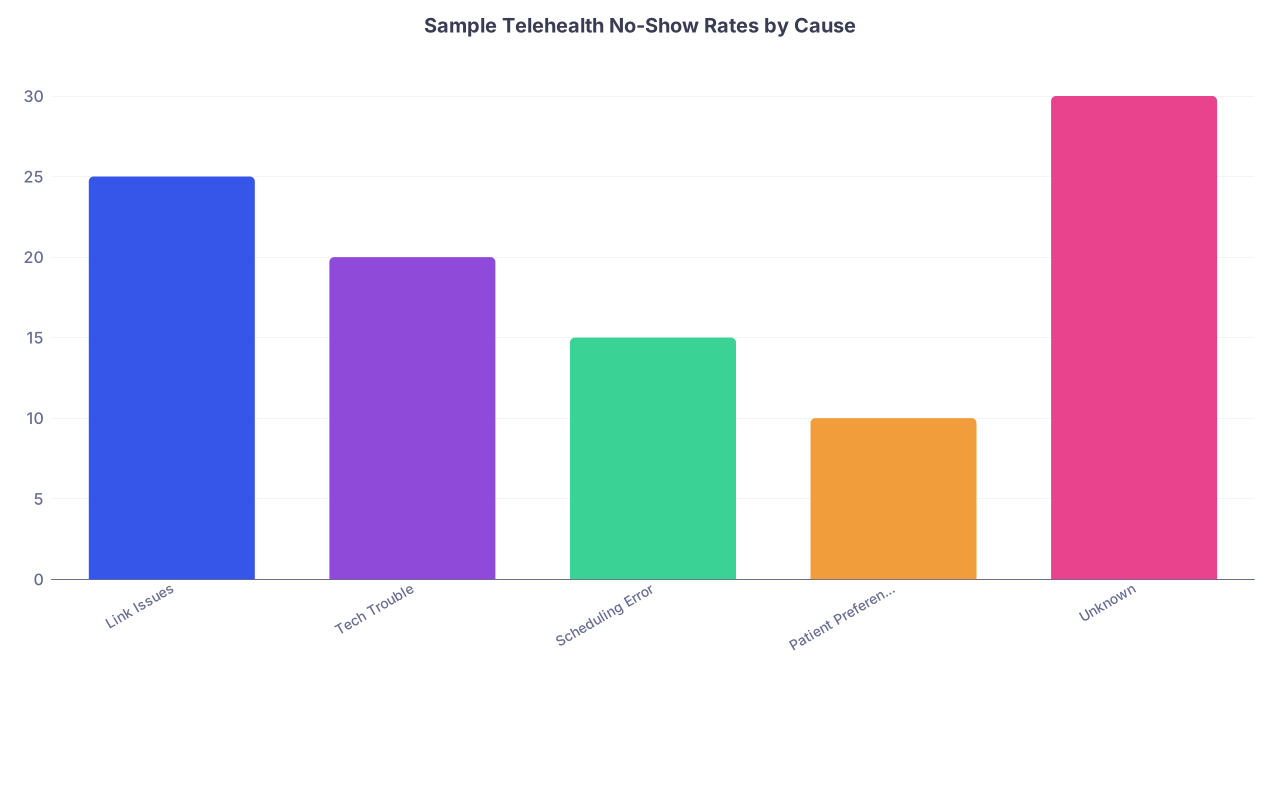
| Category | Value |
|---|---|
| Link Issues | 25 |
| Tech Trouble | 20 |
| Scheduling Error | 15 |
| Patient Preference Change | 10 |
| Unknown | 30 |
Most systems never look at this breakdown. They see: “Your no-shows are 28%.” You see:
“Of that 28%, half never even got the link or had platform errors.”
That’s a very different story than: “My patients hate me and never show up.”
What To Do Right Now If Your Telehealth Metrics Are Below Target
You’re probably looking at your dashboard and thinking, “Okay, but what do I actually do this month so I don’t get blindsided?”
Here’s the short, practical version.
1. Get context fast
You need to know if you’re truly an outlier or just slightly below some arbitrary fantasy line.
Ask your supervisor or practice manager questions like:
- “Where do my telehealth metrics fall compared to group averages?”
- “Is this something leadership is actively worried about, or just on a report?”
- “What specific thresholds should I be aiming for this quarter?”
If they can’t give you concrete answers, that’s data: they’re not using this as a decisive weapon yet. It’s still squishy.
2. Protect yourself with documentation (quietly)
Any time something goes wrong that affects metrics, start capturing it simply in your notes or in a private log. Not five paragraphs. Just enough for patterns.
Example in your private log (not the chart):
- “1/9 – 3 telehealth no-shows – 2 patients never received link (front desk confirmed wrong email), 1 platform crash”
Or in the chart, a quick line:
- “Visit converted to phone due to platform connection failure despite multiple attempts.”
Why? Because if someone drags you into a meeting about your “poor telehealth performance,” you’re not sitting there empty-handed, mumbling. You have a story backed by data.
3. Pick 1–2 changes that give you visible improvement
Not perfection. Just visible improvement that you can point to when asked, “What have you done about this?”
Examples:
- Ask scheduling to call certain high-risk patients the day before with basic tech check
- Ask for in‑person conversion automatically after a second telehealth no-show
- Shorten telehealth visits slightly and increase slots, if volume is the issue and you can do that safely
- Standardize your telehealth opening: confirm audio, video, backup phone number in first minute
Then you track the before/after for 1–2 months. Even modest improvement gives you something to show:
“Since we started doing X, my telehealth no-show rate dropped from 28% to 19%.”
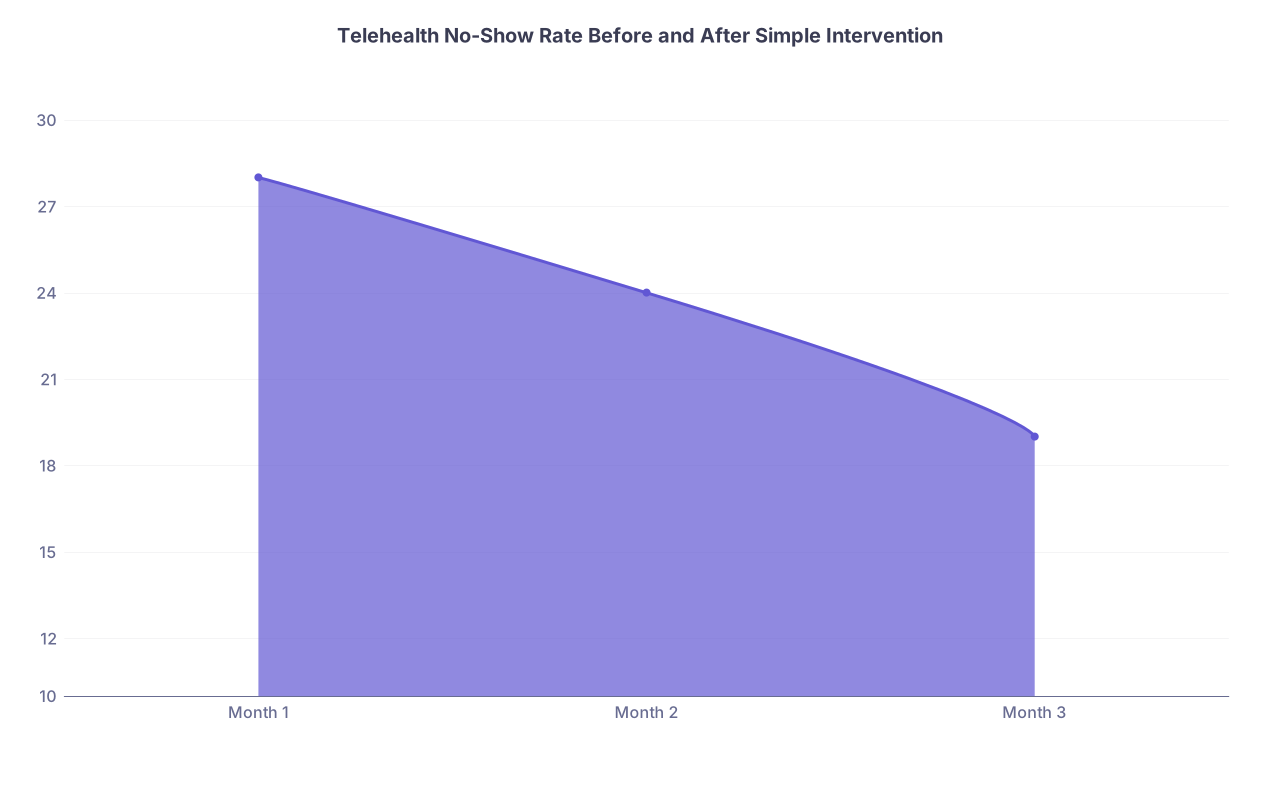
| Category | Value |
|---|---|
| Month 1 | 28 |
| Month 2 | 24 |
| Month 3 | 19 |
That’s the kind of thing that makes meetings go from accusatory to collaborative.
4. Get ahead of the narrative with your boss
Do not wait for someone to “call you in.” That makes you the defendant.
Instead, send an email like:
“I’ve noticed my telehealth no-show rate and RVUs are a bit below target. I’ve started doing X and Y to address it, and I’m tracking the effect over the next 1–2 months. I’d appreciate any guidance on how these numbers are being used and what the expectations are for my role.”
This does three things at once:
- Shows insight (you see the problem)
- Shows initiative (you’re acting on it)
- Forces them to clarify if this is a “concern” or just a line in a report
It’s hard to seriously discipline the person who’s proactively trying to improve and asking for clear expectations.
How Worried Should You Actually Be?
Let me put this as directly as I can.
You should be concerned enough to:
- Understand your numbers
- Document barriers
- Show a good-faith effort to improve
You should not be losing sleep imagining you’re one bad virtual clinic away from being unemployable forever.
Most organizations are still figuring telehealth out. Quietly. Sloppily. There are politics and budgets and patient complaints and vendor contracts shaping this way more than your personal metric line.
You have more power than you feel like you do. Not to magically hit some impossible target, but to shape the story around your performance:
“I’m the physician who is engaged, adaptable, and trying to make telehealth actually work for my patients, even when the system makes that hard.”
That’s what protects your career. Not a perfect dashboard.
FAQs
1. My telehealth RVUs are lower than in-person. Does that mean I’m less “valuable”?
Not automatically. Telehealth visits are often shorter, paid differently, or coded more conservatively because people are still skittish about audits. Many systems expect slightly lower RVUs per telehealth visit. What matters more is your overall productivity and access. If your total RVUs (tele + in-person) are in the normal range for your specialty and FTE, you’re not suddenly “less valuable” because the virtual slice is lower. You only really get into trouble when your total output is consistently low and you look disengaged from trying to fix it.
2. Could low telehealth metrics affect my future job offers or contracts?
Only indirectly. Future employers rarely see granular telehealth stats. What they do hear is whether you were in good standing and adaptable. If low metrics were framed as, “This physician refused to adopt telehealth, ignored feedback, and blocked initiatives,” that can hurt you. If the story is, “They worked with us, documented barriers, and tried to improve in a tough environment,” it’s very hard for anyone to weaponize that against you. That’s why the narrative you build now—emails, logs, small improvements—matters more than the raw numbers.
3. My patients prefer in-person and keep declining telehealth. Is that my fault?
No. Preference is not failure. If you serve older adults, low-income patients, or people with limited tech access, a strong preference for in-person is normal. Where it can become your issue is if you’re seen as discouraging telehealth or visibly annoyed by it. You don’t need to convert every patient. You do need to show that you offer telehealth when appropriate, explain its benefits clearly, and make a reasonable effort when it’s clinically suitable. The system doesn’t get to blame you because your patients don’t all want video visits in perpetuity.
4. Can I push back on unrealistic telehealth targets without looking difficult?
Yes, but it has to be data-based, not emotional. Instead of, “These targets are ridiculous,” frame it as: “Here are my current numbers, here’s what I’ve tried, and here are the structural barriers I’m seeing (patient tech, scheduling, platform). I think a realistic target for my panel would be X, and I’d need help with Y to go beyond that.” That’s not being difficult; that’s being clinically grounded. Admins will still sometimes roll their eyes, but it’s a lot harder to dismiss you when you’re bringing specifics instead of vibes.
5. My telehealth satisfaction scores are lower than in-person. Does that mean I’m bad at virtual care?
Not necessarily. Telehealth amplifies annoyances that patients already have: wait times, tech friction, feeling rushed. A lot of what gets scored as “provider” is actually the entire experience: logging in, holding times, audio quality. That said, there are small, fixable things that can move your scores: clear openings (“Here’s what we’ll cover today”), using the patient’s name more, checking for understanding, and explicitly acknowledging tech hiccups instead of just plowing through. Improvement of even a few points over a couple months changes how this looks on paper: from “bad at telehealth” to “actively improving.”
6. If I really hate telehealth, can I just avoid it without hurting my career?
Depends where you work. In some settings (certain academic centers, old-school private groups), you can quietly skew heavily toward in-person without much drama. In systems loudly pushing “digital transformation,” flat-out avoiding telehealth can get read as “not a team player.” The safer move is usually: do some telehealth, do it competently, show effort to improve, and then negotiate your mix honestly: “I’m most effective with a heavier in-person load, but I’m maintaining X% telehealth as appropriate.” Completely refusing it in a telehealth-heavy institution is more risky than having mediocre-but-improving metrics.
Bottom line: Your telehealth metrics are one data point, not a verdict.
Care enough to understand them, improve what you reasonably can, and document the rest.
Don’t let a glitchy video platform convince you your entire career is hanging by a thread.