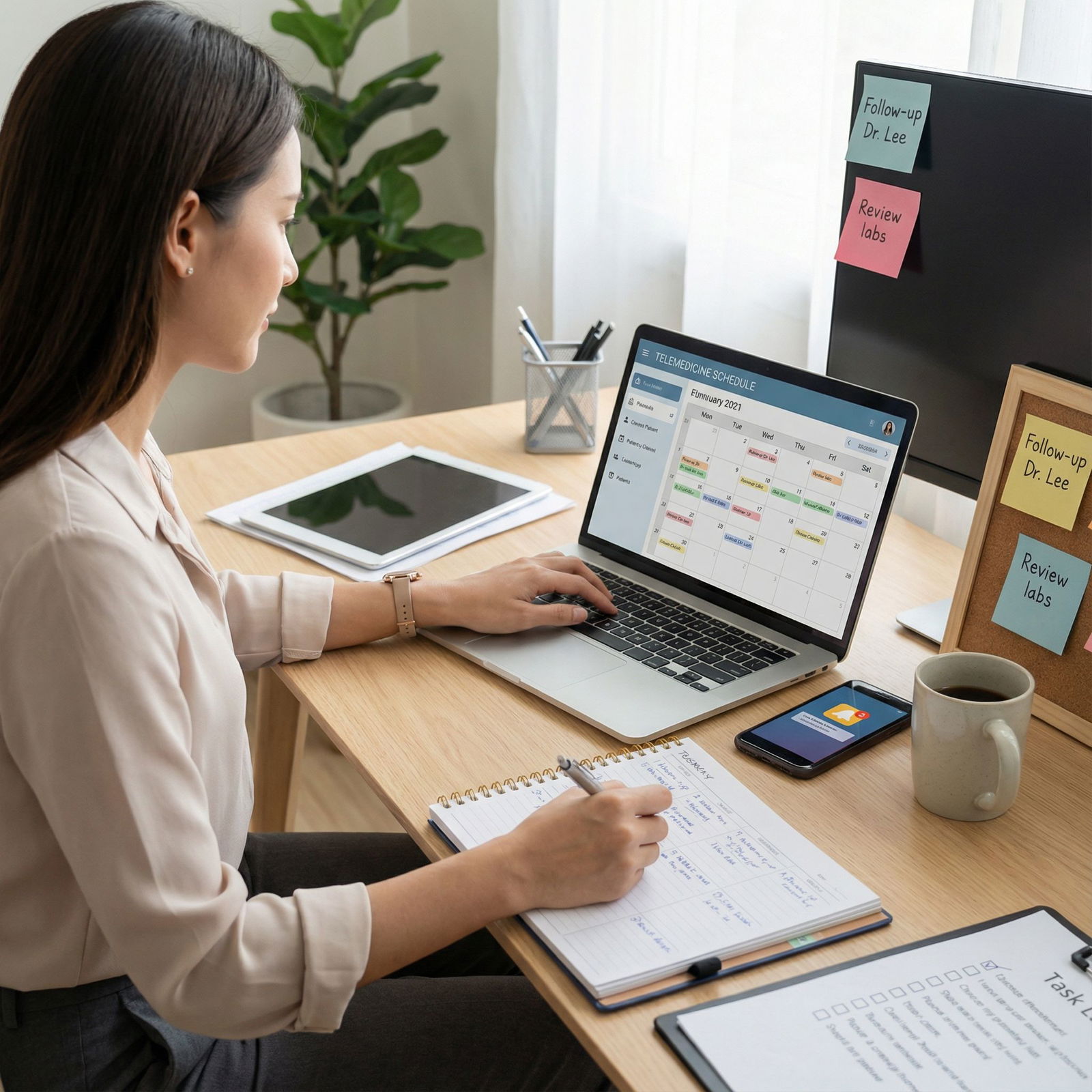
The fear of missing a diagnosis on video isn’t silly — it’s rational, and every good telemedicine doctor lives with it.
If you’re imagining yourself on a grainy video call, a parent saying “he’s just been a little off,” and you’re secretly thinking, “What if this is sepsis and I’m about to send this kid to bed?” — yeah. That’s the anxiety talking. And also the reality of remote care.
I’m not going to sugarcoat it: telemedicine does come with more uncertainty. You don’t have vitals on everyone. You don’t have hands on the abdomen. You can’t smell the GI bleed. And yes, that can go wrong if you treat telemedicine like in‑person clinic with a webcam.
But here’s the part no one tells you when you’re doom‑scrolling Reddit: the doctors who last in telemedicine learn a very structured way to manage that uncertainty so it doesn’t eat them alive. Or their license.
Let’s break down how they actually do it — and what that means if you’re thinking about a telemedicine career but can’t stop picturing worst‑case scenarios.
The Ugly Truth: Your Fear of Video Misdiagnosis Is Valid
You’re not crazy for being scared.
Here’s what lives in the back of your mind (because I’ve heard versions of this a hundred times from residents and new attendings):
- “What if they look fine on camera, but they’re actually hypoxic?”
- “What if I miss subtle meningismus because they’re holding the camera under their chin?”
- “What if they lie about how sick they are because they don’t want to go to the ER?”
- “What if the board review comes, and they say ‘Why didn’t you pick that up?’ when I literally couldn’t examine them?”
Some of this is trauma from residency culture: if you miss anything, you’re an idiot. If you over‑call anything, you’re wasting resources. Perfect accuracy or shame. That mindset is toxic in telemedicine.
Because telemedicine is built on one core fact:
You will not have enough information. On purpose. By design.
And the job isn’t “make perfect diagnoses anyway.” The job is:
Use limited data to make the safest, most reasonable next step — and know exactly when to say, “This is above telemedicine’s pay grade.”
The people who get in trouble aren’t the ones who worry. It’s the ones who stop worrying. Who start treating “video only” like urgent care with a stethoscope that somehow reaches through the screen.
How Telemedicine Doctors Actually Reduce Risk (Instead of Just Hoping)
Let me be blunt: no responsible telemedicine company is relying on you to MacGyver a full physical exam over Zoom. They know the limitations. The good ones build guardrails so you don’t have to reinvent safety on every call.
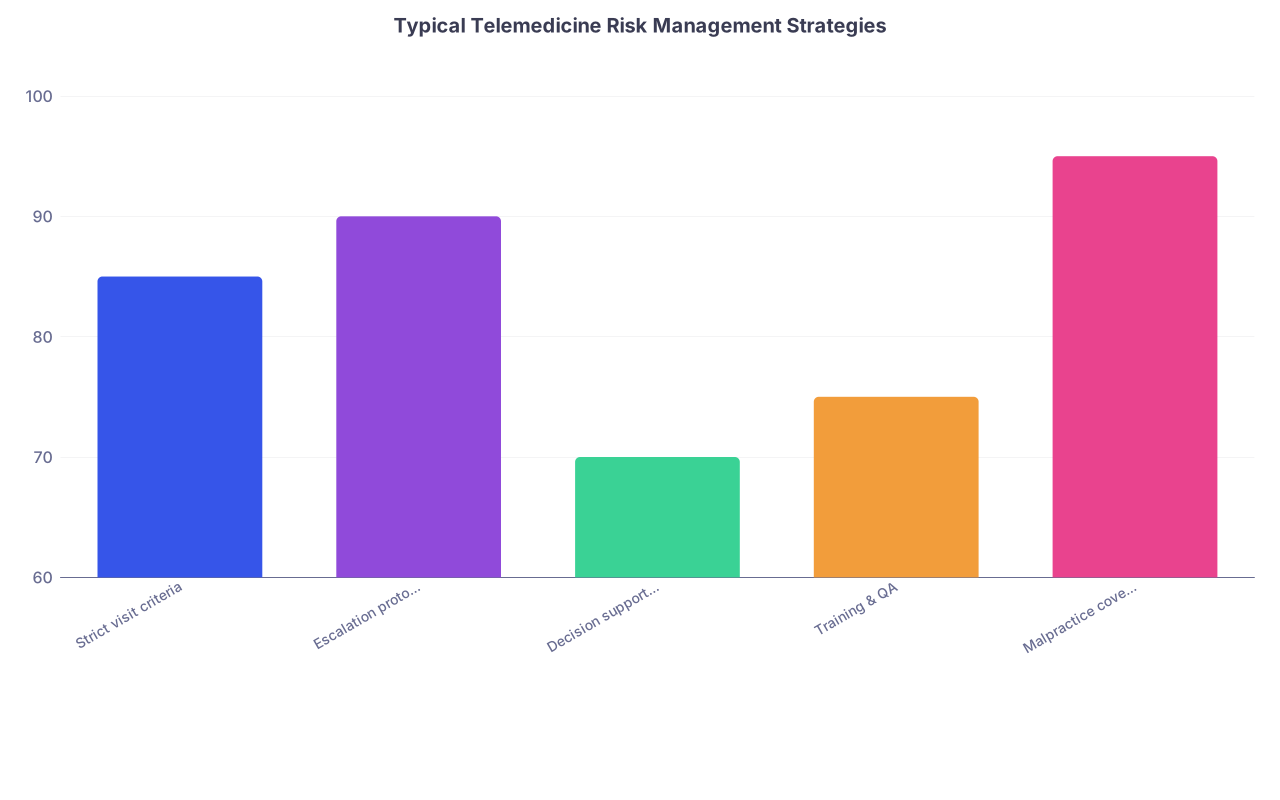
| Category | Value |
|---|---|
| Strict visit criteria | 85 |
| Escalation protocols | 90 |
| Decision support tools | 70 |
| Training & QA | 75 |
| Malpractice coverage | 95 |
Here’s what that looks like in real life.
1. Hard Exclusion Criteria: Patients You’re Not Allowed to Manage by Video
This is the stuff the platform literally blocks or strongly discourages:
- Chest pain with concerning features? Hard stop: “You need emergent evaluation.”
- SOB at rest? Same.
- Focal neuro deficits, possible stroke? You’re not “tele‑managing” that.
- High‑risk OB complaints.
- Kids under a certain age with concerning symptoms (some platforms won’t see <2 months at all for fever; others are very strict about <6 months).
I’ve watched platforms auto‑route or block visits when patients click “chest pain” or “can’t breathe” as their chief complaint. Sometimes they’re wrong and it’s reflux, but that’s the price of safety. Your job there isn’t to be clever; it’s to not override the system just to feel “helpful.”
2. Scripted Triage Questions That Aren’t Just For Show
You know those “Are you having any of the following…” checklists that feel annoying? In telemedicine, they’re your early warning system.
The questions are often written by risk management and seasoned clinicians together. They’re designed to surface red flags you might otherwise miss in a 10‑minute video visit with laggy audio.
Example: tele‑urgent care for URI symptoms. Before you even enter the visit, the patient may have answered:
- Any confusion, trouble thinking clearly, or difficulty staying awake?
- Are you having trouble breathing even when you’re sitting still?
- Have you noticed blue lips, face, or fingertips?
- Does your chest hurt when you take a deep breath?
If they say yes to certain combos, they may never reach you. Or if they do, you’re walking in already primed: “I’m probably sending this person in.”
3. “Low Threshold to Escalate” Culture
Traditional clinic: you get side‑eyed if you send someone to the ED “too often.”
Good telemedicine: you get side‑eyed (or fired) if you don’t escalate when there’s reasonable doubt.
Telemedicine attendings who sleep well at night use one simple rule:
“If I’d be uneasy letting my own family member stay home with what I’m seeing on video — they’re going in. I don’t care if they look ‘kind of okay’.”
You can’t listen to lungs? Then you don’t sit there agonizing over “Is this bronchitis or pneumonia?” You decide whether this level of diagnostic uncertainty is acceptable to manage remotely. If not, urgent in‑person evaluation wins.
The Video Exam Is Not A Joke: It’s Just Different
The physical exam you learned in med school? That doesn’t die in telemedicine; it mutates.
No, you can’t percuss. You can’t auscultate. But you can do a surprising amount if you’re deliberate.
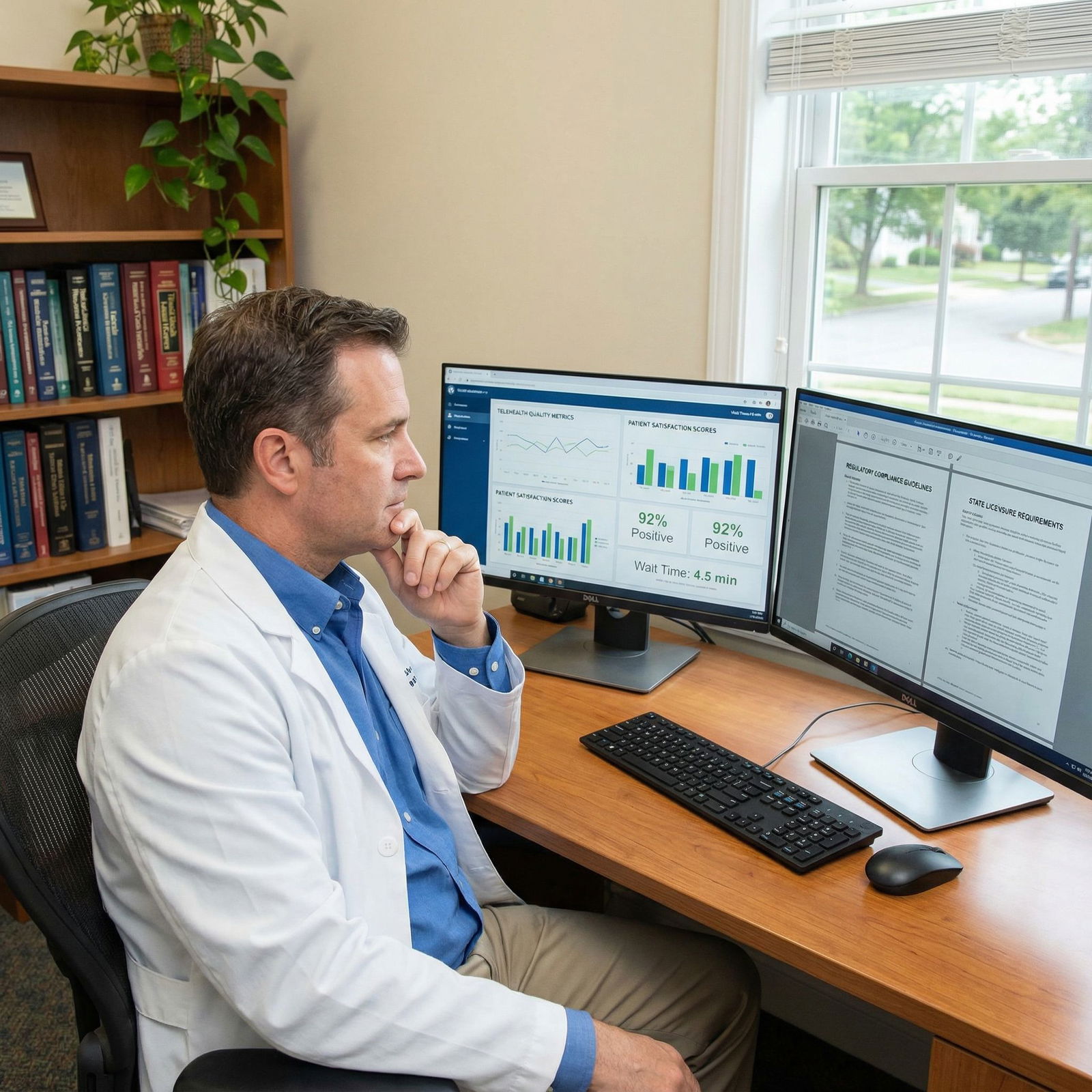
Think of it less like “exam” and more like guided observation + patient‑assisted maneuvers.
Concrete examples:
Abdominal pain:
You don’t just say, “Where does it hurt?” You say, “Take your fingers, push gently starting here on the left side, move slowly toward the right. Tell me exactly when it gets worse.” You watch their face. You ask them to jump, cough, change positions. Are they guarding even when they try not to?Neuro:
You don’t settle for “any weakness?” You say, “Stand up (with someone nearby if needed), walk to the other side of the room, turn, walk back. Now close your eyes, hold your hands out like this.” You have them smile, raise eyebrows, stick out tongue. It’s crude, but you can see asymmetry.Child with fever:
You watch how they interact with the parent. Are they listless, not making eye contact? Or trying to grab the phone? You listen to the sound of the cough. You look at their work of breathing — supra‑ and subcostal retractions, nasal flaring, belly breathing.
Is it perfect? No. Can it be safely combined with good history and a low threshold to escalate? Yes. That’s the point.
The key mental shift: you stop pretending you’re doing a normal physical exam. You’re doing a telehealth exam, with its own strengths and limits. You document the hell out of what you see and what you couldn’t assess.
Documentation as Your Lifeline, Not Just Annoying Clicks
Here’s the part that quietly protects telemedicine doctors from “video misdiagnosis” disasters: explicit documentation of uncertainty and limitations.
This is where many anxious new tele‑docs mess up. They under‑document because “it was just a simple visit.” Then they panic later: “Did I miss something huge?”
The seasoned folks do this instead:
They spell out:
- What they could not assess (no vitals, no in‑person exam, limited view of rash, etc.)
- What they explicitly warned the patient about (red flags, when to go to ED)
- Why they chose a particular path (e.g., “Given lack of alarming symptoms, stable appearance on video, patient preference, and ability to return/seek urgent care, will trial X with strict precautions.”)
So if a case is reviewed 6 months later, the question isn’t “Why didn’t you magically know?” but “Did you act reasonably with what you had?” That’s the standard. Not omniscience.
| Aspect | Telemedicine Emphasis |
|---|---|
| Physical exam | What you SEE and can guide |
| Limitations | Explicitly listed |
| Safety netting | Very detailed |
| Shared decision making | Clearly documented |
| Follow-up plan | Concrete, time-bound |
If you’re the kind of person who already obsesses over your notes and covers your bases — weirdly, telemedicine might suit you better than chaotic clinic did.
How Malpractice, Protocols, and Systems Actually Protect You
You’ve probably imagined the board hearing scenario where you’re alone in front of a panel and they’re like, “Doctor, why didn’t you order a CBC through the screen?”
Reality is less dramatic and more boring.
Most established telemedicine jobs:
- Carry malpractice insurance tailored to telehealth
- Have clear protocols for high‑risk complaints
- Run quality assurance on random charts and coach you early if you’re under‑escalating
- Restrict what you’re allowed to do (e.g., no chronic opiates, tightly limited benzos, strict antibiotic criteria)
You’re not freelancing in the void. You’re working inside a set of constraints that are there partly to keep you from getting destroyed by exactly the kind of “what if I miss something” cases you’re obsessing over.
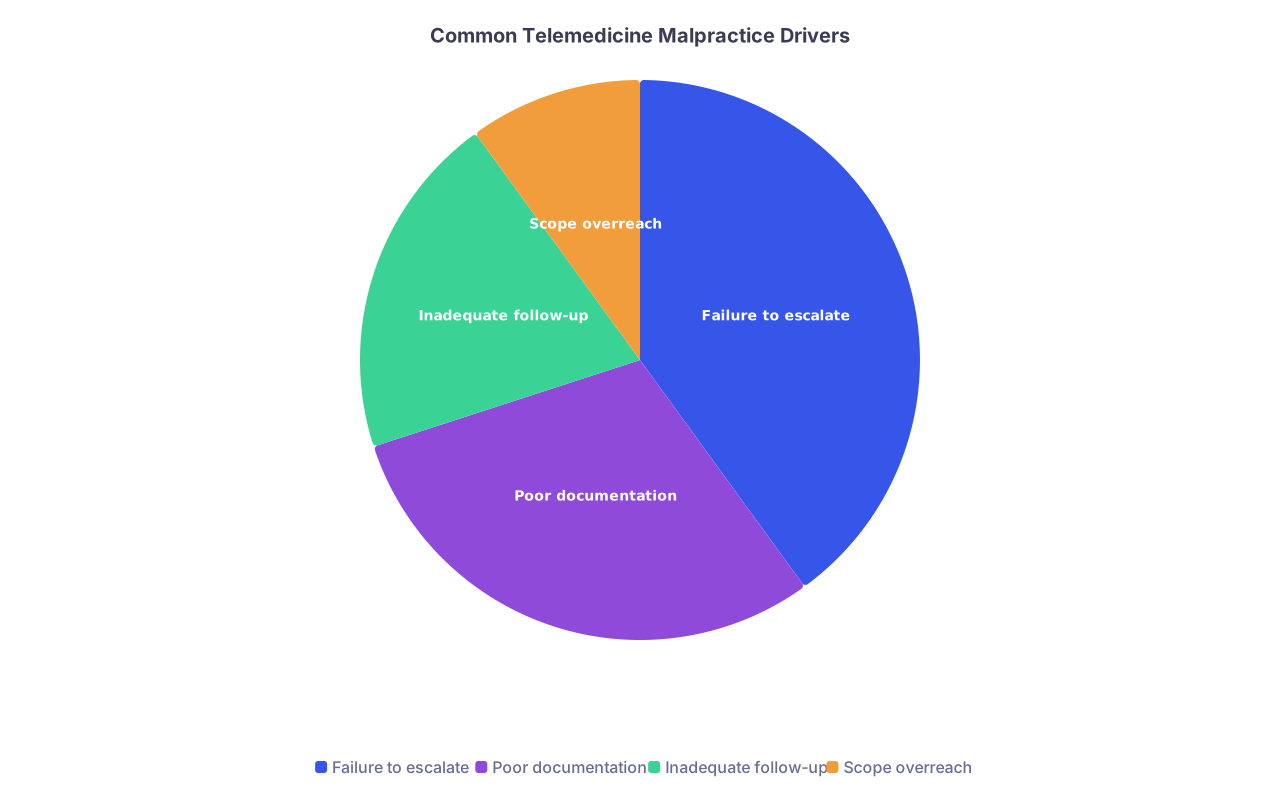
| Category | Value |
|---|---|
| Failure to escalate | 40 |
| Poor documentation | 30 |
| Inadequate follow-up | 20 |
| Scope overreach | 10 |
Look closely at that breakdown:
- It’s not “didn’t guess rare disease correctly on video.”
- It’s very basic stuff: didn’t send them in when you should have, didn’t document why you made the decision, didn’t make sure they knew what to do if worse.
That’s uncomfortable — because it’s totally preventable. But also reassuring — because it’s not about being some diagnostic savant. It’s about being cautious and transparent.
If your default worry is “Is this safe?” instead of “How fast can I clear this queue?” — you’re already more aligned with what these companies want than half the burned‑out docs out there.
How to Decide If You Can Tolerate Telemedicine Uncertainty
Let’s be honest. Some people shouldn’t do telemedicine.
If you need to touch every patient to feel okay, or you spiral for days about any “what if,” you might be miserable in a pure telehealth role. The job will poke every anxiety you’ve been repressing since intern year.
But your fear by itself doesn’t mean you can’t handle it. It means you care about not harming patients. That’s a good starting point.
Here’s a quick gut‑check set of questions:
- When you were on nights as a resident, and you had to make decisions over the phone — could you do it, even if you hated it?
- Did you learn how to give clear “come back if X” instructions in clinic, or did you always avoid that conversation?
- Can you live with saying, “I don’t have enough information, so we’re going to choose the safer but more inconvenient option”?
If your honest answers are: “Yeah, I could do phone triage,” and “I do talk through red flags,” and “I’d rather be safe than sorry even if it annoys people” — you’re actually wired for telemedicine.
If your brain is screaming, “But what if I still miss something?” — welcome to the club. We all think that. The difference is, experienced tele‑docs don’t treat that fear as a sign they’re incompetent. They treat it as a signal to slow down, document more, or escalate.
FAQ: Your 3 a.m. Telemedicine Anxiety Questions, Answered
1. What if I miss something serious because I couldn’t examine them properly?
You will miss things in your career — telemedicine or not. The standard you’ll be judged on isn’t “Did you miss anything ever?” It’s “Were your decisions reasonable given the information and tools you had?”
If you clearly document what you could and couldn’t assess, warn about specific red flags, and escalate liberally when things don’t feel right, you’re acting within that standard. That’s exactly how telemedicine doctors manage the fact that some subtle findings just aren’t available on video.
2. What if a patient lies or minimizes symptoms to avoid the ER, and I believe them?
That happens in person too. In telemedicine, you protect yourself by:
- Asking the same question different ways
- Watching for mismatch between words and appearance
- Making it crystal clear in your documentation: “Advised ED evaluation; patient declined; discussed risks including X, Y, Z.”
You can’t control their choices. You can control making the risk real and traceable in the chart. That’s what experienced tele‑docs do instead of trying to out‑guess every possible lie.
3. Are telemedicine doctors sued more because of misdiagnosis?
Current data doesn’t show telemedicine as some malpractice apocalypse. The risk tends to be comparable when systems are well designed. The big drivers are usually: failure to escalate, poor documentation, and sloppy follow‑up.
So no, you’re not automatically walking into a legal minefield just by turning on a webcam. You’re at risk if you ignore protocols, downplay your uncertainty, or try to manage things remotely that obviously need in‑person care.
4. How do telemedicine doctors sleep at night with all this uncertainty?
They build habits that contain the anxiety. Things like: strict personal rules for escalation, detailed red‑flag counseling, and brutally honest documentation of limitations. Over time, your brain learns: “I did what was reasonable. I didn’t ignore my worry. I gave a clear plan.”
Do the anxiety spikes go away completely? Not really. But they stop controlling you. It becomes background noise instead of a constant alarm.
5. Is it unsafe to work for high‑volume tele‑urgent care platforms?
It depends on how desperate they are for speed and how ruthless you’re willing to be about safety. Some places push fast visits but still back you up for escalations. Others quietly punish “over‑triaging.”
If a job makes you feel bad for sending people to urgent care or ED when you’re legitimately uncertain — that’s not a good telemedicine job. That’s a liability farm. The responsible platforms would rather lose a few impatient customers than keep a doctor who’s too scared to escalate.
6. How can I test if telemedicine is right for me before committing full‑time?
Look for:
- Per‑diem tele‑urgent roles
- Hybrid clinic jobs with some telehealth sessions
- Hospital systems using video triage or follow‑ups
Do a few shifts. Pay attention not just to the medicine, but to how your nervous system reacts. Are you anxious but functional, or flooded and frozen? Do you feel better when you stick to clear rules — escalate early, document thoroughly — or does it never feel “safe enough” no matter what?
If you want a concrete step you can take today: pull up a few of your old complex clinic notes and rewrite one as if it were a telemedicine visit — explicitly listing what you couldn’t examine, what red flags you’d warn about, and when you’d escalate. That exercise alone will tell you a lot about how you’ll handle uncertainty on video.