
Group Study for Step 1: Helpful Strategy or Productivity Trap?
Why do so many people swear that “our Step 1 study group saved me” while others quietly say, “I stopped going and my score jumped 20 points”? Both groups think they’re right. They can’t both be.
Let me be blunt: most Step 1 “study groups” are social coping mechanisms wearing an academic costume. They feel productive. They rarely are.
But that does not mean group work is useless. It means the way most people do it is garbage.
Let’s separate myth from data, and anecdotes from what actually moves your Step 1 score.
What the Evidence Actually Says About Group Study
There isn’t a giant randomized trial titled “USMLE Step 1: Group vs Solo Study.” But there is plenty of relevant cognitive science on learning, memory, and collaboration. And there is survey data from medical students.
Here’s the pattern across multiple domains:
Testing yourself improves retention much more than rereading or passive review.
Repeated finding. Practice questions, self-testing, and active recall outperform “discussing content” or listening to others talk.“Collaborative learning” helps when it’s structured, limited, and focused on problem solving.
Even in undergrad studies, unstructured groups often end up in off-topic chatter and social loafing. Structured tasks with clear goals work better.Social accountability can increase time spent, but not necessarily quality of learning.
You might show up more consistently, but if the session is inefficient, you’re just more consistently wasting time.
Let’s anchor this with Step-style behavior.
Most people who “study in groups for Step 1” are doing some version of this:
- Sitting around a table with UWorld open.
- Someone reads a question out loud.
- People shout out answers.
- One or two people explain their reasoning.
- The group collectively clicks an answer.
- Then they debate minutiae in the explanation.
It feels active. It feels smart. It often isn’t.
Here’s why: the individual cognitive effort is diluted. You lean on whoever’s fastest or loudest, and your brain goes into spectator mode. You’re not fully predicting, committing, and being wrong on your own. That’s what drives learning.
Compare that to doing a block solo, timed, no distractions, then brutally reviewing your own errors. Very different brain state.
So yes, group learning can be helpful. But only if it preserves the core driver of Step 1 improvement: individual active retrieval, repeated, with feedback.
The Myths About Step 1 Group Study
Time to break the sacred cows.
Myth 1: “Everyone I know who scored 250+ was in a study group”
No. Many high-scorers avoid study groups like contagion. They might have had targeted group sessions (e.g., weekly pathology review, anki sync session), but their core grind? Solo. Headphones on. UWorld alone.
This survivorship bias is predictable. The people who love talking about “our study group” are… the people who had a good social experience. People who quietly crush 8 hours of solo questions don’t form a club about it.
More importantly, even when high-scorers do use groups, that does not mean the group caused the score. Usually the correlation is this:
- Strong baseline students
- High personal discipline
- Use groups as a small supplement, not the main dish
The group is dessert. Not the calories.
Myth 2: “Group study keeps me accountable, so it must be good”
Accountability is a double-edged sword. If the structure is bad, you’re being held accountable to the wrong thing.
If your group “meets daily” but:
- Starts 20 minutes late
- Spends 15 minutes deciding what to do
- Takes “quick breaks” that stretch
- Gets derailed arguing about one explanation for 25 minutes
You’re very accountable… to losing 2–3 hours a day.
I’ve watched this play out over and over. One student quietly bows out of the group after week 1. People whisper that they’re being “antisocial” or “overly intense.” They show up on exam day with a significantly higher score. Not magic. Just math.
Myth 3: “We learn better by teaching each other”
Sometimes. When done right.
Teaching can be powerful. But the research is clear: the benefit comes from the preparation and the effort you expend to organize and explain, not from sitting in a room while others talk.
So yes, if you’re assigned “You’re covering nephritic vs nephrotic tomorrow, teach it in 10 minutes”—and you spend an hour the night before making a concise, high-yield explanation—that can cement your understanding.
But what most “teaching each other” looks like in Step groups is this:
- One person monologues off the top of their head.
- Everyone else nods vaguely and half-zones out.
- Nobody writes anything down.
- It never gets tested again.
That’s performance. Not learning.
If teaching is going to help you, you need to be slightly uncomfortable. Unsure. Forced to clarify, compress, and be corrected. Informal rambling doesn’t do that.
When Group Study Helps for Step 1 (And When It Clearly Hurts)
Let’s stop pretending there’s one answer here. Group work can be a weapon or an anchor. The question is how you use it.
The Situations Where Group Study Actually Helps
There are a few clear use-cases where the data and my real-world experience align:
Clarifying truly confusing concepts
One hour with a sharp classmate explaining renal physiology can save you five hours of solo flailing. The point is precision: you’re coming in with specific questions, not “let’s just go over renal.”Accountability for discrete tasks
Meeting 3x/week for 60 minutes, all doing timed individual UWorld blocks in silence (with phones away), then spending 20–30 minutes max reviewing key questions together. That can work.Coaching on strategy, not content
Debriefing: “How are you approaching multi-step questions? What’s your timing? How are you integrating Anki with UWorld?” Strategy discussions are high-yield, and you do not need 4 hours for them.Targeted, time-limited “teach back”
Example: Each person gets a micro-topic (e.g., “Type II hypersensitivity,” “MEN syndromes,” “Strep vs Staph differentiators”) and has exactly 5 minutes to explain as if writing a perfect Step question stem. Stopwatch on. No rambling.
This is hard. That’s exactly why it cements knowledge.
In those scenarios, the group is an amplifier. Not a distraction.
Now look at how those differ from what most people actually do.
The Classic Productivity Trap Version of Group Study
If your Step 1 study group looks like any of this, you’re in the danger zone:
- Meeting “whenever,” often 3–5 hours at a time.
- Vague goals like “cardio day” or “let’s get through 40 questions together.”
- People rolling in late, food runs mid-session, constant phone checking.
- One or two students dominating; others barely talking.
- No one tracking individual performance or question accuracy.
That’s not a study group. That’s time leakage with textbooks.
And here’s the uncomfortable part: for some of you, this is emotionally useful. It feels less lonely. It soothes anxiety. You feel like you’re “in it together.”
But then don’t lie to yourself and call it a high-yield Step 1 strategy. Call it what it is: emotional support with a thin academic layer. If your score matters, you adjust accordingly.
The Real Tradeoffs: Personality, Baseline, and Risk
Let’s talk about you. Not “students in general.”
If you’re generally strong and self-directed
You likely benefit more from mostly solo study, with small doses of group work:
- Quick, focused sessions to clarify hardest topics
- Occasional teaching to lock in material
- Strategy check-ins so you’re not reinventing the wheel
Your biggest risk is time dilution—letting other people’s anxiety or inefficiency drag your schedule off course.
If you struggle with structure or motivation
Here’s where group study can be either your savior or your coffin.
If you’re weak in self-discipline, a tight, rules-based group (silent individual questions, strict time limits, clear objectives) can get you to do the work you would otherwise avoid.
But an unstructured group is exactly what you don’t need. It lets you pretend you’re working while avoiding real accountability for your own scores, your own weaknesses, your own question performance.
You need more individual data, not less.
A Harder Look: Solo vs Group Efficiency
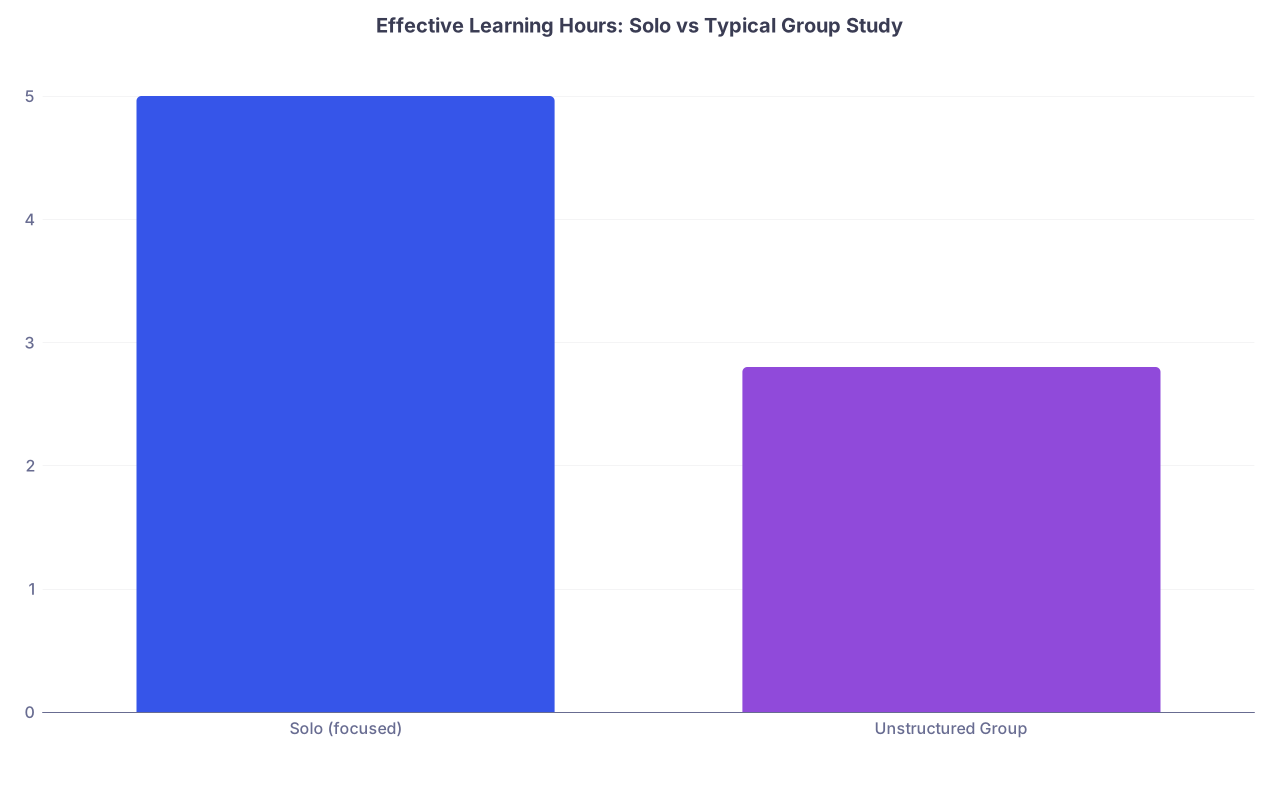
Let’s put numbers to this. Imagine two students with a 6-hour daily dedicated window.
| Category | Value |
|---|---|
| Solo (focused) | 5 |
| Unstructured Group | 2.8 |
This is what I actually see when I deconstruct people’s days:
The focused solo student:
- 3–4 hours of timed, serious questions
- 1–2 hours of targeted review / Anki / reading
The typical group student:
- 2 hours in group: maybe 60–80 minutes of real cognitive effort, rest is drift
- 2–3 hours solo but unfocused and tired
Total “deep work” time? Often cut in half by the group.
You cannot compensate for bad structure with more hours. At some point, you’re just more exhausted and less precise.
If You Insist on a Step 1 Study Group, Do This Instead
If you’re going to do group study anyway, at least make it sane.
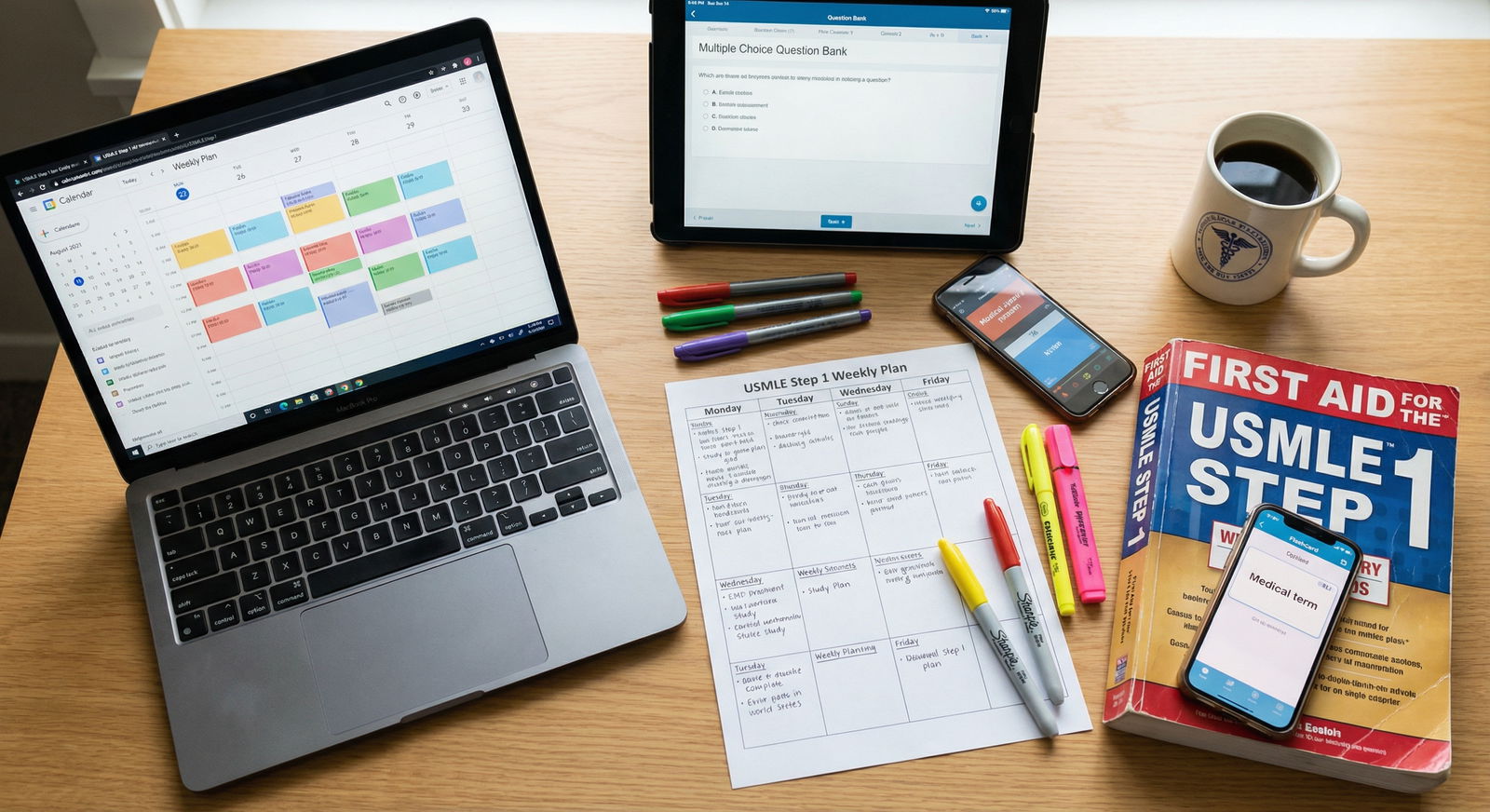
A bare-minimum functional model:
- Limit it to 2–4 people. Beyond that, it turns into a seminar or a circus.
- Set a fixed start and end time. Example: 6–8 pm, three nights a week. Not negotiable.
- Define the task before you show up. “Each of us does 20 timed endocrine questions solo. Then we pick the 3 hardest per person to discuss.”
- Absolutely forbid phones, side browsing, and social breaks during the set time. You want conversation? Do it after.
- Stop on time, even if you’re “in a good discussion.” Scarcity forces focus.
Compare two models side by side:
| Feature | High-Yield Model | Trap Model |
|---|---|---|
| Group Size | 2–4 | 5+ |
| Duration | ≤ 2 hours | 3–5 hours |
| Task Type | Timed Qs + hard spots | General content review |
| Structure | Pre-defined, strict | Vague, flexible |
| Role of Socializing | Before/after only | Mixed throughout |
| Metric of Success | Individual performance | “Time spent together” |
You don’t need perfection. You need enough structure that your brain doesn’t slip into passive mode.
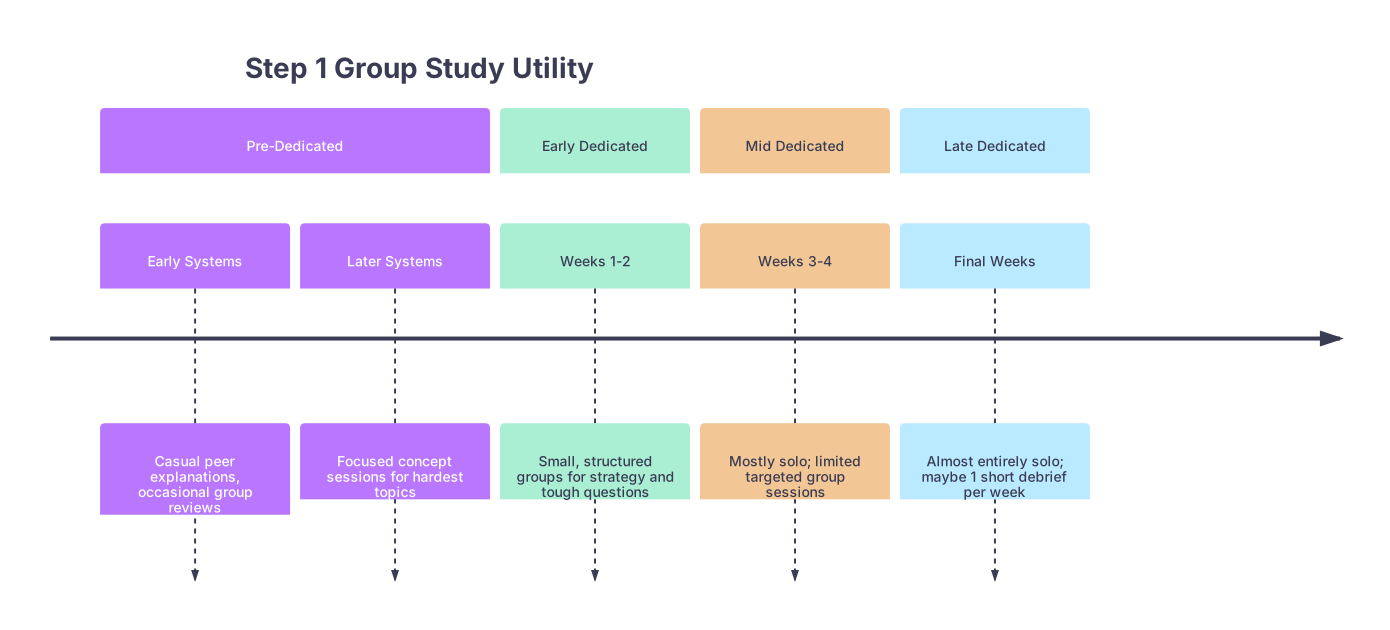
A Smarter Timeline: How Group Study Should Evolve
Here’s how I’d handle group work across the Step 1 prep timeline.
| Period | Event |
|---|---|
| Pre-Dedicated - Early Systems | Casual peer explanations, occasional group reviews |
| Pre-Dedicated - Later Systems | Focused concept sessions for hardest topics |
| Early Dedicated - Weeks 1-2 | Small, structured groups for strategy and tough questions |
| Mid Dedicated - Weeks 3-4 | Mostly solo; limited targeted group sessions |
| Late Dedicated - Final Weeks | Almost entirely solo; maybe 1 short debrief per week |
Pre-dedicated:
Fine to have occasional group reviews—especially for things like neuroanatomy or renal that many people find opaque. Just don’t confuse this with “Step 1 prep.” It’s laying foundation.
Early dedicated:
Maybe you meet with 1–2 peers to lock in your routine and share strategies. You try a few group question sessions and see if your personal efficiency goes up or down. Be honest with yourself.
Mid to late dedicated:
This is where most people need to go heavily solo. The game is granular weakness targeting now: weird biochem pathways, your nemesis cardio questions, your timing holes. That’s solo work.
A brief, weekly check-in can help for sanity. But your score ceiling is being set by how ruthlessly you attack your own specific deficits—not by how connected you feel.
The Bottom Line: Is Group Study for Step 1 Helpful or a Trap?
Two things can be true:
Most Step 1 study groups, as they’re actually run, are productivity traps. They’re unfocused, socially driven, and give a false sense of accomplishment.
Well-designed, tightly structured, time-limited group sessions can be a useful supplement. Not the main strategy. A supplement. For specific pain points.
So if you remember nothing else:
- Your Step 1 score is built on individual active practice and feedback, not group attendance.
- Treat group study like a drug with side effects: low dose, clear indication, stop if it harms performance.
If your “study group” disappeared tomorrow and your productivity would go up, you already have your answer.