
What happens when your brain just doesn’t study like everyone else’s, but Step 1 still expects you to?
You’re watching classmates crank through 80-question blocks like it’s light cardio, and you’re sitting there thinking: “I can barely get through 20 without my brain fogging out. Am I screwed?”
You are not screwed.
But you are in a different situation than many of your classmates. And pretending otherwise is how people with learning disabilities get flattened by Step 1.
Let me lay this out bluntly:
If you have ADHD, dyslexia, processing speed issues, or another learning disability, your Step 1 prep plan cannot be a copy‑paste of your neurotypical classmates’. You need:
- The right accommodations – at your school, on NBME practice exams, and on the actual Step 1.
- A different way of structuring time, energy, and content – that works with your brain, not against it.
- A realistic floor, not fantasy expectations based on what “everyone else” is doing.
We’ll go through both: what to get (accommodations) and what to do (tactics).
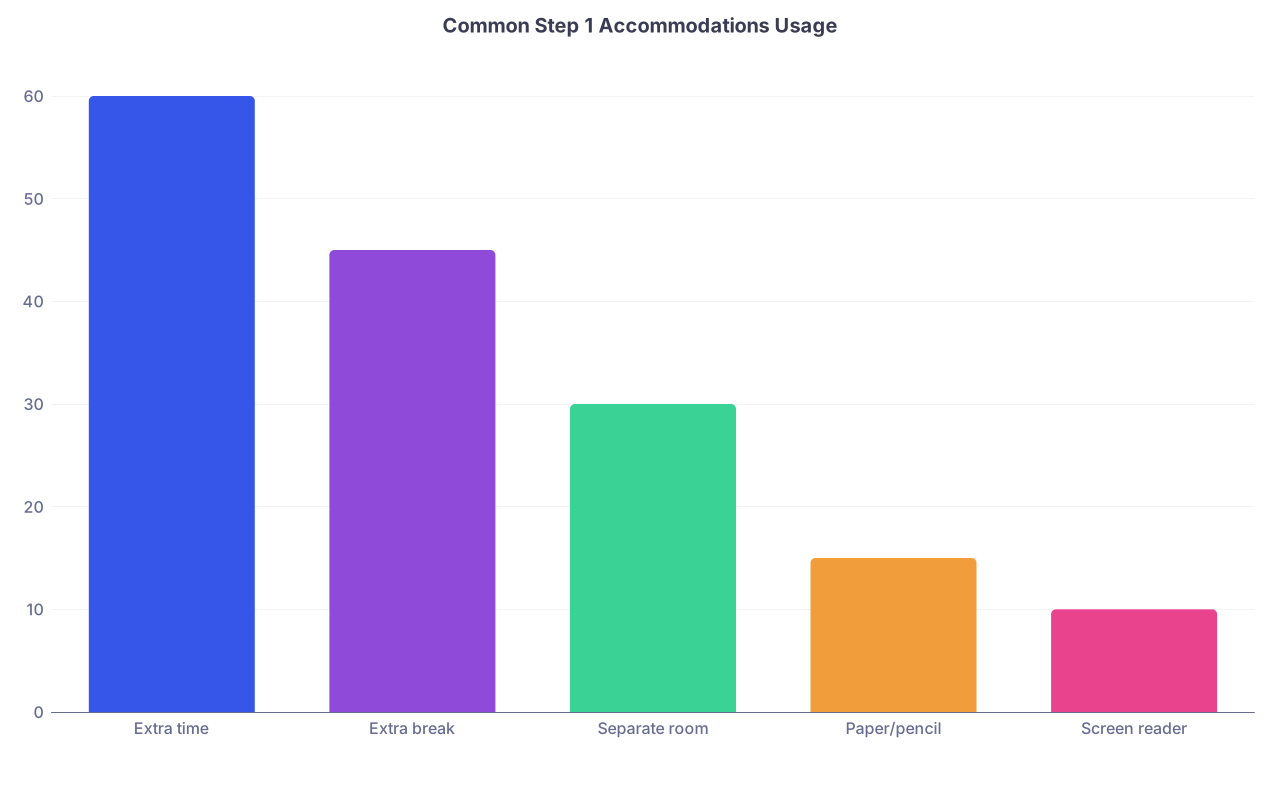
| Category | Value |
|---|---|
| Extra time | 60 |
| Extra break | 45 |
| Separate room | 30 |
| Paper/pencil | 15 |
| Screen reader | 10 |
Step 1 accommodations: what to ask for and when to start
If you remember nothing else from this section, remember this:
If you need accommodations, you are already behind if you haven’t started the process. The paperwork is slow, annoying, and very bureaucratic.
1. Step 1 accommodations you can actually request
The NBME has a menu. You don’t have to guess. Common ones:
- Extended time: usually +25% or +50% time
- Extra break time
- Separate/quiet testing room or reduced-distraction setting
- Permission for:
- Earplugs / noise‑canceling headphones (sometimes only their provided ones)
- Medication, snacks, or blood glucose monitoring in the room/break area
- Paper and pencil or erasable noteboard beyond the usual
- Screen reader or other assistive tech (for certain visual or reading disabilities)
What you request should match your documented disability and your history.
If you’ve never had extended time for anything in your life and suddenly ask for 50% extra for Step 1, they’re going to look at that sideways.
2. How to make your case stronger (and avoid a denial)
NBME is bureaucratic, not compassionate. They respond to:
- Documentation from a qualified professional
- Neuropsych eval with cognitive/achievement testing
- Recent is better (within 3–5 years is ideal)
- History of accommodations
- High school and college IEP/504
- MCAT accommodations
- Med school exam accommodations
If you’re missing that history, you’re not dead in the water, but you’ll need stronger current documentation.
If you’re reading this and thinking, “I’ve never been formally evaluated, but I’m struggling like hell” – then your next step is not another UWorld block. It’s:
- Email student affairs or disability services.
- Get a referral for formal testing (yes, expensive; sometimes partially covered, sometimes your school has a list with discount rates).
- Start that process months before you plan to sit for Step 1.
Real timeline I’ve seen multiple times:
- Month 0: Student finally admits “I need help.”
- Month 1–2: Psych testing scheduled and completed.
- Month 3: Report finalized.
- Month 3–4: Accommodation application submitted to NBME.
- Month 5–6: Decision, sometimes with request for more documentation.
That’s half a year. If your dedicated period starts in April and you begin this in March, you’re already cooked for this test date.
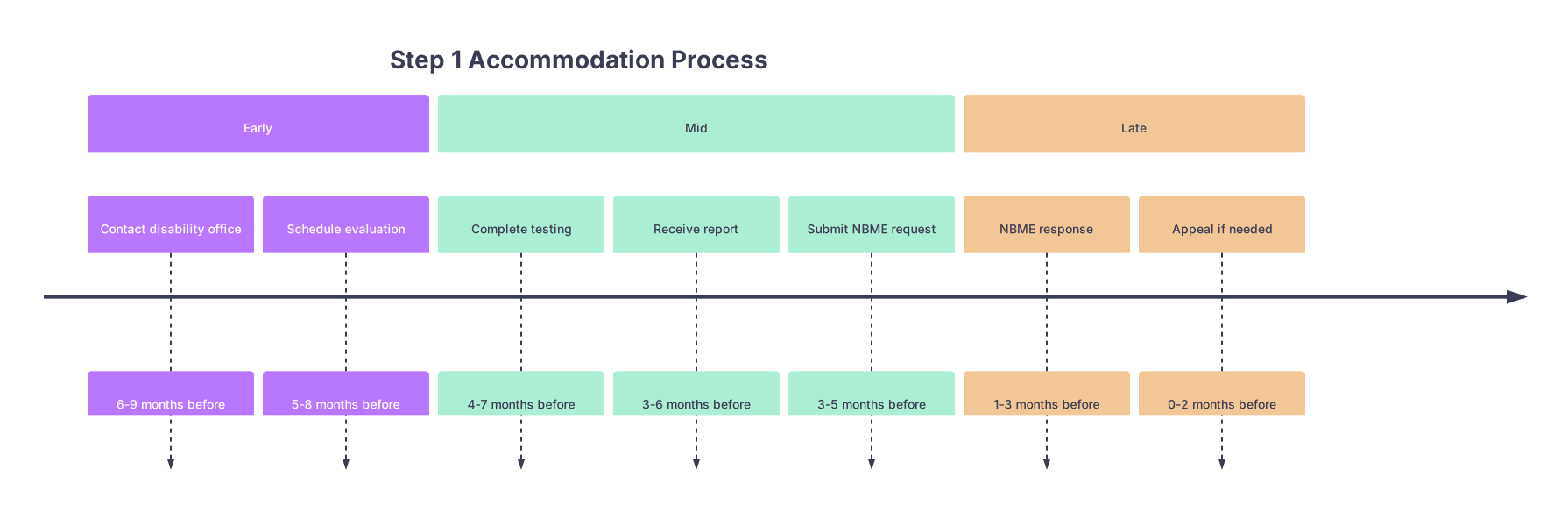
| Period | Event |
|---|---|
| Early - Contact disability office | 6-9 months before |
| Early - Schedule evaluation | 5-8 months before |
| Mid - Complete testing | 4-7 months before |
| Mid - Receive report | 3-6 months before |
| Mid - Submit NBME request | 3-5 months before |
| Late - NBME response | 1-3 months before |
| Late - Appeal if needed | 0-2 months before |
If your school is the bottleneck (and how to push back)
Here’s the ugly part: some schools are quietly hostile to accommodations. They won’t say that out loud; they’ll just “drag their feet” and “lose paperwork.”
If you’re seeing this behavior:
- Emails go unanswered for weeks.
- You’re told, “Let’s see how you do on the next exam first.”
- Someone implies accommodations are “unfair” or “won’t help you on boards anyway.”
Then you’re not dealing with a neutral system. You’re dealing with institutional resistance.
Tactics that actually move things:
Put everything in writing.
After any in-person conversation, send an email:
“As discussed today on [date], we agreed that I would be evaluated for [condition] and that disability services would…”.
This creates a paper trail.Use specific language tied to function and risk.
Not “I feel stressed and behind.”
Try: “Without formal evaluation and accommodations, I am unable to complete timed exam blocks and this puts my academic progress and eventual Step 1 attempt at risk.”Ask for concrete timelines.
“By when can I expect the referral to be sent?”
“What is the typical waiting time for evaluation?”
“What date should I follow up if I do not hear back?”Escalate calmly but directly if you’re stonewalled.
- Start: disability services / learning specialist
- Then: student affairs dean
- Then: ombuds office or equivalent if your school has one
You’re not being difficult. You’re protecting your ability to sit for the single exam your entire preclinical life is structured around.
How to study when you have ADHD, dyslexia, or processing speed issues
Now let’s talk tactics. Because even with perfect accommodations, Step 1 prep can wreck you if you study like everyone else.
I’ll break it down by common patterns I’ve seen.
A. If you have ADHD (or ADHD‑ish symptoms)
Your main enemies:
- Long, unstructured time blocks
- Boring resources
- Infinite digital distractions
- The fantasy that “tomorrow I’ll be focused”
Do this instead.
1. Short, structured work intervals
You’re not going to sit for 6 hours and “grind.” Stop pretending.
Use 25–45 minute blocks:
- 25–35 minutes: active work (questions/cards)
- 5–10 minutes: break (but controlled – bathroom, stretch, quick snack, not TikTok black hole)
For long days, think in “blocks,” not hours. Example for dedicated:
- 3 blocks morning (Qbank + review)
- 2 blocks afternoon (content review/video)
- 1–2 lighter blocks evening (Anki, sketchy-ish, low cognitive load)
That’s 6–7 blocks. More than enough if done consistently.
2. Question-first, not content-first
With ADHD, passive reading is death. Your brain checks out.
Structure days like this:
- Start with questions (UWorld, NBME, AMBOSS)
- Use the results to decide what to review
- Then targeted content (Boards & Beyond, Pathoma, Sketchy, First Aid, etc.)
No more “I’ll read all of cardio then do questions later.” You won’t.
3. Physical environment hacks that actually help
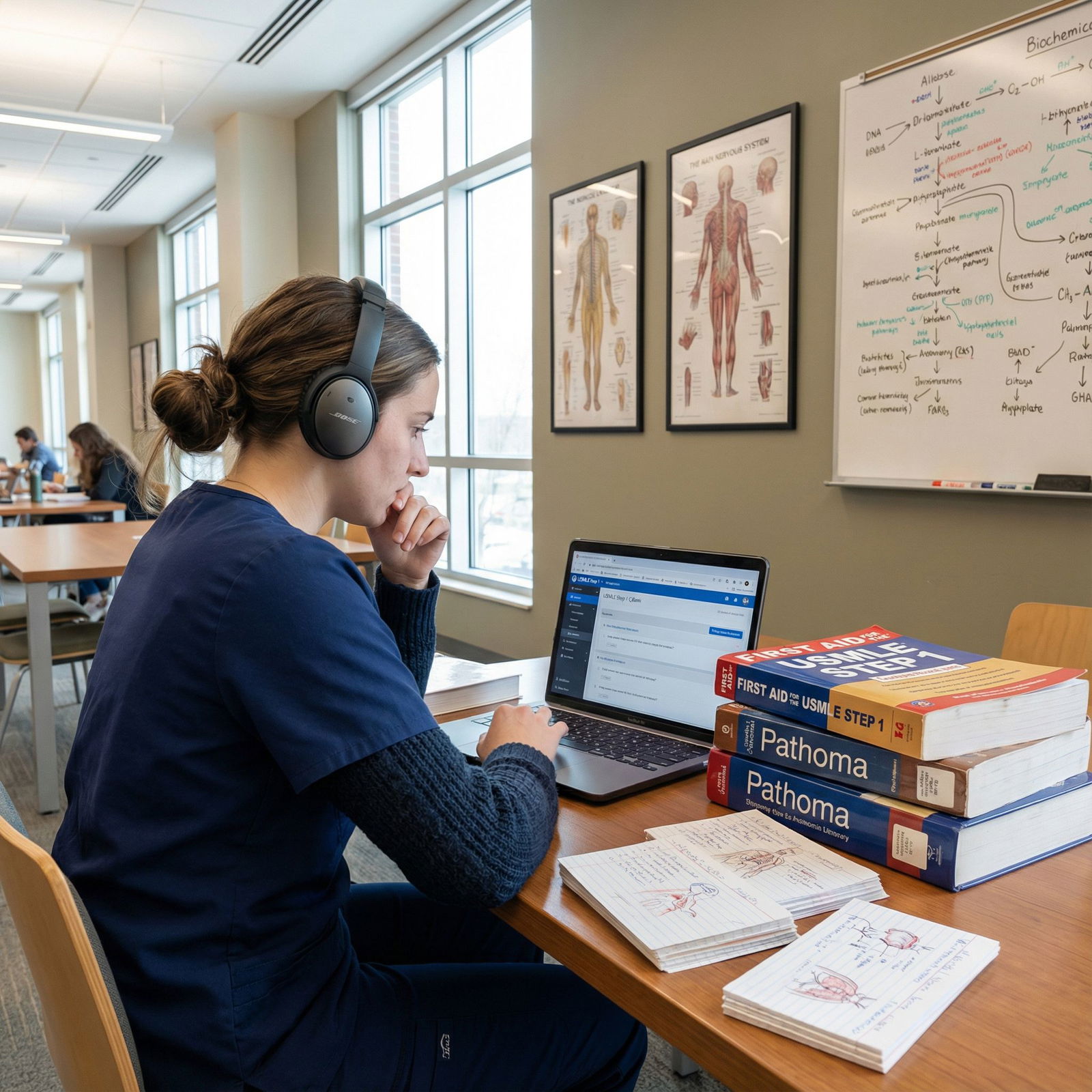
- One primary study location with no TV, no bed, no couch. Library carrel, school study room, or one boring desk.
- Keep your phone out of reach and out of sight. Not face down. Physically somewhere else.
- Use website blockers (Cold Turkey, Freedom, StayFocusd) for your worst sites during blocks only, not 24/7. You’re not trying to become a monk. Just functional.
B. If you have dyslexia or reading speed/comprehension issues
Step 1 is text‑heavy. You’re not imagining it. The volume will bury you if you try to read everything the same way as classmates.
You need to prioritize:
- Audio + visual learning where possible
- Boards & Beyond / Sketchy / Pathoma / Pixorize – whatever you actually stick with
- Use audio speed that keeps you engaged, even if you pause often
- Text only for targeted reinforcement
- Not cover‑to‑cover First Aid reading marathons. That’s a trap.
Concrete tactics:
For UWorld:
- Do smaller blocks (10–20 questions) so you can really read them carefully
- Toggle font size up. Use highlighting sparingly – emphasize key clues, not whole paragraphs.
- Consider reading the last line first (the question stem), then scan for relevant info. Reduces re‑reading.
For content:
- Watch the video first.
- Then use text (First Aid / review book) to build a short, handwritten or typed outline.
- Keep outlines brutal: only what you’d need to recall key frameworks, not every detail.
If you qualify for screen readers or text-to-speech, use them consistently during prep, not just on the real exam. You don’t want exam day to be the first time you’ve processed Qbank-like material that way.
Building a Step 1 schedule that respects your brain, not Instagram
The worst thing you can do is pull some random Reddit “8-week schedule” and try to force your brain through it.
You have three constraints:
- Cognitive stamina (how long you can work before quality tanks)
- Processing speed (how much you can reasonably cover per day)
- Recovery needs (how many off-ramps you need to not burn out)
Let’s sketch a realistic structure for someone with a learning disability.
1. Decide your realistic number of daily high‑quality hours
Not “ideal you.” Actual you on a Wednesday in February.
For many students with LD or ADHD, this is 4–6 real hours of work. That’s not lazy. That’s your honest bandwidth.
4–6 real hours = usually 6–8 blocks of 25–35 minutes.
If you aim for 10 and hit 4, you feel like a failure.
If you aim for 5 and hit 4 most days, you’re fine and you’re consistent.
2. Prioritize question practice earlier than your peers
Students with processing issues need more repetitions with question stems.
I’d rather see you:
- Start UWorld earlier, go slower, and circle back
than - Start late, and try to do 80–120 questions/day with rushed, shallow review.
Example structure for a 10–12 week dedicated:
- Weeks 1–4
- 20–30 questions/day, untimed or tutor mode
- Heavy review, shorter content blocks
- Weeks 5–8
- 40–60 questions/day, mix of timed/tutor
- Targeted content for weakest systems
- Weeks 9–10+
- 40–80 questions/day, mostly timed blocks
- NBME practice exams every 1–2 weeks
If you have LD, that may sound “too slow” compared to your classmates. It’s not. Because your depth of review needs to be higher.
| Time | Task Type |
|---|---|
| 8:30–9:15 | Qbank block (10–15 Qs) |
| 9:20–10:05 | Review explanations |
| 10:15–11:00 | Qbank block |
| 11:05–11:45 | Review explanations |
| 1:00–1:45 | Video (system/topic) |
| 1:55–2:35 | Outline / notes |
| 3:00–3:30 | Anki / flashcards |
You stack 5–6 of those blocks and you’ve had a serious workday. You don’t need 14 hours.
How to use Qbanks and NBMEs when reading/processing is slower
You’re at a disadvantage if you approach questions the same way as someone with blazing reading speed. But you’re not outmatched if you change how you interact with them.
1. Untimed and tutor mode are not “crutches” – they’re training environments
For the first half of prep:
- Use untimed or tutor mode for a good portion of your blocks.
- Focus on:
- Extracting the core clinical scenario quickly
- Identifying the actual question being asked
- Then reasoning through answer choices
Speed comes after accuracy and pattern recognition.
If you try to build speed first, you’ll just codify your bad habits.
2. Your review matters more than your raw score
If you have LD, you might measure improvement differently:
Signals you’re improving even if percentages aren’t exploding:
- Fewer “totally blank” feelings when you see vignettes
- More questions where you narrow to 2 options and actually understand why you got it wrong
- You can explain a missed question to someone else without looking at the explanation
For review, instead of 5-paragraph notes (you’ll never reread them):
Try a tight error log with:
- Topic/system
- What kind of error it was (knowledge gap, misread question, attention lapse, forgot exception)
- 1 sentence: “Next time I see ____ I should think ____.”
Review that error log briefly every few days. That’s your personalized curriculum.
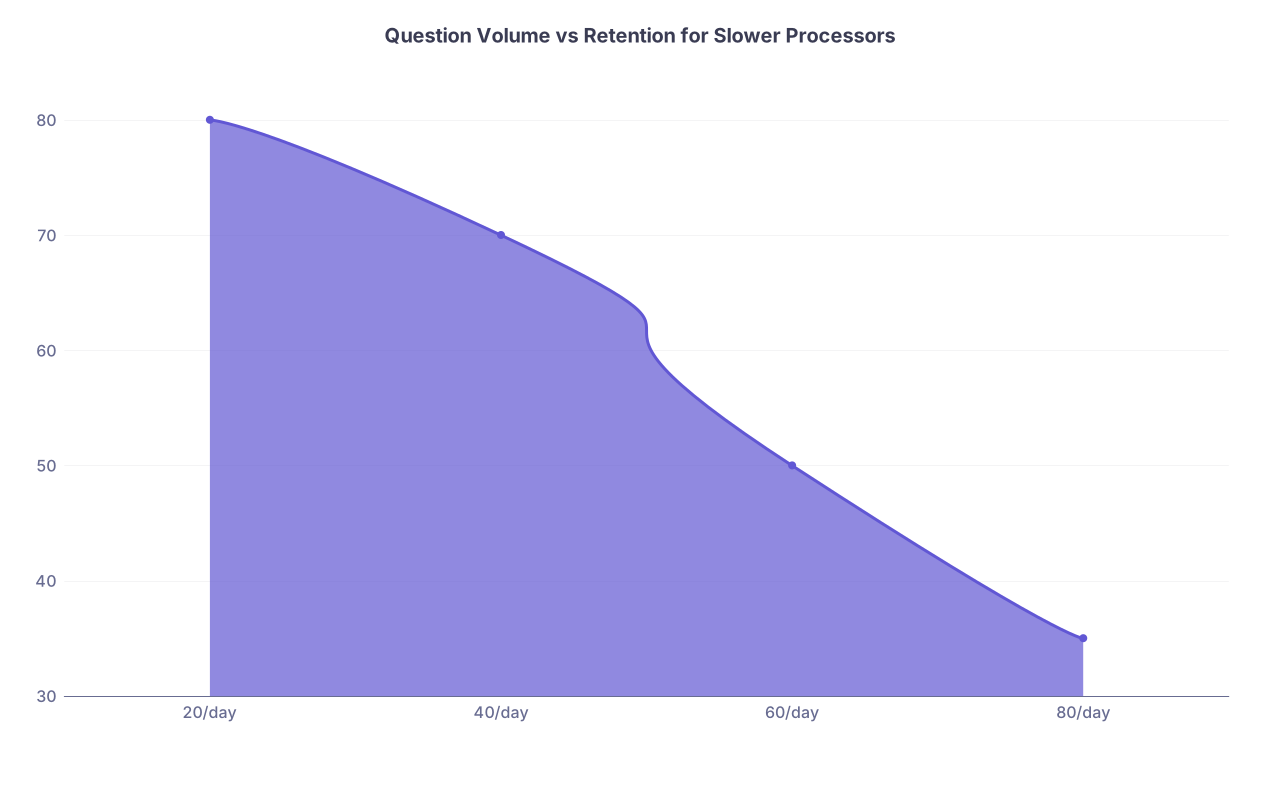
| Category | Value |
|---|---|
| 20/day | 80 |
| 40/day | 70 |
| 60/day | 50 |
| 80/day | 35 |
(Illustrative concept: for many students with LD, actual retention drops as daily question volume becomes unrealistic and review quality tanks.)
Energy management and burnout prevention when you already start closer to empty
Students with learning disabilities usually spend more cognitive effort just to keep up with baseline demands. Then Step 1 prep stacks on top of that. If you ignore energy management, you’ll flame out halfway through dedicated.
Here’s what I’ve actually seen work.
1. Pre‑schedule true zero‑work time
Not “breaks.”
True off time, where you’re not “kind of” studying.
- Minimum: half‑day off per week
- Better: one full day off every 1–2 weeks during dedicated
If that sounds impossible, you’re probably already in panic mode. The students who never take days off do not win some magical score bonus. They just break earlier.
2. Medication and sleep are part of your study plan
If you’re on stimulants or other meds:
- Align your heaviest, most cognitively demanding tasks (Qbank, NBME) with your peak medication window.
- Don’t waste that time on watching videos you could watch almost half-asleep.
For sleep:
- Non-negotiable: consistently 7+ hours. Not heroic 3–4 hour nights.
- Protect the same wake time daily as much as possible – your brain loves predictability.
You cannot brute‑force your way around poor sleep and a learning disability. You’ll just reinforce the story that you’re “not smart enough,” when in reality you’re just running half‑charged every day.

If you’ve already failed a school exam or NBME practice: how to recover without self-destruction
A lot of students discover their learning disability because Step 1 prep or preclinical exams go badly. That’s brutal, but it’s also a clear signal.
Scenario:
You take a school CBSE or NBME and your score report is ugly. Below-passing, maybe way below.
Here’s how to respond like an adult in a bad spot, not a panicked M2 with infinite guilt.
Stop hiding.
Tell your academic support office or student affairs what happened. Show them the score. Say, “I need a plan, because what I’m doing isn’t working.”Separate two questions:
- Do I have a content problem?
- Do I have a conditions problem? (untreated LD, no accommodations, impossible schedule)
You probably have both to some degree. But if conditions are bad enough, you’ll misinterpret everything as “I’m just not smart.”
Rebuild in smaller loops.
- Instead of “I’ll fix everything in 8 weeks,” think:
- “For the next 7 days, I’ll do X questions/day, Y content, and sleep like a human.”
- Then reassess. Short loops give you actual feedback and prevent spiraling.
- Instead of “I’ll fix everything in 8 weeks,” think:
Use a professional if you can.
Learning specialists who understand LD + med school are worth their weight in gold. If your school has one, use them. If not, there are external coaches (yes, they cost money; if family ever wanted to spend on something that actually matters, this is it).
What to do in the last 2–3 weeks before Step 1 with a learning disability
At this point, you’re not doing a personality transplant. You’re optimizing what you already are.
Focus on:
- Stabilizing your daily routine
- Wake time, first study block, mealtimes, wind-down time
- Mixed timed blocks that mimic the real exam
- If you have extra time accommodations, practice with that time extension
- NBME review over broad new content
- Go deep on why you missed what you missed
Do not:
- Suddenly double your question volume “to cram”
- Add 3 brand new resources you’ve never used before
- Slash sleep to make room for more content
If your practice scores are borderline and your disability/processing issues are clearly impacting performance, talk to:
- Your dean / academic support, and
- The person managing your accommodations
Sometimes the right move is a short postponement with a structured plan, not a Hail Mary attempt that leaves you burned out and possibly failing.

Final reality check
Three things I want you to walk away with:
You are not broken.
Your brain works differently, and Step 1 is built for a narrow slice of learners. That’s a design flaw in the system, not proof that you don’t belong in medicine.Accommodations are not a luxury; they’re a necessity if you qualify.
Start the process early, document everything, and push through institutional inertia. No one will care as much about your access as you do.Your strategy must fit your brain, not your classmates’ Instagram stories.
Short, focused blocks. Question-first learning. Realistic hours. Aggressive protection of sleep and energy. That’s how you win your version of this exam.
You don’t need to study like everyone else.
You need to study like someone who knows exactly how they work—and builds their Step 1 plan around that.