
The idea that one COMLEX Level 3 score can haunt your entire career is wildly exaggerated—but not completely false.
Let me be blunt: a low COMLEX Level 3 score is not the end of your fellowship dreams. But it can become a problem if
- it’s part of a bigger pattern, or
- you let the anxiety from it poison everything else you do.
You’re probably here because:
- You just got your Level 3 score and it’s lower than you wanted.
- You failed once and passed on a retake.
- Or you’re about to take it and spiraling about “what if I bomb and ruin my fellowship chances forever?”
Let’s walk through this like someone who’s seen a lot of residents spiral over exactly this.
How Much Do Fellowships Actually Care About COMLEX Level 3?
Short answer: much less than you think, but not zero.
Here’s the basic hierarchy for most fellowship programs (IM, cards, pulm/crit, GI, heme/onc, etc.):
| Priority Level | Factor |
|---|---|
| 1 | Residency performance (letters, evaluations) |
| 2 | Research / productivity |
| 3 | Reputation of residency program |
| 4 | Step/COMLEX scores (mostly 1 & 2) |
| 5 | COMLEX Level 3 / USMLE Step 3 |
Notice where Level 3 lives. Bottom of the list.
Program directors care about:
- Can you function as an independent fellow?
- Do attendings trust you?
- Are you reliable on call?
- Do you show curiosity, follow-through, and maturity?
COMLEX Level 3 is mostly:
- A box to check for licensing.
- A small extra data point for “test-taking ability” if they’re trying to interpret a weird pattern.
I’ve literally heard a PD say: “Once they’re in residency, I don’t lose sleep about Level 3 unless they keep failing it.”
So if your question is:
“Can a single low-but-passing Level 3 hurt my fellowship chances?”
Realistically: not much, if the rest of your application is solid.
When Can a Low Level 3 Score Actually Hurt You?
Let’s go through the worst-case scenarios you’re probably spinning in your head.
1. Multiple failures or repeated attempts
This is the one that really gets noticed.
- One fail then a pass? Annoying, but survivable.
- Two or more fails? Now programs start asking “What’s going on?”
They worry about:
- Test-taking weakness → future board certification risk.
- Underlying issues: poor work habits, chronic disorganization, burnout, life chaos.
But even here, context matters:
- Did something serious happen in your life? Illness, family emergency, postpartum, major depression?
- Did your other scores improve?
- Are your residency evaluations strong and consistent?
If you failed, be prepared to:
- Own it.
- Explain it briefly.
- Show clear improvement and stability afterward.
2. Pattern of low scores across all exams
One low Level 3 in a sea of decent scores? Barely a blip.
Low COMLEX 1, low 2, low Level 3, weak in-training exams? That starts to look like a pattern.
Fellowship PDs think:
- “Is this person going to pass their boards on the first try?”
- “Are they going to need remediation?”
- “Are they going to be a headache for our metrics?”
This doesn’t mean you’re doomed. It just means:
- You need something else that’s strongly in your favor—research, incredible letters, clear clinical excellence, niche interest.
3. Hyper-competitive fellowships + borderline application
For things like:
- Cards
- GI
- Heme/Onc
- Derm fellowships
- Some critical care programs
When programs have 300+ applications for 2–4 spots, they look for easy filters. Step/COMLEX scores are an easy filter.
But even there:
- They lean more on Step 1/2 / Level 1/2 and in-training exams.
- Level 3 is rarely the decisive factor unless it stands out (very low or multiple attempts).
If your application is already borderline—average or below-average residency program, thin research, average letters—then a noticeably low Level 3 can become “one more reason” not to interview you.
Not the main reason. Just another strike.
What Programs Actually See vs What You’re Imagining
You might be imagining them zooming in on your exact three-digit number and circling it in red ink.
Reality is way less dramatic.
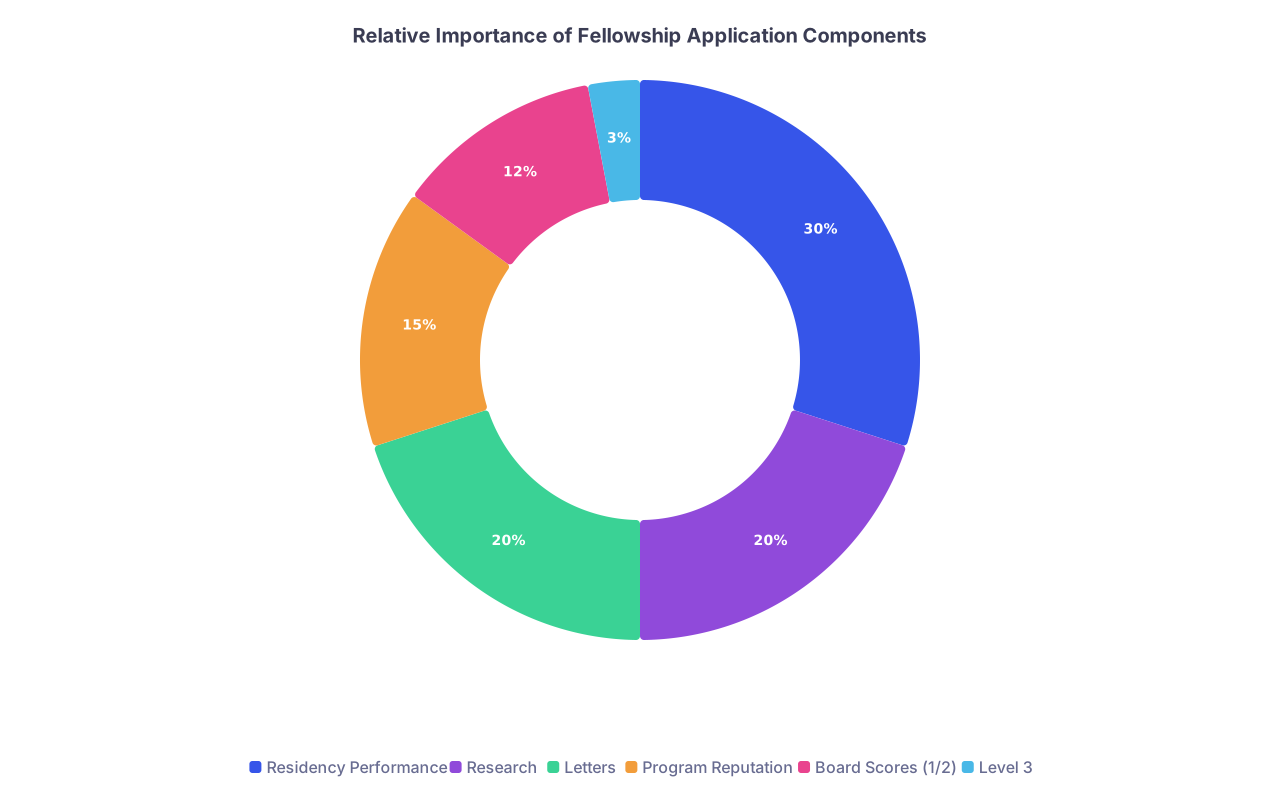
| Category | Value |
|---|---|
| Residency Performance | 30 |
| Research | 20 |
| Letters | 20 |
| Program Reputation | 15 |
| Board Scores (1/2) | 12 |
| Level 3 | 3 |
Does every program look at this exactly? No. But this is roughly how it shakes out.
Most PDs:
- Glance at your exam history.
- Make sure you passed everything and are board eligible.
- Look for major red flags (multiple fails, huge drops, unexplained gaps).
- Then move on quickly to what actually matters: letters, reputation, their faculty’s opinions.
They’re not sitting around muttering: “Well, she got a 510 on Level 3 instead of 580, so she’s clearly not fellowship material.”
You know who is doing that?
You. At 2 a.m. Staring at your score report like it’s a character judgment.
How Much Does Timing Matter? (When You Take Level 3)
Another anxiety loop:
“If I take Level 3 late, or right before fellowship apps, will they judge that?”
Here’s the real story:
- Most fellowships just want you to be on track for licensing.
- Many residents take Level 3 PGY1–early PGY2.
- Some delay because: new baby, brutal schedule, visa issues, or honestly…they’re just overwhelmed.
If you:
- Take it later but pass → not usually an issue.
- Take it right before apps and barely pass → mildly concerning if you also have weaker prior scores.
If you failed close to application season:
- That’s rough. Not career-ending, but rough.
- You’ll want to pass as quickly as reasonably possible.
- Some people choose to delay fellowship application by a year to apply with a clean “passed” record and better narrative. That’s not failure. That’s strategy.
Ways to Offset a Low or Failed COMLEX Level 3
Here’s where your brain probably goes: “I blew Level 3, so what’s the point of even trying for a competitive fellowship now?”
That’s the part that’s actually dangerous—not the score.
What moves the needle a lot more than Level 3:
1. Be a standout resident on the wards
If faculty say:
- “This is the resident I trust most on nights.”
- “They run a great code.”
- “They read and actually know the literature.”
Those comments crush whatever damage a mediocre Level 3 score might’ve done.
You want letters that sound like:
- “Top 5% of residents I’ve worked with.”
- “Functions at the level of a fellow already.”
- “I’d be happy to have them as my own physician.”
Not:
- “Shows up on time and is pleasant to work with.”
2. Get at least one meaningful scholarly thing done
Doesn’t need to be a NEJM paper. But:
- Case report → fast and doable.
- Retrospective chart review.
- Quality improvement project with a poster.
If your scores are not amazing, productivity helps you look motivated, disciplined, and serious about your field.
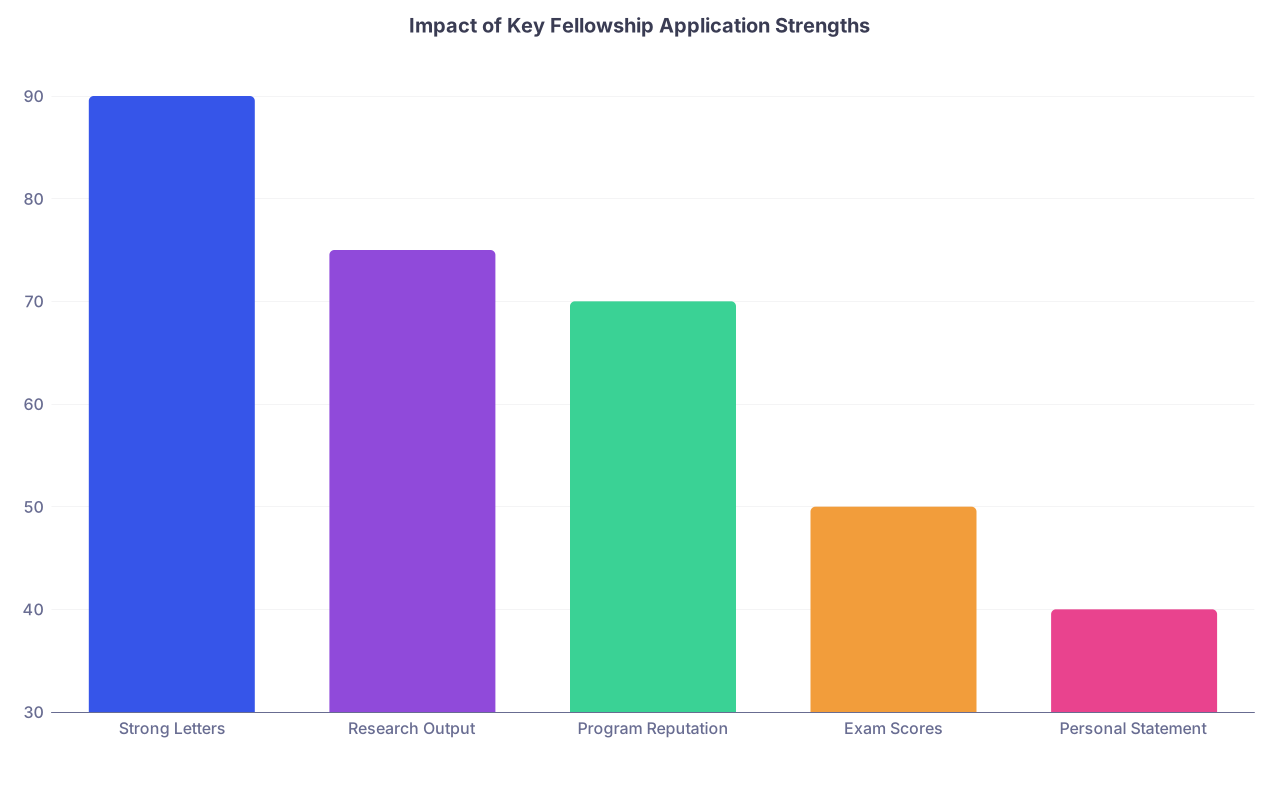
| Category | Value |
|---|---|
| Strong Letters | 90 |
| Research Output | 75 |
| Program Reputation | 70 |
| Exam Scores | 50 |
| Personal Statement | 40 |
Again, scores matter. They just don’t matter as much as the narrative you build around them.
3. Crush your in-training exams
If your COMLEX Level 3 is low but your In-Training Exam (ITE) scores improve each year, that tells a better story:
- Growth.
- Adaptation.
- You’re peaking when it matters.
A weak Level 3 + strong ITE + strong final boards = forgiven and forgotten.
If You Haven’t Taken Level 3 Yet and You’re Spiraling
Let me talk to future-you for a second—because the fear of “ruining my career” can sabotage test day.
Here’s the trap:
You over-attach to Level 3, panic, overstudy inefficiently, or freeze. That makes a mediocre score more likely.
Basic beat-the-anxiety strategy:
- Schedule it during a rotation that’s not killing you.
- Give yourself 4–6 weeks of consistent, not heroic, study.
- Use a main Qbank (COMQUEST, COMBANK) and some CCS-style practice.
- Don’t turn this into Step 1-level obsession. It’s not Step 1.
And realistically:
- Passing on the first try with a “fine” score beats killing yourself trying to chase a superstar score that fellowship PDs probably won’t even care about.
How to Talk About a Low or Failed Level 3 in Applications
This is the nightmare scenario in your head: “What’ll I say if they ask about my low Level 3?”
You do not give a 5-minute soul-bearing monologue.
You:
- Acknowledge.
- Give a short, honest explanation if there is one.
- Pivot to growth and current performance.
Example if you failed once:
“During that time I was balancing a new ICU rotation and some personal family stress, and I underestimated the adjustment. I didn’t prioritize studying well and it showed. Since then, I restructured how I prepare for exams, passed comfortably on the second attempt, and my in-training scores have gone up each year. I feel much more confident about board certification now.”
That’s enough. Don’t over-confess. Don’t overshare. Don’t self-flagellate.
They care more about:
- Are you stable now?
- Are you reliable now?
- Are you performing at or above your PGY level?
When It Might Be Smart to Adjust Fellowship Expectations
I’m not going to lie and say scores never matter.
If you’ve got:
- Multiple exam failures (COMLEX 1/2/3, ITE),
- Limited research,
- Average residency program,
- And you’re aiming for top-tier GI or cards at big-name academic centers…
You might need to strategically:
- Add more mid-tier or community-based fellowships.
- Consider slightly less cutthroat specialties.
- Potentially do an extra chief year or hospitalist year, build research, then apply stronger.
That’s not “giving up.” That’s playing the long game. Plenty of people match into strong fellowships after a gap year or a slightly non-linear path.
Reality Check: What Actually Hurts Fellowship Chances More Than a Low Level 3
This part might sting a little, but it might also calm you down.
Things that hurt far more than a single bad Level 3:
- Being labeled “unreliable” or “lazy” on rotations.
- Poor communication with nurses, staff, or patients.
- Not following up on tasks or orders.
- Major professionalism issues.
- Bad word-of-mouth from attendings.
I’ve seen:
- People with mediocre exam histories match great fellowships because everyone loved working with them.
- People with gorgeous exam sheets and publications get quietly blackballed because attendings refused to write strong letters.
If your anxiety about Level 3 makes you withdrawn, checked out, or constantly self-deprecating—that will hurt you way more than the number itself.
Quick Self-Triage: How Worried Should You Actually Be?
Use this rough mental scoring:
| Situation | Risk to Fellowship |
|---|---|
| One low-but-passing Level 3, rest decent | Low |
| One fail, then solid pass, good ITEs | Low–Moderate |
| Two or more fails on Level 3 | Moderate–High |
| Multiple low scores across all exams | Moderate |
| Low Level 3 but stellar residency + research | Low |
If you’re in the first two rows:
You’re probably catastrophizing more than is justified.
If you’re in the last three rows:
You’re not doomed. But you need a deliberate strategy and stronger compensating strengths.

What You Can Do Today If You’re Panicking About Level 3
Forget the 10-year career forecast. Think next 24–48 hours.
If you already took it and hate your score:
- Print your score report once. Then close the portal.
- Make a short list: 3 strengths you do have (letters you can probably get, research, clinical feedback).
- Choose one next-step move:
- Email a mentor/PD and say: “I’d love to get your thoughts on strengthening my fellowship application given my exam history.”
- Start a small, doable project (case report, QI idea).
- Fix something concrete in your daily habits—pre-rounding structure, reading 15 minutes a day, etc.
If you haven’t taken it yet and feel frozen:
- Pick a test date that gives you a realistic but not crazy timeline.
- Commit to one primary question bank.
- Create a simple weekly plan: “X questions per day, review wrongs, 1 longer case set on weekends.”
- Tell one person you trust (co-resident, partner, friend) your date and study plan so you’re not alone in your head.

FAQ (Exactly 5 Questions)
1. I failed COMLEX Level 3 once. Is fellowship out of reach now?
No, it’s not out of reach. One failure, especially with a later solid pass and decent ITE scores, is usually seen as a bump, not a wall. You’ll need to be ready with a brief, mature explanation and show stronger performance afterward, but plenty of people with a single exam failure match good fellowships.
2. Do fellowship programs even see my exact Level 3 score, or just pass/fail?
Most will see the score and attempt history, but they won’t obsess over the exact number unless it’s dramatically low or part of a pattern of weak exams. Their bigger concern is: did you pass, are you board-eligible, and are there multiple attempts that raise questions?
3. I have strong Step/COMLEX 1 and 2 scores but a low Level 3. How bad is that?
That’s actually one of the least concerning patterns. It reads more like a fluke or a stressful year than a fundamental test-taking problem. Strong earlier exams plus good ITEs and board pass = your low Level 3 becomes background noise.
4. Should I delay fellowship applications for a year because of my Level 3 performance?
Only consider delaying if:
- You have multiple exam failures or a very recent fail, and
- You can realistically use the extra year to build a much stronger story (better letters, research, improved evaluations, a stable re-take pass).
Delaying just to “wait for people to forget” without changing anything else doesn’t help.
5. What’s worse for fellowship: a low Level 3 or mediocre letters?
Mediocre or weak letters are worse. Every time. A lukewarm letter screams “This resident is technically fine but not special,” which kills you in a competitive pile. A low-but-passing Level 3 with glowing, specific letters from respected faculty is almost always the better position.
Open your COMLEX Level 3 report one last time today, write down the facts (score, attempts), then close it and don’t log back in. Right after that, email one potential mentor and ask for a 15–20 minute meeting to talk honestly about how to build the strongest possible fellowship application from where you are now.
(See also: Step 3 CCS cases: High-Yield Orders and Timing for Acute Scenarios for more details.)