
The usual Step 3 study advice quietly assumes you do not have a life. Or kids. Or a dependent parent. That fantasy ends here.
If you’re the primary caregiver at home and staring down Step 3, you are not in the same game as your co-resident who goes home to a quiet apartment and HelloFresh. You’re in the “two full-time jobs at once” game. You need different rules.
I’m going to walk you through what actually works when you’re running point at home and still need to pass this exam without setting your life on fire.
1. Face the Reality of Your Situation (Then Plan Like a Sniper)
You do not have “study time.” You have “small, fragile, easily-destroyed pockets of semi-focus.”
Pretending otherwise is how people end up failing Step 3 and rescheduling it three times.
Your first move is brutal honesty:
- How many reliable hours per week can you study?
- Who really has your back, and when?
- What rotations are killers, and which are survivable?
Write it out. Not in your head. On paper or your notes app.
| Time Block | Realistic Study Minutes | Notes |
|---|---|---|
| Early morning (5–7a) | 60–90 | Before kids wake / caregiver tasks |
| Post-bedtime | 30–60 | Unreliable if exhausted |
| Commute | 20–40 | Audio questions / review |
| “Golden” weekend day | 120–180 | If partner/family can cover |
You’re aiming for something like 10–14 focused hours/week. Less than that and you either:
- Need a longer prep timeline, or
- Need more help at home, or
- Need to move the exam date.
If you’re thinking, “I’ll just grind harder,” stop. That’s how you burn out and end up scrolling Instagram at 1 a.m. pretending it’s “rest.”
2. Build a Ruthless, Caregiver-Adjusted Timeline
You can’t copy someone else’s 4-week or 6-week Step 3 plan off Reddit. You have more constraints and more responsibility.
You need a timeline that survives real life — call shifts, daycare viruses, your dad’s blood pressure spiking at 10 p.m., the toddler’s night terrors. So you build in margin from the start.
Step-by-step timeline if you’re primary caregiver
Assume a 10–12 week run-up. If your date is sooner, we’ll adjust later.
Pick the exam block intentionally.
If you can influence it: schedule Step 3 during or just after a lighter rotation (clinic, elective, consult) rather than ICU or nights.Back-calculate from test date.
- Last 2 weeks: heavy CCS + full-length practice days
- Middle 6–8 weeks: main question-bank build
- First 2 weeks: content refresh + systems check
Protect at least 1 “long” block per week.
You need one 2–3 hour block each week to run a practice block + full review. This usually means:- Partner / friend / family / paid sitter takes the kids/parent
- You leave the house (library, coffee shop, parked car with hotspot if you’re desperate)
Accept that some days will be zero.
You’ll have days where the kid spikes a fever, your attending texts you at 9 p.m., or your parent falls. Build your weekly goals assuming you’ll lose at least 1–2 study days.
Here’s a rough example for a 10-week caregiver-focused schedule:
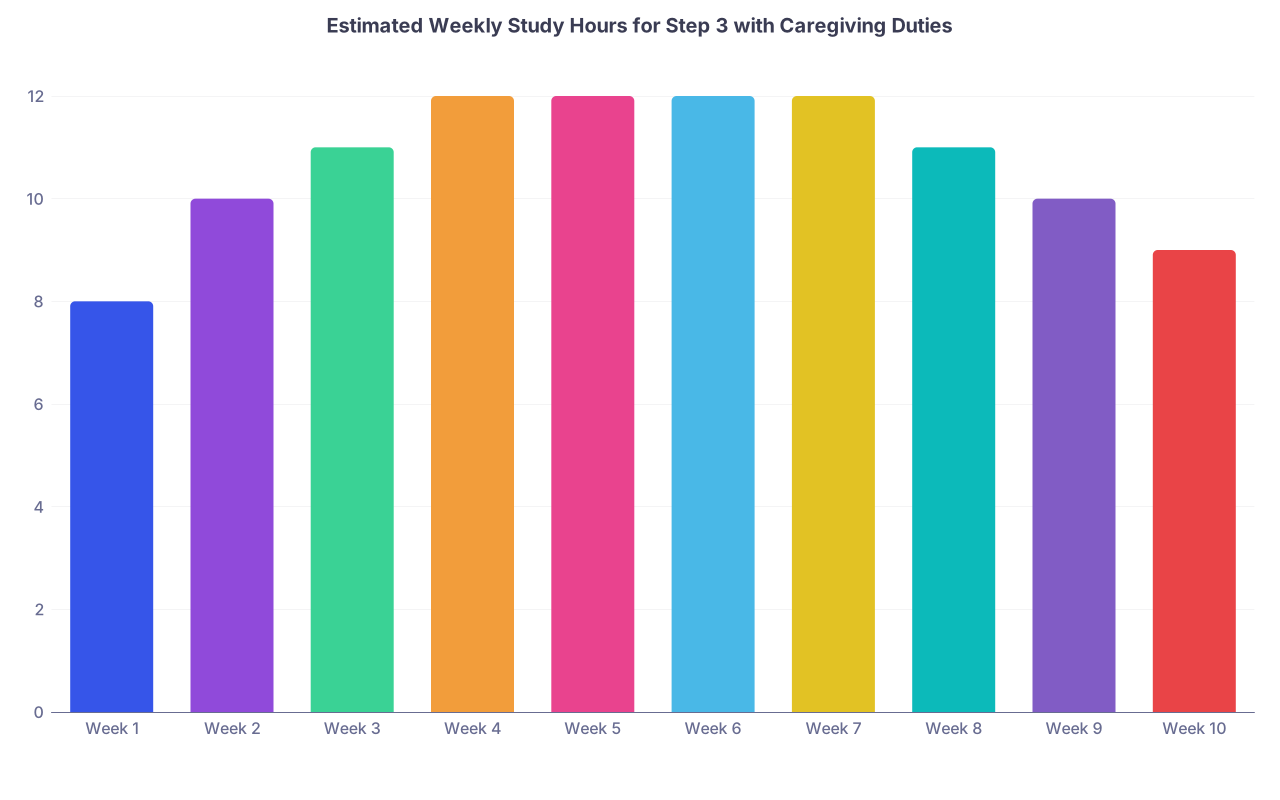
| Category | Value |
|---|---|
| Week 1 | 8 |
| Week 2 | 10 |
| Week 3 | 11 |
| Week 4 | 12 |
| Week 5 | 12 |
| Week 6 | 12 |
| Week 7 | 12 |
| Week 8 | 11 |
| Week 9 | 10 |
| Week 10 | 9 |
Notice it does not assume 25 hours/week. Because that’s fantasy land for you.
3. Choose a Minimalist Resource Setup (Everything Else is a Trap)
You do not have the luxury of “trying all the resources.” Every extra resource is time you steal from childcare, sleep, or your own sanity.
For Step 3 as a caregiver, the winning move is minimalist and deliberate:
- One main question bank
- One concise CCS resource
- One light reference / video backup if you really need it
That’s it. If you’re juggling four things and watching 60 hours of video, you’ve already lost.
Concrete resource setup that actually works
Use something like:
- Main Qbank: UWorld Step 3
- CCS: Official NBME CCS software + one short CCS guide or case-walkthrough source
- Reference (optional): AMBOSS or a quick “Step 3 high-yield” PDF / notes, but only for targeted gaps
Do not build a giant Anki deck from scratch. Do not re-watch all of OnlineMedEd. Borrow high-yield notes or use what you already have.
Your time goes into questions + CCS. Period.
4. Design Study Blocks Around Real-Life Caregiving
You can’t study like a single PGY-1. You need different patterns.
Let’s break study into three kinds of blocks you can actually sustain.
A. Micro-blocks (10–20 minutes)
What you do:
- Single question (or 2) in timed tutor mode
- One CCS case review
- Flash review of notes from missed questions
Where they happen:
- While your kid is finishing a snack
- Sitting in the car before daycare pickup
- Waiting at your parent’s specialist appointment
You’re not trying to learn new content here. You’re reinforcing and staying in “Step 3 mode.”
B. Core blocks (45–75 minutes)
What you do:
- 10–15 question timed block + full explanation review
- Or 1–2 CCS interactive cases with debrief
Where they happen:
- Early morning before the house wakes up
- Late evening if you’re not totally wiped
- On a post-call day (after some sleep) while someone else is home
These are the backbone. You want at least 4–6 of these per week.
C. Long blocks (2–3 hours, weekly)
This is your “simulation” time:
- 1 full 38–40 question block in exam-like conditions
- Followed by targeted review
- Or a mix of 1 block + 2 CCS cases
These need intentional coverage. If you’re the primary parent or caring for an elder, this can feel selfish. It’s not. Passing this exam preserves your income and career. That’s not optional.
5. Lock In Support (And Script the Conversations)
You’re carrying Step 3 and the household. If you don’t deliberately pull other people in, everything lands on you by default.
Who can realistically help?
Be specific, not vague:
- Partner or spouse
- Co-parent or ex (yes, even if things are tense)
- Sibling / cousin / grandparent
- Trusted neighbor or friend
- Paid childcare / eldercare for very targeted blocks
Then you script it. Because “I have a test” is vague. “I need three hours alone this Sunday from 9–12 for a practice exam” is actionable.
Here’s the kind of script I’ve seen work:
“I’m scheduled to take a major board exam on [date]. If I don’t pass, I have to retake it and it could affect my job. I need your help for the next 8 weeks. Specifically:
– One morning or afternoon each week where you fully take over [kid/parent care] for 3 hours
– On [two weeknights], I need you to handle bedtime so I can study from 7–9
Can we look at the calendar together and lock this in?”
Is it comfortable? Not always. Is it necessary? Yes.
6. Use the Right Mental Model for Step 3 (Especially When You’re Exhausted)
Step 3 isn’t Step 1. It’s not about memorizing every weird enzyme. It’s about making reasonable, safe decisions as a new doctor.
This helps you in two ways:
- You can lean on your clinical instincts from residency.
- You don’t need 500 pages of obscure facts. You need pattern recognition and management steps.
What this means for a caregiver schedule
When you’re doing questions:
- Focus on: “What would I actually do on the wards?”
- Ask: “Is this stable or unstable? Outpatient or inpatient? What’s the safest next step?”
- Notice when you’re missing: triage, escalation, long-term follow-up
You’re often tired. That means you lean on systems, not willpower.
Make a very short “Step 3 thinking checklist” you glance at before each block:
- Have I ruled out emergencies?
- Is there anything life-threatening being ignored?
- Do I have the complete story, or should the next step be more info?
- Am I thinking outpatient vs inpatient correctly?
Tape this to your laptop. Seriously.
7. CCS When You Have a Screaming Toddler in the Background
CCS is where a lot of caregivers panic because it feels “time-pressured” and fiddly. Good news: you do not need to be perfect. You need to be safe and systematic.
Your CCS goals:
- Get comfortable with the software
- Internalize generic “move patterns” for common case types
- Avoid the big blunders (missed pregnancy test, ignoring ABCs, never re-checking vitals)

| Step | Description |
|---|---|
| Step 1 | Start Case |
| Step 2 | Stabilize ABCs |
| Step 3 | Focused H&P |
| Step 4 | Initial Orders |
| Step 5 | Decide Location |
| Step 6 | Advance Time & Reassess |
| Step 7 | Adjust Management |
| Step 8 | Disposition & Counseling |
How to study CCS with limited time
- Run 1–2 practice cases during your weekly long block
- On weekdays, spend micro-blocks quickly reading case write-ups or watching a short CCS walkthrough
- Practice “ordering quickly” in bursts: lab panels, imaging, initial orders, moving to ICU/floor/clinic
The key: consistency over intensity. Five CCS touchpoints per week beat a single 6-hour cram session that gets canceled when your kid vomits at 3 a.m.
8. Protect Your Energy Like It’s Part of the Exam
Caregivers chronically underestimate this part. You can’t just “push through” endless weeks of residency, caregiving, and exam prep without your brain revolting.
This isn’t wellness fluff. This is performance maintenance.
Three non-negotiables
Sleep floor, not sleep goal.
You might not hit 8 hours. Fine. But choose a hard floor—maybe 5.5–6 hours—where you stop studying and go to bed. No “just one more block” at 1 a.m.Pre-bedtime cut-off.
Set a strict digital cutoff 30–45 minutes before bed. No questions, no CCS videos. Your brain needs to downshift or your sleep quality goes to garbage.One true off-night per week.
Not “I’ll just review a few questions.” One night with zero Step 3. You are a person, not just a machine attached to a Qbank.
When you’re this stretched, your margin is your life support. Guard it.
9. What If Your Date Is Too Soon and You’re Behind?
This happens all the time, especially for primary caregivers who keep trying to “make it work” past the point of realism.
Here’s the decision tree I use when talking to residents in your situation:

| Step | Description |
|---|---|
| Step 1 | 4-5 weeks before exam |
| Step 2 | Strongly consider rescheduling |
| Step 3 | Lock added support & keep date |
| Step 4 | Keep date and tighten plan |
| Step 5 | Consistent 10+ hrs/week studying? |
| Step 6 | Able to increase support/time? |
| Step 7 | Practice scores near pass range? |
Ask yourself, honestly:
- Have you hit at least ~60–70% of your Qbank with serious review?
- Are practice assessments (if available) within striking distance of passing?
- Is your life about to get worse (e.g., ICU month next) or better?
Rescheduling isn’t failure. Failing because you refused to reschedule when you were drowning? That’s avoidable pain.
10. Concrete Weekly Examples for Different Caregiver Setups
To make this less abstract, let’s look at three common caregiving setups and what a realistic week looks like.
A. Primary parent with partner who works normal hours
You: PGY-1 IM resident
Partner: 9–5 job, no call
Kids: 2 (ages 2 and 5)
Sample Step 3 prep week:
- Mon–Thu:
- 5:30–6:30 a.m.: 10–15 Qs + review
- During lunch: 5 Qs or CCS read
- After kids’ bedtime (2 nights only): 45 minutes review
- Sat:
- Partner takes kids 9–12: full 38–40 Q block + review
- Sun:
- 30 minutes CCS practice during nap
Total: ~10–12 focused hours
B. Single parent, limited external help
You: PGY-2 FM resident
Co-parent: intermittently involved
Kids: 1 (age 3)
Here you have to lean heavier on micro-blocks and maybe one paid sitter slot if financially possible.
Sample Step 3 prep week:
- Mon–Fri:
- 20–30 minutes before wake-up
- 10–15 minutes in the car before pickup or after drop-off
- Wed evening:
- Co-parent takes kid 6–8 p.m.: 15–20 Qs + review
- Sat:
- Sitter / family 2–3 hours: practice block + CCS
You might only get 8–10 hours/week. That’s fine—just extend your prep to 12–14 weeks if you can.
C. Caring for an elderly parent at home
You: PGY-3 Neurology resident
Parent: Lives with you, needs supervision, some ADL help
Your time is chopped up, but you often have at-home stretches.
Sample week:
- Mon–Fri:
- 45–60 minutes after morning caregiving tasks, before work (if on clinic rotation)
- 2–3 micro-blocks of 10–15 minutes while parent naps or watches TV
- One weekend morning:
- Sibling or visiting nurse covers 3 hours: practice case + CCS
Core move: schedule other family members like a rotation schedule, not last-minute favors.
11. The Day-of-Exam Logistics — With a Household Depending on You
You can’t roll into Step 3 Day 1 and Day 2 like you’re still a med student with no other obligations. Plan exam logistics like a procedure.
Key decisions:
Who has the kids/parent, and for how long?
You need coverage from breakfast to at least an hour after your scheduled end time. Day 2 is longer. Add even more buffer.What’s your commute plan?
You do not want “surprise” drop-off meltdown or your dad refusing to get in the car making you late.What’s the evening of Day 1 look like?
Do not plan a full evening shift of caregiving + house tasks + studying. Light dinner, short walk, early bed. Your brain will be cooked.

12. The Guilt, The Fear, and Why You’re Still Going to Be Okay
Let’s be blunt: being the primary caregiver comes with a special flavor of guilt.
- Guilt for “disappearing” to study on your one weekend off.
- Guilt for not being more present with your child or parent.
- Fear that if you fail, this all gets worse.
You are not going to “balance” this perfectly. There will be days you snap, days you cry in the car, days your kid watches more TV than you’d like. That doesn’t make you a bad parent or child. It makes you a human being carrying too much at once.
Here’s the reframe I’ve used with residents in your spot:
You’re not studying instead of caring for them. You’re studying for them — to keep your career intact, your income stable, and your future options open. A few months of being less available is an investment in years of being able to show up.
So, what next?
You pick your exam window realistically. You choose a brutally simple resource list. You carve out tiny, imperfect but consistent blocks of study time. You ask for help more directly than you’re used to. You forgive yourself for the mess.
And then you get through Step 3, one interrupted question block at a time.
Once that score drops and this exam is off your plate, we can talk about something much more interesting: how to rebuild a life that’s more than just residency plus caregiving. But that’s a story for another day.