
The worst Step 3 prep plans are the ones people design for the version of themselves that no longer exists.
You’re not the intern you were before burnout. Or before that medical leave. You’re tired in a different way now. Your confidence took a hit. And Step 3, annoyingly, does not care.
So let’s be blunt: you cannot prepare for Step 3 the way your co-residents did if you’re coming off burnout or medical leave. If you try to copy them, you’ll either flame out again or drag this out for months.
You need a different playbook. Here it is.
Step 3 Reality Check After Burnout or Leave
First, orient yourself. Your situation is different from the Instagram “just did 2 weeks of UWorld and crushed Step 3” crowd.
Here’s what you’re probably dealing with:
- Cognitive stamina is lower. You hit a wall faster than you used to.
- Anxiety is higher. You catastrophize every wrong question.
- Schedule is unstable. You’re catching up on rotations, rebuilding trust, maybe still in therapy or follow-ups.
- Confidence is shaky. You’re not sure you remember anything, especially management details.
None of that means you cannot pass Step 3. It means your strategy must fit reality, not fantasy.
Let’s nail down your constraints.
1. Know your deadlines and non-negotiables
You need actual dates, not vibes.
- When does your Step 3 eligibility period end?
- Does your program require Step 3 passed by:
- end of PGY-2?
- before applying for fellowship?
- before contract renewal?
- Are you on reduced hours or accommodations that affect study time?
Write these down, not in your head. I’ve seen people “think” they had 12 months and actually had 6.
| Item | What You Need to Know |
|---|---|
| Eligibility Window | Start and end dates exactly |
| Program Requirement | Latest date to *have result*, not just test date |
| Current Rotation | Average weekly hours realistically |
| Planned Leave/Events | Vacations, exams, weddings, moves |
You cannot build a sane study plan until you know the constraints.
2. Accept you’re playing on “easy mode” for content, “hard mode” for energy
Step 3 content is not conceptually harder than Step 1/2. It’s more like Step 2 CK plus adult ambulatory medicine, management, and CCS.
The tricky part in your situation is not knowledge. It is:
- Sustaining effort without triggering another crash
- Managing anxiety so you don’t spiral every time UWorld humbles you
- Balancing real clinical work while your brain still feels half-thawed
Once you accept that, you stop beating yourself up for not doing “80 questions a day like my co-residents.” Your metric becomes: “Can I study consistently for 8–12 weeks without wrecking myself?” That’s the goal.
Build a Step 3 Timeline That Won’t Break You
You need a timeline that respects your energy, your leave history, and your program’s requirements.
Let’s map the realistic options.
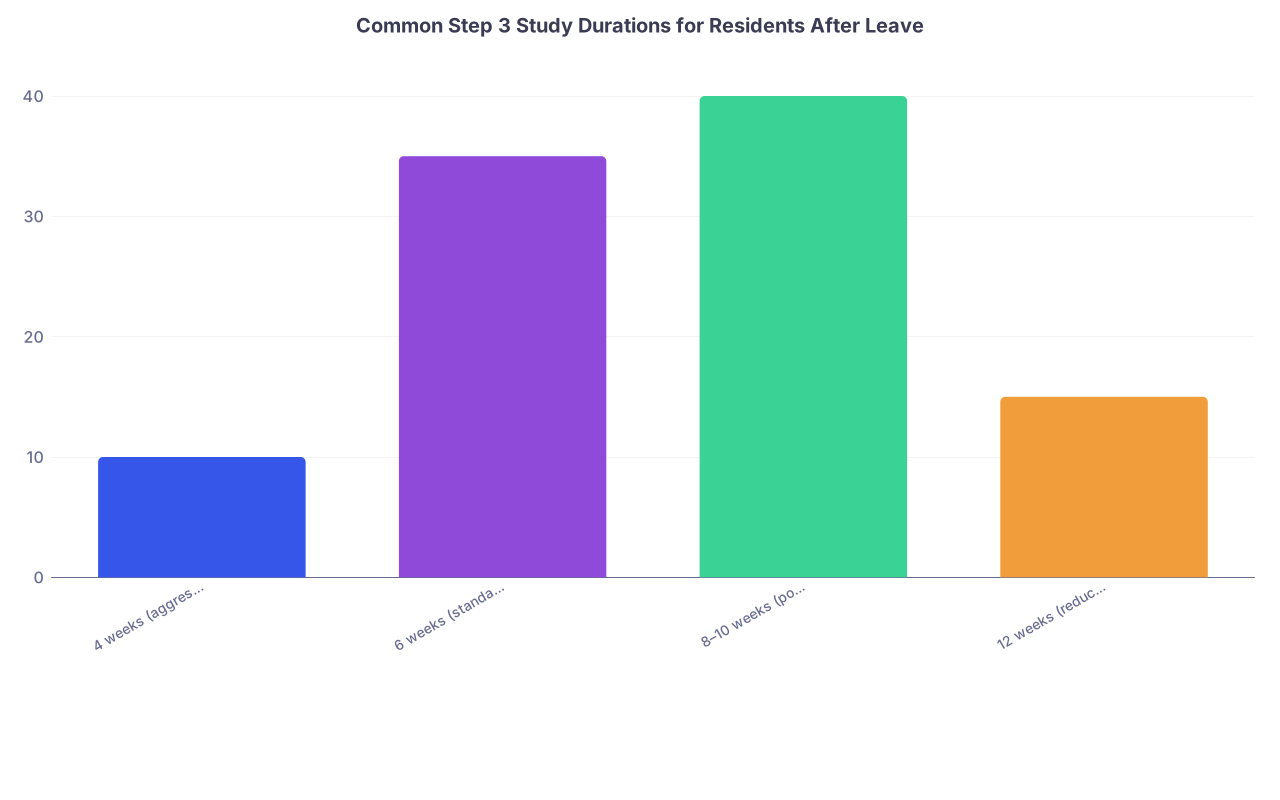
| Category | Value |
|---|---|
| 4 weeks (aggressive) | 10 |
| 6 weeks (standard) | 35 |
| 8–10 weeks (post-burnout) | 40 |
| 12 weeks (reduced schedule) | 15 |
Those percentages are what I see in practice for residents returning from burnout or leave: the majority end up needing 8–10 weeks or a gentler 12-week ramp.
If you’re fresh back from leave (first 1–3 months)
Do not open a question bank on day one back. Your main job early is proving to yourself you can tolerate basic work volume again.
Rough sequence I’d use:
Month 0–1 back:
- Focus: clinical stability, sleep, mental health follow-ups
- Step 3: none or at most 10–15 questions twice a week. Just to unfreeze test anxiety. That’s it.
Month 2–3:
- If work is stabilizing, build to:
- 10–20 questions per study day, 3–4 days/week
- Start casually reading through an outpatient/ambulatory book (e.g., Master the Boards Step 3) on call-free evenings or weekends
- If work is stabilizing, build to:
After you can get through a normal week without crashing:
- Plan a proper 6–10 week dedicated-but-part-time Step 3 block, ideally anchored around:
- A lighter elective
- Clinic blocks instead of ICU nights
- Or strategically placed vacation weeks
- Plan a proper 6–10 week dedicated-but-part-time Step 3 block, ideally anchored around:
If your PD is supportive, you can often negotiate one or two light months specifically framed as “Step 3 + reintegration.”
If you’re months out from leave but still not 100%
Different scenario. You’re “functional” but slower and more fragile than pre-burnout.
In that case, you’re usually best with:
- 8–10 weeks total
- 5–6 days/week of studying
- 60–80 questions on light days, 20–40 on heavy call days
- CCS practice 2–3 times per week in the last 3–4 weeks
Not heroic. Just consistent.
Choosing Resources Without Overloading Your Brain
You’re not building a Step 1 shrine again. You are aiming for “solid pass” with maximal efficiency.
Here’s what to use and what to skip.

Core resources (don’t skip these)
UWorld Step 3 Qbank
Non-negotiable. It mirrors the exam’s style and management focus. But if you’re post-burnout, the way you use it matters (we’ll get into that).CCS preparation
Minimum: UWorld CCS cases.
If your test anxiety is severe, adding CCS-only cases from another provider is fine, but don’t blow time on three different platforms.One high-yield overview book / outline
Something like:- Master the Boards Step 3
- Step-Up to Medicine (select chapters for IM-heavy folks) This is for structure and quick refreshers, not detailed memorization.
Nice-to-have (only if you have capacity)
- Biostats/ethics quick review (online PDFs or short videos)
- A short Step 2 CK-style review of weak areas (OB, peds, psych) if you’ve been away from them for years
Actively skip
- Massive video series “from scratch” if you passed Step 2 CK in the last 3–4 years
- Multiple full Qbanks (NEJM, AMBOSS, etc.) unless UWorld is exhausted and you still have time/energy
- Over-detailed texts (Harrison’s, Williams OB, etc.) “just for Step 3”
Your brain has a limited daily bandwidth right now. You preserve it by saying no to everything that doesn’t materially move your Step 3 score.
How to Do Questions When Your Brain Is Fried
This is where most post-burnout residents blow themselves up: they try to match their co-intern’s “100 questions a day” war stories and then wonder why by day 3 they’re crying over a diabetes management question at 1 a.m.
You need a different operational model.
Step 1: Set a hard upper limit per day
Pick a max number that feels almost “too gentle.” For many in your situation, that’s:
- 20–40 questions on hard rotation days
- 40–60 questions on lighter days
- Rare 80–100 question days on vacation blocks only
If you get halfway and your brain is mush, stop. Burning through questions in a daze teaches you almost nothing and spikes anxiety.
Step 2: Timed blocks, but shorter
Don’t start with 40-question blocks if your focus is shot.
Progression I like:
Week 1–2:
- 10–15 question timed blocks
- Focus: get used to time pressure again without panic
Week 3–5:
- 20-question timed blocks
- Work on reading speed and decision-making
Week 6+:
- 30–40-question blocks, simulate full exam sections occasionally
You are rebuilding test stamina like a muscle after injury. You do not start with a marathon.
Step 3: Review smarter (not longer)
The point of review is pattern-building, not rewriting First Aid.
For each block:
- Flag only:
- Concepts you truly did not understand
- Recurrent management patterns (e.g., when to start insulin, when to do CT vs MRI, when to admit vs outpatient)
- Glance over questions where you “almost” got it—don’t sink 10 minutes into those
- Write targeted notes, not essays. Things like:
- “Hyponatremia: hypervolemic vs euvolemic vs hypovolemic → treatment ladder”
- “Chest pain: when to stress test vs cath vs CT angio”
If your review per 40-question block regularly exceeds 2 hours, you’re overdoing it. Trim.
CCS: The Part Everyone Neglects Until It Hurts
CCS feels scary after time away because you’re rusty on ordering, timing, and the “computer-logic” of the cases.
You don’t need to be perfect at CCS. You just need to not be terrible.

| Step | Description |
|---|---|
| Step 1 | Start: 4-5 weeks before exam |
| Step 2 | Read CCS orientation and sample cases |
| Step 3 | Do 1-2 untimed practice cases per session |
| Step 4 | Review feedback and build order sets |
| Step 5 | Increase to timed cases 2-3 weeks out |
| Step 6 | Simulate mini-CCS block week before exam |
Minimal viable CCS plan
Starting about 4–5 weeks before your test:
Week 1:
- Learn the interface (don’t skip this)
- Do 3–4 untimed practice cases just to see flow:
- Introduce yourself
- Focused history/physical
- Key initial orders (vitals, IV access, pulse ox, etc.)
- Admit vs discharge decisions
Week 2–3:
- 1–2 CCS cases, 3–4 days/week
- Focus on:
- Having pre-built mental checklists for:
- Chest pain
- Abdominal pain
- SOB
- Fever/sepsis
- Remembering to advance the clock
- Having pre-built mental checklists for:
Week 4+:
- Timed cases only
- At least one “mini CCS session” each week (2–3 cases back-to-back)
If you’re highly anxious, write 1-page CCS “scripts” for:
- Chest pain
- DKA
- Asthma exacerbation
- Prenatal visit
- Well-child visit with vaccines
Not full notes. Just:
- Initial orders
- Key labs/imaging
- Disposition
- Follow-up
Working With Your Program Instead of Against It
If you took medical leave or had documented burnout, you are already on someone’s radar. You can pretend you’re not, but you are.
Use that.

Have the uncomfortable but strategic conversation
You talk to your PD or APD and say something like:
“I’m committed to passing Step 3 and staying healthy long-term. After coming back from leave, I know I can’t do the same kind of high-intensity prep as before. Can we map out a realistic test date and a couple of lighter months so I can study consistently without burning out again?”
Key things to negotiate:
- Which blocks are lighter (good for heavier Qbank use)
- Any chance of:
- Fewer nights while studying
- Protected study days during vacation
- Pushing back the last-possible test date if your window allows
Programs massively prefer:
- One resident who is honest about limits and passes Step 3 on the second try
over - One who pretends everything is fine, crashes mid-ICU month, and has a meltdown when they fail Step 3 by 1 point.
Be realistic about work-study integration
On service-heavy months (ICU, nights, trauma):
- Aim for:
- 10–20 questions/day max
- Maybe one larger review block on your golden weekend
- Emphasize quality over quantity:
- Read explanation thoroughly for the 10 questions you did
- Make sure you fully understood the logic
On clinic/elective months:
- That’s when you push:
- 40–60 questions/day, 5–6 days/week
- Add CCS regularly
Handling Anxiety, Shame, and the “Everyone Is Ahead of Me” Spiral
This is the quiet part nobody talks about but everyone lives.
You scroll group chats and see:
- “Just got my Step 3 score, done!!”
- “Lol did UWorld in 2 weeks on nights”
You? You’re barely getting through 20 questions on a post-call day and wondering if you’re broken.
You’re not broken. Your nervous system is trying to protect you after it got overloaded.
Two mental rules that help
Your only benchmark is: am I studying more consistently this week than last week?
Not “am I matching my co-resident’s speed.”You are training for a pass, not a perfect score.
Step 3 is not a flex exam. Fellowship directors rarely care about the number. They care about “pass vs multiple fails” and “are you clinically functional.”
Managing test panic during prep
If your anxiety spikes whenever you open UWorld:
- Set a timer for 25 minutes (Pomodoro style)
- Commit: “I will just sit here and attempt questions for 25 minutes. I don’t have to finish a block.”
- When the timer goes off:
- If you’re okay, keep going
- If you’re fried, stop and review what you did. That was enough for the day.
If you find yourself doom-scrolling explanations thinking “I’m stupid” every other line, that’s not studying. That’s self-harm disguised as productivity. Walk away for an hour. Come back later or call it for the day.
Concrete 8-Week Plan for a Resident After Burnout
Let’s make this real. Say you’re PGY-2, back from leave for a few months, on a mix of wards and clinic, and you want a realistic 8-week plan.
Assumptions:
- You can study ~1–2 hours on ward days, 2–3 hours on elective/clinic days
- You’re not starting from absolute zero (you passed Step 2 CK reasonably)
Here’s a skeleton:
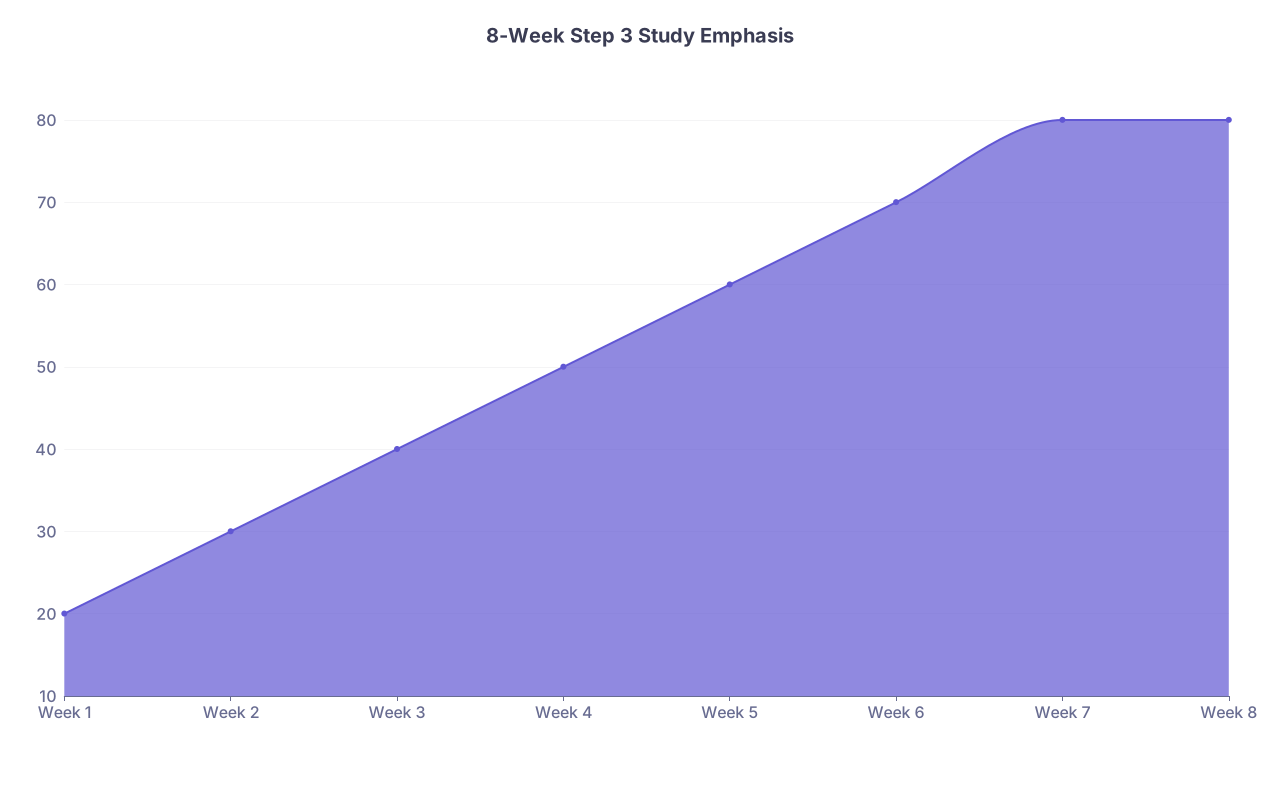
| Category | Value |
|---|---|
| Week 1 | 20 |
| Week 2 | 30 |
| Week 3 | 40 |
| Week 4 | 50 |
| Week 5 | 60 |
| Week 6 | 70 |
| Week 7 | 80 |
| Week 8 | 80 |
Week 1:
- 15–20 Qs/day on 4–5 days
- All in tutor or lightly timed mode, small blocks
- Skim a Step 3 overview book 15–20 min/day
Week 2:
- 25–30 Qs/day on 5–6 days
- One 20-question timed block
- Start writing tiny notes: management algorithms only
Week 3:
- 30–40 Qs/day on 5–6 days
- Two 20-question timed blocks per week
- Identify bottom 3 weak areas (e.g., OB, peds, stats) and read targeted sections
Week 4:
- 40–50 Qs/day average
- 2–3 fully timed 20–30 Q blocks
- Start CCS: 3–4 untimed cases this week
Week 5:
- 50–60 Qs/day on lighter days, 20–30 on heavy days
- CCS: 1–2 cases every other day, start timing them
- One self-assessment (if you’re emotionally ready; if not, push to Week 6)
Week 6:
- Finish ~70–80% of UWorld by now
- 40-question timed blocks to mimic exam sections
- CCS: 3–4 timed cases this week
- Schedule your exact exam days if not already set
Week 7:
- Finish remaining UWorld (or get close; 90–95% is fine)
- Focus review on:
- Wrong questions
- Flagged management topics
- CCS: multiple cases back-to-back at least twice
Week 8 (taper week):
- 20–40 Qs/day only
- No massive cram days
- Two “mock” days:
- One with 3–4 blocks + some CCS
- One lighter with just review and CCS
- Day before exam:
- Light review only (ethics, preventive care, basic pharm side effects). Do not heroic-cram until 2 a.m.
Tweak this around your rotations, but keep the structure: ramp up, peak around weeks 5–7, taper in week 8.
Exam Days: Tactics for the Post-Burnout Brain
Step 3 is two days. You cannot brute-force willpower if your energy is still fragile.
Some practical rules:
Day 1:
- Breakfast with protein, not just caffeine
- Aim to underuse the early break time; you’ll need more later
- Stick to your usual question rhythm: don’t suddenly start over-analyzing every item because it’s “real now”
Day 2 (the harder day for many):
- Expect to feel more anxious, because CCS is weird
- Between CCS cases:
- Close your eyes, three slow breaths, reset
- Do not obsess about how previous cases went; the scoring is more forgiving than you think as long as you did:
- Basic stabilization
- Reasonable workup
- Correct general direction of management
If your brain starts screaming “you’re failing,” recognize it as a panic symptom, not a prediction. Your job is to finish the exam behaving like a minimally competent resident, not a perfect textbook.
The Bottom Line
If you’re managing Step 3 prep after burnout or medical leave in residency, here’s what actually matters:
- Build a realistic, not heroic, 6–10 week plan that matches your current energy and your program’s deadlines.
- Use fewer resources, harder: UWorld, basic CCS prep, one concise review source, and stop there.
- Prioritize consistency and mental health over volume; passing Step 3 with your brain intact beats destroying yourself for a marginally higher score every single time.