
It’s late. You’re on jeopardy, your phone is finally not buzzing, you open your contract email again and there it is: “Must pass Step 3 by the end of PGY-2 as a condition of contract renewal.” Your stomach drops. You’re already drowning in notes, cross-cover pages, and trying to remember when you last had a real day off. Now this.
Let me be blunt: this clause is not a suggestion. Programs really will put you on probation or non-renew you over Step 3 in some states and some specialties. I’ve seen residents scrambling to book last-minute dates, failing once because they “winged it,” then having to tell their PD and watch the whole tone of their semi-annual review change.
If this is your contract, you are not in a normal “maybe I'll get to Step 3 when I have time” world. You’re on a clock. The good news is you can beat this if you treat it like a survival problem, not an academic exercise.
Here’s the game plan.
Step 1: Know Exactly What You’re Up Against
First thing: you can’t fight a deadline you don’t fully understand.
Pull up your contract and your GME handbook and get concrete:
- Is it “must take Step 3 by end of PGY2” or “must pass Step 3 by end of PGY2”?
- Is the deadline tied to:
- end of academic year (June 30)?
- date when next contract is issued?
- promotion decision meeting (often April/May)?
- Are there consequences spelled out (probation, non-renewal, no moonlighting credentialing, etc.)?
Then talk to a human who’s seen this play out.
Ask your chief or a PGY3:
“What actually happens here if someone doesn’t pass Step 3 on time?”
You’ll get one of three answers:
| Program Type | Realistic Consequence Level |
|---|---|
| Very strict academic | High (probation/non-renewal) |
| Mid-size community | Moderate (probation, pressure) |
| Relaxed or unionized | Low-Moderate (extensions possible) |
If your program is in the “high” group, you don’t get the luxury of procrastinating. You need a real schedule and protected time, not vague intentions.
Also, check your state licensing board timeline. Some states require Step 3 for a full license by a certain PGY level. If your program expects a full license by PGY3 for independent call or billing, this deadline gets even more serious.
Step 2: Pick Your Test Window Strategically (Not Emotionally)
Most residents handle Step 3 timing badly. They either:
- Delay until late PGY2 “when things calm down” (they rarely do), or
- Panic-book the earliest date possible without building in study time or retake buffer.
You have three main windows:
- Late MS4 / directly after graduation (if your program / state allows)
- Early PGY1 (after a few months of inpatient)
- Mid-late PGY1 / early PGY2 with a focused block
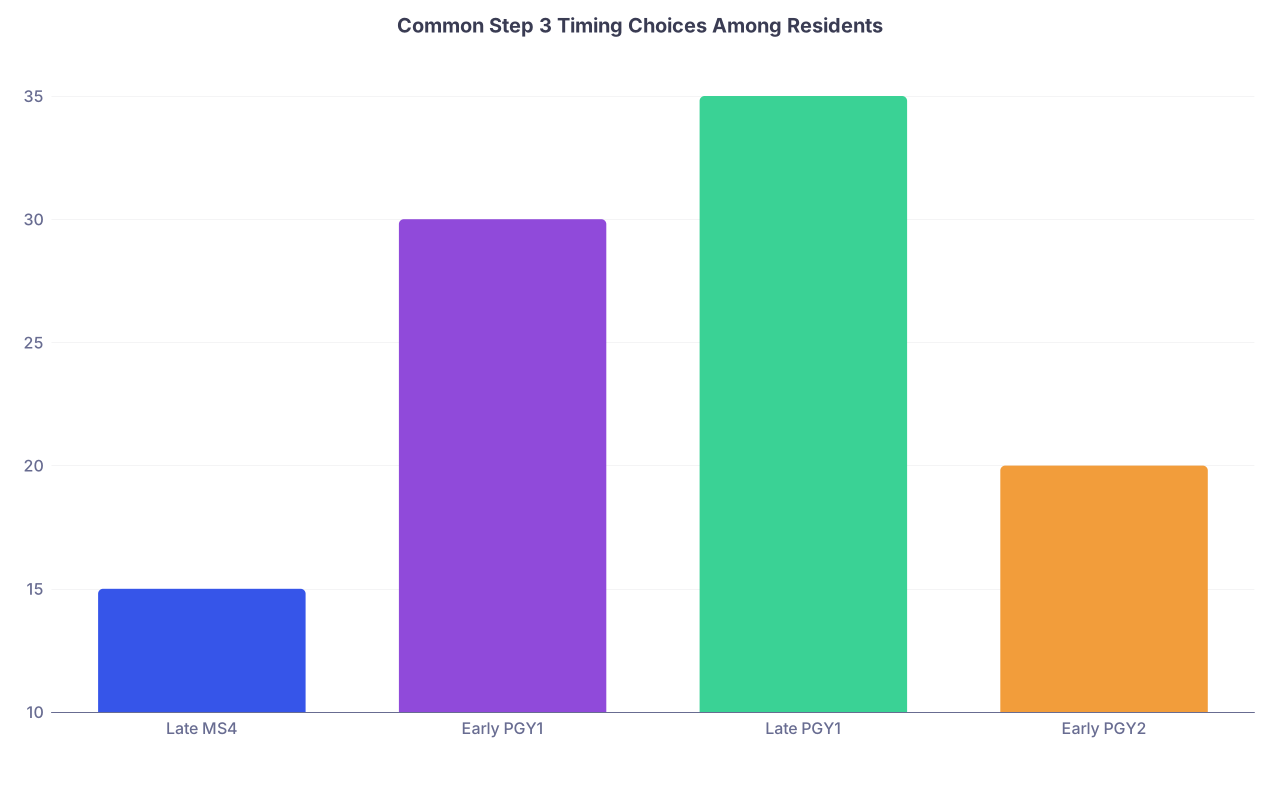
Here’s how this usually shakes out in real life:
| Category | Value |
|---|---|
| Late MS4 | 15 |
| Early PGY1 | 30 |
| Late PGY1 | 35 |
| Early PGY2 | 20 |
My bias: if your contract requires Step 3 by PGY2, you should aim to be done by the middle of PGY1 or very early PGY2, not “by the deadline.” You want room for a retake if something goes wrong—illness, schedule change, test center meltdown, or just underperforming.
Practical approach:
- Count backward:
- Find the last realistic date you’d be okay taking a retake (if needed).
- Then schedule your first attempt 3–4 months before that.
- Avoid:
- The month you start nights or ICU for the first time.
- The month of in-service exams or major rotations known to be brutal.
- Target:
- A lighter rotation (clinic, elective, consult service with predictable hours).
- A month where you can actually take 4–6 days off in a row (more on that later).
Then move from “I should probably sign up soon” to “I have a confirmed date.” Seats fill. Your future self will thank you.
Step 3: Build a Realistic Resource Stack (Not a Hoarder Pile)
You don’t have time for resource tourism. Pick a tight set and commit.
For Step 3 under time pressure, a lean, effective stack looks like:
- UWorld Step 3 Qbank
Non-negotiable. This is the core of your prep. - CCS-specific practice
- UWorld CCS cases
- Or CCSCases.com (people still use this because it forces active practice)
- A concise text / review
- OnlineMedEd Step 3 videos/notes
- Or Master the Boards Step 3, only if used as a quick reference, not cover-to-cover reading.
- Optional:
- NBME or UWSA practice test if you need score feedback or reassurance.
What you should not do:
- Buy 4 different Qbanks “just to be safe.”
- Start but never finish an 800-page Step 3 book.
- Watch endless videos as your primary method while doing <50 questions/week.
You are a resident. Your brain is already being hit with clinical content all day. Step 3 prep should be about:
- Question pattern recognition
- Exam stamina
- Learning the Step 3 “style” of management, not learning medicine from scratch
Step 4: Turn Your Schedule Into a Math Problem
Stop saying “I’ll do UWorld when I can” and start with a numbers-based plan.
Let’s say:
- UWorld Step 3 has ~1,600 questions (check current number, but this is the ballpark).
- You want to complete at least 1 full pass, ideally 1.2–1.5 passes.
- You realistically can do:
- 10–15 questions on heavy days
- 20–40 questions on lighter days / weekends
Create a target:
- Aim for 40–60 questions per week during busy blocks
- And 80–120 per week during lighter or pre-test blocks
Example structure for 12 weeks:
| Weeks | Rotation Type | Qs/Week Target | Total Qs This Block |
|---|---|---|---|
| 1–4 | Busy inpatient | 50 | 200 |
| 5–8 | Mixed / moderate | 80 | 320 |
| 9–12 | Lighter + pre-test | 120 | 480 |
That’s already 1 full pass (~1,000 questions) plus extras. Many residents end up doing 1–1.5 passes this way.
You’re not trying to study like it’s Step 1. You’re threading Step 3 into a chaotic PGY1/2 life in a way that doesn’t blow up your sanity.
Daily reality rules:
- Heavy call weeks: 10–15 questions every other day is a win.
- Post-call: Don’t force it. You’re better off sleeping than doing zombie-mode questions you won’t retain.
- Days off: One 40–60 question block with review is your anchor.
If you’re a calendar person, block it out. If not, use a simple rule:
“If I have >1 hour of usable brain tonight, I do at least 10–20 Step 3 questions before Netflix or doomscrolling.”
Step 5: Integrate Studying Into Real Life, Not Fantasy Life
You won’t suddenly become a disciplined robot because Step 3 is required. You’re still the same person who falls asleep on the couch after a 28-hour call.
So you build around your real behavior:
Use micro-chunks.
15–20 minutes between sign-out and going home? Do 5–8 CCS or multiple-choice questions on your phone.
On hold with radiology? Same.
Pair Step 3 with routines you already have.
- Morning coffee = 5 questions
- Before bed = review marked questions or CCS rationales
- Post-run or gym cooldown = 10 minutes of quick review
Exploit your rotation.
On outpatient clinic months, you’re seeing the exact bread-and-butter cases that show up on Step 3. When you see a DM2/HTN/hyperlipidemia patient, actually ask yourself:
- “What’s the next best step in management if this were a Step 3 question?”
- “Are there any screening tests they love here that I’m forgetting?”
That small mental habit massively increases your exam instincts with zero extra time.
Step 6: CCS Cases – Don’t Ignore the Weird, Clunky Part
Step 3 isn’t just MCQs. CCS (computer-based case simulations) can be the difference between passing and failing. People under-prepare for CCS because the interface is annoying and it feels “fake.” Then they panic during the exam.
Don’t be that person.
You need:
- At least 15–20 full-length, timed CCS simulations before test day.
- Familiarity with:
- Ordering basic labs and imaging quickly
- Advancing the clock appropriately
- Admitting vs sending home
- When to transfer to ICU, when to call OB, etc.
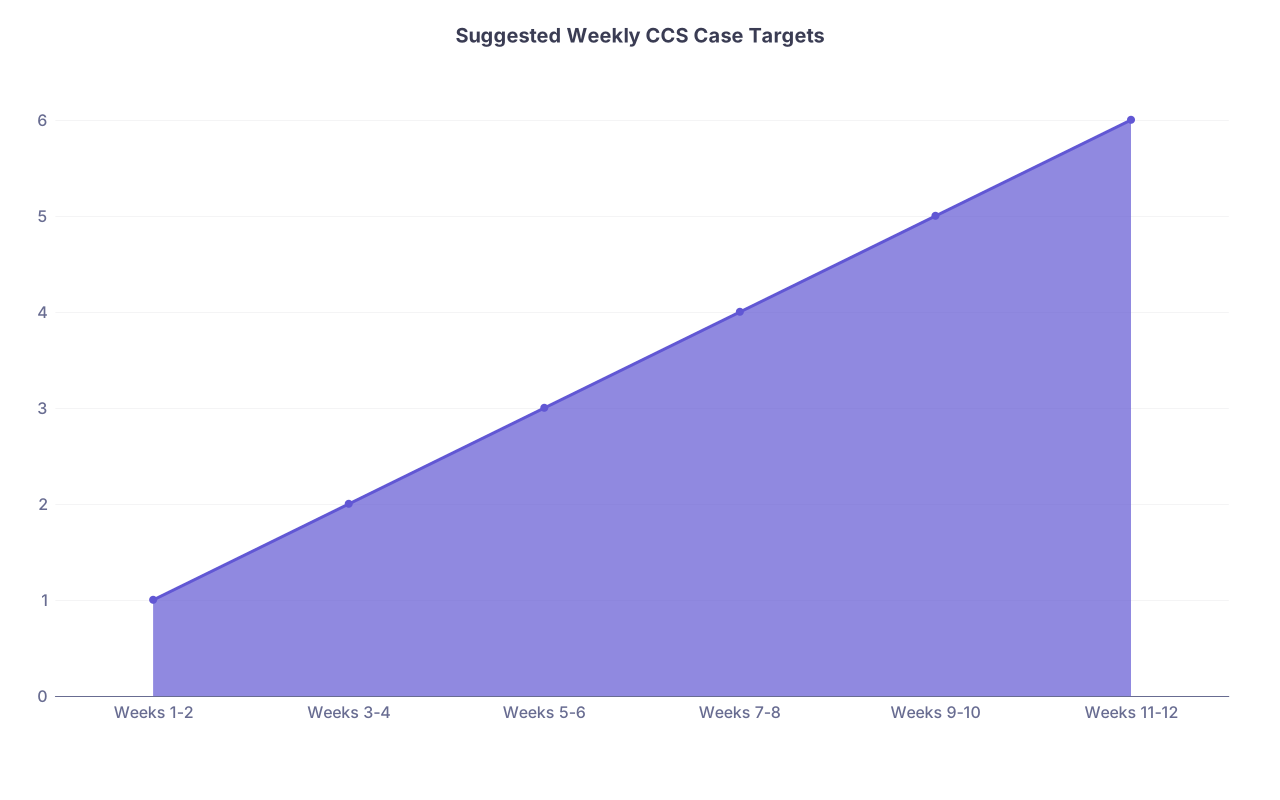
Set a CCS plan:
Weeks 1–4:
- Just learn the interface. Do 1–2 untimed cases per week, no pressure.
Weeks 5–8:
- Two timed cases per week
- Focus on:
- Stabilization steps (ABC, IVF, O2, monitors)
- Don’t forget basics like pregnancy test, IV access, pain control
Weeks 9–12:
- 3–4 timed cases per week
- Aim for:
- Speed
- Clean order sets
- Not over-ordering every possible test “just in case”
| Category | Value |
|---|---|
| Weeks 1-2 | 1 |
| Weeks 3-4 | 2 |
| Weeks 5-6 | 3 |
| Weeks 7-8 | 4 |
| Weeks 9-10 | 5 |
| Weeks 11-12 | 6 |
You’re not trying to be perfect. You’re trying to become fluent with the format so you don’t waste exam points on logistics.
Step 7: Get Your PD and Chiefs On Board Early
This is the part people avoid. They don’t want to look “weak” by asking for help. Then they end up requesting a week off 3 weeks before the test and get shut down.
You have leverage here: the program wants you to pass Step 3. A resident failing Step 3 is a headache for them too.
So:
Tell your PD/associate PD by email or in person:
“Because our contract requires Step 3 by PGY2, I’m planning to take it around [month]. I’d like to make sure I have a few consecutive days off before the exam. Can we look at the schedule to make that possible?”Loop in the chief who makes schedules:
“I’m booked for Step 3 on [dates]. Could you help me protect 3–4 days before that on a lighter rotation?”
Be direct. Don’t apologize for needing time. You are literally trying to satisfy the contract they wrote.
Ideal setup:
- Two contiguous days off before Day 1
- One day between Day 1 and Day 2 (if your schedule allows)
- At least post-call or light days around those
If your program is rigid and won’t move anything: fine. Then you need to adjust your test date early, not wait and hope.
Step 8: Know When to Move the Date vs. When to Commit
Residents panic about rescheduling. They keep saying, “I’m not ready,” and endlessly push the test back. That’s how you end up too close to the contract deadline with no buffer for a retake.
You need clear rules for yourself:
Move the test if:
- You haven’t even finished 50–60% of your Qbank by 4 weeks out.
- Your life blows up (illness, family crisis, schedule changed to nights right before exam, etc.).
- Your practice scores are consistently in a dangerous zone after real effort.
Hold the test date and go for it if:
- You’ve finished at least 70–80% of UWorld with decent review.
- Your practice scores suggest you’re in the passing neighborhood (you don’t need star scores, you need “likely to pass”).
- You can reasonably carve out 4–6 heavy study days in the last 2 weeks.
Remember the meta-game:
You’re not just choosing a test date. You’re choosing how much room you’ll have if you need a second attempt. With a contract requirement, that buffer matters more than “feeling perfectly ready.”
Step 9: What If You Fail the First Time?
Let’s talk about the scenario you’re hoping to avoid but absolutely have to plan for.
You took Step 3. You get the email. You didn’t pass.
First: don’t disappear. Don’t quietly spiral and avoid telling anyone. That’s how this becomes a contract problem rather than an academic setback.
Your move within 48–72 hours:
Tell your PD or APD:
“I did not pass Step 3. I already started planning for a retake. The earliest date I can rebook is [X], and I’m adjusting my study plan to focus on [weak areas].”Ask directly:
“Given my contract requires passing by [date], can we talk about how to prioritize this with my schedule so I can retake in time?”Get the report, not just the score.
Identify:- Weak content areas (OB, peds, biostats, etc.)
- Were you hammered more on CCS or multiple-choice?
- Did time management kill you?
Then build a short, ruthless remediation plan:
- 4–6 weeks of focused study
- Prioritize:
- Weak sections in UWorld
- More CCS cases
- Timed, full-length blocks to fix stamina and pacing
You’re not starting from zero. You already did a full pass and a test. Now you’re patching holes with urgency.
If you’re late PGY2 and cutting it close to the contract deadline, push for:
- Temporarily lighter rotations
- Reading time if your program has it
- Transparent documentation in your file that you’re addressing this aggressively
Programs are more likely to work with you if you’re proactive and honest early, not if you show up at the eleventh hour saying, “Oh, I never took Step 3.”
Step 10: Keep Your Sanity (Because Burnout Kills Scores Too)
You can’t cram Step 3 like a med school exam while also doing 80-hour weeks and expect your brain to cooperate. Burned-out residents do dumb things on vignettes they would normally get right.
So you do a few sanity-protection moves:
- Don’t study post 11 pm on call-heavy weeks. Sleep is worth more than 8 extra questions.
- Pick one low-stress thing that remains non-negotiable:
- A weekly workout
- Lunch outside the hospital once a week
- A walk or podcast on your day off
And be honest with yourself: if you’re at the level of burnout where you’re forgetting basic patient info, you may need a slower Step 3 ramp with a later date, not an early cram that leads to a fail and more stress.
This isn’t about wellness posters. It’s about raw test performance.
A Simple 8-Week Example Plan (If You’re Right Up Against It)
If you suddenly realize: “My contract deadline is closer than I thought,” and you’ve got about two months before your chosen test date, here’s a realistic outline.

| Step | Description |
|---|---|
| Step 1 | Week 1-2 |
| Step 2 | Week 3-4 |
| Step 3 | Week 5-6 |
| Step 4 | Week 7 |
| Step 5 | Week 8 |
| Step 6 | 40-60 Qs/week, learn CCS interface |
| Step 7 | 80 Qs/week, 2 timed CCS cases/week |
| Step 8 | 100-120 Qs/week, fill weak areas |
| Step 9 | Practice test, heavy review, CCS daily |
| Step 10 | Light review, sleep, logistics |
Very compressed. Not ideal. But it’s a path that fits into a real resident’s life. If your timeline is longer—good. Stretch some blocks, keep the structure.
Final Thoughts: Your Game Plan in 3 Sentences
- Treat the Step 3 contract clause like the hard deadline it is and schedule your test early enough to allow a retake if needed.
- Build a numbers-based plan around UWorld + CCS practice that fits your actual rotation life, not the imaginary version where you’re always rested.
- Pull your PD/chiefs into the plan early, not after something goes wrong; proactive residents get help, last-minute panickers get “we’ll see” and consequences.