
You’re standing in the workroom, white coat on, stethoscope around your neck, and you catch yourself doing it again.
You lower your voice when the attending walks in.
You uncross and recross your legs so you look “more serious.”
You stop yourself from saying “oh my gosh, that’s so exciting” about a cool case because… that sounds too young. Too girly. Too “not surgeon enough” or “not internist enough” or whatever stereotype is lodged in your brain.
And then you go home and think:
What the hell am I doing?
Why do I feel like I have to sand off every “feminine” part of myself just to be taken seriously?
And is this just… what it’s like forever if you’re a woman in medicine?
You’re not imagining it. And you’re not overreacting.
Let’s pull this apart.
Where This Pressure to “Act Less Feminine” Actually Comes From
Let me say the quiet thing out loud: medicine still has a default template in a lot of people’s minds.
Confident. Assertive. Not too emotional. Not too soft.
Basically… a historically male-coded personality.
You see it in the tiny comments people toss at you like they’re nothing:
“Wow, you’re actually really assertive for a tiny girl.”
“You’re so sweet, you’ll be a great pediatrician.” (When you just said you love trauma surgery.)
“You might want to be careful with the makeup on interview day—training is serious.”
No one says, “Act less feminine.”
They just reward you when you’re more “neutral” (read: closer to male-coded) and subtly punish you when you’re not.
You laugh too loudly? “Unprofessional.”
You’re warm with patients? “You’re going to get walked all over.”
You speak up directly? “Aggressive.” But your male classmate does the exact same thing and he’s “a leader.”
So your nervous system learns.
Okay, so if I just… flatten myself a bit, talk a bit lower, dress a bit plainer, smile a bit less… maybe they’ll think I’m competent.
That isn’t you being fake or weak. That’s you adapting to a system you’re not stupid about. You’re reading the room correctly.
The question is not, “Why am I like this?”
The question is, “How much of this do I actually want to carry with me long-term?”
Will This Pressure Ever Go Away? The Ugly And The Honest
Short answer: the pressure doesn’t magically disappear. But your relationship to it can change a lot.
I’ve watched people at different stages:
- Premed who wears only black blazers and low ponytails to shadow because “I don’t want to look like I’m trying too hard.”
- MS3 who stops wearing mascara on surgery because the senior once joked about “Instagram doctors.”
- PGY3 who says, “Screw it,” and shows up with her usual eyeliner because she’s too tired to pretend, and somehow… nothing explodes.
Here’s the pattern I keep seeing:
Early on, the pressure feels constant and suffocating. You don’t know the rules, you don’t know what’s allowed, and everyone around you seems to be watching and scoring you. So you clamp down.
Then over time, a few things shift:
You get more power.
As you move from premed → med student → resident → attending, you gain credibility. That doesn’t magically fix sexism, but it does give you a buffer. People are less likely to question everything about you once you’re proven competent.You find your people.
Not the brochure version. I mean the attending who wears winged eyeliner in the OR and is an absolute beast at lap choles. The senior resident who is soft-spoken with patients and still commands instant respect. Once you see it done, your brain relaxes: “Oh. There’s more than one way to be a good doctor.”Your tolerance for self-erasure drops.
At 21, you’re like, “I’ll become whatever they want.”
At 29, after years of call and codes and death and charting, you’re like, “Absolutely not. I cannot strip away my entire personality just to make a mediocre attending more comfortable.”
So does the external pressure fully vanish? No. I won’t lie to you. Even attendings get comments about being “too emotional” or “too stern” or “not maternal enough.”
But the internal pressure—that panicked need to constantly contort yourself—can absolutely shrink. A lot.
You stop thinking: “I must act less feminine or they won’t respect me.”
You start thinking: “I can adjust in certain rooms because I’m strategic, but I’m not erasing myself for this place.”
The Double Bind: Too Soft, Too Harsh, Never Just Right
There’s this psychological trap that especially hits women in medicine: the competence–likability double bind.
Be “feminine”: warm, soft, smiley, agreeable → people like you but may doubt your authority.
Be “masculine”: direct, firm, blunt → people respect your knowledge but call you “intimidating,” “cold,” or worse.
You’ve probably felt it on rotations:
You apologize when you ask a nurse to page the attending again because you don’t want to be “annoying.”
You preface everything with “Sorry, I just had a quick question…”
Then someone tells you during feedback, “You need to speak with more confidence.”
So next rotation, you’re decisive: “Let’s get a lactate, let’s call pharmacy, I’m concerned about sepsis.”
Now the vibe shifts: “You can come across as a bit intense.”
You’re not crazy. That’s the bind.
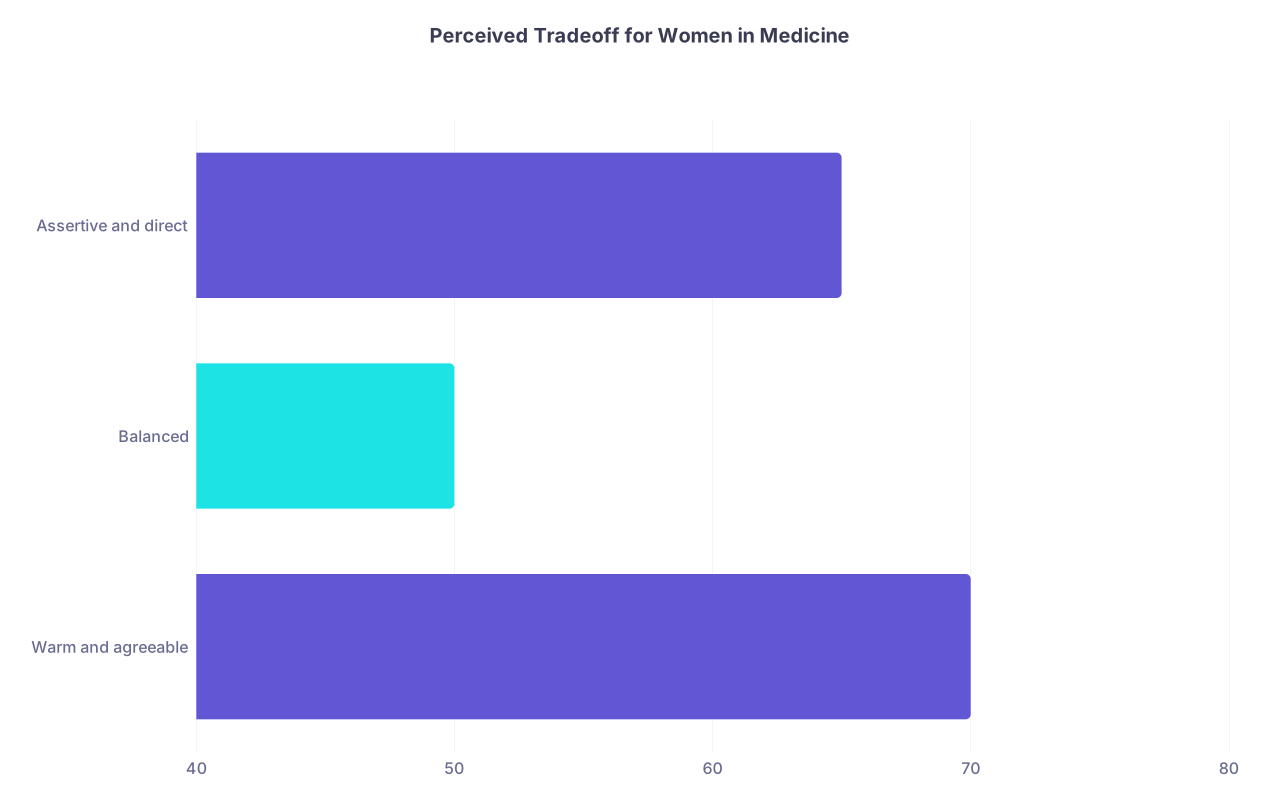
| Category | Value |
|---|---|
| Warm and agreeable | 70 |
| Balanced | 50 |
| Assertive and direct | 65 |
What I’ve seen work is not trying to escape the bind completely (you can’t; it’s built into the culture), but deciding where you want to sit on that line.
So instead of, “How do I act less feminine so they like me?”
It becomes, “How much do I care about being perceived as ‘nice’ in this room vs. clear and safe for the patient?”
It’s not about abandoning femininity. It’s about consciously choosing when you dial things up or down, for your reasons, not because you’re terrified of every evaluation.
“But What If I’m Actually Very Feminine?” (And I Don’t Want to Kill That Part of Me)
This is the nightmare, right? You’re like: I like dresses. I like soft colors. I like laughing. I cry at sad consults. I care deeply about how my patients feel.
And medicine keeps screaming: Neutral. Toughen up. Harden. Be less.
You’re scared that if you really go all-in on this path, you’ll wake up one day and not recognize yourself. You’ll be efficient and respected and completely hollow.
So here’s the thing: the women I’ve seen burn out the hardest are not the ones who are “too feminine.”
It’s the ones who erased themselves for years to fit some imaginary box.
The ones who cut off every part that felt “too much”:
- No color, no “girly hobbies,”
- No vulnerability,
- No owning excitement or joy because that looks “immature.”
They become this sanitized, gray version of themselves. And then they wonder why the job feels like suffocating.
Your femininity—however that shows up for you—is not the enemy. The enemy is the belief that only one narrow personality wins in medicine.
Look at the women ahead of you. Really look. You’ll see:
- The EM attending with glitter nails who codes like a boss.
- The hospitalist who speaks softly and never yells and still gets everything done.
- The surgeon who wears lipstick and cracks dry jokes and runs a terrifyingly efficient OR.
They exist. Not always in huge numbers at every place, but they are real.

The more you see that, the easier it becomes to ask:
“If they’re allowed to exist fully, why not me?”
Ethics Question: Am I Complicit If I Conform?
This is the part that keeps a lot of people up at night but they don’t say out loud.
You’re thinking:
“If I wear plain clothes, never mention kids, act ‘chill’ when someone says something sexist… am I part of the problem? Am I selling out other women?”
You’re trying to survive and do the right thing. And sometimes those feel incompatible.
Let me be blunt: it is not your job, as a premed or med student or junior resident, to single-handedly reform the gender politics of an entire hospital.
Self-preservation is not a moral failure.
You’re allowed to:
- Wear what makes you feel safest in a given setting.
- Let stupid comments slide because you’re exhausted.
- Play the “less feminine” card in certain rooms to get through the damn day.
Ethics in medicine isn’t only about grand stands and whistleblowing. It’s also about what you can sustain. What lets you keep practicing long enough to actually help people.
That said, I’ve seen a shift that tends to happen:
Early training: “I’ll just keep my head down and fit in.”
Mid training: “Okay, I can start setting small boundaries.”
Later: “I’m comfortable enough to model a different way of being and to back up trainees who want that too.”

| Step | Description |
|---|---|
| Step 1 | Premed |
| Step 2 | MS1-2 |
| Step 3 | MS3-4 |
| Step 4 | Intern |
| Step 5 | Senior Resident |
| Step 6 | Attending |
You’re not failing feminism because you wore a boring blazer to your interview.
You can pick your battles now and still grow into someone who makes things better later.
How Much Of This Is Strategy vs. Self-Betrayal?
Here’s the uncomfortable truth: there is some strategy in professional shape-shifting. Everyone does it to a degree.
You talk differently to a scared patient than to a cocky consultant.
You talk differently on psych than on trauma surgery.
That’s not fake. That’s range.
The line you’re worried about is: when does “strategy” become “I don’t recognize myself anymore”?
A couple of signs you’re crossing into self-betrayal:
- You feel physically tense every day you get dressed for clinical stuff.
- You feel ashamed after being yourself (“Why did I laugh like that? Why did I say that?”) even when you didn’t actually do anything wrong.
- You don’t remember the last time you relaxed around colleagues.
- You feel more like a character you’re playing than a person who’s growing.
If that’s where you are, it doesn’t mean you picked the wrong field. It means the mask is too tight.
The fix is not going 0 to 100 and showing up tomorrow in hot pink heels and red lipstick to a notoriously sexist department just to prove a point. That’s how you get crushed.
The realistic path is micro-adjustments. Tiny rebellions that your nervous system can tolerate.
- If you’ve been flattening your affect completely, allow yourself to express genuine excitement about one case per day.
- If you stripped your wardrobe down to beige nothingness, add back one small thing that feels like you—earrings, a hair clip, a notebook that isn’t black.
- If you’ve been laughing off every offhand sexist comment, pick one time you’ll just… not laugh. Let the silence sit.
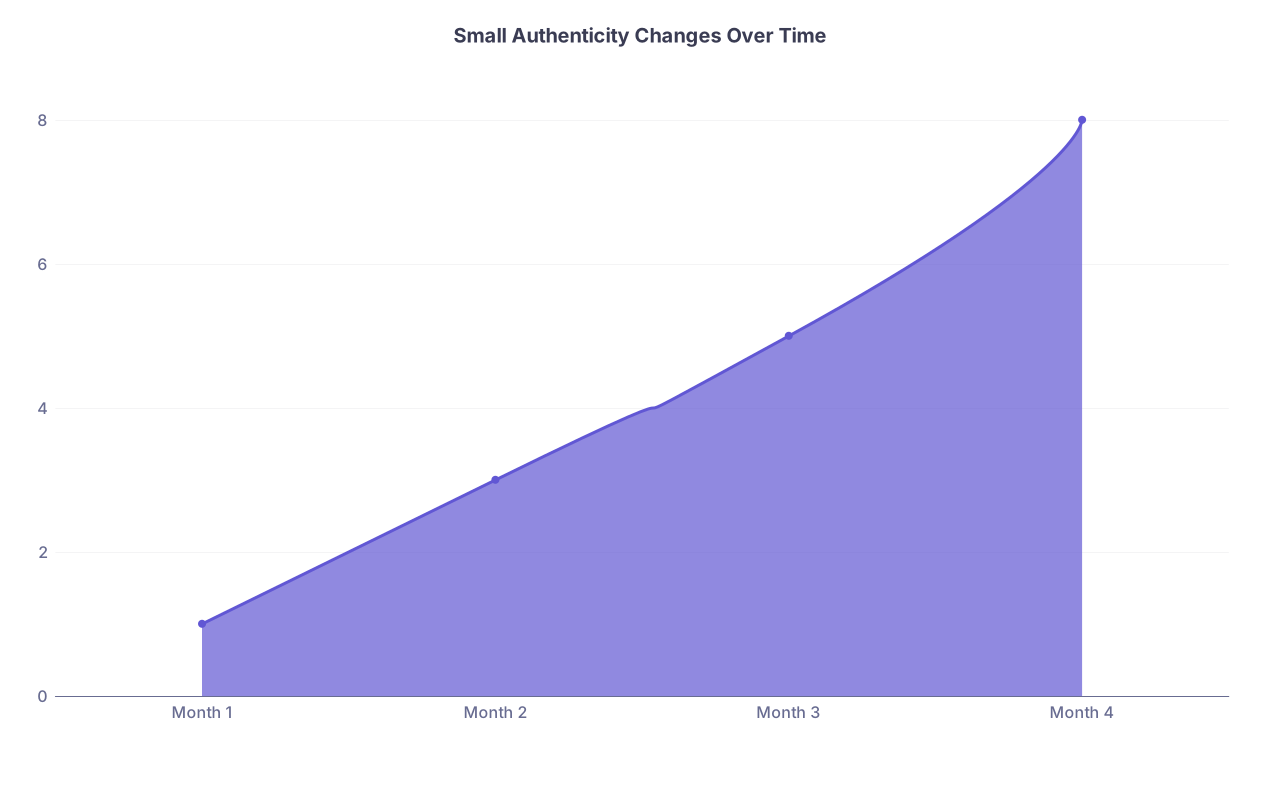
| Category | Value |
|---|---|
| Month 1 | 1 |
| Month 2 | 3 |
| Month 3 | 5 |
| Month 4 | 8 |
These are small enough that they don’t blow up your evals, but large enough that you start to feel like an actual person again.
Finding Places Where You Don’t Have to Hide So Much
Some environments really are worse than others. I’m not going to sugarcoat that.
I’ve seen:
- Programs where women literally compare notes on which attendings downgrade you for being “too friendly.”
- Departments where the only women leaders are aggressively “one of the guys” because that’s how they survived.
- But also… services where the team lead is a woman who brings coffee, remembers birthdays, cries when patients die, and is still absolutely revered.
You’re allowed to factor this into where you apply, where you rotate, where you match.
Not just: “Is this program prestigious?”
Also: “Can I be a woman here without constantly bracing?”
Pay attention when you rotate or interview:
- Do women residents joke about “looking too cute” for OR, or do they look comfortable in their own skin?
- Do female attendings exist… and if so, do they seem like they’ve been ground down or like they still have personalities?
- How do staff talk to each other? Are nurses respected? Do people interrupt women more than men?
| Signal | What You Might Notice |
|---|---|
| Women in leadership | Female PDs, chiefs, service heads who are visibly themselves |
| Visible style diversity | Different ways of dressing/expressing without constant jokes |
| How feedback is given | Comments focus on skills, not tone/appearance |
| Informal culture | Mixed-gender socializing without creepy vibes |
| Resident stories | Women trainees speak candidly and don’t sound terrified |
You can’t fix the whole culture of medicine. But you can choose to plant yourself in places that don’t require you to carve out half your identity to survive.
So… Will I Always Feel Like I Have to Act Less Feminine?
Here’s my honest, non-sanitized answer:
You will probably always be aware of the pressure. That little voice that says, “Tone it down so they take you seriously”—I don’t think it disappears completely.
But it gets quieter.
The more you:
- Build competence.
- Find allies.
- See examples of women being fully themselves and still thriving.
- Take small risks that prove to you that you won’t shatter if you act like yourself for once.
The less that pressure runs you.
Instead of being the background noise of your entire career, it becomes one factor you weigh. Sometimes you’ll choose to lean into neutrality for a particular attending or situation. Sometimes you’ll decide, “No, I’m not shaving off this part of myself for this person.”
That is a huge difference. That’s the difference between living in a box and knowing how to step in and out of one when you feel like it.

One Specific Thing You Can Do Today
Do this right now. Not later. Now.
Open the Notes app on your phone (or grab a piece of paper) and write down two short lists:
“Things I’ve been hiding because they feel ‘too feminine’”
Could be anything: how you laugh, certain clothes, how you talk to patients, the fact that you like cute pens, whatever.“One tiny thing I’m willing to reclaim this week”
Emphasis on tiny. Not a full personality overhaul. Just one thing.
Maybe it’s:
- Wearing the slightly more “you” earrings to clinic.
- Letting yourself say “I’m really excited about this topic” out loud on rounds once.
- Not apologizing before every question you ask.
Pick the smallest one that still feels like something. Circle it.
That’s your assignment for this week.
Not “fix medicine.” Not “be fearless.” Just: take back 1% of yourself on purpose and see what actually happens.
You don’t have to decide today who you’ll be as an attending.
You just have to decide that you’re not going to sacrifice everything about who you are to fit into a mold that probably shouldn’t exist in the first place.
And then take one concrete, tiny step toward being a doctor who looks like you, sounds like you, and still deserves to be taken seriously—because you do.