
The biggest myth about women physicians in rural practice is that the challenges are just “more of the same” with longer commutes. They are not. They are qualitatively different, and if you treat them like a generic practice-choice problem, you will get burned.
Let me break this down specifically.
You are talking about practicing where:
- You are often the only woman physician in a 50–100 mile radius.
- Everyone knows your car, your kids’ names, and your marital status.
- Patients can see your house from the road and will absolutely knock on your door in a crisis.
- The line between professional obligation, community expectation, and personal safety blurs constantly.
That combination creates a distinct web of ethical, professional, and personal dilemmas that most urban colleagues simply do not understand.
1. Gender Dynamics in a Small, Tight Community
In rural practice, your gender is not just a demographic line on your hospital’s HR report. It shapes clinical encounters, call schedules, and whether the community sees you as “our doctor” or “that lady doctor.”
Being “the” woman physician, not “a” physician
If you are the only or one of very few women physicians:
- You will be asked for every female-sensitive visit: pelvic exams, prenatal care, sexual assault evaluations, contraception, adolescent gynecology.
- Male colleagues may “offload” complex or emotionally heavy cases onto you because “the patient would probably be more comfortable with a woman.” Sometimes true. Often lazy.
- Administrators and community members may treat your presence as a symbolic fix for “women’s health” without resourcing you properly.
Ethical tension: Are you obligated to take on disproportionate gender-concordant care because it benefits patients, even when it overloads you?
My stance: you prioritize patient benefit, but you also set clear institutional boundaries. That means:
- Formal policies for how “female provider preferred” requests are handled.
- Explicit limits on your panel and procedure mix to prevent gendered overloading.
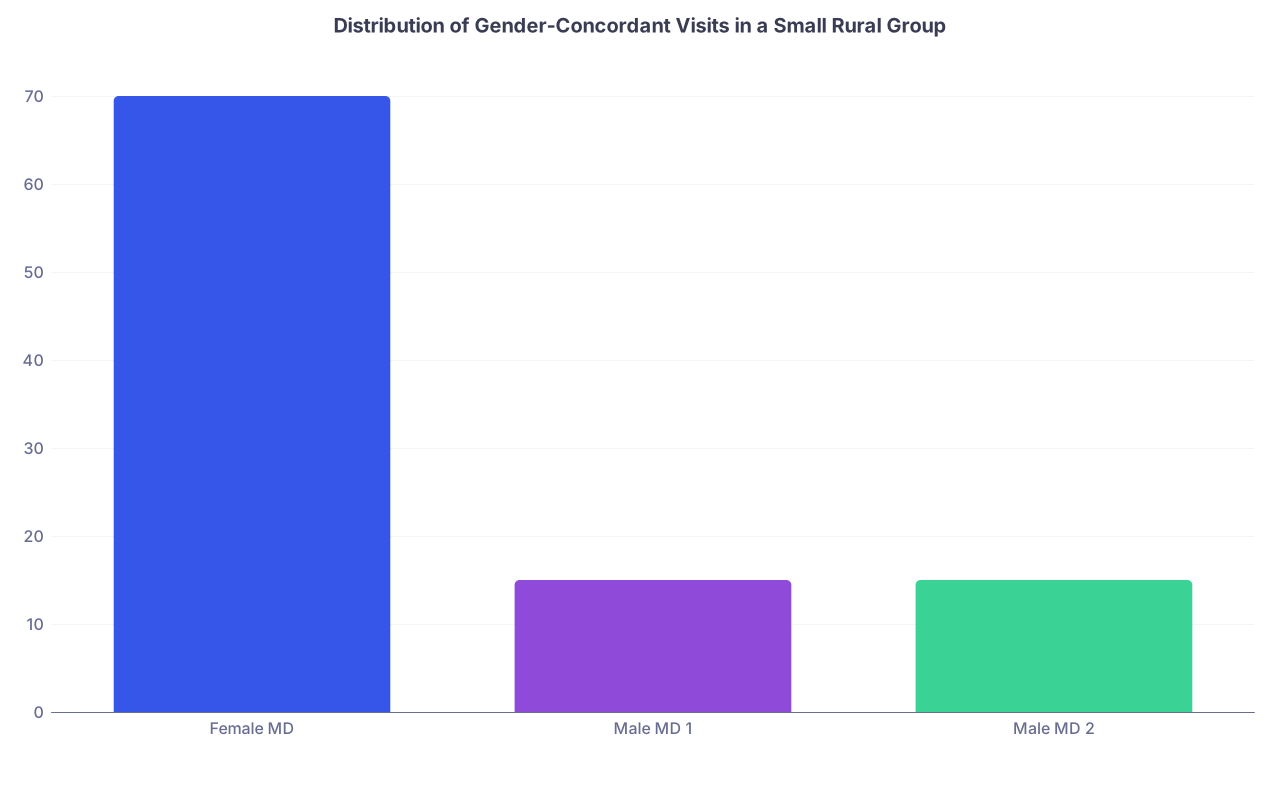
- Clear documentation and data showing panel complexity and visit types, so you have hard numbers when you push back.
| Category | Value |
|---|---|
| Female MD | 70 |
| Male MD 1 | 15 |
| Male MD 2 | 15 |
That bar pattern is not hypothetical. I have seen it in real group reports.
Informal power structures and authority
Rural communities may still operate on traditional gender norms. Translation:
- Male elders and hospital board members may respect your expertise in the room…until you push back on a cherished local practice. Then you are “young” or “emotional”, regardless of your age.
- Staff who are used to male physicians may subtly test your authority—ignoring orders, bypassing your decisions, “double checking” with a male colleague.
You cannot fix ingrained culture with charm. What works:
Early, explicit role definition.
“When I am on call, I am the attending. Final decisions run through me. If there’s disagreement, we talk, but I will decide.”Rapid, consistent follow-through when undermined.
If a nurse calls your male colleague to override your decision, you address it formally, not with a hallway sigh.Strategic allies.
One or two respected senior staff (not necessarily physicians) who will say, “Doctor X is in charge. We do it her way when she’s on.”
This is not about ego. It is about patient safety and professional integrity.
2. Boundary Management When Everyone Knows You
Urban physicians talk about boundary setting. Rural women physicians live it on hard mode.
Role overlap: physician / neighbor / friend / “town doctor”
You will be:
- Getting clinical questions at church, school events, grocery aisles.
- Caring for your child’s teacher, your landlord, and maybe your pharmacist’s spouse.
- Receiving friend requests from patients on social media who are also your kid’s soccer coach.
Ethical crux: Conflicts of interest and dual relationships are unavoidable. You are managing risk, not aiming for perfection.
A realistic framework:
Decide in advance what types of dual relationships you will accept:
- Yes: providing primary care to the only local teacher if there is no viable alternative.
- No: prescribing controlled substances to close friends or people you socialize with weekly.
Be explicit with patients:
“I am happy to be your doctor because access here is limited. But I cannot discuss your medical issues outside clinic except in emergencies.”Use the “clinic rule”: All non-urgent medical questions routed to scheduled visits or official triage, not casual encounters.

| Step | Description |
|---|---|
| Step 1 | Encounter with acquaintance |
| Step 2 | Provide immediate care or direct to ER |
| Step 3 | Ask to schedule visit through office |
| Step 4 | Recommend another clinician |
| Step 5 | Consider accepting as patient with documented rationale |
| Step 6 | Urgent medical issue |
| Step 7 | Existing patient |
| Step 8 | Access alternatives available |
Having a mental flowchart like this protects you from ad hoc decisions driven by guilt or pressure.
Home, privacy, and safety
Separate but related problem: people know where you live. Women physicians are more likely to bear safety risks in this context (stalking, boundary violations, domestic-violence-related threats spilling into their space).
Practical and ethical considerations:
Law enforcement relationship.
In many rural areas, you will know the sheriff or chief personally. Use that. Establish a clear plan: how quickly can they respond if an ex-partner of a patient shows up at your house angry?Confidentiality vs safety.
If you treat local law enforcement, make sure they understand: you are not a back channel for gossip, even in crisis. Keep every disclosure by the book.Physical boundaries:
- Do not list your home address on anything public.
- Consider a P.O. Box for mail.
- Avoid posting recognizable home or neighborhood photos on social media.
This is not paranoia. I have seen women physicians in small towns have patients sit in their driveway at night “just to talk.”
3. Clinical Scope, Isolation, and Gendered Expectations
Rural practice often demands broader scope: emergency care, obstetrics, pediatrics, inpatient rounding, nursing home visits. For women physicians, that scope collides with gendered expectations about who should carry which emotional and care burdens.
The “default” provider for complex, emotional care
Patterns you will see:
- Survivors of sexual assault more often seek you.
- Women in abusive relationships selectively ask for you because they “don’t want to talk about this with a man in a small town.”
- Teens with pregnancy scares or gender/sexuality questions quietly request “the lady doctor.”
You are not just doing more gynecology visits. You are doing more emotionally intense medicine. That has consequences: time per visit goes up; vicarious trauma risk goes up; burnout risk goes way up.
Clinical and ethical tactics:
Build longer default appointment slots for certain visit types.
If your panel is heavy with trauma and complex psychosocial issues and you run 15-minute slots, you will be constantly forced into cutting corners or staying late. Both are bad.Screen for secondary trauma proactively.
If you are doing frequent sexual assault exams without backup or debriefing, you should assume risk, not hope for resilience. Get regular supervision or peer support.Document local resource gaps.
When you advocate for a social worker, domestic violence advocate contract, or tele-psych service, bring evidence: number of IPV cases, ED visits, repeated crisis encounters.

Practicing at the edge of your comfort zone
Another dynamic: you may be pressured to “do everything” because there is no one else.
Typical examples:
- You are asked to manage complex high-risk OB without MFM support, “because the nearest center is 3 hours away.”
- You are asked to perform procedures you did only a couple times in residency (C-sections, complex laceration repairs, emergency D&Cs) because there is no specialty backup.
- You are expected to stay on call extra because “the community really needs you” and “you’re so good with the women patients.”
Ethical line: You must balance beneficence (helping with limited options) against nonmaleficence (not harming by practicing beyond safe competence).
A practical rule set:
- Define your red lines in writing. “I do not perform emergency C-sections without surgical backup. Period.”
- Define your “conditional yes” zone. “I will manage moderate-risk OB if I can have MFM teleconsult access and clear transfer plans.”
- Communicate this before the crisis.
Push your medical staff office and hospital administration to adopt written protocols for:
- When to transfer obstetric, pediatric, or trauma cases.
- Which procedures must have specialist or second-physician backup.
Document every time you are pushed beyond these boundaries and how you responded. It protects you legally and morally.
4. Workload, Call, and the “Invisible Second Shift”
Rural women physicians often carry a disproportionate share of both emotional and physical work—at the clinic and at home.
Call schedules and “flexibility” traps
You will hear this line: “You can have flexibility here.”
Translation, in many places: you can compress your workday, but call will swallow your nights and weekends, and you will be expected to “help out” when male colleagues with stay-at-home partners want time off.
You need to look at the real arithmetic.
| Physician | Gender | FTE | Call Nights/Month |
|---|---|---|---|
| Dr. Smith | M | 1.0 | 5 |
| Dr. Johnson | M | 1.0 | 5 |
| Dr. Patel | F | 0.8 | 6 |
| Dr. Garcia | F | 1.0 | 7 |
This pattern is common: the women working “flexible” or part-time FTE mysteriously have more or equal call compared with male colleagues. Because “your husband also works, so evenings are better for you anyway” or similar nonsense.
Ethical strategy:
- Tie call to FTE and complexity, not to perceived “flexibility”.
- Insist call agreements be in the contract, not handshake culture.
- If you take more of the “soft” call (L&D triage, nursing home calls, low-paid coverage), demand recognition—either RVU adjustments, stipend, or schedule offsets.
The home front: caregiving, gender, and burnout
Let us be blunt. Many rural regions have more traditional gender roles. Even highly educated spouses may default to assumptions that the woman physician will:
- Manage childcare logistics.
- Stay home when the kids are sick.
- Coordinate elder care.
If you are not explicit and somewhat ruthless about rebalancing, you end up doing:
- Full-time rural practice.
- On-call nights.
- A second shift at home.
That is a direct pipeline to burnout and moral injury. It also feeds a subtle ethical conflict: if you are depleted and resentful, your patient care quality and empathy will slip.
What actually helps:
- Schedule-level negotiations with your partner that treat your time as equally valuable.
- Clear “non-negotiables” (for example, post-call days where you do not carry household responsibilities).
- Use of paid help if financially possible. And no guilt about it.
Calling this “self-care” is too soft. This is about sustaining ethical, competent clinical practice over decades.
5. Reproductive Health, Autonomy, and Local Politics
Many rural areas are in regions with restrictive reproductive laws and strong cultural opposition to contraception or abortion. Women physicians practicing there face a minefield.
Counseling vs local norms
Scenarios you will encounter:
- Teens asking for contraception when their parents (who are also your patients) are outspokenly against it.
- Patients requesting information about abortion or out-of-state options when your hospital or community is hostile to even discussing it.
- Pharmacists who refuse to fill emergency contraception or certain contraceptives.
Ethical baseline: You still owe patients accurate, evidence-based medical information about their options, within the law. You are not obligated to align with local ideology.
This means:
- Knowing your state’s legal boundaries cold.
- Using precise language in documentation: “Patient counseled on all legally available options for pregnancy management including risks and benefits.”
- Having pre-identified referral pathways (including telemedicine) that are ethically sound and legally safe.
You may face social blowback. The board member who hears that you “support abortion” may suddenly question your contract renewal. This is where institutional backing—or its absence—becomes very clear.
Conscientious objection—yours or theirs
The conflict is not only between you and the community. It can also be between you and your colleagues.
- If you provide contraception or early abortion where legal, and your partners refuse, you may inherit the full volume of these patients.
- If you have your own conscientious objection to certain procedures, in a small community, there may be no alternative provider.
Ethically, conscientious objection is only legitimate if:
- Patients still have timely access to care.
- You are transparent in advance.
- You do not abandon patients in emergencies.
In rural practice, the “timely access” standard is harder to achieve. If the nearest alternative is 4 hours away and the patient has no car, telling yourself “they can always go elsewhere” is self-deception.
So you need to:
- Decide what you will and will not do in this environment before you commit to a job.
- Ask direct questions about your group’s stance and service scope.
- Be honest with yourself: Are you willing to be “the only one” doing X in town and take the social heat?
6. Safety, Harassment, and Power Imbalance
Sexual harassment and gender-based disrespect happen everywhere in medicine. Rural settings add intensity because of repeated contact and small social circles.
Harassment from patients and staff
Common patterns:
- Older male patients making sexualized comments, testing boundaries, or dismissing your expertise.
- Staff (usually male but not always) using “jokes” to test what they can get away with, especially if you are younger or new to the community.
- Community figures (clergy, business owners) who are also patients, flirting or pressuring socially.
In a large hospital, you can often “route around” these people. In a small clinic, you will see them again. And again.
Concrete strategies:
Scripted responses. Decide on 2–3 lines you will use the moment someone crosses a line, for example:
- “We are going to keep this professional.”
- “That comment is not appropriate in a medical visit.”
Escalation protocol. Who will you tell at the clinic or hospital? If the answer is “no one who will actually act,” that is a serious red flag about the practice culture.
Document. Every significant incident. Dates, names, context. If you get pushed out later for speaking up, this documentation matters.
| Category | Value |
|---|---|
| Large Urban Hospital | 15 |
| Suburban Clinic | 12 |
| Small Rural Hospital | 25 |
| Solo Rural Practice | 18 |
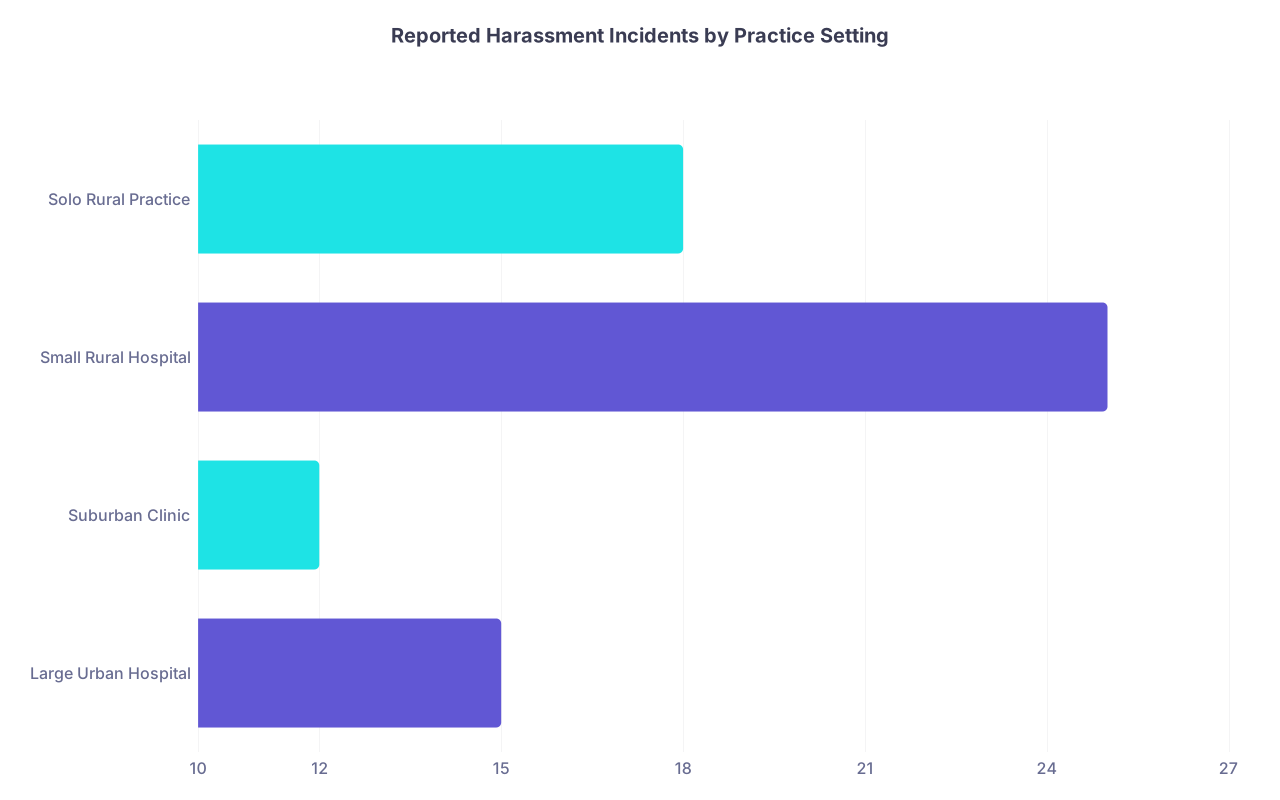
The higher bars for rural and solo settings would not surprise most women physicians who have worked there.
Power, isolation, and retaliation risk
Reality: In a small hospital, the person harassing you may be:
- The only surgeon.
- The medical director.
- The board chair.
You cannot rely on anonymous reporting or a deep HR bench.
Ethically, you must weigh:
- Your personal safety and mental health.
- Your duty to patients who may also be mistreated by this person.
- The likelihood of effective action versus retaliation.
I am not going to romanticize whistleblowing. In rural settings, it can cost you your job and your community in one move. That is why:
- You build external support: state medical society, women physicians networks, legal counsel if it escalates.
- You give yourself permission to leave a toxic environment rather than “toughing it out for the community.”
You cannot provide ethical care indefinitely in an environment that actively undermines your dignity and safety.
7. Professional Growth, Isolation, and Identity
Rural women physicians often feel professionally and personally isolated. That isolation has ethical dimensions too—stagnant skills, limited mentorship, and identity shrinkage.
Skill maintenance and ethical competence
Clinical skills decay without usage and feedback. In remote areas:
- CME access is limited by geography and time.
- You may be the “expert” by default even when you know your training is out of date.
- Procedures you rarely perform become risky, but the community still expects them.
You have an ethical obligation to:
- Honestly assess your competence and decay risk.
- Pursue tele-education, simulation sessions at regional centers, or periodic locums in busier sites to maintain procedural skills.
- Scale down or stop services once your skills fall below a safe threshold, even if the community is unhappy.
If you are the only one providing a high-risk service (for example, OB), you need a medium-term succession or modification plan. “I will stop OB at 50” is fine only if you help create alternative paths well before then.
Identity beyond “the doctor”
Rural communities can swallow your identity: you are “Doc” everywhere you go. For women that can intersect harshly with gender expectations—people expect relational availability, emotional labor, and constant presence.
You need some part of your life where you are not the doctor or “the lady doctor.” That is not self-indulgence. It is protective.
Whether that is:
- Online communities of women physicians.
- Regional peer groups that meet quarterly.
- Non-medical roles (writing, arts, farming, coaching)…
…you need something that reminds you that you exist beyond call schedules and town gossip.

Ethically, why does this matter? Because exhausted, identity-flattened physicians become cynical and detached. That is bad for patients, bad for judgment, and bad for you.
8. Choosing, Negotiating, and Exiting Rural Roles Wisely
Let me be blunt: not every rural practice is salvageable, and not every “community need” is your ethical responsibility to fix at personal cost.
Before you sign
Questions you should explicitly ask (and get in writing where possible):
- How are call and panel assignments divided? Show me data by physician.
- Who currently handles:
- OB
- Sexual assault exams
- Complex mental health
- Contraception and abortion-related counseling (if legal)?
- How many women physicians have joined and left in the last 10 years, and why?
- What is the harassment and grievance process? Has it been used? With what outcomes?
If they dodge or minimize these questions, believe their behavior, not their words.
While you are there
Ethically sustainable practice looks like this:
- Transparent, fair workload.
- Respectful, enforceable boundaries.
- At least one or two genuine allies in leadership.
- Some path for professional evolution—academic affiliations, telehealth teaching, research, or leadership roles.
You keep a running assessment: “Can I still practice the way I believe is right here?” If the answer steadily erodes, you start planning an exit before you hit the wall.
When it is time to leave
Leaving a rural practice often comes with guilt.
- “The town needs me.”
- “Who will take care of my OB patients?”
- “I am abandoning my panel.”
Here is the ethical correction: you are responsible for transitions of care, not for single-handedly fixing a systemic failure of workforce planning.
You:
- Give adequate notice.
- Help recruit or at least define the role for your replacement.
- Provide clear handoffs and summaries for high-risk patients.
- Communicate your departure to patients in a way that is honest but not self-sacrificing: “I am leaving to protect balance in my own life and career. I value the care we have shared.”
That is what responsible professionalism looks like.
FAQs
1. Is rural practice a bad idea for women physicians?
No. It can be incredibly meaningful, with broad scope, deep relationships, and real impact. The problem is not “rural” itself; it is entering blindly, without seeing the gendered workload, boundary challenges, and cultural dynamics. Go in eyes open, with clear red lines and a strong support network.
2. How do I handle male patients who refuse care from a woman physician?
You do not beg for their respect. You calmly state: “I am the attending physician today. You are entitled to decline care from me, but that may delay your treatment because another doctor is not immediately available.” Document the refusal. If it becomes a pattern or includes abuse, work with administration on behavior standards. Your worth is not determined by one patient’s bias.
3. Should I accept all female patients who request me in a small group?
Not automatically. You balance patient comfort with workload equity and your own bandwidth. It may be reasonable to prioritize complex or sensitive cases, while sharing routine care across the team. Use data to show if your panel is being overloaded. Patient preference matters, but you are not ethically obligated to accept unlimited volume.
4. What if my values about reproductive health conflict with the local culture?
You still owe patients accurate information about legal options and evidence-based care. If your practice or hospital forbids even counseling, that is a serious ethical red flag. You can sometimes work within constraints using private conversations and referrals, but if you are consistently prevented from practicing according to your core ethical standards, you should strongly consider leaving that setting.
5. How can I find mentorship as a rural woman physician when no one local looks like me?
You look beyond geography. Join women-in-medicine groups at state and national levels, use virtual mentorship programs, and connect via specialty societies. Set up regular video calls with mentors who understand rural medicine or gender dynamics specifically. Do not wait until you are burned out; build that network early. External mentors are often more honest about when a practice is using you versus truly supporting you.
Key takeaways: Rural practice as a woman physician requires deliberate boundary setting, uncompromising attention to safety and fairness, and a willingness to say no—even to a community you care about deeply. Your obligation is to provide excellent, ethical care without sacrificing your own wellbeing or values on the altar of “being needed.”