
Competitive specialties do not have a monopoly on suffering. The idea that “derm and rad onc chill, surgery and ortho grind” is a cartoon version of reality—and the actual data is a lot less clean, and a lot less flattering to some supposedly “lifestyle” fields.
Let’s peel this apart with what people actually report, not what fourth-years say on Reddit between audition rotations.
The Core Myth: “If You Choose X, You’ll Work Way More”
You’ve heard it in every student lounge:
- “Surgical subspecialties are brutal, you’ll never see your family.”
- “Derm, optho, radiology—easy life, tons of money, done by 3 pm.”
- “If you want balance, don’t go into anything competitive.”
This is wrong in three different ways.
First, hours are more tightly clustered than you think. Second, there are huge differences within specialties—your program and culture matter more than the specialty label. Third, a lot of “competitive = working more” is just people confusing training intensity with total number of hours.
Let’s look at the numbers instead of vibes.
What the Surveys Actually Show About Resident Hours
There are three main sources worth paying attention to:
- ACGME duty-hour rules (the ceiling).
- National resident surveys (what people say they really work).
- Specialty-specific surveys and burnout data.
Duty Hour Rules: The Official Ceiling (That’s Frequently Bent)
ACGME caps you at:
- 80 hours/week averaged over 4 weeks
- 24+4 hour calls
- One day off in seven, averaged
This is not a target. It’s a legal upper bound that programs regularly massage, “average,” or flat-out misreport. I’ve seen residents literally told, “Don’t chart more than 80, it creates problems for the program.”
So everything you’re about to read lives in the shadow of this ceiling. If someone is “officially” reporting 78 hours/week, that probably means: at least 80, sometimes more.
Self-Reported Hours by Specialty: The Reality Cluster
Different surveys give slightly different numbers, but the pattern is consistent: yes, there’s variation, but it’s not the Grand Canyon. It’s a ditch.
Typical self-reported weekly hours (during residency), pulled from national resident/fellow surveys and large program-level reports over the last decade, usually fall into something like this:
| Specialty Group | Typical Reported Range (hrs/wk) |
|---|---|
| General Surgery, Neurosurg | 70–80+ |
| Ortho, OB/GYN | 65–80 |
| Internal Med, EM, Anesthesia | 55–70 |
| Pediatrics, Family Med | 55–65 |
| Radiology, Pathology | 50–60 |
Notice something? There is no 35–40 hour residency. The “cush” fields are playing in the same league—just 10–20 hours below the peak.
To make the point clearer:
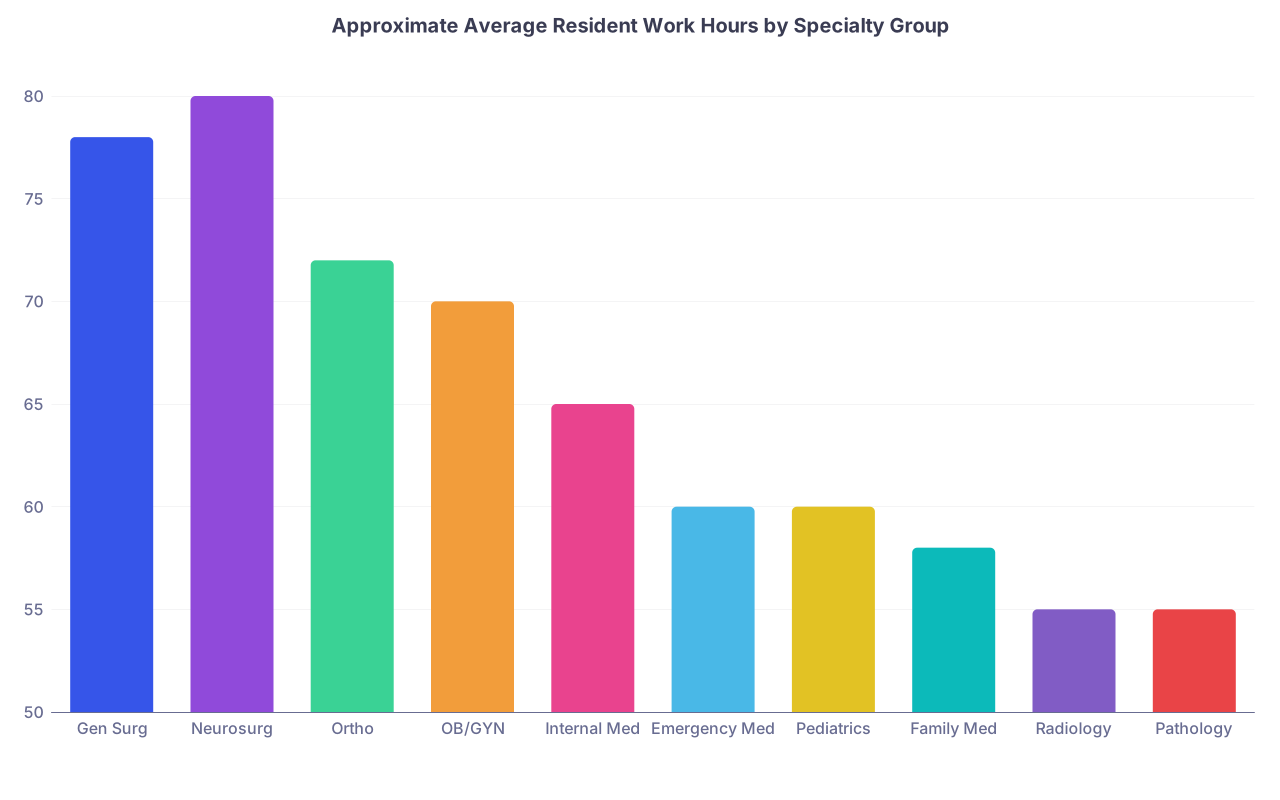
| Category | Value |
|---|---|
| Gen Surg | 78 |
| Neurosurg | 80 |
| Ortho | 72 |
| OB/GYN | 70 |
| Internal Med | 65 |
| Emergency Med | 60 |
| Pediatrics | 60 |
| Family Med | 58 |
| Radiology | 55 |
| Pathology | 55 |
These are ballpark, but they match what residents tell surveyors, and frankly, what they complain about in PGY lounges.
So yes, the surgical world tends to be higher. But the story that “competitive specialties work dramatically more hours” falls apart fast once you stop comparing stereotypes and start comparing actual ranges.
Competitive vs Non-Competitive: You’re Focusing on the Wrong Variable
Students obsess over “competitive vs non-competitive” like it’s a lifestyle axis. It’s not. It’s an “entry barrier” axis.
Some specialties are hard to match because they want:
- Higher Step scores
- Strong letters from big-name faculty
- Serious research
- Tight class rank / AOA
None of that directly tells you how many hours you’ll work in training.
Compare These Apples to Apples
Let’s contrast a few specialties people commonly misjudge:
| Specialty | Perception | Typical Hours (Residency) |
|---|---|---|
| Dermatology | Ultra lifestyle, low hours | ~45–55 |
| Radiology | Lifestyle, reading room | ~50–60 |
| Anesthesia | Good lifestyle | ~55–65 |
| OB/GYN | Brutal, always on call | ~65–75 |
| Emergency Med | Shift work, lots of time | ~55–65 |
Derm is undeniably on the lower end. Fine. But radiology and anesthesia are not 30-hour weeks in a WeWork. They’re still real residencies with nights, call, and weeks in the 60s at many programs.
Emergency medicine is the best example of how messy this is. EM is moderately competitive. It’s shift-based. But some EM residents do 18–22 shifts per month with nights and weekends, which can easily sit at 55–65 hours/week once you layer in pre/post-shift work and mandatory conferences.
Also: there are non-competitive fields with absolutely vicious schedules. I’ve seen small community family medicine programs where residents are perpetually cross-covering four services and floating near 70 hours/week. Nobody calls that “competitive.” It’s just understaffed.
The Hidden Variable: Program Culture Dwarfs Specialty Label
This is the part almost nobody tells you as a student: the spread between programs inside the same specialty is often bigger than the spread between specialties.
I’ve seen this firsthand:
- A big-name academic internal medicine program where residents routinely hover 70–80 hours on ICU and wards, short-staffed, constant admissions.
- A solid but not-famous IM program where residents mostly sit at 55–60, clear caps, no “just hold the pager you’ll be fine” nonsense.
Same specialty. Same ACGME rules. Completely different reality.
Now apply that to a competitive field:
- A malignant surgical program with 24+4-hour calls that magically “average” below 80.
- A well-run surgery program that enforces non-punitive handoffs, uses advanced practice providers intelligently, and protects days off.
Which one works more? Obviously the malignant one. But both are called “general surgery.”
This is why “do residents in competitive fields work more?” is a bad question. The better question is: “Does this specific program enforce sane workload, caps, and time off, or do they treat duty hours as paperwork?”
Burnout: The Myth of “Just Pick a Lifestyle Specialty”
Here’s where ethics and personal development collide with the data.
Burnout is not a simple function of total weekly hours. The relationship looks more like this:
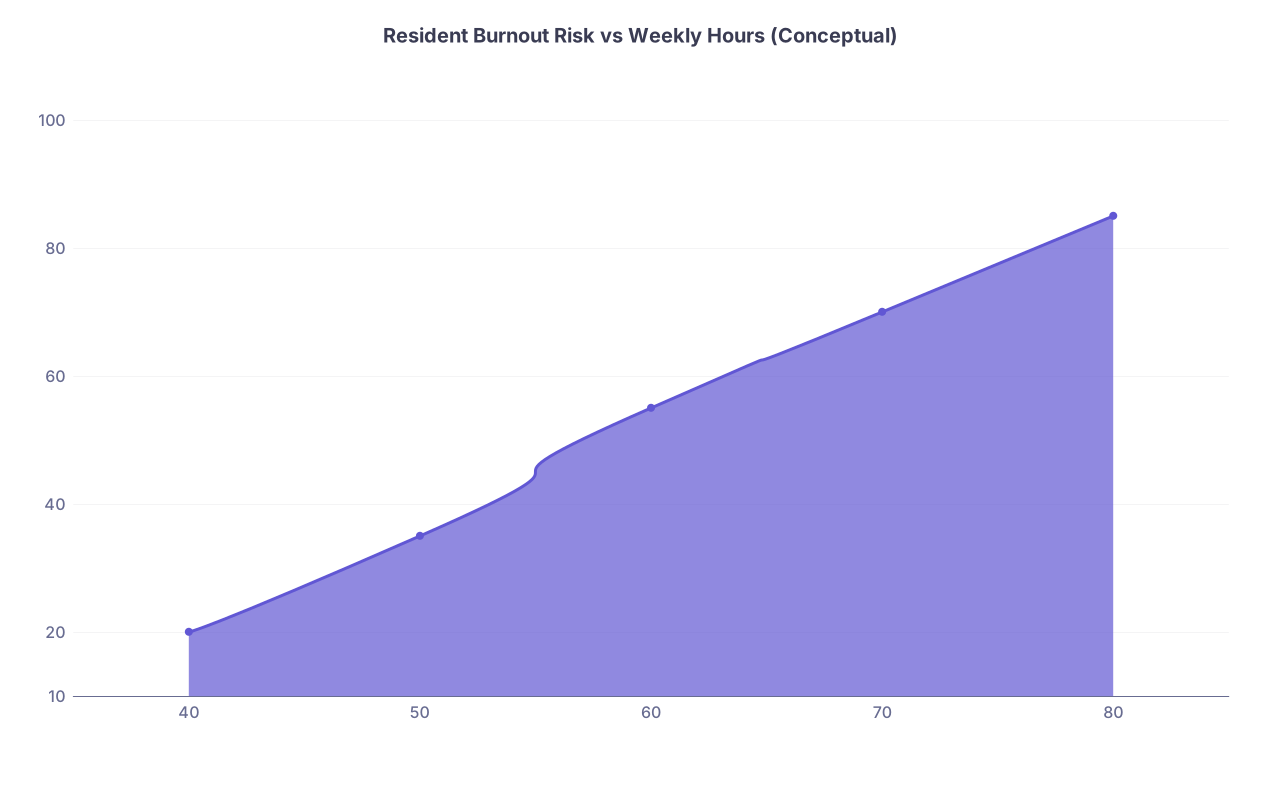
| Category | Value |
|---|---|
| 40 | 20 |
| 50 | 35 |
| 60 | 55 |
| 70 | 70 |
| 80 | 85 |
Higher hours, higher risk—no surprise. But burnout also tracks with:
- Loss of control over schedule
- Perceived unfairness (“I do all the scut, others coast”)
- Poor supervision and support
- Emotional load of the work (ICU, trauma, oncology)
- Moral injury (doing what you feel is bad care due to system constraints)
Dermatology has lower burnout than general surgery. Sure. But anesthesiology, EM, even radiology have non-trivial burnout rates despite being considered “better lifestyle” than inpatient-heavy medicine or surgery. Why? Nights, high stakes, constant vigilance, or emotional toll.
So telling a student, “Just pick a competitive lifestyle specialty and you’ll be fine” is lazy and often wrong. You can absolutely torch yourself in anesthesia or EM at a bad program. And you can have a survivable life in a mid-intensity, less competitive field if the program leadership actually cares about residents as humans.
What the Match and Work Hours Actually Correlate With
Let’s be blunt: competitiveness is driven more by prestige, pay, and perceived lifestyle after training than by resident hours. Plastics, derm, ortho, rad onc—these are intensely competitive because:
- High attending compensation.
- More procedural control or clinic control.
- Better long-term schedule flexibility.
- Social prestige and identity.
The training? Often rough. Sometimes very rough. A derm resident may work fewer hours than a neurosurgery resident, yes—but during fellowship and early attending years, many pile on clinic, procedures, and hustling to build a practice.
On the flip side, internal medicine is “less competitive,” yet residents regularly work 60–70 hours on inpatient blocks. The difference is not that IM residents have it easy. The difference is that more people can do IM and the job market is broad.
So, if you’re trying to “game” work hours by matching into a competitive field, you’re focusing on the wrong axis. You’d do better to:
- Rank programs by culture and enforcement of duty hours.
- Pay attention to how residents actually look and talk on interview day.
- Ask hard questions about call schedules, cross-cover, and backup.
That will change your life far more than whether the NRMP calls the specialty “competitive.”
Ethical Angle: Lying to Students, Lying to Ourselves
Let’s talk ethics since you asked for that phase: personal development and medical ethics.
There’s something fundamentally dishonest about the way we sell “competitive lifestyle specialties” to students.
We say:
- “Pick derm, you’ll never work hard.”
- “Radiology is relaxed, no scut.”
- “Anesthesia is just intubate and chill.”
Meanwhile, those residents are:
- On 24-hour call covering multiple services.
- Up all night for traumas, strokes, or emergency sections.
- Dealing with severe sleep disruption and physiological stress.
It’s not coal mining. But it’s not spa work either.
On the other side, we frame primary care and generalist fields as “self-sacrificing, lower paid, but better lifestyle,” while many FM or peds residents are quietly drowning in poorly designed rotations, overstuffed clinics, and no meaningful control of their time.
Ethically, faculty and advisors should stop pushing the simplistic story that competitive = grind or competitive = easy money and lifestyle. Both stories are lazy. Both are half-true at best. And they affect how students judge each other and themselves.
You want to be serious about personal development and ethics? Start by telling the next MS2 this uncomfortable truth:
Every residency is hard. A few are brutal. A few are relatively humane. And that distribution does not map cleanly to “competitive” vs “non-competitive.”
How You Should Actually Think About Work Hours and Specialty
Here’s the practical framework I wish someone had given my cohort instead of fearmongering:

| Step | Description |
|---|---|
| Step 1 | Choose Specialty |
| Step 2 | Do Not Apply |
| Step 3 | Look for Lower Hour Fields or Programs |
| Step 4 | Research Program Culture |
| Step 5 | Downrank or Skip |
| Step 6 | Rank Aggressively |
| Step 7 | Love the Work? |
| Step 8 | Tolerate Typical Hours? |
| Step 9 | Residents Look Alive? |
You start with what you actually like doing. That’s non-negotiable, because the hours will be heavy anywhere.
Then:
- Look at honest hour ranges for that field, not gossip. Think 50–60, 60–70, 70–80, not fantasies.
- Decide what tier you can realistically tolerate without breaking physically or mentally.
- Within that tier, hunt for programs with sane structures: caps, protected days off, adequate ancillary support.
- During interviews, read the room. Residents who seem dead-eyed at noon conference? That’s data.
A simple example. An MS4 likes procedures, ICU, and physiology. They’re choosing between surgery and anesthesia. Surgery might be 70–80, anesthesia 55–65 at many places. If they truly love the OR and don’t mind 60–65, anesthesia could be a sweet spot. But if they hate rapid decision pressure and night calls, anesthesia will still crush them. Hours are only one dimension.
One More Nasty Little Secret: Post-Residency Is a Different Game
Residents love to assume: “I’ll suffer in residency, then it’s chill forever.” Or: “I’ll pick the ‘easy’ field now and ride that into early retirement.”
No.
Attending workloads are wildly variable:
- Some orthopedic surgeons work 50–60 hours/week with heavy call and late OR days.
- Some outpatient internists grind at 40–50 hours of scheduled time, then add charting at home, which quietly creeps toward 60+.
- Some radiologists do telerad nights and essentially shift-work 50-ish hours. Others stack extra shifts for money.
The spread within fields gets even bigger as an attending. Work-life balance isn’t a specialty trait, it’s a job configuration trait.
So you can’t solve your whole career in MS3 by saying, “I’ll go competitive so I work less.” You might do derm in an insane private practice and be chained to a full clinic plus cosmetics plus ancillary businesses. Or you might do general peds in a well-run group and have a truly reasonable 45-hour week.
The Bottom Line
Trim away the folklore and it comes down to this:
Yes, some competitive fields work somewhat fewer hours, on average—but the difference is smaller than the myths suggest, and every residency is hard. There is no true 9-to-5 specialty in training.
Program culture and system design matter more than the “competitiveness” label. A malignant internal medicine program can be worse than a well-run surgical program. Look at hours + culture + support, not just the specialty name.
Choosing a field based on work-hour myths is a bad ethical and personal bet. Start from what work you can stand for decades, then pick programs that treat residents as humans and back that up with real schedules—not interview-day marketing.