
The usual advice about “backup specialties” after an unmatch is dangerously shallow. “Just apply broader next time” is how people waste another year.
You already unmatched once. You do not have time for vibes-based strategy now. You need a cold, structured rebuild of your entire specialty and backup plan.
This is that plan.
Step 1: Get Brutally Clear On Why You Unmatched
If you do not diagnose the first failure correctly, every decision about backups will be off.
Forget the generic “you were too competitive” or “too many reach programs.” I want specifics. Sit down with your NRMP report (if you have one), your application, and your interview list. Then break it into four buckets:
- Academic metrics
- Application strategy
- Red flags / professionalism
- Bad luck / market realities
Here’s how to think about it.
1. Academic metrics
You need to know where you actually sit, not where your classmates told you you were.
Look at:
- Step 1 (even if P/F now), Step 2 score
- Class rank or quartile
- Failed attempts, LOAs, remediation
- Home program opinions (honest ones)
Then compare yourself to what specialties actually match with numbers like yours.
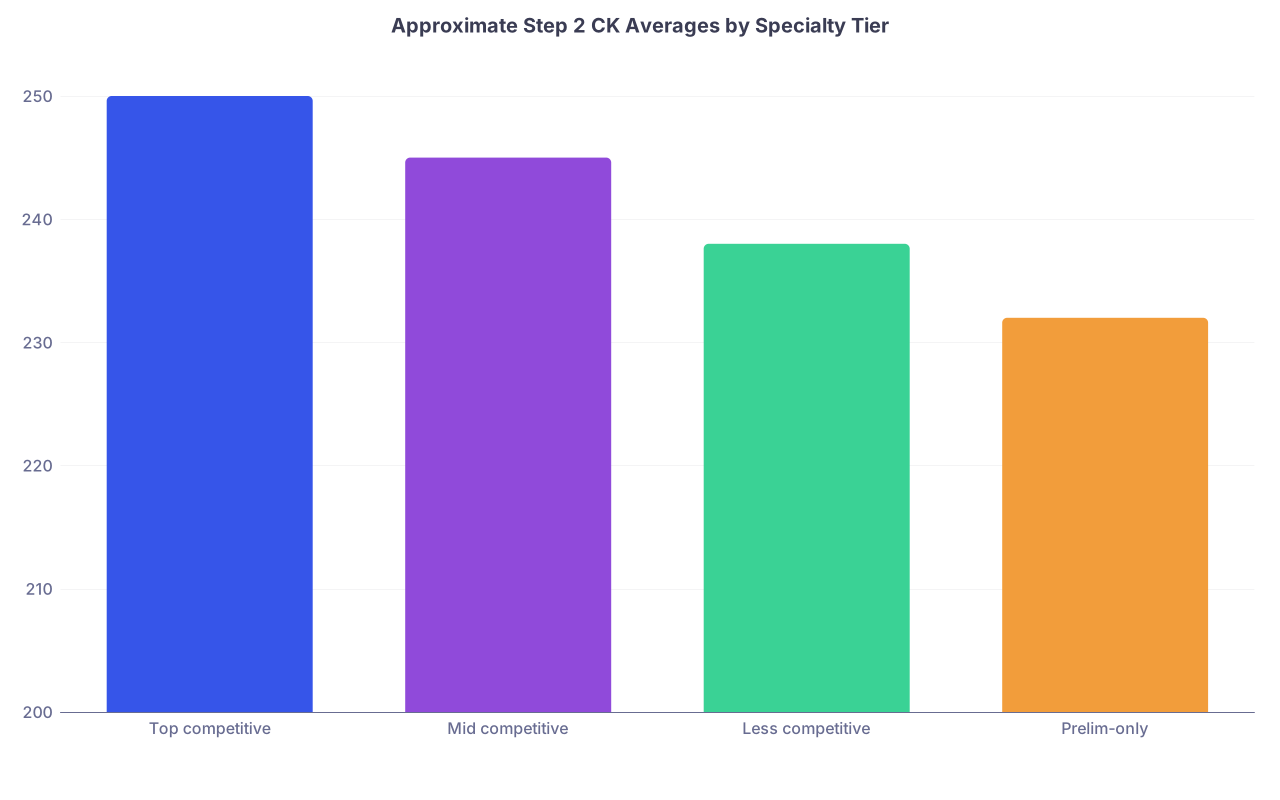
| Category | Value |
|---|---|
| Top competitive | 250 |
| Mid competitive | 245 |
| Less competitive | 238 |
| Prelim-only | 232 |
You do not need exact numbers; you need reality testing. Example I’ve actually seen:
- Applicant: Step 2 = 232, no fails, lower half of class
- Applied: 80 categorical EM and 10 IM programs, almost all university, coastal, many “top 40”
- Outcome: 3 interviews, all at weaker university affiliates, unmatched
They did not “get unlucky.” They overestimated their competitiveness and had no true backup.
2. Application strategy
Look at your last season with a scalpel:
- How many programs did you apply to?
- How many were categorical vs prelim vs TY?
- How many in your home region vs national?
- Did you include low-tier community programs, or only “places I’d be happy living”?
- Did you apply to any true backup specialty in a serious way (≥35–40 programs)?
If you applied to 20 derm programs, 10 IM “as backup,” all in major cities, you did not have a backup. You had wishful thinking.
3. Red flags / professionalism
This is where you need external eyes. Not your best friend. Someone who actually sits in rank meetings: PD, APD, or senior faculty.
Ask them directly:
- “If you were a PD, would you rank me top, middle, or bottom of your list?”
- “Is there anything in my file that would make programs nervous?”
- “If I apply again, what would you change first?”
Common hidden bombs:
- A vague “professionalism concern” note
- An awkward PD letter that damns with faint praise
- One rotation where you were… not great, and people still remember
If there’s a red flag, your backup choice needs to be a specialty that can absorb that and still consider you. That usually means larger fields with many community programs and high service needs.
4. Bad luck / market realities
Sometimes you were borderline competitive but:
- Your specialty had a sudden competitiveness spike (e.g., post-COVID EM chaos)
- You were from a new DO/MD school with weak home support
- You applied from abroad with complicated visa needs
- Your target region was flooded with local applicants
Those things matter. If you’re an IMG needing J-1 or H-1B, your “backup” universe is already narrower. You cannot copy advice from US MDs with no visa issues.
Step 2: Decide Whether To Reapply To Your Original Specialty
You cannot build a smart backup strategy until you answer this:
“Am I still going after my original specialty, or am I pivoting entirely?”
Let’s be blunt. These are your major paths:
- Reapply same specialty + add serious backup(s)
- Pivot primary specialty + use previous specialty as “reach”
- Fully abandon original specialty and commit to a new field
Here’s how to sanity-check that choice.
| Situation | Best Default Plan |
|---|---|
| Within 5–10 points of matched mean + no red flags | Reapply same + strong backup |
| >15 points below mean or multiple fails | Pivot primary + backup |
| Major professionalism issue in that field | Pivot away completely |
| Visa + no interviews last cycle | Pivot to more visa-friendly field |
| Extreme geographic restriction (family) | Pivot to larger specialties |
If you’re reapplying:
- You must materially improve something: new Step 2 score, strong post-grad clinical work, better letters, more realistic program list
- And you absolutely need a backup specialty with enough volume that if your main goal fails again, you don’t end up scrambling for a second time
If you’re pivoting:
- Treat yourself as a first-time applicant to the new field—but with an asterisk: you’re “the reapplicant from something else”
- You will be asked about it. Multiple times. Your backup planning must include a coherent story of why you’re switching and what you’ve actually done to explore the new field
Step 3: Criteria For Picking Backup Specialties That Actually Work
“Pick something less competitive” is lazy advice. There’s a smarter way.
You want a backup specialty that hits four boxes:
- Accepts your academic profile
- Has enough program volume and geographic spread
- Still makes sense with your real interests and strengths
- Is strategically compatible with your primary choice
Let’s walk through what that looks like.
1. Academic compatibility
Look at:
- Typical Step 2 ranges
- Failure tolerance (some fields are more forgiving of 1 fail than others)
- US vs IMG match rates if that applies
Roughly, specialties people use as functional backups (not talking about passion here, just patterns):
- Internal medicine (IM) – big umbrella: academic, community, hospitalist, subspecialties
- Family medicine (FM) – wide net, especially for primary-care-minded or geographically flexible people
- Pediatrics (Peds) – still competitive in certain regions but more open than fields like ortho, derm, ENT
- Psychiatry – used to be a soft backup; now more competitive but still accessible with thoughtful applications
- Neurology, PM&R, Pathology – each with nuances; some are saturated in certain markets, friendlier in others
2. Program volume and diversity
You’re trying to avoid another “all eggs in one extremely small basket” problem.
Compare something like:
- ENT: ~130 programs, many take 1–2 residents per year
- IM: 600+ programs, many taking 10–30 residents per year
It is mathematically easier to create a safety net in a large field with many mid- and lower-tier community programs.
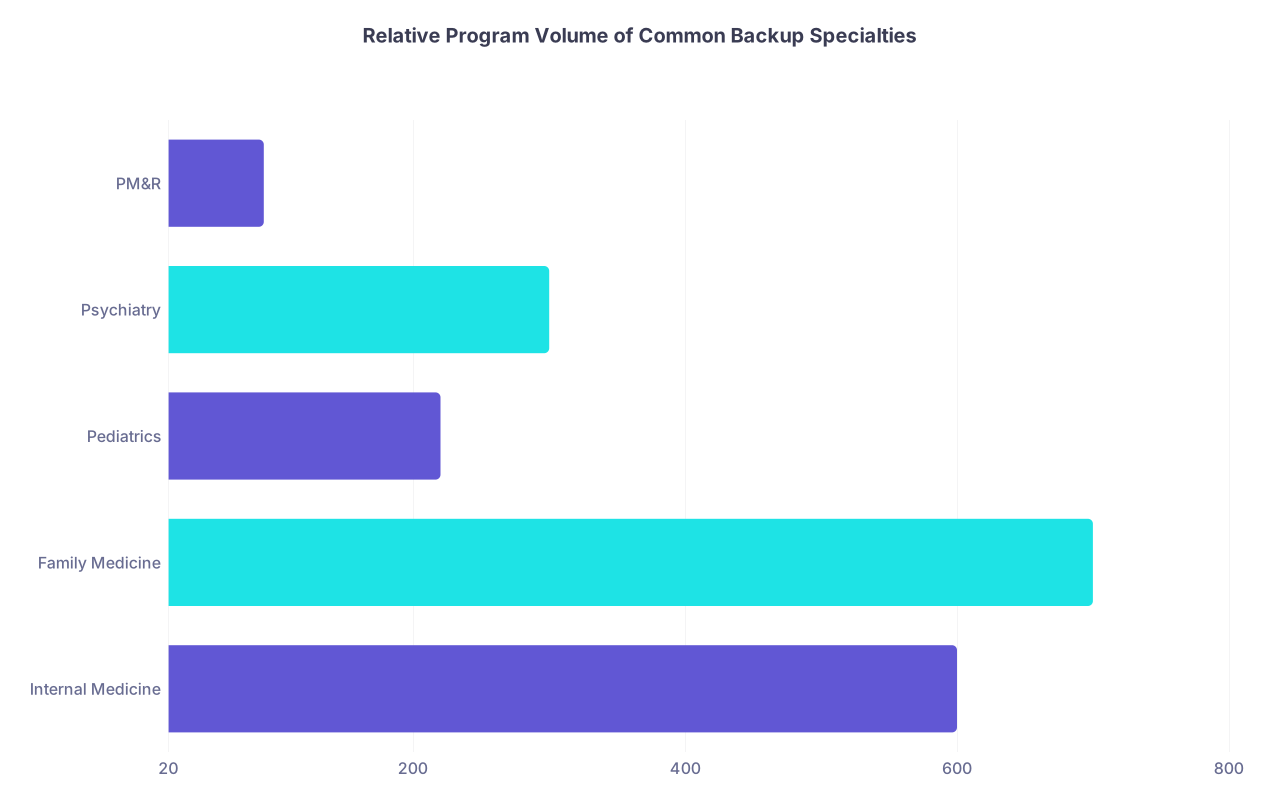
| Category | Value |
|---|---|
| Internal Medicine | 600 |
| Family Medicine | 700 |
| Pediatrics | 220 |
| Psychiatry | 300 |
| PM&R | 90 |
(Approximate ranges; you care about scale, not exact numbers.)
If your backup specialty has only ~70 programs total, that is not a real safety net unless you’re a strong applicant for it.
3. Fit with who you actually are
Do not swing from plastic surgery to pathology just because someone online said it’s “easier.” That’s how you get stuck in a career you resent.
Ask yourself honestly:
- Do I like longitudinal care or quick-hit episodes?
- Do I want procedures, and if so, what kind?
- Can I tolerate lots of outpatient clinic?
- Am I okay with nights/weekends in perpetuity?
- Do I want subspecialty options later (cards, GI, heme/onc, etc.)?
Real example:
- Original specialty: EM
- Unmatched with ~230 Step 2, decent app, few interviews
- Backup discussion: They liked acute care, team-based environments, not clinic
- Reasonable backups: IM with hospitalist or ICU interests, anesthesia in some cases, maybe neurology if they liked complex inpatient
Terrible backup: FM in a rural outpatient-heavy program they’d hate. Yes, it might match. No, they won’t be happy.
4. Strategic compatibility
This is the part people almost never think through.
Your primary and backup specialties need to:
- Not undercut each other’s narrative
- Share at least some logical through-line in your story
- Allow overlapping letters where possible
Example of good pairing:
- Primary: General surgery
- Backup: Internal medicine
- Story: “I’m drawn to high-acuity, complex inpatient care; I love thinking through sick patients. I explored surgery first, realized I’m more drawn to longitudinal management and critical care than the OR itself, and I can build that through IM.”
Example of awkward pairing:
- Primary: Dermatology
- Backup: Psychiatry
- You can make this work, but the narrative needs real thought; otherwise it looks like you picked two random fields based only on competitiveness and lifestyle
Step 4: Build A Two-Tier Application Strategy (Primary + Backup)
Now we’re into the actual mechanics of ERAS. Here’s where people mess up a second time.
You cannot “half-apply” to a backup and expect it to save you. You need a realistic numbers plan.
Decide your application split
Practical ranges I’ve seen work:
If you’re reapplying to a moderately competitive field (e.g., EM, anesthesia, OB, gen surg) and you were close last time:
– 60–70% applications to primary
– 30–40% to backupIf your first attempt wasn’t even close (very few interviews, large metric gap):
– 30–40% primary as “reach”
– 60–70% backup as functional main planIf you’re pivoting completely (e.g., ortho → IM) and realize the previous field is basically dead:
– 0–10% to old field if you cannot emotionally let go
– 90–100% to new primary and maybe a secondary backup within same domain (e.g., IM + FM)
| Situation | Primary Apps | Backup Apps |
|---|---|---|
| Close miss last cycle | 80 | 40 |
| Large gap from matched cohort | 40 | 70 |
| Full pivot away from prior field | 10 | 80 |
Numbers will vary by specialty and your budget, but the ratio is what matters.
Letters and personal statements
You need to avoid the “looks like a backup” problem.
Rules:
- Separate personal statements for each specialty. No lazy copy-paste with the word “internal medicine” swapped in. Programs can smell that.
- Letters:
– Try to get 2+ letters in each field you’re applying to
– If there’s overlap (e.g., ICU attending writing a letter that works for EM and IM), ask them to keep it general but strong
– Avoid submitting a heavily surgery-focused letter to pediatrics; it just signals drift
Your backup specialty PDs should not feel like you thought of them second. The documents they see need to read like they’re your first choice.
Step 5: Fix The Narrative: How You Explain The Unmatch And The Backup Plan
You will be asked: “So you applied last year and didn’t match. Tell me about that.”
And if they notice multiple specialties: “So you applied to X and to us. Why?”
You need a rehearsed, honest, concise answer. Not a tearful confessional. Not a bitter rant. Something like this structure:
- Own the facts
- Identify what you learned
- Show what you did differently
- Tie it directly to why you’re here now
Example for someone who reapplied to EM and added IM as backup:
“Last year, I applied only to emergency medicine. I was too narrow with geography and program types and had a limited number of interviews. I didn’t match.
Since then, I’ve done a dedicated EM/IM transitional year at [Hospital], strengthened my clinical skills, and received strong feedback from my attendings. I also realized how much I enjoy inpatient medicine and complex medical decision-making. That’s why I’m applying to internal medicine programs this year with a genuine interest in hospitalist work and potential critical care fellowship.
I’ve broadened my program list significantly, and I’m excited about the training your IM program offers.”
Notice: no drama, no self-pity, and IM doesn’t sound like a consolation prize.
For a full pivot, e.g., surgery → IM:
- Do not say “I realized I hate the OR and lifestyle is terrible.”
- Say “I found that the parts of my surgery rotations I enjoyed the most were managing complex medical issues on the wards and in the ICU, and I want a career that’s centered on that.”
You are repositioning, not apologizing for existing.
Step 6: Use This Year Intelligently To Support Both Primary And Backup
Your in-between year is either going to save your career or become a soft gap that programs side-eye.
You need work that:
- Gives you strong, recent clinical letters
- Shows reliability and professionalism
- Lines up with both your primary and backup choices where possible
Good options:
- A prelim/TY year in IM, surgery, or transitional programs
- A non-categorical position in your original field plus heavy exposure to your backup field (e.g., surgery prelim with strong ICU/IM letters)
- A hospitalist extender role, research year with clinical work, or teaching job with real patient care in the relevant specialty
Bad options:
- Totally non-clinical gap with no clear explanation
- A random research fellowship unrelated to either field
- Sitting at home “studying” for an exam you’re not actively scheduled to take
If you’re reapplying to original specialty + backup, optimize for overlap. Example:
- EM primary, IM backup → work as a medicine prelim, get letters from ward/ICU, maybe pick up EM moonlighting if allowed
- OB/GYN primary, FM backup → do a prelim year with OB exposure or women’s health-heavy clinic work
Step 7: Rank List Strategy When You Have Backups
Once interviews are in, you have one more decision: how to rank across specialties.
Two non-negotiable rules:
- Only rank specialties you’re actually willing to train in. Not “maybe I’ll transfer later.” That’s fantasy thinking.
- Rank in the true order of your preference, not what you think is “strategic.” The algorithm already favors your preferences.
That means if you’d genuinely rather do IM at a solid mid-tier program than your previous field at a tiny malignant place, you rank IM higher. Period.
If you’ve got:
- 5 interviews in your dream specialty
- 12 in your backup specialty
It is not crazy to place some backup programs above your weakest dream programs if you know you’d be miserable there. That’s a real, adult decision. No one on Twitter has to approve it.
A Simple Process Map For Your Next Cycle

| Step | Description |
|---|---|
| Step 1 | Unmatched |
| Step 2 | Analyze why |
| Step 3 | Define primary + backup |
| Step 4 | Choose new primary + backup |
| Step 5 | Get new letters and experiences |
| Step 6 | Build ERAS with 2 PS sets |
| Step 7 | Apply with defined split |
| Step 8 | Interview and refine story |
| Step 9 | Construct rank list by true preference |
| Step 10 | Match outcome |
| Step 11 | Reapply same field? |
Tape this process above your desk if you have to. It keeps you from drifting.
FAQs
1. How do I know if I’m “too weak” to keep applying to my original specialty?
Look at three things together:
- Your Step 2 score vs NRMP matched averages (≥15–20 points below with no offsetting strength is a big warning)
- How many interviews you had last time (0–3 in a field where others with your stats had 8–12 is another warning)
- Honest feedback from faculty in that field (“If we were a typical mid-tier program, would you rank me?”)
If all three are bad, strongly consider pivoting your primary specialty and using the old one, at most, as a small “reach” slice—or dropping it completely.
2. Can I use the same personal statement for both my primary and backup specialties?
No. You can reuse themes (work ethic, specific patient stories), but the framing and conclusions must be specialty-specific. A generic “I love patient care and teamwork” essay slapped onto multiple specialties screams “backup” and weakens both.
Write:
- One targeted PS for primary
- One targeted PS for backup
- Keep them short, focused, and actually about why that field makes sense for you now.
3. Is family medicine my only realistic backup if I unmatched?
Not necessarily. FM is often a good backup because of volume and geographic reach, but depending on your interests and profile, legitimate backups could be:
- IM, if you like inpatient work and want subspecialty options
- Peds, if you genuinely like working with children and families
- Psych, if your experiences and letters lean that way
- Neurology, PM&R, or pathology in selected markets
The key is: pick something that fits your numbers, your story, and your actual interests—not just something someone online labeled as “less competitive.”
4. How many programs do I need to apply to in my backup specialty?
For most US MD/DOs using a true backup:
- Aim for at least 35–40 programs in the backup field if it’s IM/FM/Peds/Psych
- More (50–70+) if you’re an IMG, have multiple fails, visa needs, or regional limitations
Below that, your “backup” is largely symbolic. Use NRMP data, look at your visa situation, and talk to advisors who actually know your file before finalizing numbers.
5. What if I match into my backup and still want to try transferring later?
You can hold that thought lightly, but you cannot treat your backup residency as a temporary holding cell. Transfers are rare, politically messy, and depend heavily on your performance and national trends.
If you match into your backup:
- Commit fully for at least the first year
- Be excellent where you are: good evals, strong relationships, no drama
- If, later, a realistic transfer opportunity appears and you still want it, explore it professionally and quietly
For now, build a plan where you’d be okay staying in your backup field long term. Because that’s the most likely outcome.
You’ve already felt what it’s like to open that “We regret to inform you” email on Match Day. Once is enough.
With a clear-eyed diagnosis, a rational primary–backup pairing, and a year spent doing work that actually strengthens your application, you give yourself something much better than “hope.” You give yourself probability.
You do not need to solve the rest of your career today. You just need to set yourself up so that this next Match cycle is the last one you ever go through as an applicant.
What comes after that—fellowship choices, first attending job, long-term career direction—that’s a different problem. A better one. And we can talk about that when you’re there.