
The biggest mistake couples make in the Match is pretending they’re not a couple until rank list time.
If you’re couples matching and thinking about backup specialties, you cannot wing this. You need a plan that is brutally honest about competitiveness, geography, and your relationship priorities. Otherwise you risk the nightmare scenario: one match, one scramble, and a lot of resentment.
Let’s walk through how to coordinate backup specialties strategically, step by step, like two people who actually want to end up in the same city and still like each other in March.
1. Get Real About Your Risk Level As A Pair
Before you even say the word “backup,” you need a hard look at your numbers, application strength, and how they interact.
Do this on paper, not in your head.
Sit down and write:
- Your Step 2 score (or COMLEX 2)
- Class rank/percentile or AOA/Gold Humanism status
- Number and quality of letters (especially from your target specialty)
- Research output (especially if you’re gunning for something like derm, ortho, plastics, ENT, ophtho)
- Red flags: leaves, failures, professionalism issues, big gaps
Then classify each of you individually:
- High risk
- Moderate risk
- Lower risk
High risk = below average board scores for your specialty, few interviews last cycle at comparable stats, weaker letters, or red flags.
Now combine those into a couple risk profile.
| Pair Type | Risk Level as Couple | Backup Planning Urgency |
|---|---|---|
| Both low risk | Moderate | Backups smart, not critical |
| One low, one moderate | High | Need real backup strategy |
| One low, one high | Very high | Backups and geographic flexibility essential |
| Both moderate | Very high | Aggressive backups, wide net |
| One or both high | Extreme | May need different cycles or very broad backups |
Here’s the uncomfortable truth: the Match is not “fair” at the couple level. If one partner is targeting a competitive specialty, the other partner needs to carry part of the risk by either:
- Choosing a less competitive specialty, or
- Expanding geography drastically, or
- Being willing to rank institution-tier mismatches (e.g., one in a strong academic program, the other in a weaker community program).
You can’t both be “all gas, no brakes” on competitive specialties and still expect a high probability of being in the same city without a backup plan.
2. Decide What You’re Optimizing For (And Actually Rank Them)
Most couples skip this and just say “we want to be together and match well.” That’s useless. You need a hierarchy. Real tradeoffs.
Sit down and separately rank these, then compare:
- Same city no matter what
- Same institution specifically
- Specific specialty for each of you
- Prestige/academic vs community
- Geographic preference (family, kids, cost of living)
- Lifestyle vs earning potential vs fellowship prospects
You’ll find differences. One of you might secretly be #1 “get this specialty” and #3 “same city.” The other might be #1 “same city” and #4 “specialty.” That mismatch is what drives bad backup decisions.
You have to agree explicitly on something like:
- “Being in the same city is more important than both of us being in our dream specialty,” or
- “You getting derm and me doing IM in a different city is better than both of us doing backup fields in the same place.”
No right answer. But there IS a wrong answer: not agreeing on this before ERAS goes in.
Here’s a simple framing that helps cut through the noise:
- Tier 1 priority: Relationship / same city
- Tier 2 priority: Each person’s broad career field (e.g., procedural vs medicine vs primary care)
- Tier 3 priority: Prestige / brand name / fellowship pipeline
Once Tier 1 and 2 are clear, backup specialties become a tool instead of an emotional landmine.
3. Understand Which Specialties Actually Pair Well As Backups
Not every specialty blends nicely with others for couples matching purposes. You want combinations that:
- Differ in competitiveness (so one can flex down if needed)
- Have enough positions nationwide
- Exist in similar types of hospitals (academic vs community)
- Line up reasonably with your skills and preferences
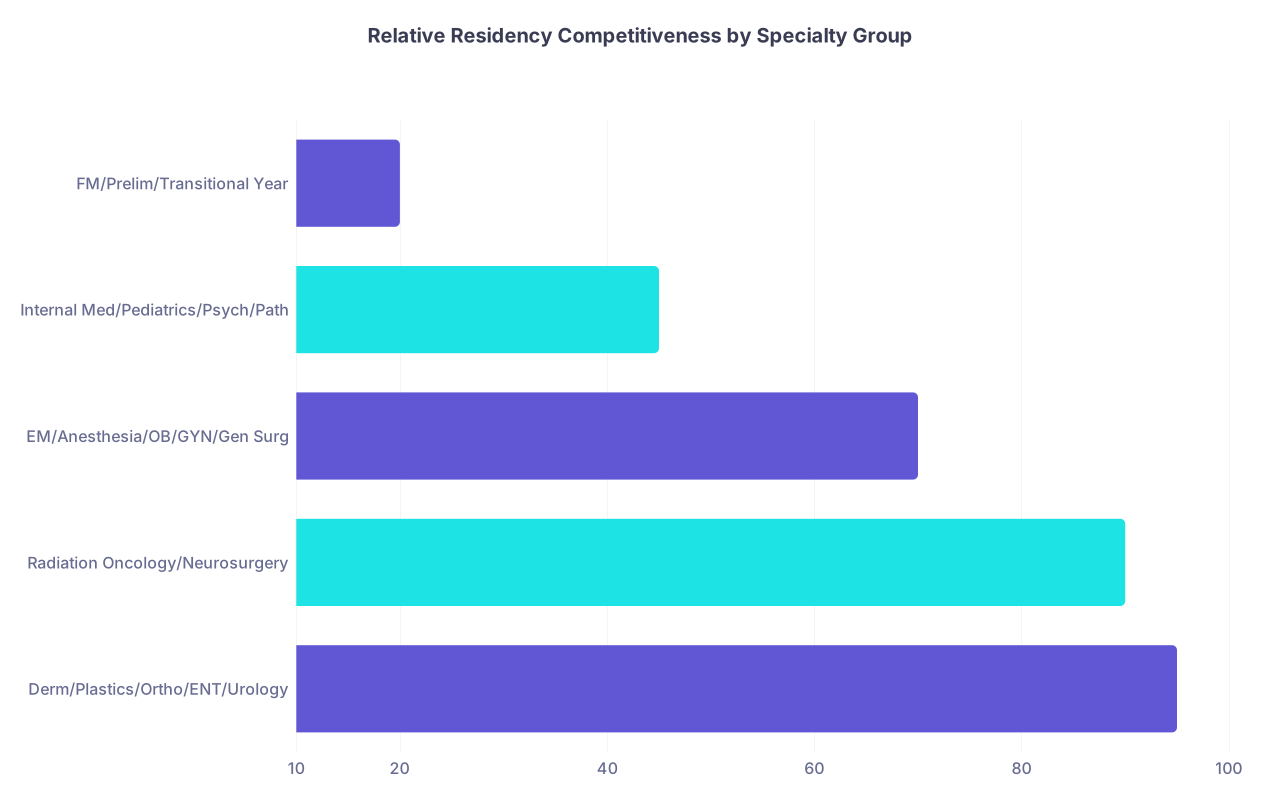
| Category | Value |
|---|---|
| Derm/Plastics/Ortho/ENT/Urology | 95 |
| Radiation Oncology/Neurosurgery | 90 |
| EM/Anesthesia/OB/GYN/Gen Surg | 70 |
| Internal Med/Pediatrics/Psych/Path | 45 |
| FM/Prelim/Transitional Year | 20 |
(Values here are rough “competitiveness pressure” scores, not exact fill rates.)
Some common, reasonable backup structures for couples:
- Ortho / IM
- Derm / IM
- ENT / FM (or IM)
- Gen Surg / IM
- EM / IM or FM
- Anesthesia / IM
- OB/GYN / IM or FM
- Psych / FM
Bad backup structures:
- Derm / Plastics (two hyper-competitive fields, minimal give)
- Ortho / Neurosurg (same problem)
- Two people both backing up with prelim-only plans
- Two people both backing up into another competitive field (EM + anesthesia as mutual backups with mediocre scores, for example)
If one of you is in a more competitive lane (ortho, derm, ENT, ophtho, plastics, neurosurg, urology, rad onc), the other ideally should:
- Sit in a broader-field lane with many spots (IM, FM, peds, psych), OR
- Be in EM/Anesthesia/OB/GYN/Gen Surg but be willing to over-apply, over-interview, and flex on geography.
4. Build a Tiered Specialty Plan For Each Partner
You need a “Tier A / Tier B / Nuclear Option” setup for each person. Not in your head—on a shared Google Sheet.
Example couple:
- Partner A: wants ENT
- Partner B: wants IM, open to FM as backup if things look bad
Partner A’s plan:
- Tier A: ENT categorical
- Tier B: TY or prelim surgery in cities with strong ENT departments they could reapply from
- Nuclear: Switch before ERAS to categorical IM if ENT advisor is screaming “do not apply ENT”
Partner B’s plan:
- Tier A: IM categorical (academic + community)
- Tier B: Same-city FM if interviews are lopsided and couples scenarios look thin
- Nuclear: IM anywhere if A lands ENT in a decent city but B’s couples options are scarce
Notice something: backup isn’t always about switching specialties before applying. Sometimes it’s about stacking your rank list with:
- “A in dream specialty, B in backup specialty, same city” programs
- “A in dream specialty, B in dream specialty, different city” lower in the list
- “Both in backup specialties, same city” in the deep backup zone
That’s still a backup strategy, even if you technically only applied to one specialty.
5. Use Data, Not Vibes, To Choose Backups
You can’t just “feel” your way through which backups are safe. You need to look at actual numbers.
Use NRMP Charting Outcomes and Program Director Survey. Pay specific attention to:
- Match rate at your Step 2 range
- Average interviews for matched vs unmatched
- Number of positions nationwide
Then sketch something like this for each of you:
| Factor | Partner A (ENT) | Partner B (IM) |
|---|---|---|
| Step 2 Score | 240 | 248 |
| Specialty Avg (Step 2) | 250–255 | 235–240 |
| Research in Field | 3 pubs ENT | 0 in IM |
| Adviser Risk Rating | High | Low |
| US MD/DO/IMG | US MD | US DO |
Then be blunt:
- Partner A ENT: high risk, needs prelim backup + extremely broad geographic spread
- Partner B IM: safer, but as a DO may need more applications, especially to university programs
Backups for this pair might look like:
- A: ENT + surgery prelims in 15–20 cities
- B: IM everywhere A has ENT or prelim surgery, plus many more solo IM options
Backup plan reality: the “safer” partner often needs to over-apply and over-interview to create flexible same-city possibilities.
6. How To Coordinate ERAS Applications As A Couple
ERAS is where couples either quietly set themselves up for success or quietly sabotage their chances.
Basic structure:
- Each of you applies to your primary specialty first, with a full list.
- Then each of you layers in backup specialties strategically based on competitiveness and geography.
Here’s how to think in categories:
Must-match-together cities
Places where you both strongly want to be. You apply broadly there in both primary and backup specialties.Would-like-but-flexible cities
Places you’d be fine together in, or one person might be okay solo if the other matches close enough.Solo-safe cities
Places one person applies widely (usually the more competitive partner) where the other does not need full coverage.

| Step | Description |
|---|---|
| Step 1 | Create all possible pairs |
| Step 2 | Label by same institution or city |
| Step 3 | Mark primary primary pairs |
| Step 4 | Mark primary backup pairs |
| Step 5 | Mark backup backup pairs |
| Step 6 | Insert solo options after couple priorities |
The trap to avoid: both of you mirroring each other’s application patterns everywhere. That wastes money and doesn’t actually help if one person’s field is much tighter.
A sharper move: anchor around the competitive partner’s likely interview geography, then have the safer partner fill those gaps aggressively with primary + backup specialty applications.
7. Reading The Tea Leaves During Interview Season
Your backup strategy is not final when you click “submit” on ERAS. You should reassess at least twice:
- After the first 2–3 weeks of interview offers
- Around midway through the season
Ask:
- Who is getting more interviews? In which regions?
- Are you consistently seeing same-city or same-institution options?
- Is one of you clearly underperforming expectations in their primary specialty?
If the answer to that last question is yes, you still have options:
- Late-season backup apps to less competitive specialties in overlapping regions
- Leaning more heavily on those backup specialties in your final rank list
- Adjusting expectations: “We’re going to prioritize getting us both matched, even if that means one of us in a backup specialty.”
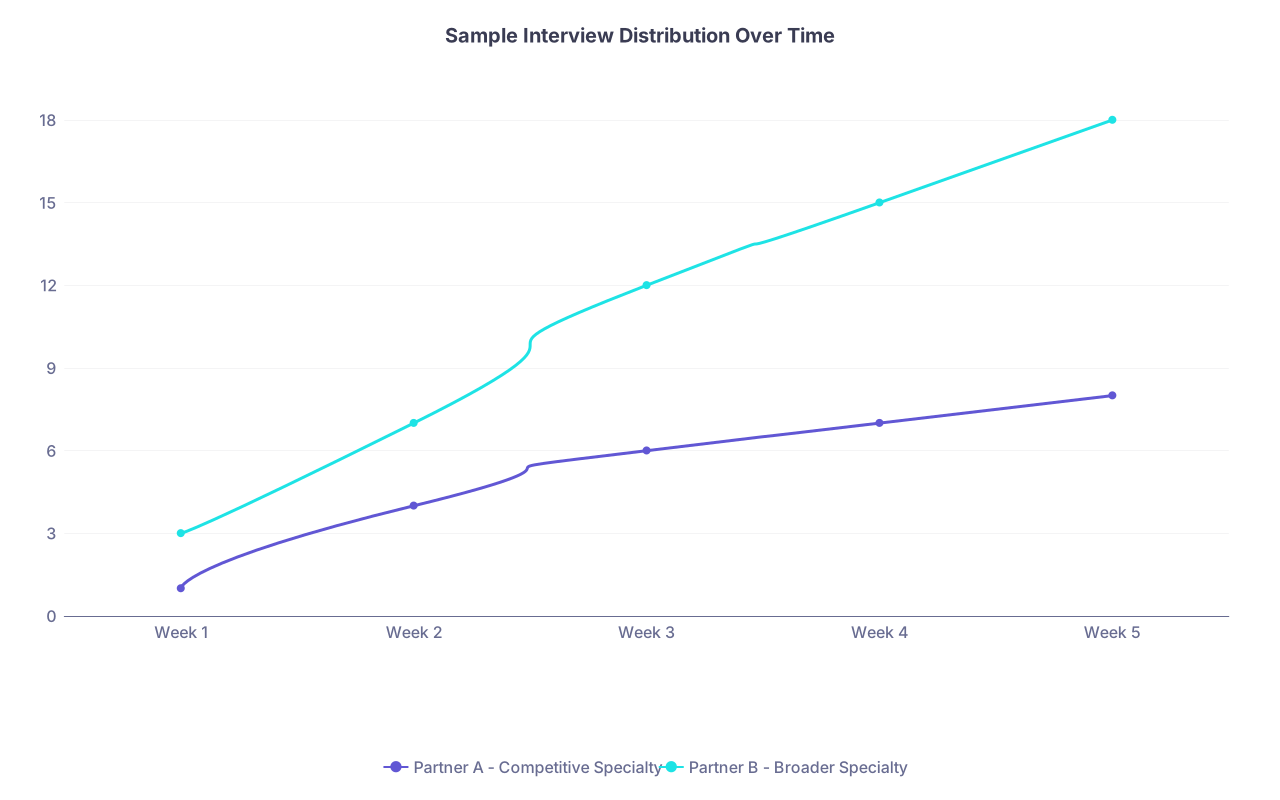
| Category | Partner A - Competitive Specialty | Partner B - Broader Specialty |
|---|---|---|
| Week 1 | 1 | 3 |
| Week 2 | 4 | 7 |
| Week 3 | 6 | 12 |
| Week 4 | 7 | 15 |
| Week 5 | 8 | 18 |
If A has 6 interviews total by mid-season and B has 18, you are not in the “we both go all-in on primaries and hope” category anymore. You are in the “we need to leverage B’s broader options to create couples pairs” category.
8. Ranking Lists: Where Backup Specialties Actually Do The Work
This is where couples freeze. They either:
- Panic and put “any job for both” over all reasonable solo-good options, or
- Panic the other way and rank a ton of solo matches above same-city backups.
You need structure.
Here’s a sane rank list architecture:
- Both in primary specialties, same institution
- Both in primary specialties, same city different institutions
- Competitive partner in primary, other in backup specialty, same institution
- Competitive partner in primary, other in backup, same city
- Both in backup specialties, same institution or city
- One in primary, one anywhere but same region (driveable)
- Both solo optimal if couple options are exhausted
The exact order depends on the priorities you set back in section 2.
Example: derm + IM couple.
- Ranks 1–6: derm + IM at same institution
- 7–15: derm + IM same city, different programs
- 16–25: derm + FM categorical same city
- 26–30: IM + IM same city (if derm fell through)
- 31+: derm solo at top programs the derm partner would accept even if the IM partner ends up elsewhere, followed by IM solo at top IM programs
That’s what “strategic” looks like. It’s not just “we’ll put all the same-city pairs first.”
| Step | Description |
|---|---|
| Step 1 | Create all possible pairs |
| Step 2 | Label by same institution or city |
| Step 3 | Mark primary primary pairs |
| Step 4 | Mark primary backup pairs |
| Step 5 | Mark backup backup pairs |
| Step 6 | Insert solo options after couple priorities |
9. When One Partner Should Strongly Consider Changing Specialties Pre-ERAS
Sometimes the honest answer is: your dream specialty plus couples match is not safe enough. Not with your scores. Not this year.
Signals you should seriously consider changing before ERAS:
- Long-standing advisor in the field tells you directly: “Your chances are very low even as a solo applicant.”
- You’re an IMG/DO aiming at a hyper-competitive specialty with mediocre scores and limited US-based research.
- The couples dynamics means you’d need a near-perfect solo match just to drag your pair to a feasible city.
In those cases, the best couples backup plan might actually be:
- You pick a more realistic primary specialty this year, together.
- You preserve your relationship, get good training, and maybe look at fellowship or later transitions.
I’ve seen couples where one person stubbornly insisted on ENT or derm despite multiple advisors discouraging it. They couples matched into:
- ENT prelim in one state
- Partner in FM two states away
They were “matched,” technically. They were miserable.
10. The Emotional Side: How To Not Destroy Your Relationship Over This
You can do everything “right” statistically and still blow up your relationship if you handle the conversation badly.
A few rules:
- No secret rank lists. If one of you is planning to rank solo dream-program options higher than some same-city backups, that has to be shared and fully agreed on.
- No martyrdom without consent. “I’ll just give up on my dream specialty for us” is only healthy if it’s truly your decision and not coerced.
- Name the resentment risk out loud. “If we choose X, I might struggle with Y feelings down the line; are we both okay owning that?”
Have one brutally honest conversation where you each answer:
- If we end up in different cities, does the relationship continue?
- Which of us is more willing to compromise on specialty?
- Are we okay with one person ending up in a less prestigious program so we can be together?
Clear answers now are better than quiet bitterness in PGY-2.

11. Sample Backup Pair Scenarios (Concrete Examples)
Let’s go through three actual-feeling scenarios.
Scenario 1: Ortho + IM Couple
- Partner A: Ortho, Step 2 246, US MD, 2 pubs, decent letters
- Partner B: IM, Step 2 230, US MD, average application
Risk: A is moderate risk in ortho. B is okay for IM.
Strategy:
- A applies broadly to ortho (80–100 programs), plus 15–20 prelim/TY in cities also strong for IM.
- B applies to every IM program in any city where A has either ortho or prelim/TY apps. Also 20–30 additional IM programs elsewhere.
Rank list priorities:
- Ortho + IM same institution
- Ortho + IM same city
- Ortho + IM in driveable cities (1–2 hours)
- Ortho + IM where A is prelim and will reapply
- IM + IM same city (if A fails to match ortho)
Backup specialty: B doesn’t need one. IM itself is the backup buffer for the couple.
Scenario 2: EM + Anesthesia Couple, Both Mid-Stats
- Partner A: EM, Step 2 232, DO, solid rotations
- Partner B: Anesthesia, Step 2 236, DO, decent but not amazing
This is not a low-risk couple. Both fields have tightened in some cycles.
Better backup strategy:
- A: EM + FM backup in overlapping cities
- B: Anesthesia + IM backup in overlapping cities
They target:
- Must-match cities with both EM + Anesthesia AND FM + IM programs
- Both over-apply: 60–80 EM, 60–80 Anesthesia, plus 25–30 FM and IM each
Rank list structure:
1–10: EM + Anesthesia same institution
11–30: EM + Anesthesia same city
31–45: EM + IM same city
46–60: FM + Anesthesia same city
60–80: FM + IM same city
Yes, it’s ugly. But it gives multiple layers where at least both have jobs, in the same place, even if neither lands the A-tier target.
Scenario 3: Psych + Psych Couple, Both Solid
- Both US MD, Step 2 240s, decent research, average letters
This is actually a relatively low-stress couples match. Backup specialties aren’t as critical.
What they should still do:
- Decide on geographic must-haves vs “we’ll go anywhere together.”
- Apply broadly to psych, but identify a few cities where they’d consider one person taking IM/FM if they only get one strong psych match there.
Backup: Maybe one of them throws 10–15 IM or FM apps in the cities that are top-priority for life reasons (family, cost of living). They don’t need it nationwide, just where they’d really hate to miss a chance to be together.

12. Quick Reality Checks Before You Lock Anything In
Run through this list and make sure you can answer “yes” to most of it:
- Do we each know our honest risk level in our primary specialties?
- Have we explicitly agreed what matters most: same city vs dream specialties vs prestige?
- Does at least one of us have a relatively safer field or backup specialty in mind?
- Have we mapped which cities both of us can reasonably match into, not just where we’d like to live?
- Have we reviewed our tentative rank strategy with at least one trusted advisor (ideally a PD or senior faculty) who understands couples match?
If not, you’re not done planning your backups yet.

FAQs
1. Should both of us apply to backup specialties, or just the more competitive partner?
Usually, the safer partner (less competitive field, better stats, or both) should be the one to hold more of the backup flexibility. If both of you are in moderately competitive fields with mid-range stats, then yes, both may need backups. But one of you should usually take the lead on being the “flex” person so your couple strategy is coherent.
2. Is it smart for both of us to switch into “easier” backup specialties just to guarantee the same city?
Not automatically. If you both pivot downward in specialty just for geography, you can end up with long-term regret. You need to be at least “I can live with this specialty for 30 years” level okay with anything you rank. Sometimes it’s better for one person to keep their dream field and the other to flex more on specialty or program type.
3. How many programs should we apply to as a couple if one of us has a competitive specialty?
More than you think. Competitive-specialty partner: often 70–100+ programs. Safer partner: enough to cover every city where the competitive partner might get traction, plus additional solo options. Yes, it costs money. So does a failed couple match and a SOAP year.
4. If one of us fails to match, does that mean our backup strategy was bad?
Not necessarily. The Match is probabilistic, not perfectly predictable. But it does mean you should look back and ask: Did we over-prioritize prestige? Did we under-apply in backup specialties? Did we put solo dream matches above realistic same-city pairs that we actually would have preferred? Learn from it if you have to go another round.
5. When should we bring in an advisor specifically about our couples strategy?
As soon as you have a tentative specialty plan. Don’t wait until after you’ve already applied. Talk to: your specialty advisor, maybe a PD, and ideally someone who has actually couples matched before (recent grads are gold here). Show them your real stats and a draft of your city/specialty tier plan and ask them to poke holes in it.
Key points to carry out of this:
- You need explicit priorities as a couple—same city vs specialty vs prestige—before you can choose rational backups.
- Backups work best when at least one partner has flexibility in specialty or geography and you both lean on data, not wishful thinking.
- Rank lists are where you operationalize all of this; do the messy, honest planning now so March is about results, not regret.