
What do you do when you suddenly realize you might love a different specialty… after you’ve already built an application for something else?
I’m talking about the brutal version, not the hypothetical. You’re an MS4 or a prelim resident. ERAS is submitted or about to be. Your letters are mostly in one lane. Your personal statement screams “ORTHO OR DIE,” and now you’re thinking, “Uh… what about anesthesia?” Or you’re a TY psych prelim realizing you actually light up on medicine wards.
You are not the first person to be here. But people do blow up their entire careers in this exact moment by panicking or by refusing to change at all.
Let’s handle it like adults.
Step 1: Get brutally clear on your actual situation
Before you start rewriting your life, you need the facts, not vibes.

| Step | Description |
|---|---|
| Step 1 | Realize new interest |
| Step 2 | Can change main apps |
| Step 3 | Add programs or SOAP |
| Step 4 | Plan formal switch |
| Step 5 | What stage are you at |
Ask yourself four very specific questions:
What stage are you in?
- MS4, pre-ERAS submission
- MS4, post-ERAS but before interviews
- Mid-interview season
- Matched but not yet started
- Already in residency (PGY1+)
How strong is your current primary application? You know roughly where you stand. Be honest.
- Competitive for your current specialty
- Borderline
- Weak / heavy uphill battle
What does “new passion” actually mean? This matters. Is it:
- A genuine pattern (you consistently enjoy this work more)
- A reaction to fear (“ENT is too competitive, maybe FM is safer”)
- A one-off high (“That one derm attending was amazing”)
How structurally compatible are the two specialties? Some moves are clean. Some are a bloodbath.
Here’s the reality:
| Current Track | New Interest | Relative Difficulty | Why |
|---|---|---|---|
| IM → Cards/GI (fellowship) | N/A | Easy (normal path) | Built-in route |
| IM → Anesthesia | Moderate | Overlap in medicine but different training | |
| Surgery → Anesthesia | Moderate | OR culture overlap, still a switch | |
| Ortho → Radiology | Hard | Different letters, skillset, applicant pool | |
| Psych → Neuro | Hard | Different rotations, letters, boards emphasis |
If you’re trying to jump from one ecosystem to another late (e.g., plastics → psych), you need a more conservative strategy than someone pivoting from IM to anesthesia.
Step 2: Decide what role this “new passion” should play this cycle
You have three realistic roles for the new field:
- Full switch – You flip and apply mainly (or only) to the new specialty.
- True backup – You apply to your original specialty as primary, and the new field becomes the backup.
- Future plan – You keep your original plan and use the new passion as:
- a fellowship route (IM → Cards, Peds → NICU)
- a later re-application if needed
Let’s get concrete.
Scenario A: You discover a new field before ERAS is submitted
This is the best version of a bad situation.
If it’s August and you realize you might love anesthesia more than EM, you can still restructure. But you have to move fast and not in a chaotic way.
Here’s how I’d triage it in your shoes:
Look at your assets:
- Do you have any rotation in the new specialty?
- Any possible letter writer?
- Any signalable interest (electives, research, shadowing)?
Ask two people who actually know you clinically. Not your class group chat. Not Reddit.
- One in your current specialty
- One in the new specialty (or closest thing you can get)
Ask them specifically:
- “Given my performance and application, do you think I’d realistically match in [X] if I pivot this late?”
- “If I kept [Original Specialty] as my primary and used [New Specialty] as backup, how would you structure that?”
If both tell you:
- “You’re strong in the current field, and switching will hurt you more than help” → That new passion probably becomes a future path or fellowship, not a sudden specialty switch.
- “You’re lukewarm for current field and you’re clearly better suited here” → Then you seriously consider a full switch or at least 50/50 application split.
- Decide on primary vs backup explicitly.
This is where people screw up: they “kind of apply” to both in a mushy, non-committal way and end up not competitive in either.
You need to answer one question in one sentence:
“If I only matched in ONE specialty this cycle, which would I rather train in?”
That’s your primary. The other is either a true backup or a future plan, not co-equal.
Scenario B: ERAS already submitted, then you fall in love with another field
This is more common than people admit.
You submit 60 IM applications. Then you do a neuro ICU elective and your brain lights up. Or you applied EM and then two months later you’re on anesthesia and suddenly your previous “top choice” feels wrong.
At this stage, you realistically can’t completely rebuild an app from scratch. So your question flips from:
“Which specialty do I love more?”
to
“What’s the smartest way to use this new passion without detonating this cycle?”
Options depend on timing:
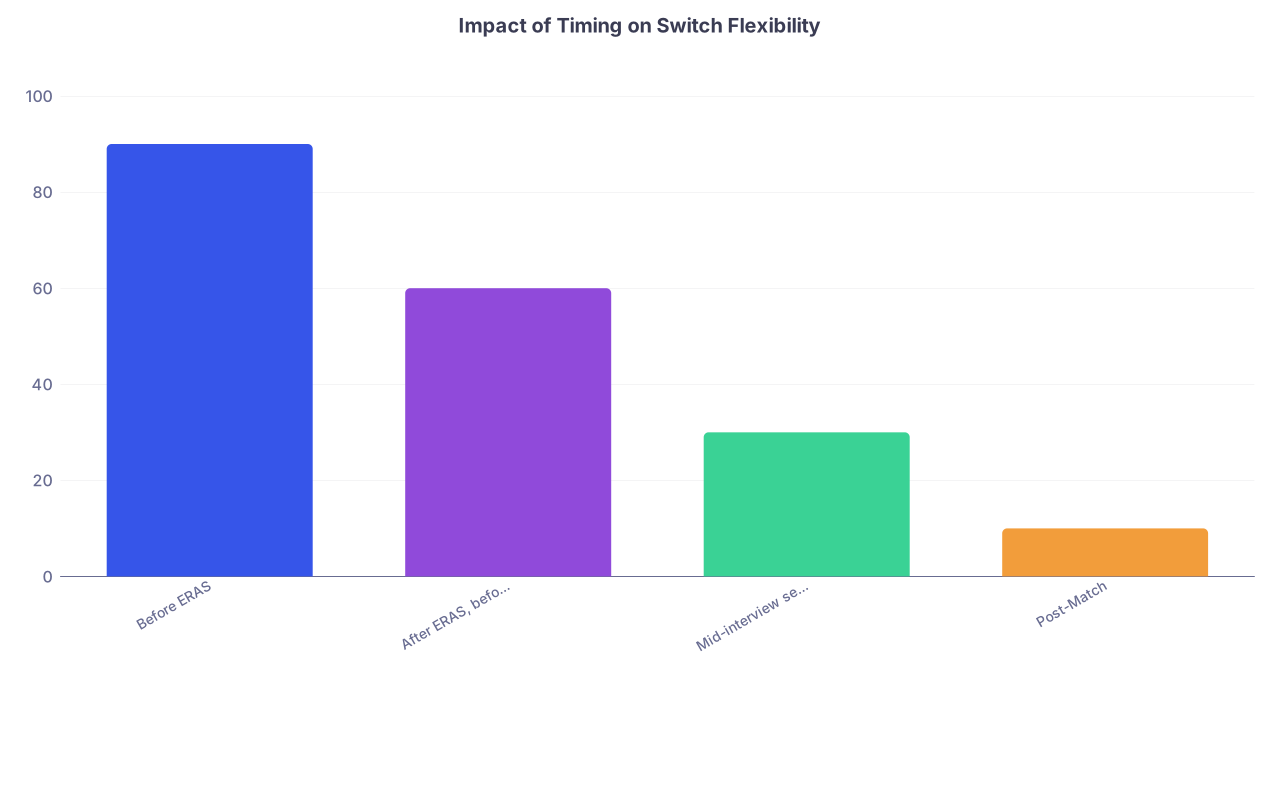
| Category | Value |
|---|---|
| Before ERAS | 90 |
| After ERAS, before interviews | 60 |
| Mid-interview season | 30 |
| Post-Match | 10 |
(Think of those numbers as “percent flexibility” – very approximate, but you get the point.)
If you’re post-ERAS, pre-interviews:
- You might still:
- Add a handful of programs in the new specialty if you can scramble letters quickly
- Adjust your personal statement for new programs only
- Start building a story that you can explain if asked
If you’re mid-interview season:
- You’re not rebuilding an application now. It’s almost entirely about:
- How you rank programs
- Whether you leave space for the new field as a future switch or fellowship
Example:
- You applied IM, discover you love cardiology. Good. Rank IM programs with strong cards: lots of cath exposure, big fellowship placement list. Don’t suddenly try to apply anesthesia in December with no letters.
Step 3: Should you actually switch this cycle?
Here’s the blunt version: switching late works when you have at least some real alignment with the new field, and usually when the new field isn’t way more competitive than your original.
Switching:
- FM → Psych
- IM → Neuro
- EM → Anesthesia
can be doable if you move early enough and have some supporting evidence.
Switching:
- FM → Derm
- IM → Ortho
- Psych → Ophtho
late in the game? You’re almost always better preserving this cycle and planning a calculated re-route later, not YOLO-ing a weak late-application.
Ask yourself:
Competitiveness gap Are you going from less competitive → more competitive? That’s usually a red flag for late switches.
Evidence of commitment Can you show:
- At least 1 meaningful elective
- 1 letter from someone in the new field
- Some alignment in your CV (research, QI, or leadership that makes sense there)
If your answer is basically “no, but I just FEEL it,” you’re probably in future plan territory, not immediate switch.
Step 4: Using the new passion as a backup vs as your new primary
There’s a subtle but huge difference between:
- “I’m applying IM, with psych as my backup,” and
- “I’m applying psych, with IM as my backup.”
One of those is the field you’re telling PDs you want your career in. The other is the field you’re saying you’d be okay training in if your main plan fails.
You need to respect that distinction.
When the new passion should become the backup
Use it as a backup when:
- Your original specialty still makes sense for you long-term
- You’ve already built stronger capital (letters, rotations, research) there
- The new field is either:
- Slightly more competitive (not ideal to flip fully)
- More “niche” and less clearly aligned with your record
Example:
- You’re an IM applicant who suddenly loves allergy/immunology from one elective. Allergy is not a primary residency. You don’t blow up IM for that. You:
- Match in good IM
- Target AI fellowship later
That “new passion” is future fellowship, not a new primary.
Another example:
- You applied EM and discover you actually like psych a lot. But:
- All your letters are EM
- Your away rotations are EM
- Your app screams EM
In that case, EM stays your primary. You might: - Add a small number of FM or IM programs as a safety net if EM is looking dicey
Your psych interest becomes something you revisit if you don’t match, or later via fellowships (e.g., addiction).
When the new passion should replace your original choice
You let it take over when:
- Multiple attendings independently tell you you’re better suited for this new field
- Your current specialty was always a bit of a compromise or “default”
- You can assemble at least:
- 2 strong letters in the new field
- A coherent personal statement story that doesn’t sound like you picked it last Tuesday
- Some kind of track record (even short) suggesting alignment
This might still mean:
- Dropping from 60 apps in the original field → 15–20
- Going harder (40–60 programs) in the new field
- Being mentally ready for a re-application year if the late switch hurts your numbers
Step 5: Concrete moves you should make in the next 2 weeks
Let’s stop speaking abstractly. Here’s what I’d tell you to do if you emailed me in a panic.
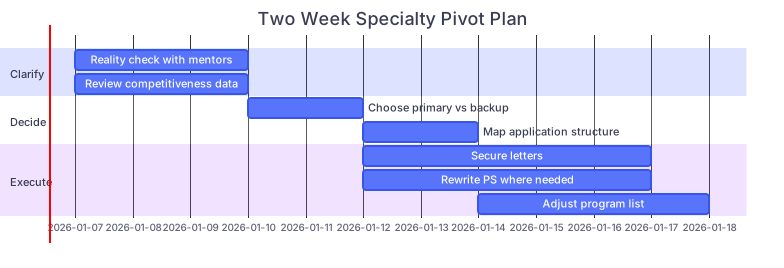
| Task | Details |
|---|---|
| Clarify: Reality check with mentors | a1, 2026-01-07, 3d |
| Clarify: Review competitiveness data | a2, 2026-01-07, 3d |
| Decide: Choose primary vs backup | b1, after a1, 2d |
| Decide: Map application structure | b2, after b1, 2d |
| Execute: Secure letters | c1, after b1, 5d |
| Execute: Rewrite PS where needed | c2, after b1, 5d |
| Execute: Adjust program list | c3, after b2, 4d |
Get data, not feelings
- Check NRMP Charting Outcomes / FREIDA data for both specialties
- Compare:
- Average step scores
- Match rates
- Applicant-to-position ratios
Have 3 frank conversations
- Mentor in current specialty
- Mentor or upper-level in new specialty
- Someone who matched in either (recent grad)
Ask them each:
- “If you were me, would you switch specialties now, keep this as backup, or plan a later move?”
- Build two versions of your story
You’re going to need to explain:
- To your original specialty: why you’re still genuinely interested
- To your new interest (if you’re applying there now): why this isn’t a 5-minute whim
Do not lie. But you can truthfully say:
- “I discovered [New Specialty] later in training, and the more I saw, the more I realized that [specific aspects] align with how I like to work. That said, I’ve built a strong foundation in [Original Specialty], and I’d be genuinely happy to train in it as well.”
Adjust program lists and personal statements intentionally
- If the new field is primary now:
- Majority of your apps, tailored PS, targeted letters there
- Original field gets fewer apps and a modified PS that doesn’t sound half-hearted
- If the new field is backup now:
- Apply broadly only if you’re realistically competitive
- Don’t accidentally signal to both fields you’re unsure about everything
- If the new field is primary now:
Prepare mentally for non-linear paths Sometimes the correct move is:
- Match in something acceptable this year
- Then switch later via:
- PGY2 transfer
- Re-applying after a prelim or categorical year
- Fellowship route that gets you closer to the new passion
You are not signing a forever contract with a single ERAS submission. People change fields. It’s messy, but it happens every year.
Special case: Already in residency and discovering a new passion
This deserves its own section, because the game changes once you have a contract, colleagues, and a PD.
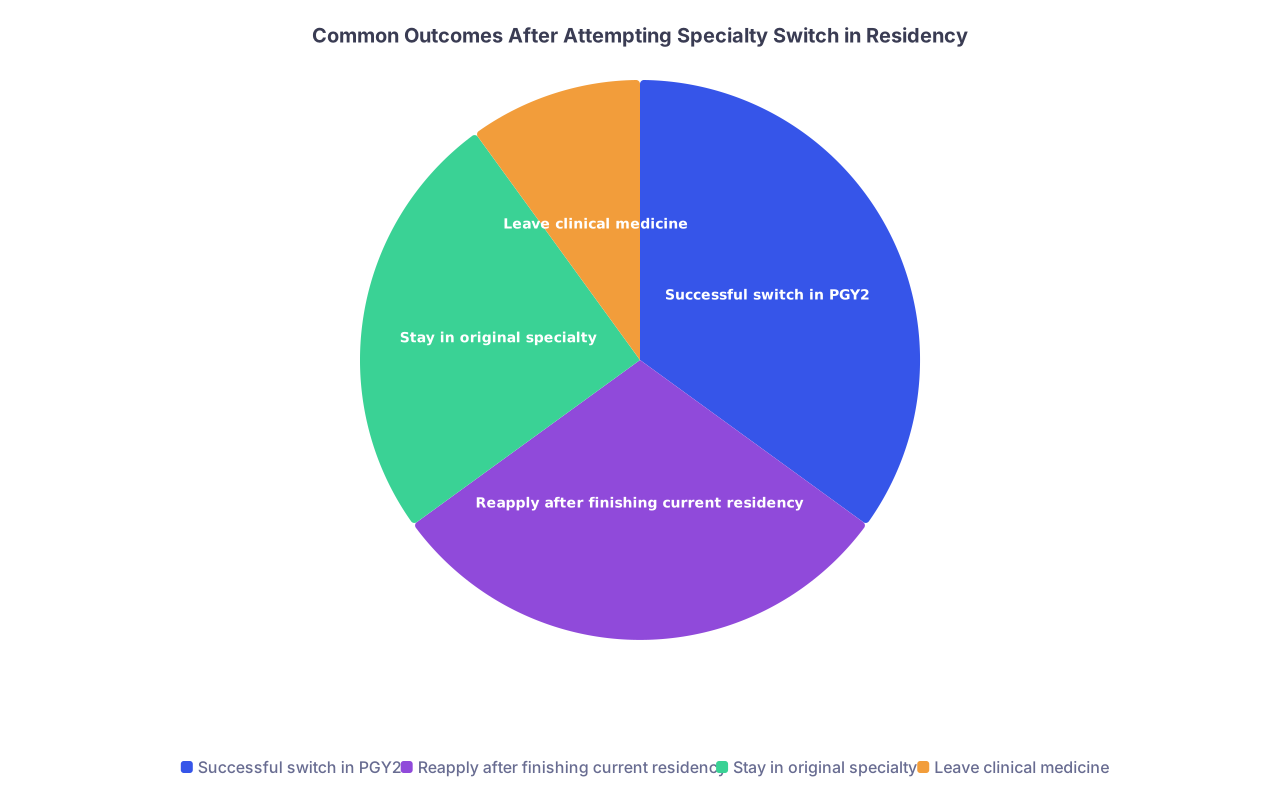
| Category | Value |
|---|---|
| Successful switch in PGY2 | 35 |
| Reapply after finishing current residency | 30 |
| Stay in original specialty | 25 |
| Leave clinical medicine | 10 |
If you’re a PGY1 or PGY2 saying, “I picked wrong,” you need to separate:
- Acute misery from specific factors
(toxic program, bad hours, bad rotation) - Chronic mismatch with the actual specialty
(you hate the core work everybody else likes)
Steps:
Track your reactions across different rotations
- Do you hate all of it? Or are some blocks better?
- Are you more alive when you’re in the OR vs clinic vs ICU?
Quietly gather information
- Talk to residents who switched specialties (there are always a couple)
- Ask your GME office how often they’ve handled transfers
Decide if you want: transfer vs finish-then-switch
- Transfer (PGY2 start in new specialty) is easier if:
- You’re early
- Your clinical performance is strong
- Your PD is not out to sabotage you
- Finish-then-switch makes sense if:
- You’re in IM, FM, Peds, Psych, etc., and can pivot later
- You want a stable board certification as a safety net
- Transfer (PGY2 start in new specialty) is easier if:
Have the PD talk strategically You don’t walk in and say, “I hate this, I’m leaving.”
You say:
- “I’ve done a lot of reflection. I’m realizing that my strengths and interests may align better with [New Specialty]. I care about doing the right thing for patients and my career long-term. I want to explore whether a formal transfer is possible, and I’m committed to finishing this year strong regardless.”
If your PD is reasonable, they’d rather help you than have a disengaged resident dragging down the team.
Quick reference: When to switch vs when to use as backup
| Situation | Best Use of New Passion | Why |
|---|---|---|
| MS4, pre-ERAS, some exposure | Possible primary switch | You still have time to redirect |
| MS4, post-ERAS, no exposure | Future plan | Application too weak to support switch |
| Mid-interview season | Backup at best | Too late to credibly rebuild |
| PGY1, strong resident, clear mismatch | Consider formal switch | You have evidence and time |
| IM/Peds resident discovering fellowship interest | Fellowship path | Normal, expected route |
FAQ (exactly 4 questions)
1. If I switch late, will programs think I’m flaky or unfocused?
Some might. But what matters is whether your story is coherent and supported by action. “I saw derm once and decided to apply” looks flaky. “I realized through multiple ICU and OR experiences that I’m consistently energized by [specific work], so I pivoted and sought out letters and mentorship in that area” looks thoughtful and mature. A clear, honest explanation beats a forced narrative.
2. Can I write one generic personal statement that fits both specialties?
You can. It’s just usually bad. Generic PSs read like someone trying to avoid commitment. If you’re applying to two specialties, you should have two statements, each making a real case for why that field fits you. You can share some core values and experiences, but the framing, language, and “why this specialty” section should be specific.
3. Is it better to match in a not-quite-right specialty or go unmatched and reapply to what I really want?
If by “really want” you mean a significantly more competitive specialty that you’re only now flirting with, playing chicken with the Match is a terrible idea. For most people, matching in something acceptable and then re-evaluating—switching later or using fellowships—is safer than gambling on going unmatched. The exception: when your mentors in the new field strongly believe you’re a top-tier candidate there and your current specialty is a poor fit.
4. How do I know if this new interest is a real passion or just rotation honeymoon syndrome?
Look for patterns, not peaks. Did you like this kind of work:
- On different days, with different attendings?
- Even when you were tired and the patients were difficult?
- For reasons beyond lifestyle and money?
Also check your past. Have you always gravitated to similar tasks (procedures, long-term relationships, acute crises, complex diagnostics)? If it lines up with a deeper pattern in who you are as a learner and clinician, it’s more likely real. If it’s mostly “those attendings were cool and hours were good,” assume honeymoon until proven otherwise.
You’re in a messy but very human spot. Lots of smart people discover too late that the story they’ve been telling about themselves doesn’t quite match how they feel on the wards.
Your job now is not to perfectly solve your whole career in one ERAS cycle. It’s to make the smartest move available from where you stand: choose a true primary, decide if this new interest is a backup, a full switch, or a future fellowship, and act in a way you’ll still respect five years from now.
With that clarity, you can survive this application cycle without blowing up your future. The next step is picking specific programs and arranging your rank list to keep doors open for the person you’re becoming—but that’s a whole separate strategy session.