
The scariest part of residency isn’t the nights on call. It’s the thought that your contract ends and you still haven’t passed your boards.
Let me just say the nightmare out loud, because I know it’s living rent‑free in your head: You finish residency, your contract ends, your board exam doesn’t go well, and suddenly you’re imagining you’ll never get licensed, never get a job, and everything you’ve worked for is over.
That fear? Very common. You’re not the only one lying awake game‑planning the worst possible version of this.
Let’s walk through what actually happens, step by step, and where things get sticky versus survivable.
First: Can Your Contract Really End Before You Pass the Boards?
Yes. Absolutely. And it does. All the time.
Most residency contracts are year‑to‑year. They say something like “this agreement is for the academic year July 1 – June 30” with renewal contingent on satisfactory performance. They do not usually say “we’ll keep employing you until you pass your boards.”
You typically finish residency in June. Board exams are often:
- Scheduled months after graduation, or
- Offered in windows that don’t line up neatly with your contract, or
- Failed on the first try and retaken later
So there are a few totally normal scenarios where your contract ends before you pass:
- You graduate in June, sit for boards in August or fall. You’re working as an attending (or job‑hunting) while awaiting the result.
- You take boards near the end of training, fail, and you’re already post‑residency when you find out.
- You have delays (illness, pregnancy, mental health, scheduling mess) and don’t even take the boards before graduation.
So yes, your contract can and often will end before you officially pass. That alone isn’t a disaster.
The more important question is: what does that mean for your license, your job, and your ability to practice?
Big Picture: Passing Boards vs Being Board Eligible vs License
This is where a lot of people get twisted up: residency contract, licensing, and board certification are related, but they’re not the same thing.
Let me break the pieces down, because they each fail in different ways.
| Thing | Who Controls It | What It Lets You Do |
|---|---|---|
| Residency Contract | Hospital/Program | Train, be paid as resident |
| Medical License | State Board | Legally practice medicine |
| Board Certification | Specialty Board | Be 'board certified' in field |
You finish residency → that’s your contract.
You apply for state licensure → that’s separate.
You sit your specialty boards → separate again.
Most states will let you get a license and start working as an attending before passing boards, as long as:
- You’ve completed an accredited residency
- You meet whatever “board eligible” definition applies
So your life doesn’t freeze the second your residency contract ends.
The anxiety comes from: What if the clock keeps ticking, I keep failing or delaying, and my “board eligible” status expires?
Okay, Worst Case: I Finish Residency and Fail My Boards
Let’s actually walk the nightmare path, not the brochure version.
You graduate June 30.
You take your specialty boards in, say, September.
Results come out: “Fail.”
You’re already in one of these positions:
- You have an attending job lined up (or already started).
- You’re doing a fellowship.
- You’re unemployed and still job‑hunting.
- Your visa or personal situation depends heavily on you being board certified ASAP.
Now what?
1. If You Already Have an Attending Job
Most real‑world scenario: you’re hired as “board eligible, must become board certified within X years of hire.”
Many hospital systems or groups give you a window like 3–5 years from completion of training to become board certified. They know people fail on the first attempt. They’ve seen it. It’s not rare.
So failing once doesn’t instantly terminate you.
The pain points:
- You’ll probably have to tell your employer you failed. That feels humiliating, but it’s way worse to hide it and have them find out from credentialing.
- They may expect you to:
- Register for the next available exam
- Show an actual plan (dedicated study, maybe less call, tutoring, etc.)
- Your pay or bonus might be affected if board certification is tied to a salary bump or incentive.
Can they fire you if you keep failing?
Yes, eventually. If the contract is written as “must be board certified within X years” and you hit that deadline with multiple fails, they can choose not to renew, or even terminate depending on the language.
But that’s the endpoint, not what happens after one bad result.
2. If You’re in Fellowship
Fellowship is usually more forgiving about when you pass as long as:
- You’re board eligible
- You met the residency requirements
Failing your core specialty boards while in fellowship doesn’t normally cause automatic dismissal. But it increases the pressure. Fellowship leadership may:
- Strongly encourage you to re‑take as soon as possible
- Worry quietly about your overall performance if there are other red flags
Still: your fellowship contract doesn’t usually vanish just because of one failed exam.
3. If You Don’t Have a Job Yet
This is the truly awful‑feeling scenario. You’re done with residency, your contract is over, you don’t have a job yet, and now you’ve failed your boards.
Emotionally, this feels catastrophic.
Practically, it’s more nuanced:
- You’re still board eligible (after one fail) in most specialties and timeframes.
- You can still apply to jobs that accept “board eligible” physicians.
- Some employers will be skittish. They may ask, “Why did you fail? What’s your plan?” You’ll need a calm, non‑panicked answer.
- Rural or underserved areas are often more flexible than big academic centers.
The hardest part here is selling yourself while you’re internally spiraling. But it’s done. Every year. I’ve seen people match into community jobs, urgent care, hospitalist positions, etc., after a fail.
What If I Can’t Pass Before My Board Eligibility Expires?
Here’s the real doomsday scenario people spin out:
“My contract ended. I failed once. I retook and failed again. Time passed. Now my eligibility window is closing. If I don’t pass this next time, they’ll make me do more training or I’ll never practice.”
And… okay, yes. This one can get ugly.
Most specialties give you a time‑limited window to become board certified. It might be:
- X number of years after training
- Or Y number of attempts total
- Or both
After that, the specialty board can say: “You’re no longer board eligible. To sit again, you must complete additional training.”
That “additional training” can look like:
- An extra year (or more) of residency or fellowship
- A re‑entry program if you’ve been out of practice too long
- Practice assessments or remediation
This is rare, but it happens. And if it happens to you, it feels like the floor dropping out.
Practically, here’s what people in this worst‑case bucket end up doing:
- Taking less competitive, more flexible jobs that don’t absolutely require active board certification
- Working in urgent care, telemedicine, locums, smaller hospitals, or correctional health
- Sometimes leaving that specialty entirely or pivoting to non‑clinical roles (industry, consulting, utilization review, etc.)
Is that the dream you started med school with? No.
Is your life over? Also no.
What Happens Right When Your Contract Ends (and You’re Not Yet Certified)?
Let’s zoom back out to what you probably actually asked:
“What happens if my residency contract ends before I pass the boards?”
What changes the day your contract ends:
- You’re no longer employed as a resident. No salary, no malpractice coverage under that GME umbrella, no access to clinical systems as a trainee.
- You become “a physician who completed residency” with no active institutional home.
- You exist in this weird limbo where you’re technically trained but not yet board certified.
If you don’t have a job or fellowship lined up, the most immediate issues are:
- Money: No paycheck. Boards are expensive. You’re paying out‑of‑pocket.
- Study conditions: You’ve lost the automatic structure of “protected” time (what little you had) and colleagues around you studying the same material.
- Identity hit: You go from “Dr. ___ the resident” to “unemployed physician studying at home,” which is brutal psychologically.
But from a board perspective? Nothing dramatic flips at midnight on June 30. The specialty board doesn’t care about your contract dates. They care about:
- Did you finish an accredited program?
- Are you within the eligibility window?
- Have you registered and shown up for the exam?
If those boxes are checked, your lack of a contract is emotionally awful but not legally blocking your ability to sit for boards.
How Programs Actually Handle Residents at Risk of Failing
One thing people underestimate: your program does not want you to fail. Not just for you—your pass rates reflect on them.
So if you’re clearly struggling, a halfway responsible program may:
- Delay graduation or promotion if your in‑training exam scores are extremely low and performance is weak
- Put you on a performance improvement or academic remediation plan
- Strongly push you toward extra studying, question banks, faculty tutoring
Sometimes, if they’re really worried, they won’t just let your contract cleanly end. They might extend you an extra year of training, which feels like punishment but is actually meant to protect you from exactly this: being out in the wild, alone, failing.
Ugly truth: some programs are bad at this. They graduate marginal residents, say nice things at the dinner, and then wash their hands when the boards go poorly.
If you already know you’re at risk (bad in‑service scores, failed Steps, trouble with exams your whole life), you have to be the one to push the uncomfortable conversation:
- “What happens if I don’t pass on the first try?”
- “Will there be any institutional support after graduation?”
- “If my contract ends, can I still access study resources or faculty mentoring?”
It’s awkward, but not asking doesn’t protect you. It just keeps you uninformed.
Concrete Moves If You’re Terrified This Will Be You
You’re probably not reading this academically. You’re reading this because you’re scared.
So here’s what I’d actually do if my contract was ending and I was worried about boards:
Get super clear on your board’s eligibility rules.
Not in vague Reddit terms. Go to your specialty board’s website. Read the fine print on:- Number of attempts allowed
- Time window after training
- Requirements if you don’t pass within that window
Talk to your program leadership before you graduate.
Yes, it’s uncomfortable. Say:- “I’m worried about the boards. Can we talk about what support looks like if I don’t pass on the first try?”
- “Will I have any access to resources or faculty after graduation?”
Be honest with potential employers.
If you’re applying as board eligible, don’t pretend you’re a sure thing. Ask them explicitly:- “What’s your policy if someone doesn’t pass on their first attempt?”
Make a real plan, not a vague intention.
This is the part no one wants to hear. If you know exams are your Achilles’ heel, you cannot casually “fit in” studying around a 1.0 FTE hospitalist job and endless nights. You may need to:- Negotiate reduced FTE for the first year
- Take serious study time right after graduation before starting work
- Get a tutor, structured course, or accountability plan
Protect your mental health.
The cycle of shame after a failure is what derails people more than the content. I’ve seen fantastic clinicians spiral because they internalized one exam as “I’m stupid.” You’re not. But you might need therapy, coaching, meds, or just someone non‑judgmental you can talk to.
Does Failing Boards Mean You’ll Never Have a Career?
No. It really doesn’t. It might mean:
- Your path is messier than your classmates’
- You work in a less prestigious setting than you imagined
- You pivot to a slightly different role or setting
I’ve seen:
- A failed internal medicine boards candidate become a solid, beloved hospitalist in a community hospital after passing on the second attempt.
- Someone who never became board certified in a competitive field move into industry and make more money with far less call.
- A resident who needed extra training years for performance issues eventually stabilize, pass, and practice successfully—just on a slower timeline.
Board exams are a massive gate. They are not the sole judge of your worth as a physician or a human.
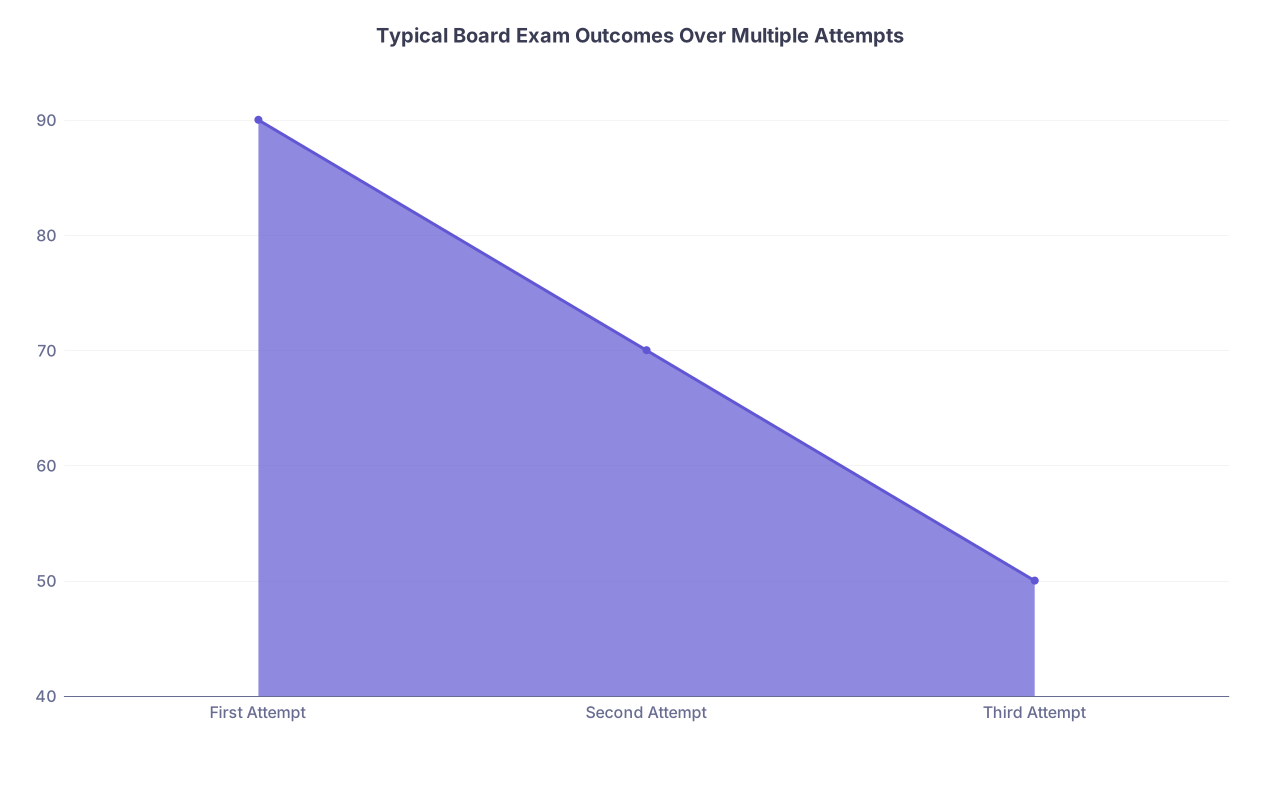
| Category | Value |
|---|---|
| First Attempt | 90 |
| Second Attempt | 70 |
| Third Attempt | 50 |

| Step | Description |
|---|---|
| Step 1 | Residency Contract Ends |
| Step 2 | Apply for Jobs as Board Certified |
| Step 3 | Board Eligible Physician |
| Step 4 | Work While Studying |
| Step 5 | Intense Study Period |
| Step 6 | Retake Boards |
| Step 7 | Continue Career |
| Step 8 | Consider Extra Training or Alternate Paths |
| Step 9 | Passed Boards? |
| Step 10 | Job or Fellowship? |
| Step 11 | Pass Within Eligibility Window? |
Quick Reality Check
The scariest version in your mind goes like this:
“My contract ends. I don’t pass boards. No one will hire me. I’ll never get licensed. I’ll be in infinite debt doing nothing.”
Reality is messier, but far less binary:
- Your contract ending does not stop you from sitting the boards.
- Failing does not instantly end your career.
- Employer policies vary, and you often have more wiggle room than you think.
- The real danger is quietly avoiding the problem, not asking questions, and letting deadlines sneak up on you.
You don’t have to like any of this. I don’t. The way we tie a whole career to a timed exam several years into sleep‑deprived training is… questionable at best.
But you’re not powerless in it.
Years from now, you won’t remember the exact wording of your contract. You’ll remember whether you faced this fear head‑on, asked the hard questions, and gave yourself a real shot instead of letting anxiety quietly run the show.
FAQ (Exactly 6 Questions)
1. Can I still take my boards if my residency contract has already ended?
Yes. As long as you’ve successfully completed an accredited residency and you’re within your specialty board’s eligibility window, your employment status doesn’t block you from taking the exam. The board cares about your training and timing, not whether you’re currently on a payroll somewhere.
2. Will employers rescind my job offer if I fail my boards after starting?
Some might, but most won’t after a single failure. Many contracts are written as “board eligible at hire, must become board certified within X years.” That usually means they’ll expect you to retake the exam and show a real plan. Multiple failures, or hitting the end of that X‑year window without passing, are when you’re at real risk of non‑renewal or termination.
3. Can I get a state medical license without being board certified?
In many states, yes. Board certification is not the same as licensure. Most states just require that you’ve completed the required amount of accredited training and passed the USMLE/COMLEX steps. Board certification is more about hospital privileges, insurance credentialing, and certain jobs, not the legal ability to practice at all.
4. What if my “board eligible” status expires before I pass?
Then you’re in the harder category. Your specialty board may require additional training, a re‑entry program, or other remediation before you can sit again. This can limit job options and make some employers drop you or refuse to hire you. People in this situation often pivot to more flexible settings (smaller hospitals, urgent care, telemedicine, non‑clinical roles) or bite the bullet and do the extra training.
5. Should I delay starting an attending job to study full‑time for boards?
If you know you struggle with exams, it’s not a crazy idea. A few months of dedicated study before you dive into an attending role can make the difference between passing and starting your career on solid footing versus scrambling after a failure while working full‑time. You’ll have to balance money, loans, and visa or life constraints, but yes—this is a valid strategy people use.
6. How honest should I be with my program or employer about being at risk of failing?
More honest than your anxiety wants. Hiding it doesn’t protect you; it just cuts you off from support and makes trust issues worse if things go badly. With your program, you can ask for help, resources, or even consider an extension if needed. With employers, you at least need clarity on their policies if you don’t pass on the first try, so you’re not blindsided later. It’s uncomfortable, but so is pretending everything’s fine until it isn’t.