
It’s 11:48 p.m. You’re on your couch in wrinkled scrubs, half-eaten takeout on the table, UWorld question 12 out of 40 sitting unfinished on your laptop. Your group text lights up:
“Just hit 72% on UWorld, feeling good about boards now 😅” “Same, just finished my second pass of Anki!” “Anyone want to do stats questions together tomorrow?”
You look at your own UWorld stats. 55%. Haven’t touched Anki in a week. Your exam is in three months. And you feel like you’re already behind. Way behind.
So now the question in your head is loud and ugly: What if my co-residents are way ahead in board preparation… and I’m not? Does that mean I’m screwed?
Let me go straight at the scariest parts of that.
First: Worst-Case Scenarios You’re Probably Imagining
You’re probably not just worried about “being behind.” You’re worried about the chain reaction.
The brain usually goes something like:
- They’re ahead →
- They’ll score higher →
- Attendings will respect them more →
- I’ll look like the weak link →
- I’ll barely pass or fail →
- Fellowship doors close →
- I become That Resident everyone whispers about
I’ve seen versions of all those fears. On nights in call rooms. In hallways after conference when someone pulls me aside and whispers, “My UWorld is garbage. Everyone else is crushing it. Do I even have a chance at passing?”
Let me be blunt: yes, you absolutely still have a chance at passing. Even at excelling. But only if you stop using your co-residents as the measuring stick for your panic.
The worst-case scenario isn’t that your co-residents are ahead.
The actual worst-case scenario is this:
You let their perceived progress freeze you into a shame spiral where you study less, avoid questions because they “hurt,” and delay real prep until it’s actually dangerous.
That’s the thing that tanks people. Not the baseline gap. The spiral.
The Comparison Trap: Why Their “Head Start” Looks Bigger Than It Is
You’re seeing the highlight reel, not the reality.
The resident who posts “Just hit 72% on UWorld!” usually doesn’t add:
- “I’ve been doing this question bank since intern year and this is my second pass.”
- “I test well but my clinical notes are a mess and I’m always behind on discharge summaries.”
- “I panic about procedures the way you panic about boards.”
Everyone’s ahead in something.
Everyone’s behind in something.
The problem is, boards are public currency in medicine. People talk about scores, question banks, daily goals. No one brags in the group chat: “Just wrote terrible progress notes and forgot to follow up on labs again 😅”.
You only see the thing you’re sensitive about.
I’ve watched residents with:
- UWorld 80% and shiny graphs… fail because they never sat for long test sessions and melted down on exam day.
- UWorld 50–55%… pass solidly because they steadily improved, reviewed mistakes well, and peaked at the right time.
You’re over-assigning meaning to right now scores and right now prep differences. But the test cares about what you know and how you perform on one day, not what your co-residents did in January.
Are You Actually “Behind”… or Just Different?
Let’s separate emotion from reality for a second.
There are a few dimensions here that actually matter:
| Factor | You vs Co-Residents Question |
|---|---|
| Exam Date | Is your test earlier, same, or later? |
| Starting Point | How strong is your fund of knowledge? |
| Daily Bandwidth | How many hours can you *realistically* do? |
| Study Efficiency | Are you reviewing mistakes well or just clicking? |
| Trajectory | Are your scores trending up, flat, or down? |
The “I’m behind” feeling usually ignores all these and just latches onto:
“They’ve done more questions than me.”
But look at some very real scenarios I’ve seen:
- Resident A: Starts early, does 40 Q/day for 9 months, but reviews shallowly. Scores plateau at ~60%.
- Resident B: Starts 3–4 months before, does 60–80 Q/day plus real review, goes from 45% to 65–70% in that window.
On paper, Resident B was “behind” for months. On test day, they’re fine.
Volume looks impressive. Trajectory matters more.
What Actually Puts You At Risk (And What Doesn’t)
Let me be harsh for a second, because the danger isn’t imaginary.
Things that actually do increase your risk for failing boards:
- Denial: “I’ll be fine, I always pull it together last minute,” despite flat/low practice scores.
- Magical thinking: “Everyone says UWorld % doesn’t matter,” used as an excuse not to fix your weak areas.
- Fragmented work: Randomly doing a few questions here and there without any pattern, schedule, or review system.
- Hiding: Avoiding NBME/COMSAE/IN-TRAINING style assessments because “I’d rather not know.”
Things that feel scary but are not automatic doom:
- Your co-residents are on their second UWorld pass and you haven’t finished your first.
- Your Anki streak is dead and theirs is 300+ days.
- They’re scoring 10–15 points higher on practice right now.
- They started studying months before you.
The first list you need to fix. The second list you need to stop worshipping.
What To Do Tonight If You Feel Way Behind
Let’s say the worst is true: they are ahead. Substantially. You feel like trash about it.
Here’s what you do right now, not someday.
1. Get a brutally honest snapshot of reality
You need a baseline that isn’t filtered through anxiety.
- Look at your main QBank percentage (overall and last 2 weeks).
- Look at any practice exam you’ve taken in the last 1–2 months.
- If you’ve taken nothing? That’s your first problem. Schedule a practice exam 7–10 days from now. Pick something—NBME, COMSAE, in-training style, whatever’s appropriate for your specialty/board.
No more “I think I’m probably around X.” You need a number. Even if it’s ugly. Ugly you can fix. Vague you can’t.
2. Define a short rescue window
Not a 3‑month master plan. Your brain doesn’t trust that right now.
Give yourself a 10–14 day “reset period.” During that period, decide in advance:
- How many questions per day you’ll do (make it realistic, not Instagram-medstudent levels).
- When you’ll review them.
- When your next assessment will be (day 10–14).
Your only job for that window: prove to yourself that you can move your numbers and your discipline in a small, controlled timeframe.
If after 2 weeks your scores and consistency haven’t budged at all, then we reassess how serious the risk is. But you haven’t actually tested your capacity yet; you’ve just been spiraling.
3. Stop trying to “keep up” with their exact plan
If your co-resident:
- Is childfree, partnered with someone who does all the life logistics, on an easy elective, and sleeps 7 hours…
and you: - Are on nights, have kids, or are drowning in notes…
You can’t, and honestly shouldn’t, copy their schedule.
Boards prep is like training for a race. If a friend is already doing 10 miles a day and you’ve been doing 1–2, matching them tomorrow is how you get injured, not faster.
Accept this:
Your plan will look different. That doesn’t make it worse. It makes it yours.
How To Mentally Sit With Them Being “Ahead” Without Falling Apart
This is the part no one teaches you in residency.
You’re going to keep hearing their numbers. Their progress. Their “I just did another block.”
You need some stock mental scripts so every one of those comments doesn’t hit like a punch.
Try a few of these and see what feels least fake:
- “Good for them. That doesn’t change what I need to do today.”
- “They’re on their path. I’m on mine. I’m focusing on my next block.”
- “Their score is not my score. Their prep is not my prep.”
Sounds cheesy. But your brain is already running scripts. Stuff like:
- “I’m behind. I’m not as smart. I’ll never catch up.”
If you don’t consciously replace those, they will keep running.
Using Co-Residents Strategically Instead of as Weapons Against Yourself
Here’s the irony: the people who stress you out the most right now could actually be your biggest resource—if you change how you interact with them.
Instead of: “Wow, you’re already on your second pass? I’m trash.”
Try: “Hey, you seem pretty organized with boards. Can I ask how you structure your days? I’m trying to build a realistic plan.”
Or: “Can we compare which topics we keep getting wrong? Might be helpful to see overlap.”
Or even: “Would you be down to do one timed block together once a week? I need some external accountability.”
You do NOT have to disclose your scores if you don’t want to. You can say: “I’m not super comfortable sharing my numbers, but I’d love to join for blocks/review if you’re okay with that.”
I’ve watched this happen over and over:
- Resident feeling behind joins a small study pod.
- Just having set times and other people doing questions shifts them from chaos to structure.
- Their scores climb.
You don’t need their exact prep. You might just need their consistency.
What If You Really Are Significantly Behind?
Let’s go darker, since your brain’s already there.
Say:
- Your baseline score is way lower than theirs.
- Exam is 8–10 weeks away.
- You’re scoring way below where you “should” be.
This is where you get proactive, not secretive.
Loop in someone senior you actually trust.
PD, APD, chief, or that one attending who doesn’t make you feel stupid. You say something like: “My recent practice scores are lower than I want them to be, and I’m worried about my trajectory. I’d like help creating a realistic plan so I can pass this exam safely.”Ask concrete questions:
- “Given my current score and weeks left, what would you consider a safe target?”
- “Is there a recommended minimum number of questions or hours per week at this point?”
- “Have other residents in my situation needed time off or dedicated study?”
Be open to uncomfortable solutions. Sometimes the right move is:
- A lighter elective
- A short period of modified schedule
- Or in rare cases, delaying the exam a bit
A lot of residents avoid these conversations because they’re ashamed. Then they blow the exam. And then everyone has to get involved anyway—but now the stakes are higher and the options are worse.
As scary as it feels, asking for help early when you’re “behind” is what adults in medicine actually respect.
Why “Everyone Else Is Ahead” Almost Never Predicts Your Final Outcome
I’ve lived through and watched this pattern every exam season:
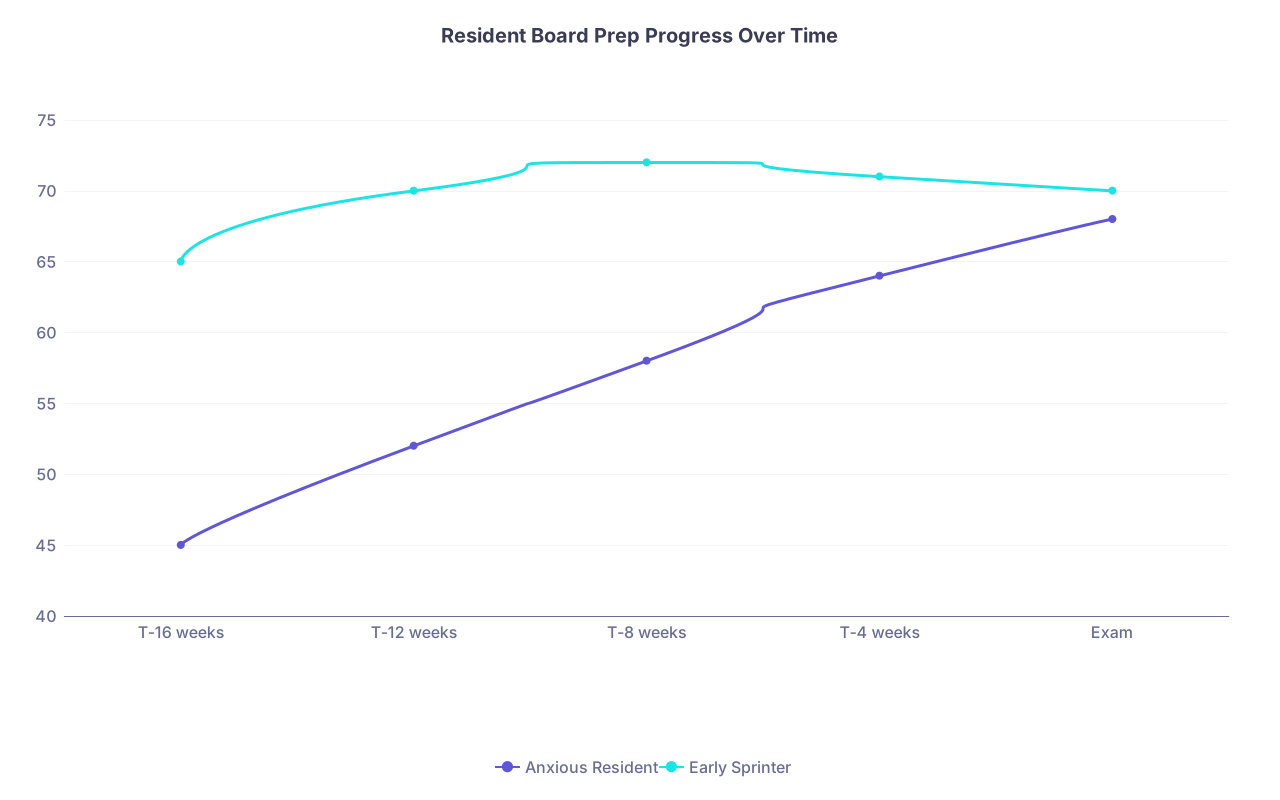
| Category | Anxious Resident | Early Sprinter |
|---|---|---|
| T-16 weeks | 45 | 65 |
| T-12 weeks | 52 | 70 |
| T-8 weeks | 58 | 72 |
| T-4 weeks | 64 | 71 |
| Exam | 68 | 70 |
- The “early sprinter” co-resident looks like a superstar at T‑16 weeks.
- The anxious, “behind” one starts slow, but then suddenly finds a groove once they stop panicking and start working a plan.
On test day, what matters is your endpoint, not your starting line.
No one looks at your CV later and asks, “But what was your UWorld percentage 3 months before the exam?”
They just see “Passed” or your final score.
A Very Simple, Not-Fancy 4-Week Framework If You Feel Behind
If you want something concrete (because vague reassurance is useless), here’s a basic approach I’ve seen work for “late bloomers”:
Week 1:
- Take a baseline assessment (if you haven’t recently).
- Do 40–60 questions/day max, untimed → then review deeply.
- Don’t worry about doing everything. Just establish consistency.
Week 2–3:
- Move to 60–80 questions/day (or your realistic equivalent) in timed blocks.
- Identify your 2–3 worst systems or topics each week and spend 1–2 hours specifically on those (videos, high-yield review, whatever your resource is).
- Take another practice test at the end of week 3.
Week 4:
- Focus on exam conditions: longer timed blocks, mixed mode.
- Daily review of weak topics flagged from all prior weeks.
- Final practice test 7–10 days before real thing if recommended for your exam.
This assumes you’re not at catastrophic baseline. If you are, that’s where PD/mentor input matters.
But notice what’s not on that plan:
- “Match your co-resident’s exact schedule.”
- “Do three QBanks plus full Anki plus every video series in existence.”
Your brain wants extreme. The exam wants steady.
One More Thing Nobody Admits Publicly
There will be people in your program who crush boards and are frankly mediocre clinicians.
There will be people who barely pass boards and are phenomenal with patients, efficient, and deeply trusted.
You obviously need to pass. That’s non-negotiable. But try not to hand over your entire sense of worth as a physician to a practice score gap between you and your co-resident in March.
You are not a bar graph compared to your class.
You’re a doctor trying to survive long shifts, ridiculous documentation, life outside the hospital, and board prep. On a nervous system that is already stretched thin.
You being “behind” right now says a lot about timing and circumstances. It does not decide your ending.

| Step | Description |
|---|---|
| Step 1 | Feel behind compared to co residents |
| Step 2 | Avoid questions and assessments |
| Step 3 | Scores stay low or worsen |
| Step 4 | Higher risk of failure |
| Step 5 | Get baseline and short plan |
| Step 6 | Consistent daily questions and review |
| Step 7 | Scores trend up |
| Step 8 | Safer position for exam |
| Step 9 | Spiral or Act |
FAQ (Exactly 5 Questions)
1. What if my co-residents are all doing two QBanks and I’m barely getting through one?
You don’t get extra points for number of QBanks. I’ve seen residents “finish” three and still score poorly because they never reviewed explanations or tracked patterns. One well-done QBank with thorough review and targeted content fill is better than two done superficially. If you truly have time and mental space for more later, fine. But right now, depth beats flexing volume.
2. My practice scores are 10–15 points lower than my co-residents’. Does that mean I’ll score 10–15 lower on the real thing?
Not necessarily. Practice gaps between people don’t translate 1:1 to real exam gaps. People peak at different times. Anxiety, stamina, sleep, and final few weeks of prep shift numbers. The only comparison that matters is your trajectory: are your scores going up over time? If yes, focus there instead of trying to predict the final ranking.
3. Should I delay my exam if I feel behind compared to everyone else?
“Feeling behind” is not, by itself, a reason to delay. You consider delay if your recent objective scores are substantially below the usual pass-safety threshold for your exam and you don’t reasonably think you can bridge that in the time left. That decision should never be based purely on what your co-residents are scoring. It should be based on your data plus discussion with your PD/mentor.
4. I’m embarrassed to admit to my program that I’m struggling. Will they think I’m incompetent?
Good programs do not equate needing support with being incompetent. They’ve seen people in your position before. What actually worries them more is the resident who hides everything, bombs the exam, and then comes in crisis mode. Telling them early with a clear ask (“I need help structuring a plan,” “I might need a lighter rotation leading up to the test”) looks responsible, not weak.
5. Is it too late to catch up if my exam is in 6–8 weeks and I feel way behind?
Not automatically. I’ve seen residents make huge gains in 6–8 weeks of focused work. But in that window, you don’t have time for scattered, FOMO-based studying. You need a tight plan, a primary QBank, targeted content for weak areas, and at least 2–3 practice assessments. If your baseline is very low, this is exactly when to loop in a PD/mentor to decide whether an aggressive 6–8 week push is realistic—or whether adjusting your exam date is safer.
Key points, so you don’t leave more anxious than you started:
- Your co-residents being “ahead” doesn’t decide your outcome. Your next 4–8 weeks do.
- Stop hiding from real numbers; get a baseline, build a short, realistic plan, and track your trajectory, not theirs.
- Ask for help early if your scores are truly low—quiet shame is way more dangerous than being honest while there’s still time to fix it.