
It’s January. You’re in the workroom post-call, half-asleep, and the email hits: “ITE Scores Available.” You tell yourself you’ll check later. You don’t. You open it right there.
PGY-1: 65th percentile.
PGY-2: 48th percentile.
PGY-3: 32nd percentile.
And your stomach just drops.
Now all the thoughts start screaming at once:
- “Program leadership is going to think I’m lazy.”
- “This means I’m going to fail my boards.”
- “Did I actually get dumber in residency?”
- “What if they don’t graduate me?”
- “What if this ruins my fellowship chances?”
You’re not crazy for thinking any of that. ITE trends freak everyone out, but when yours are going the wrong direction year after year, it feels like there’s a countdown timer over your career.
Let’s talk about what this actually means, what’s real risk vs brain-gremlin catastrophizing, and what you can do right now before this spirals.
First: Are Dropping ITE Scores Really a Big Deal?
Short answer: they can be, but not in the “you’re doomed” way your brain is screaming.
Here’s the honest breakdown.
What program leadership actually worries about
They’re not obsessing over percentiles the way you are. They’re mostly thinking about:
- Will this resident pass boards on the first try?
- Will we get called out by the RRC/ACGME for board pass rates?
- Is this someone who needs support, remediation, or a structured plan?
Most programs don’t care if you’re 40th percentile vs 70th percentile. They care if you’re:
- consistently very low (like <10–20th percentile)
- trending downward and already near the “danger zone”
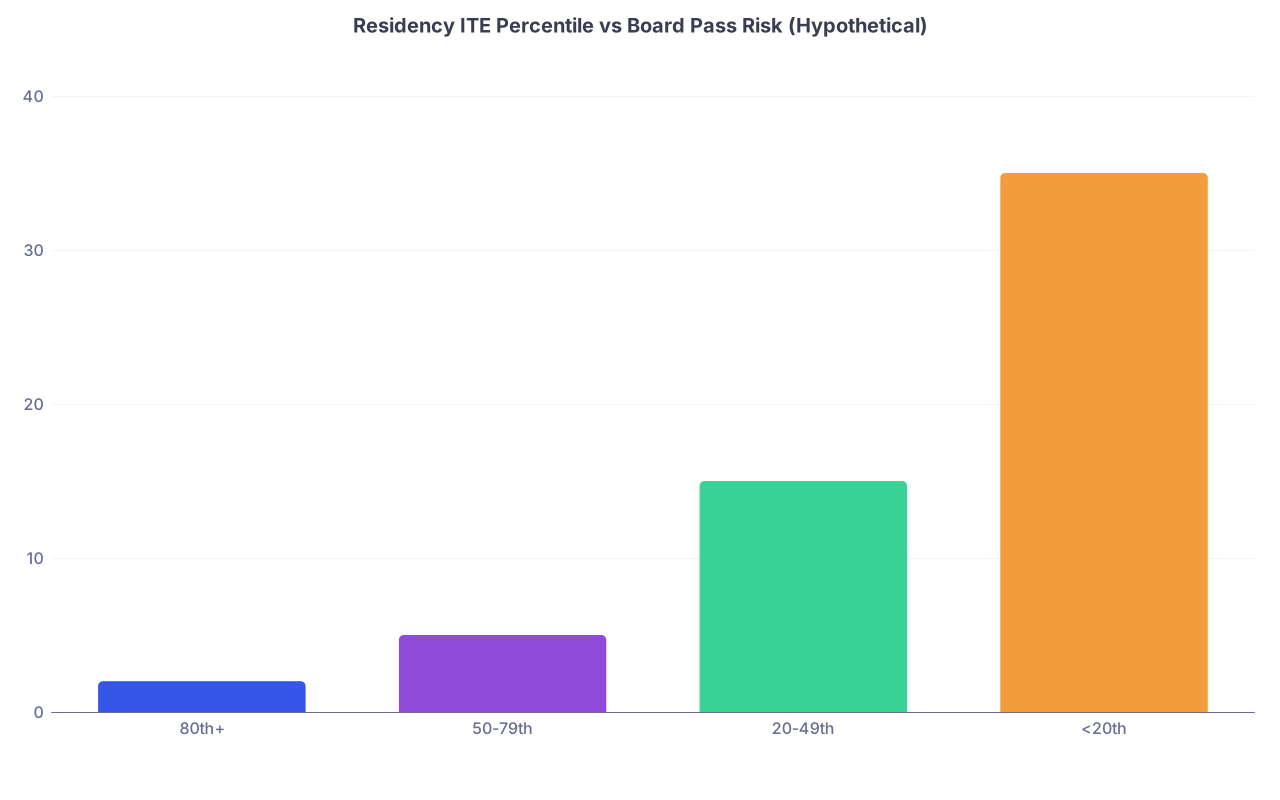
| Category | Value |
|---|---|
| 80th+ | 2 |
| 50-79th | 5 |
| 20-49th | 15 |
| <20th | 35 |
Those numbers are not exact (every specialty is different), but the trend is real: the concern ramps up when you’re both low and dropping.
Dropping from 80th to 55th to 40th? Mildly annoying. Not career-ending.
Dropping from 35th to 22nd to 12th? Yeah, that’s on people’s radar.
The ugly but true part
ITE scores do correlate with board pass rates. Programs know this. They get nervous because:
- A failed board exam hurts their stats and accreditation reports.
- Remediation and repeat years are a nightmare for scheduling and funding.
- It becomes an administrative headache they’d rather avoid.
So they do care. But this is different from “They’re going to fire me.” Most of the time, especially if you’re functioning fine clinically, it becomes a “We need a plan” issue, not an “You’re out” issue.
Worst-Case Scenarios Your Brain Is Already Imagining (And How Real They Are)
You probably already went to the darkest place. So let’s drag those fears out into the light.
“What if they don’t let me graduate?”
This is the nuclear fear. Real talk: this happens, but it’s rare. And when it does, it’s almost never just because of ITE trends alone.
People usually get delayed or held back when there’s a cluster of concerns:
- Repeatedly very low in-training scores
- Documented concerns about medical knowledge or judgment
- Failed rotations or remediation plans not completed
- Prior failed board exam (if you took it early)
- Poor engagement with support plans, or denial/minimizing
If your evals are solid, attendings trust you, and your only “red thing” is a downward ITE trend? That’s not usually a “don’t graduate” scenario. That’s a “we need to make sure you’re board-ready” scenario.
“What if I fail my boards?”
Fair fear. Honestly? Yes, if your ITE is tanking and you keep doing the same thing, your board risk is higher. That’s just data.
But higher risk ≠ guaranteed failure.
I’ve watched residents go from 15th percentile ITE to passing boards comfortably after one brutal, structured, but doable 4–6 month plan. Not because they magically became geniuses. Because they:
- stopped random, passive studying
- picked the right resources
- did a stupid amount of questions
- adjusted how they studied when they realized what wasn’t working
The opposite story is real too: people panic, avoid, procrastinate, and then cram in the last month. Those are often the ones who fail.
So yeah, risk is real. But it’s not fixed. It’s a moving target, and you do have control, even if it doesn’t feel like it right now.
“Is this going to wreck my fellowship chances?”
Depends on the specialty and how bad the drop is.
Competitive fellowships (cards, GI, heme/onc, derm, ortho subspecialties) like:
- strong ITE / board-style performance
- upward trends or at least stable scores
- evidence that you’re academically serious
But they also care a lot about:
- letters from people they trust
- research and productivity
- clinical reputation
If you’re, say, going into cardiology and you’ve gone 70th → 60th → 40th, with good letters and some research? No, your career isn’t over.
But if you’re hovering around 10–20th percentile and still dropping, fellowship PDs will worry that you’re a board risk. They’ve seen residents struggle and fail boards, and they don’t love inheriting that risk.
Does that mean “don’t even apply”? No. But it does mean: you need to fix the trajectory now, not shrug and hope it magically improves before fellowship apps go out.
Why Your Scores Might Be Dropping (And It’s Probably Not Because You’re Stupid)
The easiest explanation your brain jumps to is “I’m not smart enough.” That’s lazy and wrong.
Common real reasons I’ve watched play out:
1. You never shifted into “board-style” studying
PGY-1, you might’ve done okay off med school habits and random question banks. But as the ITE gets more advanced and you’re more tired, you actually need more structure, not less.
Patterns I see:
- Reading UpToDate for everything, but barely doing questions
- Bouncing between 4 different resources and mastering none
- “Reviewing notes” instead of retrieval-based studying (questions, flashcards, spaced repetition)
ITE is pattern recognition + test-taking, not “who read the most UpToDate pages.”
2. Your brain is just…fried
Chronic fatigue wrecks test performance. Shocking, I know.
- Night float months around ITE? Scores drop.
- You’re consistently on heavy inpatient months? Lower scores.
- You’re burned out, depressed, anxious? Your focus is trash.
Residency doesn’t care about your brain’s testing conditions. The ITE doesn’t care if you were post-call, dehydrated, or mentally done. But your performance absolutely does.
3. You never got feedback on how you take tests
Huge one. Some people:
- change answers too often
- rush and misread stem details
- overthink every nuance and time out
- get destroyed by anxiety mid-exam
I’ve watched people gain 15+ percentile points by fixing only test-taking habits. Not content. Not intelligence. Just process.
What You Should Do Immediately (Not Three Months From Now)
You do not have to accept this trend as your fate. But you also can’t “vibe” your way out of it.
Here’s what I’d do if I were in your exact shoes, staring at those falling numbers.
1. Stop hiding the scores
Your instinct is to bury them, hope nobody notices, and just feel quietly sick about it.
Bad plan.
Schedule a meeting with:
- your program director or associate PD, or
- your academic/education chief, or
- a mentor who’s honest and not sugar-coaty
Go in with:
- Your ITE score printout from all years
- What you think you’ve been doing to study
- Specific questions: “What percentile should I be at for you to feel comfortable with my board chances? What has worked for past residents in my position?”
Yes, it’s uncomfortable. Yes, you’ll feel exposed. But if your scores are dropping, leadership already sees it. You gain nothing by pretending it isn’t happening.
2. Pick one primary question bank and actually commit
Not five. One main bank. Maybe a second as cleanup later.
For example (internal medicine example, but same idea for other fields):
| Specialty | Primary Qbank | Secondary Resource |
|---|---|---|
| IM | UWorld | MKSAP questions |
| Peds | PREP | Board-specific text |
| EM | Rosh Review | EM-specific qbank |
| FM | AAFP Qbank | Board review book |
Your goal: questions become your default, not reading.
Rough target if your scores are dropping and boards are within 12 months:
3,000–5,000 questions completed properly (reviewing explanations, making notes/flashcards, tracking patterns of mistakes).
3. Create an actual schedule that fits your reality, not fantasy
The fantasy plan is: “I’ll just study 2 hours every day and crush this.”
The real plan needs to look like:
- On lighter rotations: 20–40 questions/day + review
- On heavy inpatient months: 10–20 questions/day or every other day
- Protected weeks (vacation, elective): cram in bigger blocks to make up for inpatient months
You don’t need to be perfect. You need to be consistent enough.
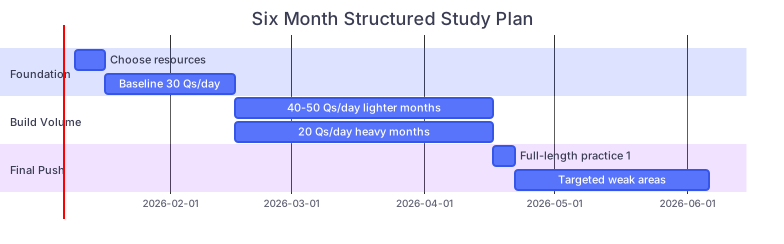
| Task | Details |
|---|---|
| Foundation: Choose resources | a1, 2026-01-10, 7d |
| Foundation: Baseline 30 Qs/day | a2, 2026-01-17, 30d |
| Build Volume: 40-50 Qs/day lighter months | a3, 2026-02-16, 60d |
| Build Volume: 20 Qs/day heavy months | a4, 2026-02-16, 60d |
| Final Push: Full-length practice 1 | a5, 2026-04-17, 5d |
| Final Push: Targeted weak areas | a6, 2026-04-22, 45d |
Does this look aggressive? Yes. Does it need tweaking to your life? Absolutely. But “I’ll study when I have time” is exactly how you got here.
4. Fix how you review questions
Doing 40 questions and spending 5 minutes checking answers is useless.
Better flow:
- Do the block timed, like the real exam
- Mark questions you were unsure of, even if you got them right
- Review every question:
- Why was the right answer right?
- Why was your answer wrong?
- Is this a knowledge gap or a test-taking problem?
- If you see a pattern (e.g., always missing nephro, or always misreading lab values), write that down as a “theme” to target later.
Yes, this is slow. That’s the point. It’s where the learning actually happens.
5. Take your brain seriously: sleep, mood, anxiety
You can’t out-study unmanaged burnout. You just can’t.
If:
- You’re sleeping 4–5 hours most nights
- You’re constantly on edge, dreading work
- You’ve lost interest in pretty much everything
- Your anxiety makes you freeze in front of questions
…you are not in a place for optimal test performance. That doesn’t mean you’re weak. It means you’re human.
Talk to:
- a therapist (your hospital usually has access or referrals)
- a PCP or psychiatrist if you need meds
- your PD if you need a quieter month or some real-time to stabilize
You’re not the first resident to need mental health help because of exams and residency. The only residents who get quietly crushed are the ones who pretend they’re fine until everything implodes.
How to Talk About Dropping ITE Scores If Someone Brings It Up
Another anxiety trap: “What if my PD, advisor, or fellowship director asks about this trend?”
Here’s how to not sound defensive or doomed.
You want three parts:
- Acknowledge the reality
- Show you’ve analyzed why
- Present concrete steps you’re taking
Example:
“Yeah, my ITE scores have trended down: 65th → 48th → 32nd. I think part of it is that I shifted away from doing questions and leaned too hard on reading UpToDate, plus I was on back-to-back heavy rotations around the exam each year. I’ve started a structured plan with UWorld, I’m tracking my weak areas, and I’m aiming for consistent question volume instead of cramming. I’d love your input on whether my plan seems realistic for boards.”
That sounds like insight + ownership + action. Program leadership loves that. Fellowship PDs too.
What you don’t want to do is shrug, say “yeah, I don’t know, exams just aren’t my thing,” and leave it at that. That’s exactly the person they worry will fail boards and blow up their stats.
The Part of This You’re Not Seeing Right Now
You’re zoomed in on the numbers and the shame. Let me zoom you out for a second.
You’re doing residency. You’re showing up at 5:30 am, taking care of sick humans, answering pages at 2 am, trying not to miss major diagnoses, dealing with code situations, families, consults, bureaucracy, and your own life imploding in the background.
Of course it’s harder to study now than in med school. Of course your brain isn’t as sharp for standardized tests.
ITE scores dropping do not mean:
- You’re not smart
- You’re not meant to be in this specialty
- You’re going to automatically fail boards
- Your career is over
They mean: the way you’re studying and living right now isn’t enough to carry you through a more advanced exam while your brain is exhausted. That’s a solvable problem, not a moral failure.
FAQ (Exactly the Stuff You’re Probably Still Worried About)
1. My ITE dropped two years in a row but I’m still around 40–50th percentile. Should I panic?
No. That’s not panic territory. That’s “pay attention” territory. You’re not in the danger zone, but you don’t want to keep sliding. Tighten up your studying now so boards don’t sneak up on you.
2. I’m below 20th percentile now. Is my program going to force remediation or delay graduation?
They might push for a structured remediation plan, yes. That could mean required question blocks, a board review course, more frequent check-ins. Delay in graduation usually only happens if you’re consistently low, not improving, and there are other concerns (clinical performance, professionalism, etc.). Get ahead of it by being proactive instead of waiting for them to come to you.
3. Should I tell my program director I’m worried, or will that just draw more attention to my scores?
They already see your scores. You’re not revealing a secret; you’re showing maturity. Framing it as, “I’m concerned about this trend and want help building a plan,” makes you look responsible, not weak. Hiding is what makes PDs nervous.
4. Can I still match into a competitive fellowship with a downward ITE trend?
Yes, if: your scores aren’t in the absolute basement, you fix the trajectory before applications, your letters are strong, and you have decent research/clinical reputation. If you stay low and keep dropping, it becomes a red flag. Again, this is why you attack it now.
5. Should I take a board review course, or is that overkill?
If you’re significantly below average and dropping, a structured review course can help a lot—especially if you struggle with self-discipline or organization. But it shouldn’t replace question banks; it should complement them. Courses don’t magically fix things if you passively sit there and then don’t practice.
6. What if I genuinely feel too burned out to even start a serious study plan?
Then that is the first problem to treat, not the ITE score. Talk to someone—PD, mental health, trusted attending—about your burnout now. You might need a lighter rotation, protected time, or actual treatment for depression/anxiety. You can’t brute-force your way through burnout and expect your brain to still perform on exams.
Key takeaways:
- Dropping ITE scores are a warning signal, not a verdict on your intelligence or future.
- Programs mostly care about board pass risk; if you’re proactive and structured, you lower that risk.
- You’re not stuck. With one solid qbank, a realistic schedule, honest mentorship, and actually taking your mental health seriously, you can turn this trend around before it becomes the thing that haunts your career.