
The biggest myth of PGY‑1 is that your career path is already locked in. It is not. Within internal medicine, you’ve got a full year of real, usable pivot points—if you know when to move.
You are not “just an intern.” You’re in the only year where almost everyone will still take your call, answer your emails, and vaguely remember your name from orientation. Use that runway right and you can still pivot between inpatient vs. outpatient careers, academic vs. community paths, and most IM fellowships. Use it wrong and doors quietly close without any dramatic warning.
Here’s your timeline—month by month—of what you can still change, what’s already narrowing, and exactly when to act.
Big Picture: How Much Can You Pivot, and Until When?
Before we go month-by-month, you need the top-level map.
| Decision Area | Best Window | Harder After | Essentially Closed By |
|---|---|---|---|
| Switching IM programs | July–October PGY‑1 | After Jan PGY‑1 | Mid PGY‑2 |
| Choosing fellowship vs. hospitalist | Jan–June PGY‑1 | PGY‑2 midyear | Late PGY‑2 |
| Competitive fellowships (cards, GI, heme/onc, PCCM) | Sept–June PGY‑1 | After July PGY‑2 | Start of PGY‑3 |
| Academic vs. community track | Sept PGY‑1–PGY‑2 | Late PGY‑2 | Early PGY‑3 |
| Outpatient vs. inpatient career focus | PGY‑1 | Mid PGY‑2 | End of PGY‑2 |
Core truth: fellowship applications go in summer of PGY‑2. Everything you do in PGY‑1 either builds or destroys options for that moment.
July–September (PGY‑1 Q1): Maximum Flexibility, Minimum Clarity
At this point you should assume nothing is fixed except your specialty and the fact that you’re tired.
Your pivot power is highest now, even if your insight is lowest. So the move is not “decide forever” but “set up future options.”
Weeks 1–4: Survive, Observe, Soft-Label Your Interests
You’re learning to place orders, not choosing between cardiology and GI. Fine. But don’t run on autopilot.
At this point you should:
- Notice what energizes you:
- Do you find yourself reading echo reports for fun?
- Are you weirdly happy in clinic while your co-interns complain?
- Are ICU notes the only thing that keeps you awake at 3 a.m.?
- Track this in one running note (phone or Notion, whatever). Every few days, jot:
- “Liked: complex hemodynamics, dislike: endless med recs”
- “Clinic felt good—continuity was satisfying”
- “Heme/onc attending was amazing, like the thinking style”
You’re not deciding yet. You’re gathering signals.
At this point you should not:
- Declare, “I’m definitely cards” because you liked one cath lab day.
- Email every program director asking how to get into GI. You look frantic.
Weeks 4–12: Start Asking the Right Questions
This is when you start intentional information gathering.
At this point you should:
- Identify 2–3 senior residents who:
- Are going into different fellowships (cards vs. pulm/crit vs. hospitalist)
- Are people you would actually want to be in five years
- Ask each of them (15-minute hallway or pre‑sign‑out chat):
- “What made you choose your path?”
- “When did it actually matter to decide?”
- “If you were me as an intern, what would you start now?”
You’re building a mental model of timelines, not picking a lane yet.
- Pay attention on rotations:
- On wards: do you like complex inpatient puzzles?
- In ICU: are you drawn to procedures and acute physiology?
- In clinic: does continuity click or drain you?
By the end of September, you should have:
- A ranked list in your head like:
- “Top 3: Pulm/crit, heme/onc, general academic IM.”
- A shortlist of 3–5 attendings you’d be happy to eventually ask for letters.
October–December (PGY‑1 Q2): Quiet Deadlines You Can’t See Yet
This is where most interns blow it. They think “I’ll figure it out PGY‑2,” but PGY‑2 fellowship applications start in 9–10 months. That’s not far.
At this point you should stop thinking “someday” and start thinking “this academic year.”
October–November: Clarify Whether a Big Pivot Is Even On the Table
If you’re unhappy in your program (not just tired), this is your narrow window to consider switching internal medicine programs. Switching specialties out of IM is another article; here we’re staying within IM.
At this point you should:
- Ask yourself brutally:
- “Is this just intern misery, or is this program/culture wrong for me?”
- “Would I be happier doing the same work somewhere else?”
- If you think a program switch might be needed:
- Quietly talk to your chief or a trusted APD.
- Ask, “If I wanted to explore a transfer for fit/location reasons, what’s the realistic timeline?”
- Do not threaten. Do not ultimatums. You’re gathering intel.
Program pivot is easiest before January. After that, spots are rarer and narratives get messier.
December: Start Positioning for Fellowship vs. Hospitalist
Even if you’re not sure, you must assume you might apply to fellowship. Because if you act like “probably not” and change your mind next year, you’re sunk.
At this point you should:
- Decide your default plan:
- Option A: “Act as if I’m fellowship‑bound, can always decline later.”
- Option B: “I’m 95% sure I’m hospitalist/primary care; fellowships are backup only.”
- If you lean Option A (or even 50/50):
- Identify 2–3 subspecialties that feel most aligned.
- For each, find:
- 1–2 faculty who are clearly fellowship‑connected.
- 1 senior resident in that pathway.
This is prep for the next phase: converting vague interest into concrete steps.
January–March (PGY‑1 Q3): Commit to a Direction, Not a Detail
This is when “I’m just figuring things out” becomes a luxury you can’t afford. You don’t need a fellowship decision yet. You do need a lane.
Think in three lanes:
- Lane 1 – I want fellowship, probably competitive (cards, GI, heme/onc, PCCM).
- Lane 2 – I want fellowship, likely less cutthroat (ID, rheum, endo, geri, allergy).
- Lane 3 – I’m leaning hospitalist or primary care.
At this point you should choose a lane, even if you reserve the right to switch later.
If You’re in Lane 1 (Competitive Fellowship Leaning)
This is where timing really bites people.
At this point you should:
- Schedule 1–2 meetings per subspecialty of interest:
- “I’m an intern considering [cards/heme/onc/etc.] for fellowship. When during PGY‑1 and early PGY‑2 should I be:
- Starting research?
- Lining up letters?
- Doing electives?”
- “I’m an intern considering [cards/heme/onc/etc.] for fellowship. When during PGY‑1 and early PGY‑2 should I be:
Most will tell you the same rough truth:
- You need some research started by end of PGY‑1.
- You need at least one subspecialty mentor who knows your name by spring.
- You should aim for a subspecialty elective early PGY‑2, not March of PGY‑2.
So, at this point you should:
- Get on:
- One realistic research project (chart review, QI, case series).
- One sub‑I‑level elective request for early PGY‑2 in that specialty.
- Tell one core medicine mentor:
- “I’m seriously considering [field]. Can I check in with you every couple of months as things evolve?”
If You’re in Lane 2 (Less Competitive Fellowship Leaning)
You have more room, but not infinite.
At this point you should:
- Still get on a project. It does not need to be Nature Medicine. Just something with:
- Clear PI.
- Reasonable timeline (<12 months).
- Try to schedule:
- One elective in that field late PGY‑1 or early PGY‑2.
- Ask about program-specific expectations:
- Some ID/rheum/endo programs are chill.
- Some care a lot about letters and evidence of interest.
The pivot window for you extends later, but you’re buying yourself stress reduction by moving now.
If You’re in Lane 3 (Hospitalist/Primary Care Leaning)
You still shouldn’t burn bridges.
At this point you should:
- Keep fellowship options mildly alive:
- Don't blow off research offers.
- Don’t publicly say “I’d never do a fellowship” every third day on rounds.
- Clarify which “hospitalist” you mean:
- Academic vs. community vs. nocturnist vs. hybrid.
- Clinic‑heavy vs. purely inpatient.
Start scoping job options:
- Watch where recent grads went: academic hospitals, local community groups, hospitalist tracks with teaching roles.
You can pivot from “hospitalist leaning” to “actually, I want PCCM” later than most people think—but only if you’ve kept your reputation and evaluations strong.
April–June (PGY‑1 Q4): You’re Quietly Writing Your Fellowship Application
By now, your evaluations, relationships, and initial projects are either helping you or haunting you. This quarter is when the shape of PGY‑2 and your real pivot power becomes visible.
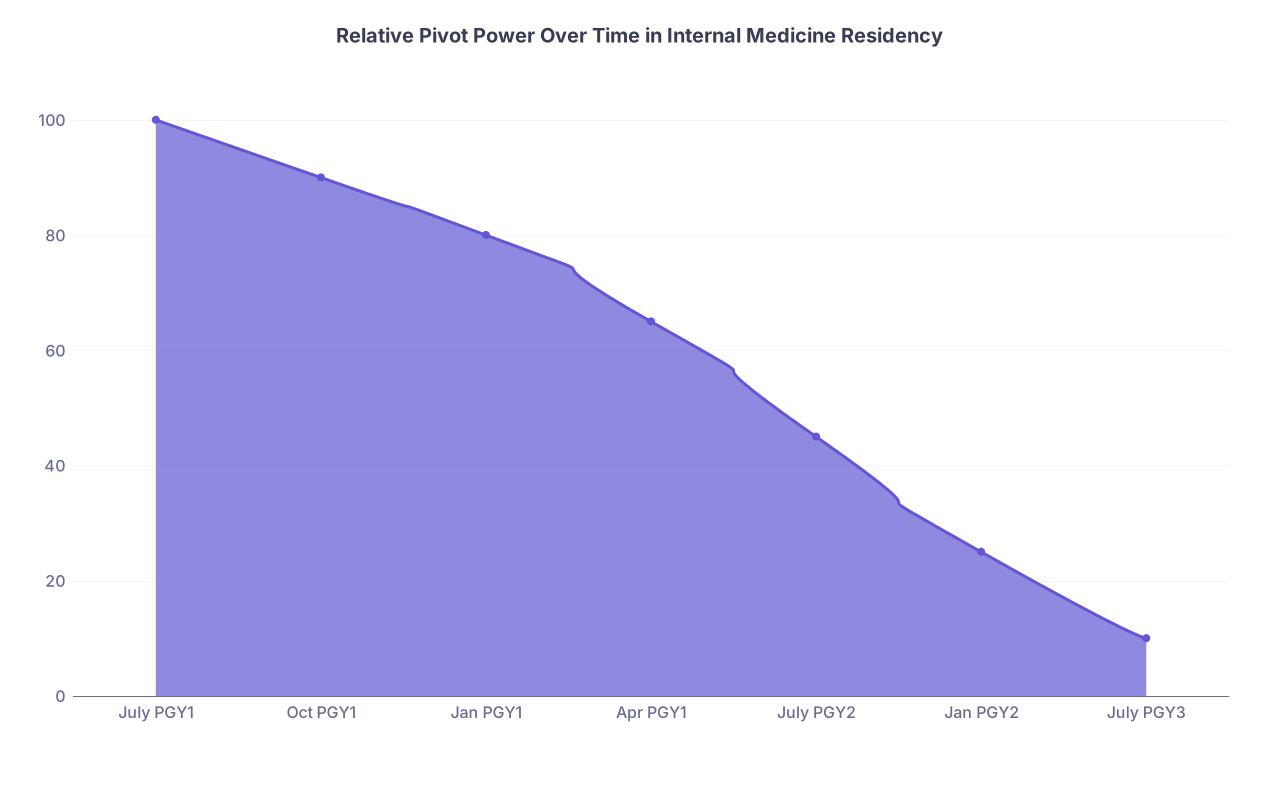
| Category | Value |
|---|---|
| July PGY1 | 100 |
| Oct PGY1 | 90 |
| Jan PGY1 | 80 |
| Apr PGY1 | 65 |
| July PGY2 | 45 |
| Jan PGY2 | 25 |
| July PGY3 | 10 |
April: Checkpoint Reality Audit
At this point you should sit down (30–45 minutes, uninterrupted) and answer:
- What are my top 2 realistic post‑residency options right now?
- Do my current CV and relationships support those options?
- If I had to apply for fellowship 16 months from now, what would be missing?
Then talk with:
- One trusted faculty mentor.
- One senior resident in your desired area.
Ask them bluntly:
- “Given where I am now, what paths remain very realistic?”
- “What would you focus on between now and December?”
May–June: Lock in PGY‑2 Rotations and Letters Strategy
This is where you make or break high-level pivots inside IM.
At this point you should:
- Advocate (tactfully) for strategic PGY‑2 rotations:
- If leaning ICU/PCCM:
- Early PGY‑2 MICU block.
- Extra ICU or step‑down time if possible.
- If leaning cards:
- Cards consults/cath lab early PGY‑2.
- If heme/onc:
- Leukemia/BMT/heme‑onc consults early PGY‑2.
- If primary care:
- More continuity clinic exposure.
- Ambulatory blocks with mentors doing the job you want.
- If leaning ICU/PCCM:
- Start mentally short-listing letter writers:
- 2 core IM attendings who know your work ethic.
- 1 subspecialty person in your likely direction (if fellowship‑leaning).
You are not asking yet. You’re making sure they actually see you work.
At this point you should also decide:
- Will I be fellowship‑ready by PGY‑2 applications or do I intentionally delay?
- Path A: “Apply on time even if slightly light.” Works better for less competitive fields.
- Path B: “Take a gap year as hospitalist/research then apply stronger.” Common in competitive ones.
That decision alone is a massive internal pivot, and it needs to be on your radar now.
PGY‑2: The Real Deadline Year Hiding Behind PGY‑1
You asked about PGY‑1, but pretending PGY‑2 doesn’t exist is how people get stuck. So here’s the compressed version of what your PGY‑1 decisions are feeding into.
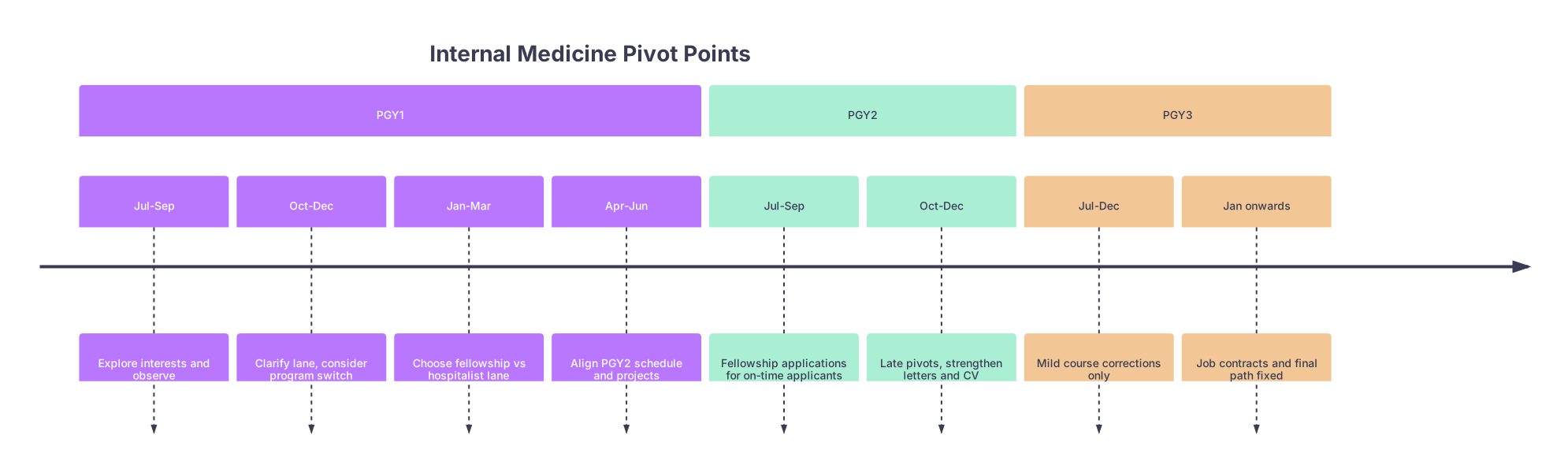
| Period | Event |
|---|---|
| PGY1 - Jul-Sep | Explore interests and observe |
| PGY1 - Oct-Dec | Clarify lane, consider program switch |
| PGY1 - Jan-Mar | Choose fellowship vs hospitalist lane |
| PGY1 - Apr-Jun | Align PGY2 schedule and projects |
| PGY2 - Jul-Sep | Fellowship applications for on-time applicants |
| PGY2 - Oct-Dec | Late pivots, strengthen letters and CV |
| PGY3 - Jul-Dec | Mild course corrections only |
| PGY3 - Jan onwards | Job contracts and final path fixed |
Early PGY‑2 (July–September): Hard Pivot or Stay the Course
For on‑time fellowship applicants, this is submission time. But even if you’re not applying yet, your lane is basically set.
At this point (early PGY‑2) you can still:
- Pivot from:
- “Probably hospitalist” → “actually I want PCCM” if your:
- Evaluations are strong.
- You jump on research/mentorship aggressively now.
- “Probably hospitalist” → “actually I want PCCM” if your:
- Reset from:
- “I wanted GI but CV doesn’t support it” → “I’ll go heme/onc or hospitalist instead.”
You cannot realistically:
- Discover interventional cardiology in August PGY‑2 with zero prior work and expect to match in it straightaway.
Late PGY‑2: Minor Course Corrections Only
By mid to late PGY‑2:
- Competitive fellowship paths are mostly binary: you’re in the pool or you’re not—for this cycle.
- Major pivots become:
- “I’ll delay fellowship and build my CV as a hospitalist.”
- “I’ll choose a less-competitive fellowship field more aligned with my record.”
Where PGY‑1 Pivots Are Actually Limited
Let me be blunt: there are a few “too late” moments in PGY‑1 people don’t recognize until afterwards.
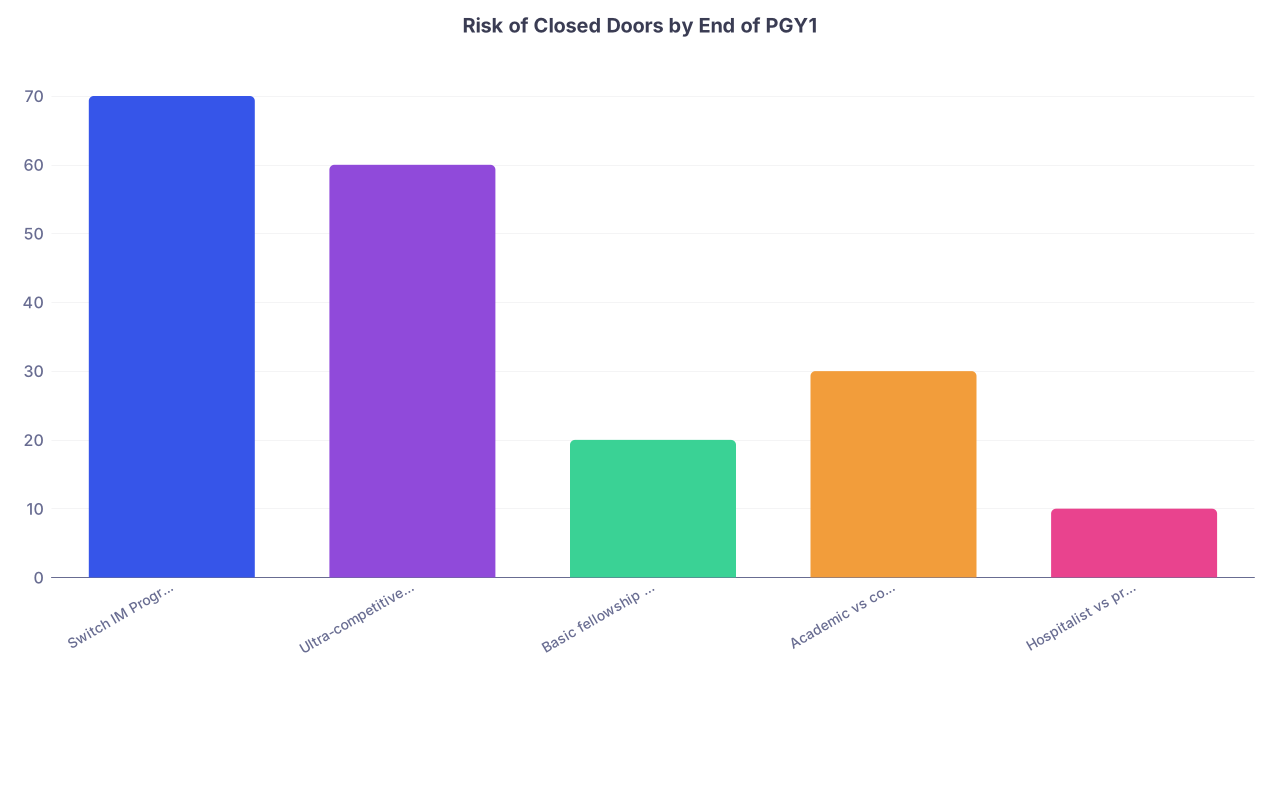
| Category | Value |
|---|---|
| Switch IM Programs | 70 |
| Ultra-competitive fellowships | 60 |
| Basic fellowship eligibility | 20 |
| Academic vs community | 30 |
| Hospitalist vs primary care | 10 |
By the end of PGY‑1, it’s often:
- Too late or very hard to:
- Transfer IM programs purely for preference (vs. serious issues).
- Start from zero and be competitive for top‑tier cards/GI at elite programs on time.
- Still very possible to:
- Build a path for most fellowships with an extra year to mature your CV.
- Pivot between academic vs. community careers.
- Switch emphasis between hospitalist vs. outpatient internist.
The trap is assuming “if I miss an on-time fellowship application, I’ve failed.” Wrong. Internal medicine is full of people who took 1–3 years as hospitalists, then came back stronger and happier into fellowship.
The real failure is letting PGY‑1 go by without lining up at least 2–3 plausible doors to walk through later.
Practical Checklist: What You Should Do This Month
Let’s land this on something you can act on immediately, regardless of where you are in PGY‑1.
If You’re in the First 3 Months of PGY‑1
At this point you should:
- Start a simple career journal:
- One note in your phone.
- After each block: 3 bullets on what you liked/hated.
- Identify:
- 2 senior residents and 1 attending you respect.
- Ask each for one 15‑minute career chat.
- Make a “possible lanes” note:
- Rank 3 you might care about: ICU, cards, clinic, oncology, etc.
- Nothing binding. Just visible.
If You’re in Months 4–6 of PGY‑1
At this point you should:
- Choose a lane (fellowship likely vs maybe vs probably not).
- Email 1–2 subspecialty faculty:
- Subject: “PGY‑1 seeking brief advice on [field] pathway.”
- Ask about timing for:
- Electives.
- Research.
- Letters.
- Look at your PGY‑2 schedule draft (if available):
- Ask for one early elective aligned with your possible fellowship or your likely job style (ICU vs clinic, etc.).
If You’re in Months 7–12 of PGY‑1
At this point you should:
- Do a 30-minute career review with:
- One core IM mentor.
- One subspecialty mentor (if fellowship possible).
- Confirm:
- Your likely PGY‑2 rotation mix supports your future path.
- You’re on at least one real project, especially if fellowship-leaning.
- Make a letter strategy list:
- 3 attendings you want evals/letters from.
- How you’ll work with them again in PGY‑2 if needed.
The Real Decision Point: Today
You don’t control the fellowship match, or your program’s rotation grid, or how malignant that one attending is on nights.
You do control whether PGY‑1 slips by in a blur of cross‑cover and progress notes, or whether you treat it as the most flexible year of your internal medicine life.
Today, you’ve got one concrete next step:
Open your calendar and block 30 minutes in the next 7 days labeled “Career Checkpoint – PGY‑1.” In that block, write down your top 2–3 possible paths, one realistic concern for each, and the name of one person you’ll email for advice about it. Then send that email.